
Looking for an amplifier that fits the way you listen?
A practical evergreen guide to choosing an amplifier by system role, covering integrated amplifiers, standalone power amplifiers, a dedicated preamplifier, and portable DAC/headphone amplifier options.

Choosing an amplifier is less about chasing a single “best” answer and more about matching the amplifier’s architecture, inputs, power delivery, and control options to the system you already have or plan to build.
A digital-only integrated amplifier is a very different proposition from a reference power amplifier with an external supply, and a preamplifier or portable DAC/headphone amplifier serves a different role again.
The models gathered here cover a broad spread of amplifier thinking: traditional high-power stereo power amplifiers, hybrid integrated designs with tubes in the preamp stage, digital-source hubs with built-in conversion, compact configurable power amps, and even portable headphone-focused options. The point is not to rank them by loudness or luxury, but to clarify where each one makes practical sense. Every recommendation below is grounded in the supplied product material. Specifications, features, and caveats are kept to what is directly supported, so the guide can be used as a reliable starting point when narrowing down the right amplifier type for a hi-fi system.

1. Naim Audio NAP 500 DR: Power amplifier with external power supply
Naim Audio NAP 500 DR stereo power amplifier with its separate NAP 500 PS power supply.
The Naim Audio NAP 500 DR is presented as the top power amplifier in Naim’s reference 500 series, with a dual-box layout that separates the amplifier from its NAP 500 PS power supply.
Its design draws on technologies associated with Naim’s Statement amplification work, including NA009 output transistors and DR discrete regulator technology.
The specification emphasizes serious system use: 140 watts per channel into 8 ohms, the ability to withstand load drops to 2 ohms without noticeable impact on performance, and support for bridged power-amplifier configuration. This is a specialist power amplifier for systems that already have source and preamplification sorted, rather than an all-in-one hub.
Best for: Reference systems needing a dedicated stereo power amplifier
- 140 W per channel into 8 ohms
- Withstands load drops to 2 ohms
- Dual-box design with external power supply
- Supports bridged power-amplifier configuration
Verdict: Choose the Naim Audio NAP 500 DR when the system calls for a high-end standalone power amplifier with external power-supply separation and robust load handling.
2. Mark Levinson No. 5802: Preamp, power amplifier, and built-in D/A converter
Mark Levinson No. 5802 integrated amplifier for digital-source systems.
The Mark Levinson No.
5802 is an integrated amplifier built specifically around digital sources.
It combines preamplifier, power amplifier, and digital-to-analog conversion, but deliberately omits analog inputs and a phono stage. In their place, the design increases digital connectivity, adding AES/EBU and an additional coaxial input alongside optical, USB, and coaxial options. Its PureDirect architecture uses a fully discrete preamp circuit followed by a direct connection to left and right mono power-amplifier channels, with volume handled by a digitally controlled resistor. A front-panel headphone output is also included, using a Class A preamplifier output stage intended to drive headphones without a separate headphone amplifier.
Best for: Digital-only systems that do not need analog inputs
- Designed exclusively for digital sources
- Built-in digital-to-analog converter
- Fully discrete preamp circuit with PureDirect architecture
- Front-panel headphone output with Class A preamp stage
Verdict: The Mark Levinson No. 5802 is a strong fit for listeners who want a serious integrated amplifier and DAC while keeping the system entirely digital at the input stage.

3. The Leema Elements Power Amp is an incredibly versatile amplifier
Leema Elements Power Amp with front-panel display and configurable operating modes.
The Leema Elements Power Amp stands out for configurability.
Rear-panel switches and an internal analog volume control allow it to work in several roles, including stereo power amplification, monoblock operation, and use within stereo or multichannel systems.
It can be added to an integrated setup for bi-amping or tri-amping, or paired with an Elements DAC preamplifier or Pyxis reference preamplifier as part of a pre/power arrangement. The compact chassis also includes features drawn from the Hydro II power amplifier in Leema’s Constellation series, such as stereo/mono switching and LIPS control capabilities. A front-panel display is unusual for a component of this type and adds to the sense that this amplifier is made for systems that may evolve.
Best for: Flexible systems that may move between stereo, monoblock, and multi-amplifier use
- Switchable stereo and monoblock operation
- Internal switchable volume control
- LIPS control capability
- Suitable for bi-amping and tri-amping setups
Verdict: The Leema Elements Power Amp is most compelling where compact size and broad configuration options matter as much as the basic power-amplifier role.
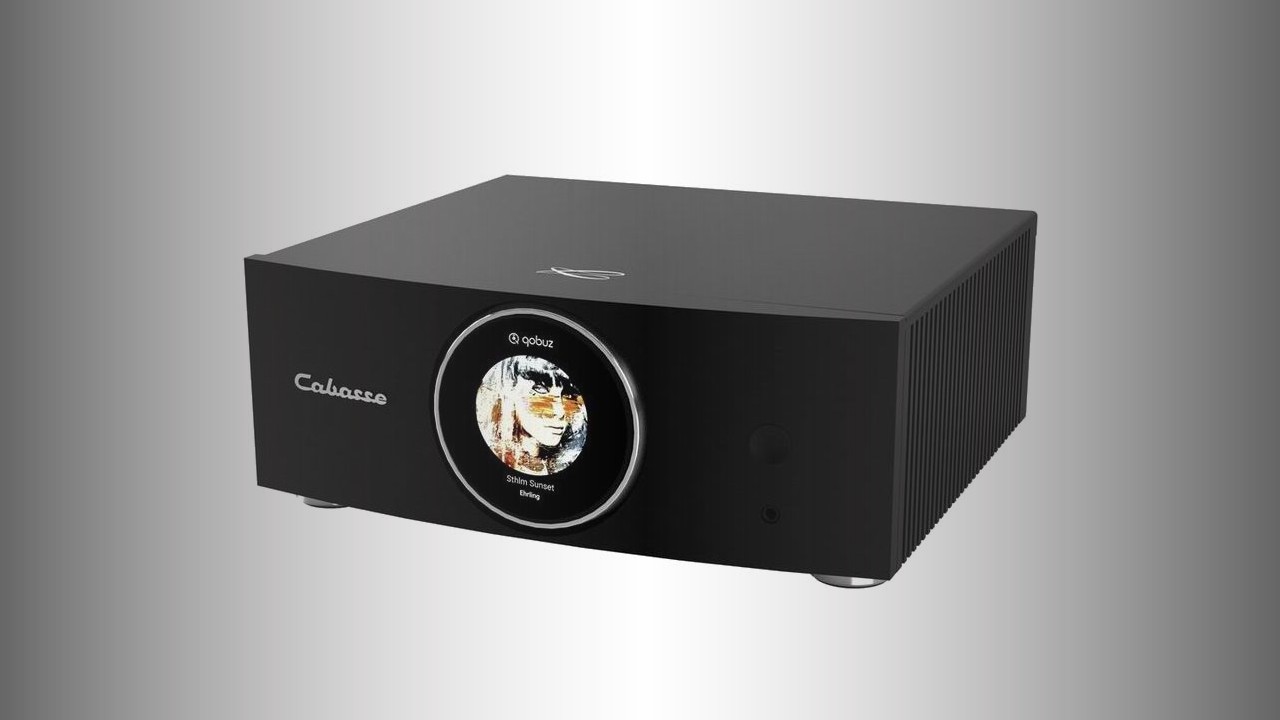
4. Cabasse Abyss: Innovative high-end amplifier
Cabasse Abyss amplifier with touch screen and rotating volume-control ring.
The Cabasse Abyss is a connected high-end amplifier rated at 2 x 120 watts into 8 ohms, with a Class D amplifier section also specified at 215 watts into 4 ohms.
Its DSP calibration algorithms are designed to identify the Cabasse input model and adapt the configuration accordingly, while DFE Dynamic Fidelity Enhancer technology adjusts dynamics in relation to listening volume, frequencies, and melody.
The user interface is distinctive: a touch screen surrounded by a rotating volume ring allows smooth level adjustment, although the source notes that dust can accumulate around and under the ring over time. The Abyss also emphasizes audio streaming and connection to other sources, but the supplied material specifically notes operation without an HDMI connector.
Best for: Connected Cabasse-centered systems where DSP matching and streaming matter
- 2 x 120 W into 8 ohms
- 215 W into 4 ohms
- DSP calibration for Cabasse system matching
- DFE technology for volume-dependent dynamic optimization
Verdict: The Cabasse Abyss suits listeners who want a modern connected amplifier with Cabasse-focused DSP features, provided HDMI connectivity is not a requirement.

5. Advance Paris A10 Classic – An audiophile integrated amplifier
Advance Paris A10 Classic integrated amplifier with hybrid tube and Class AB architecture.
The Advance Paris A10 Classic is an integrated amplifier that combines an ECC81/12AT7 tube preamplifier stage with a 2 x 130 watt Class AB push-pull power amplifier.
Its feature set is broad: six RCA analog inputs are specified, including an MM phono stage with three capacitance settings, alongside a balanced XLR line input and multiple digital inputs.
The source also lists optical, S/PDIF, USB audio, USB-A playback from an MP3 player or USB storage device, a connector for an aptX or aptX HD Bluetooth receiver, and HDMI inputs. This makes the A10 Classic one of the more system-friendly options here for users who need both legacy analog support and modern digital access in a single chassis.
Best for: Mixed analog and digital systems needing one integrated amplifier
- ECC81/12AT7 tube preamplifier stage
- 2 x 130 W Class AB push-pull amplification
- MM phono stage with capacitance settings
- Analog, digital, USB, Bluetooth-receiver, and HDMI connectivity
Verdict: The Advance Paris A10 Classic is the practical choice in this group for users who want tube preamplification character, Class AB power, phono support, and unusually broad input flexibility.

6. Canor Audio Virtus A3: High-Power Dual Mono Hybrid Amp
Canor Audio Virtus A3 dual-mono hybrid integrated amplifier with touch-screen front panel.
The Canor Audio Virtus A3 is a dual-mono integrated amplifier with analog and digital inputs, using an E88CC tube in each preamp stage.
Its power output is specified at 100 watts per channel into 8 ohms and 150 watts into 4 ohms.
The power-amplifier section combines a tube-based balanced differential input stage with a Class A Current Dumping output stage, where a low-power Class A amplifier manages the speaker load while a higher-power Class AB stage supplies current for heavier demands. The front panel includes a 1.3-inch LCD touch screen and two separate headphone jacks, making it a hybrid integrated amplifier with both speaker and headphone use in mind.
Best for: Hybrid integrated systems needing analog, digital, and headphone functionality
- Fully dual-mono construction
- E88CC tube in each preamp stage
- 100 W per channel into 8 ohms
- Two front-panel headphone jacks
Verdict: The Canor Audio Virtus A3 is well suited to listeners who want a dual-mono integrated amplifier with tube preamp stages, digital access, and built-in headphone convenience.

7. Musetec MH SA001: Flagship preamplifier with separate channel circuits
Musetec MH SA001 flagship preamplifier with separated channel circuitry.
The Musetec MH SA001 is a preamplifier rather than a power amplifier, so it belongs in systems that use separate power amplification.
Its design is built around channel separation: the body is divided into two parts by a partition, and the circuit uses separate channel arrangements.
It operates in Class A and uses current-mode volume control built from fully discrete components. The volume system offers 256 levels, with commonly used volume areas specified at 0.25 dB resolution. The circuit also uses 12 groups of amplifier modules operating in Class A for each channel, including matched JFET input modules, constant-current driver modules for the volume circuit, and high-current output modules for signal output.
Best for: Separate pre/power systems needing a dedicated preamplifier
- Class A preamplifier operation
- Physically separated channel layout
- Fully discrete current-mode volume control
- 256 volume levels with fine resolution in common ranges
Verdict: The Musetec MH SA001 is for listeners building a separates system who want a Class A preamplifier with strong emphasis on channel separation and volume-control design.

8. The very best portable DACs/Headphone Amplifiers
Portable DAC/headphone amplifiers are designed to add external conversion and amplification to mobile listening setups.
This entry is a buying-guide article rather than a single amplifier model, covering portable USB DACs combined with headphone amplification.
The category is aimed at listeners who want to improve smartphone or mobile-device headphone listening with a compact external DAC/headphone amplifier.
The supplied excerpt highlights the FiiO Jade Audio KA2 as one example: a small aluminum-bodied DAC/amplifier with a single balanced 4.4 mm headphone output, dual Cirrus Logic CS43131 DAC chips, selectable digital filters, app compatibility, and output rated at 153 mW into 32 ohms. Its limitation is also clear from the source: it is designed only for headphones using a 4.4 mm plug.
Best for: Portable headphone listeners comparing USB DAC/amplifier options
- Focuses on portable USB DAC/headphone amplifier options
- Supports smartphone-based headphone listening
- Includes compact designs such as the aluminum FiiO Jade Audio KA2
- Highlights balanced 4.4 mm headphone output in the KA2 example
Verdict: This portable DAC/headphone amplifier guide is useful when the priority is mobile headphone performance rather than driving loudspeakers.

9. Electric Audio Debuts High-Power TAE 150 & PAE 150 Amplifiers
Electric Audio TAE 150 integrated amplifier and PAE 150 stereo power amplifier from the brand’s debut lineup.
Electric Audio’s TAE 150 and PAE 150 introduce a German amplifier line connected to Gauder Akustik.
The TAE 150 is an integrated semiconductor amplifier, while the PAE 150 is a stereo power amplifier.
The TAE 150 is specified as an analog-only integrated amplifier with power ratings of around 130 watts per channel into 8 ohms, 215 watts into 4 ohms, and 365 watts into 2 ohms. Its power supply uses a 1,000 VA transformer and 80,000 uF filter capacity, with the manufacturer stating peak current of up to 70 amps. The supplied material emphasizes high-power analog amplification rather than digital features, streaming, or phono functionality.
Best for: Analog systems seeking high-power integrated or power-amplifier choices
- Integrated and stereo power amplifier options
- TAE 150 rated around 130 W per channel into 8 ohms
- Analog-only input approach
- 1,000 VA transformer and 80,000 uF filter capacity in the TAE 150
Verdict: Electric Audio’s TAE 150 and PAE 150 are most relevant for listeners considering a high-power analog amplifier platform rather than a feature-rich digital hub.

10. Tonewinner AD-1PA: Powerful Class A power amplifier
Tonewinner AD-1PA Class A stereo power amplifier with selectable operating modes.
The Tonewinner AD-1PA is a stereo power amplifier with a balanced architecture and substantial Class A output-stage hardware.
Its amplifier stage uses eight pairs of TTC5200 and TTA1943 Class A transistors and is specified at 300 watts RMS per channel into 8 ohms.
Three operating modes are provided: Class A, Class AB, and Auto. In Auto mode, the amplifier switches from Class A to Class AB when temperature reaches a set limit, then returns to Class A when temperature falls. Dual speaker terminals enable bi-wiring, while the internal layout physically separates sections of the device to help limit interference and noise. A large power supply with a toroidal transformer is also specified.
Best for: Systems needing a powerful stereo power amplifier with selectable operating modes
- 300 W RMS per channel into 8 ohms
- Selectable Class A, Class AB, and Auto modes
- Dual speaker terminals for bi-wiring
- Internally separated sections to limit interference and noise
Verdict: The Tonewinner AD-1PA is a strong candidate when high specified power, Class A operation, and mode flexibility are priorities in a standalone power amplifier.
Quick comparison
The table below separates these recommendations by role rather than treating every entry as the same kind of product.
Some are integrated amplifiers, some are power amplifiers, one is a preamplifier, and one is a portable DAC/headphone amplifier guide, so the most useful comparison is how each fits into a system.
| Product | Best for | Verdict |
|---|---|---|
| Naim Audio NAP 500 DR: Power amplifier with external power supply | Reference systems needing a dedicated stereo power amplifier | A dual-box power amplifier with external supply, 140 W per channel into 8 ohms, bridged-mode support, and strong low-load tolerance. |
| Mark Levinson No. 5802: Preamp, power amplifier, and built-in D/A converter | Digital-only integrated systems | An integrated amplifier and DAC for users who do not need analog inputs or phono support. |
| The Leema Elements Power Amp is an incredibly versatile amplifier | Configurable stereo, monoblock, and multi-amplifier systems | A compact power amplifier with stereo/mono switching, volume-control options, and LIPS control capability. |
| Cabasse Abyss: Innovative high-end amplifier | Connected Cabasse-oriented systems | A Class D connected amplifier with DSP calibration, DFE processing, and no HDMI connector in the supplied description. |
| Advance Paris A10 Classic – An audiophile integrated amplifier | Mixed analog and digital systems | A hybrid integrated amplifier with tube preamplification, Class AB power, phono support, digital inputs, and HDMI connectivity. |
| Canor Audio Virtus A3: High-Power Dual Mono Hybrid Amp | Hybrid integrated systems with speaker and headphone use | A dual-mono integrated amplifier with E88CC tube preamp stages, analog and digital inputs, and two headphone jacks. |
| Musetec MH SA001: Flagship preamplifier with separate channel circuits | Separate preamplifier and power-amplifier systems | A Class A preamplifier focused on channel separation and fully discrete current-mode volume control. |
| The very best portable DACs/Headphone Amplifiers | Portable headphone listening | A guide to USB DAC/headphone amplifier options, including compact balanced-output examples for mobile use. |
| Electric Audio Debuts High-Power TAE 150 & PAE 150 Amplifiers | High-power analog amplification | A debut amplifier pairing comprising an analog-only integrated amplifier and a stereo power amplifier. |
| Tonewinner AD-1PA: Powerful Class A power amplifier | High-power stereo power-amplifier systems | A 300 W RMS per channel power amplifier with selectable Class A, Class AB, and Auto operating modes. |
Frequently asked questions
Should I choose an integrated amplifier or a separate power amplifier?
Choose an integrated amplifier if you want preamplification and power amplification in one chassis, as with the Mark Levinson No.
5802, Advance Paris A10 Classic, Cabasse Abyss, Canor Audio Virtus A3, or Electric Audio TAE 150.
Choose a separate power amplifier, such as the Naim Audio NAP 500 DR, Leema Elements Power Amp, PAE 150, or Tonewinner AD-1PA, when you already have or plan to add a dedicated preamplifier or source with suitable volume control.
What matters most when matching an amplifier to my sources?
Input type is the first filter.
The Mark Levinson No.
5802 is for digital sources only and has no analog inputs, while the Electric Audio TAE 150 is described as analog-only. The Advance Paris A10 Classic is the broadest source hub in the supplied material, with analog, phono, digital, USB, Bluetooth-receiver, and HDMI-related connectivity listed.
Do I need a phono stage in the amplifier?
Only if you plan to connect a turntable directly and do not already own an external phono stage.
Among the supplied models, the Advance Paris A10 Classic specifically lists an MM phono stage with three capacitance settings.
The Mark Levinson No. 5802 explicitly omits a phono stage because it is designed exclusively for digital sources.
When does a portable DAC/headphone amplifier make more sense than a speaker amplifier?
A portable DAC/headphone amplifier is the right category when the listening setup is based on headphones and a smartphone or mobile device rather than loudspeakers.
The portable DAC/headphone amplifier guide covers USB DAC and headphone amp combinations, with the FiiO Jade Audio KA2 cited as a compact balanced-output example.
How to choose from this amplifier shortlist
Start by deciding what job the amplifier must do.
If it needs to be the center of the system, an integrated amplifier is the natural route.
The Mark Levinson No. 5802 is tightly focused on digital sources; the Advance Paris A10 Classic is better suited to mixed analog and digital setups; the Cabasse Abyss adds connected features and Cabasse-oriented DSP; the Canor Audio Virtus A3 combines dual-mono construction, tube preamp stages, digital access, and headphone outputs; and the Electric Audio TAE 150 is framed as a high-power analog-only option. If you already use a preamplifier or want to build a separates system, look instead at the power amplifiers. The Naim Audio NAP 500 DR is the reference-style dual-box choice, with external power supply and low-load resilience. The Leema Elements Power Amp is the most configurable, with stereo and monoblock operation plus control options that suit evolving systems. The Tonewinner AD-1PA emphasizes high specified output, selectable operating modes, and bi-wiring terminals. Electric Audio’s PAE 150 belongs in the same separates conversation as the stereo power-amplifier partner to the TAE 150. Do not overlook the role of a preamplifier if the system depends on separates. The Musetec MH SA001 is included because its Class A operation, physically separated channel layout, and discrete current-mode volume control are directly relevant to the quality and usability of a pre/power chain. Conversely, if the system is headphone-only and mobile, the portable DAC/headphone amplifier category is the more appropriate place to begin than any loudspeaker amplifier. Finally, avoid buying more features than the system can use. HDMI matters only if your sources require it. A phono stage matters only for direct turntable connection. Digital inputs matter only if the amplifier is expected to replace an external DAC. Power ratings help with system planning, but architecture, connectivity, control, and upgrade path are just as important when choosing the amplifier that will sit at the heart of a hi-fi setup.