
Hi-fi upgrades are rarely interchangeable.
A network switch aimed at complex digital audio systems, a compact DAC, a phono step-up transformer, a high-current integrated amplifier, and an all-in-one streaming system solve very different problems.
The most useful choice depends less on novelty and more on the weak point in the system you already own. This guide treats the supplied products as system-matching options rather than ranking them by a single performance claim. Where a manufacturer makes a sound-quality claim, it is identified as such; where the source provides specifications, those details are used to clarify fit and purpose. One supplied article is not a hi-fi product at all, so it is included as out-of-scope context rather than as a recommendation. Use the entries below to narrow the field by role: digital conversion, amplification, networked audio, headphone portability, vinyl cartridge matching, or a compact all-in-one system. The strongest recommendation is the one that addresses a real need in your setup without adding unnecessary complexity.
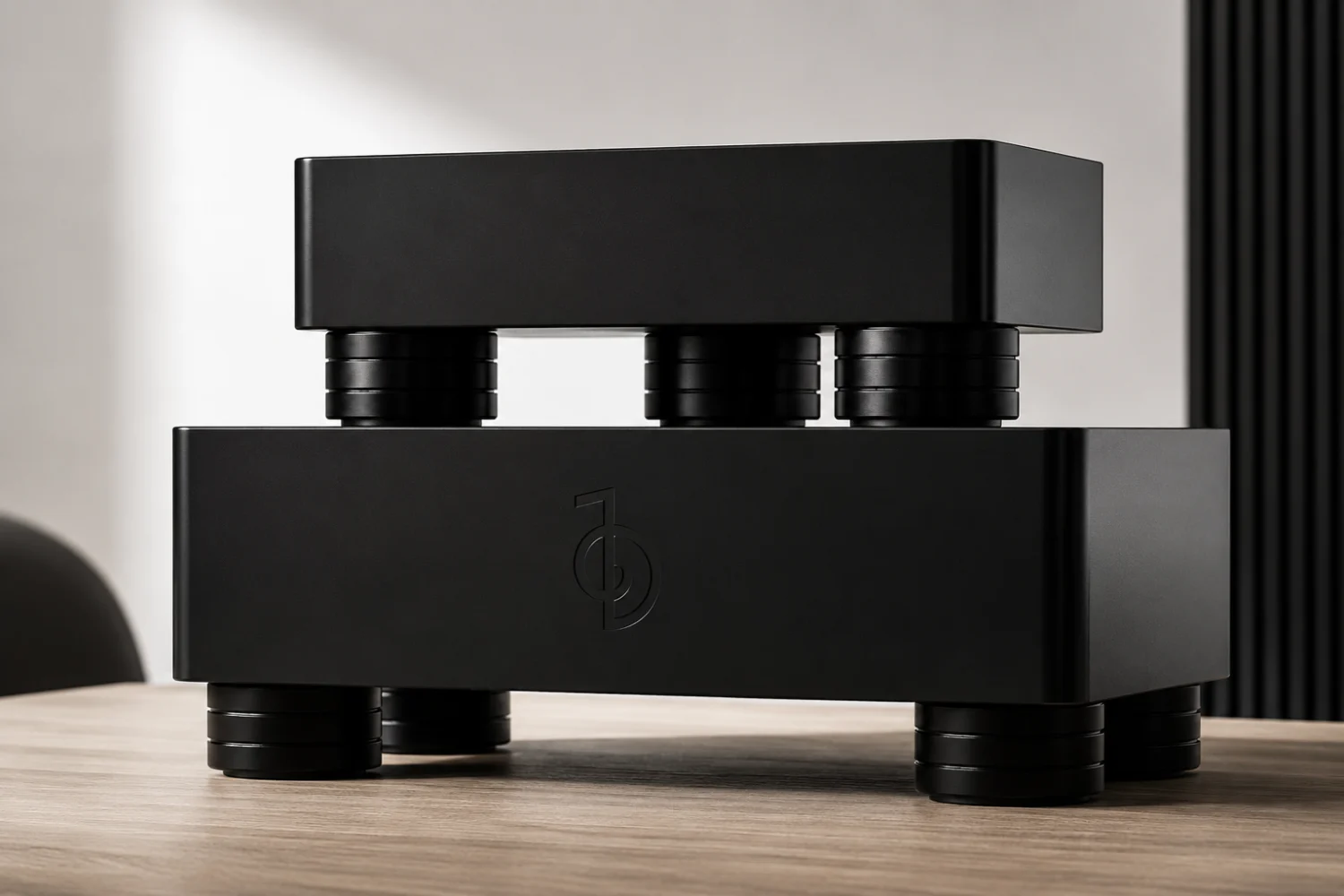
1. Reiki Audio SuperHub and OpticalBridge X networking solutions
Reiki Audio SuperHub and OpticalBridge X are positioned as network-infrastructure upgrades for audio systems with multiple Ethernet or optical-link requirements.
Reiki Audio’s SuperHub and OpticalBridge X are aimed at audio systems where network infrastructure has become part of the signal chain, particularly more complex installations that need additional Ethernet connections.
The seven-port SuperHub expands on the earlier two-port SuperSwitch concept, while a three-port SuperSwitch is also offered for smaller requirements.
Reiki Audio also presents the OpticalBridge X as an updated SFP transceiver with a machined housing, compatibility with StackAudio isolation stands, revised FMC circuitry, and lower digital-noise claims from its SFP modules. The company says these measures should improve sound quality compared with the earlier OpticalBridge, but the source frames that as a manufacturer claim rather than an independently verified result.
Best for: Complex networked audio and home-theater installations
- Seven-port SuperHub suits more complex networked systems
- Three-port SuperSwitch option for smaller setups
- OpticalBridge X uses a thicker machined housing
- Designed with DANTE and networked audio systems in mind
Verdict: Consider Reiki Audio’s network products if your system genuinely depends on multiple network audio connections, but treat the sound-quality benefit as a manufacturer claim until auditioned in your own setup.

2. FiiO ESTICK Mini Power Bank for FiiO KA17
The FiiO ESTICK Mini Power Bank attaches to the KA17 by USB-C to support portable DAC and headphone-amplifier use.
The FiiO ESTICK Mini Power Bank is a purpose-built accessory for the FiiO KA17 portable USB DAC and headphone amplifier.
Its role is straightforward: it connects directly by USB-C to help avoid drawing heavily from a smartphone battery while adding only modest width to the KA17.
The source also reminds us why KA17 owners may want the accessory: the DAC/amp is compact yet specified with PCM support up to 32-bit/768 kHz, DSD up to DSD512, MQA support, a THX AAA 78+ output stage, up to 650 mW output, 3.5 mm and 4.4 mm headphone connections, optical S/PDIF output, and USB-C source connection and charging.
Best for: FiiO KA17 owners using a phone as a source
- Designed specifically for the FiiO KA17
- Connects directly via USB-C
- Helps reduce smartphone battery drain
- Keeps the KA17 pairing compact
Verdict: The ESTICK Mini Power Bank is a practical add-on for KA17 users who want portable listening without relying as heavily on the phone’s battery.

3. Advance Paris Apex Series
The Advance Paris Apex series includes three integrated amplifiers and a CD player in a black finish with contrasting white VU meters.
Advance Paris’s Apex line comprises the A8 Apex, A10 Apex, and A12 Apex integrated amplifiers plus the ACD Apex CD player.
The series is positioned above the company’s Classic range and uses a limited black finish with contrasting white VU meters.
The amplifiers combine analog and digital inputs with the brand’s hybrid tube/transistor approach, while the ACD Apex provides digital and analog outputs, including RCA and XLR analog outputs. The A8 Apex and A10 Apex use ESS9018 DAC chips, and the A12 Apex uses an ESS9039 DAC chip. The source also notes enhanced electronics around the digital circuits, including low-noise power supplies, ESS Technology voltage regulators, and upgraded passive components.
Best for: Listeners wanting an integrated amplifier line with tubes and onboard digital conversion
- Hybrid tube/transistor amplifier design
- Analog and digital inputs on the amplifiers
- ESS DAC chips specified across the amplifier range
- Distinctive black finish with white VU meters
Verdict: Advance Paris Apex is most compelling for systems that need a full-featured integrated amplifier with both analog character and modern digital input flexibility.

4. Michi S5 stereo power amplifier
The Michi S5 is a substantial class AB stereo power amplifier with dual-mono construction and balanced XLR inputs.
The Michi S5 is a stereo power amplifier from Rotel’s flagship Michi series.
It is specified at 500 W per channel into 8 ohms in class AB and more than 800 W into 4 ohms, with a dual-mono architecture based around two custom 2200 VA toroidal transformers.
The transformers are made in-house and individually epoxy-packaged to reduce noise and vibration. Connectivity includes RCA and balanced XLR inputs, and the multilayer chassis contributes to a substantial weight of about 60 kg. A capacitor bank totaling 188,000 uF is described in the source as supporting bass energy.
Best for: Systems needing a serious standalone stereo power amplifier
- 500 W per channel into 8 ohms
- Dual-mono architecture
- RCA and balanced XLR inputs
- Substantial transformer and capacitor reserves
Verdict: The Michi S5 is a heavy-duty choice for listeners building around separates and demanding high power from a dedicated stereo amplifier.

5. SMSL SU-1 DAC
The SMSL SU-1 is a compact desktop DAC with USB-C, optical, and coaxial digital inputs plus stereo RCA output.
The SMSL SU-1 is a compact stationary DAC built around an AKM AK4493S DAC chip and an XMOS XU316 USB interface.
Its digital inputs include USB-C, optical Toslink, and coaxial, with stereo RCA output.
Over USB, the source specifies PCM support up to 32-bit/768 kHz and native DSD support, while MQA and MQA-CD decoding are also listed. Measured figures provided in the source include a 2 Vrms output level, THD+N of 0.00013 percent, 121 dB dynamic range, and 121 dB signal-to-noise ratio.
Best for: Adding a compact DAC to a desktop or stereo system
- USB-C, optical, and coaxial inputs
- AKM AK4493S DAC chip
- PCM up to 32-bit/768 kHz over USB
- MQA and MQA-CD support
Verdict: The SMSL SU-1 is a focused DAC option for systems that need multiple digital inputs and stereo RCA output in a small chassis.

6. MK Analogue SUT-1M MC transformer
The MK Analogue SUT-1M is a moving-coil step-up transformer with selectable ratios and resistor-loading options.
The MK Analogue SUT-1M is a moving-coil step-up transformer designed for medium- and high-impedance MC cartridges, with the source naming Audio-Technica, Benz Micro, and EMT as examples.
It follows the earlier SUT-1L model, which was intended for low-impedance cartridges.
The SUT-1M provides two inputs with different transformation ratios: 1:5 and 1:10, corresponding to 14 dB and 20 dB gain. An RCA connector is provided for connecting output resistors, with listed values of 100, 200, 400, 470, and 1880 ohms, and other values available on request. Construction details include a custom German Mu-metal transformer core, a bronze screen, and an intermediate steel plate intended to damp resonances.
Best for: Vinyl systems using compatible moving-coil cartridges
- Designed for medium- and high-impedance MC cartridges
- 1:5 and 1:10 transformation ratios
- Selectable output resistor values
- Mu-metal core with bronze screening
Verdict: The SUT-1M is a specialist phono-matching component for MC cartridge users who need the right gain and loading options before the phono stage.

7. Musical Fidelity X-Tube
The Musical Fidelity X-Tube uses two E88CC triodes inside a cylindrical aluminum enclosure.
The Musical Fidelity X-Tube is a tube output buffer housed in a cylindrical aluminum chassis.
It uses two E88CC triode tubes and a single-ended signal path, with Musical Fidelity positioning it as a way to add tube character to audio systems, especially when used with digital sources that rely on simpler chip-based output stages.
The one-piece aluminum extrusion chassis is described as providing shielding against electromagnetic interference, while the brushed aluminum faceplate contributes to the compact X-profile design associated with earlier Musical Fidelity products.
Best for: Listeners wanting to experiment with tube buffering
- Uses two E88CC triode tubes
- Single-ended signal path
- One-piece aluminum cylindrical chassis
- Designed as a tube output buffer for digital sources
Verdict: The X-Tube is a system-tuning accessory rather than a core source or amplifier, best suited to users who specifically want to add a tube buffer stage.

8. Denon PMA-2500NE integrated amplifier
The Denon PMA-2500NE integrated amplifier includes a USB-DAC and a high-current UHC-MOS output stage.
The Denon PMA-2500NE is an integrated amplifier that combines traditional amplifier engineering with a built-in USB-DAC for direct computer connection.
Its amplifier section uses a single push-pull circuit with UHC-MOS field-effect transistors in the output stage, specified for peak current delivery up to 210 A.
The source also notes real-time transistor temperature monitoring and a power supply using two centrally located transformers. Denon’s stated design focus was to streamline signal paths and reduce electrical and acoustic interference.
Best for: Two-channel systems needing an integrated amp with USB digital input
- Built-in USB-DAC for computer connection
- UHC-MOS output-stage transistors
- Peak current specified up to 210 A
- Dual-transformer power supply
Verdict: The PMA-2500NE is a strong fit for listeners who want one integrated amplifier to handle both conventional hi-fi sources and direct computer audio.

9. Apple to start assembling MacBooks in Vietnam next year
The Apple manufacturing report is consumer-electronics context rather than a hi-fi product recommendation.
This supplied article concerns Apple’s reported manufacturing plans for MacBooks, alongside broader production diversification involving devices such as AirPods, iPad, Apple Watch, iPhone, and Beats headphones.
It does not describe a hi-fi component, an audio specification, a listening product, or a system-upgrade role.
For a hi-fi buying guide, it is therefore useful only as general consumer-electronics supply-chain context, not as a recommendation.
Best for: Not applicable as a hi-fi recommendation
Verdict: This article is out of scope for hi-fi system buying and should not influence component selection.

10. JBL L42ms all-in-one audio system
The JBL L42ms combines streaming, analog and digital inputs, amplification, and a furniture-friendly enclosure in one system.
The JBL L42ms is an all-in-one music system presented as a more compact counterpart to the L75ms.
It uses a curved profile, Quadrex grille, and natural walnut veneer finish, with a black variant also described.
The system is specified with maximum power output up to 200 W, a low-frequency switch for placement near walls, and a sound-field expansion mode. Connectivity is broad: analog RCA and 3.5 mm inputs, a 24-bit/96 kHz DAC accessible through Toslink or HDMI ARC, Ethernet, Wi-Fi, Apple AirPlay 2, built-in Google Chromecast, Spotify Connect, Tidal Connect, Amazon Music, Qobuz, podcasts, internet radio, UPnP for local networks, and USB-drive playback.
Best for: Compact living-room systems with streaming and TV audio needs
- All-in-one design with broad connectivity
- Analog RCA and 3.5 mm inputs
- Toslink and HDMI ARC digital inputs
- AirPlay 2, Chromecast, Spotify Connect, and Tidal Connect
Verdict: The JBL L42ms is the most self-contained option here, suited to listeners who want streaming, digital inputs, analog inputs, and amplification in one compact system.
How to choose the right hi-fi upgrade from this list
Start with the system problem, not the product category.
If your current setup lacks clean digital-to-analog conversion from USB, optical, or coaxial sources, the SMSL SU-1 is the most direct answer among these entries.
If you already use a FiiO KA17 on the move and phone battery life is the problem, the ESTICK Mini Power Bank is a targeted accessory rather than a general upgrade. For amplification, separate the need for power from the need for integration. The Michi S5 is a dedicated stereo power amplifier for a separates-based system, with high output and balanced inputs. The Denon PMA-2500NE is more suitable when you want an integrated amplifier that also accepts computer audio through its USB-DAC. The Advance Paris Apex amplifiers occupy another lane, combining hybrid tube/transistor design, onboard DAC chips, and analog and digital input flexibility. Vinyl users should focus on cartridge compatibility before considering anything else. The MK Analogue SUT-1M is specifically for medium- and high-impedance moving-coil cartridges and offers two transformation ratios plus loading options. It is not a universal phono upgrade; it is a matching component that only makes sense in the right cartridge and phono-stage context. For system simplification, the JBL L42ms stands apart. It is an all-in-one audio system with streaming, analog inputs, HDMI ARC, Toslink, Ethernet, Wi-Fi, and app-friendly services built in. That makes it appealing where space, furniture integration, and everyday convenience matter more than building a rack of separates. Treat the Reiki Audio networking products and Musical Fidelity X-Tube as system-dependent refinements. The Reiki components are relevant only if your audio setup relies on networked audio infrastructure and multiple Ethernet connections. The X-Tube is for listeners deliberately exploring a tube buffer stage. Neither should be bought as a generic cure-all; both make the most sense when their specific role is clearly understood.



Sound Off
0Join the discussion if you have something to add.