Choosing an amplifier is less about finding one universal winner and more about matching topology, inputs, power, and system role to the way a hi-fi system is actually built.
A compact integrated amplifier with digital inputs solves a different problem from a balanced stereo power amplifier, a tube design, or a reference monoblock.
This guide keeps the focus on what the source material supports: circuit approach, connectivity, stated power, construction details, and the kind of system each product appears suited to. Some of these models are traditional power amplifiers, others are integrated amplifiers, and one is a dedicated preamplifier, so the right choice depends first on what part of the signal chain you need to upgrade. The order below preserves the supplied ranking. Rather than forcing direct comparisons between unlike products, each entry explains the practical appeal of the amplifier in context, along with short pros that are grounded in the available information.
1. PS Audio Stellar M700
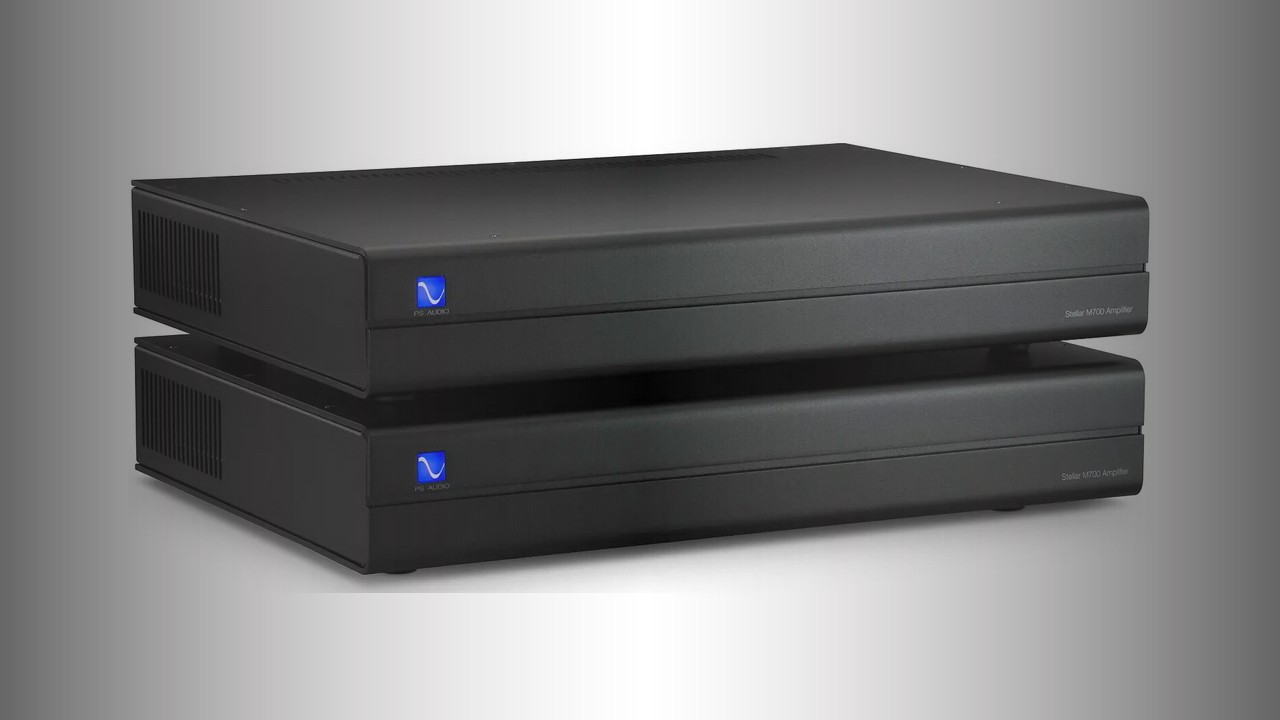
PS Audio Stellar M700 power amplifier with Analog Cell input circuitry and ICEpower Class D output technology.
The PS Audio Stellar M700 is built around a hybrid concept: a discrete Class A balanced differential input stage called Analog Cell feeds an ICEpower Class D output stage.
The source describes the Analog Cell as a zero-feedback MOSFET circuit intended to preserve delicate signals from a preamplifier or DAC, while the Class D output section is credited with efficiency, current delivery, low distortion, and linearity.
It is a strong fit for listeners who want a power amplifier that combines a rich, open character with the practical advantages of modern Class D output technology.
Best for: Systems needing a musical yet efficient power amplifier
- Analog Cell discrete Class A input stage
- ICEpower Class D output stage
- Designed for high efficiency and high current
- Source describes a clear, open, rich and detailed sound
Verdict: The Stellar M700 stands out for combining PS Audio’s Analog Cell input approach with a modern Class D output stage in a power-focused design.
2. Mark Levinson No. 5805
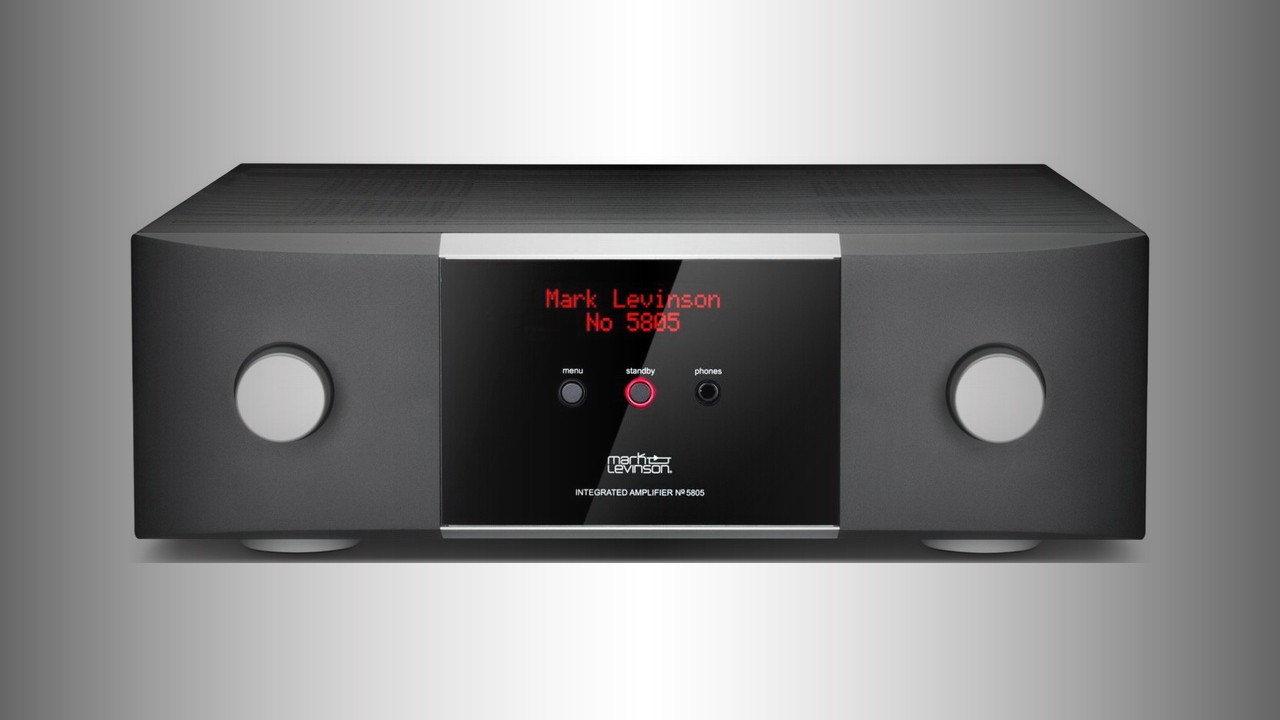
Mark Levinson No. 5805 integrated amplifier with matte black finish, red display accent, and broad analog and digital connectivity.
The Mark Levinson No.
5805 is presented as a substantial integrated amplifier with a stylish matte black, glass, brushed-aluminum, and red-accented design.
Its fully discrete amplifier section uses direct coupling to a Class AB output stage rated at 125 watts into 8 ohms, with almost twice that output into 4 ohms, and the power supply uses a transformer with separate output windings for each channel. Its appeal is broadened by the source’s emphasis on capability: analog and digital inputs are included, with USB 2.0, coaxial S/PDIF, and two TosLink S/PDIF digital connections specified.
Best for: Listeners wanting a premium integrated amplifier with built-in digital connectivity
- Fully discrete Class AB amplifier section
- 125 watts into 8 ohms
- Analog and digital input options
- Substantial chassis and stylish industrial design
Verdict: The No. 5805 is a polished integrated amplifier for systems where strong amplification and versatile input support are both priorities.
3. Luxman MQ-300
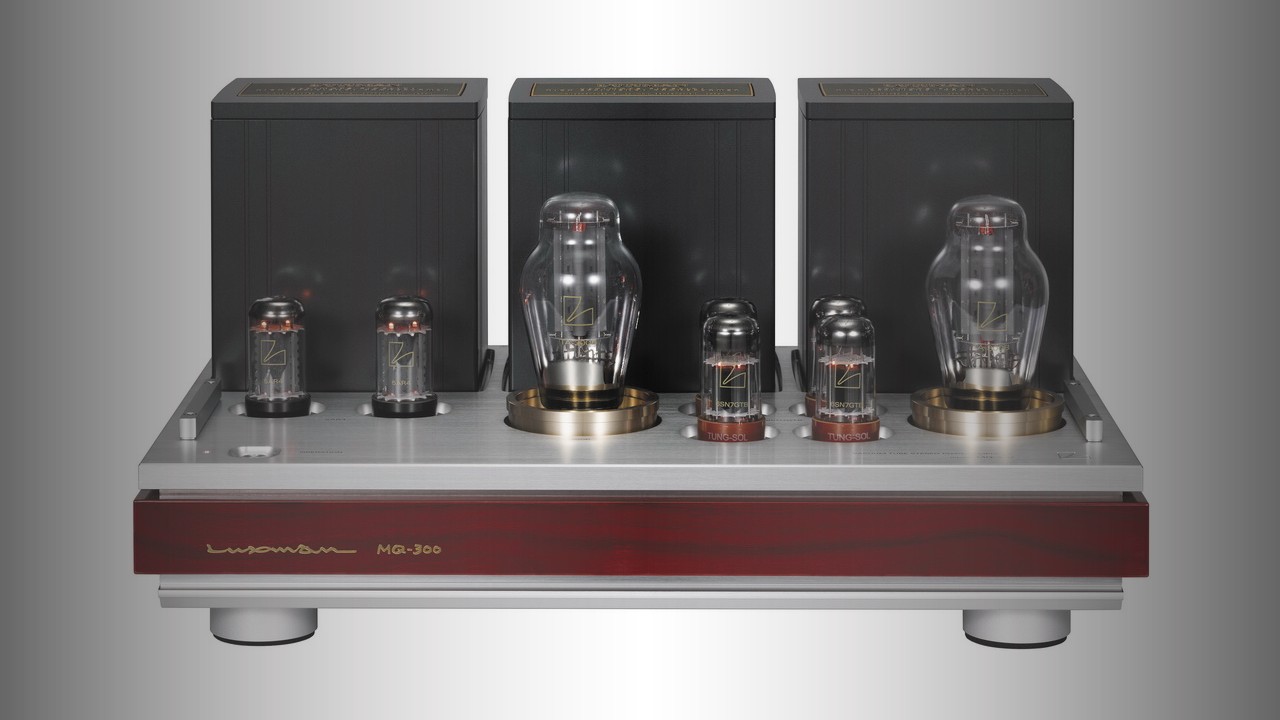
Luxman MQ-300 single-ended tube power amplifier with exposed tubes, transformer housings, and piano-lacquer wood detailing.
The Luxman MQ-300 is a stereo single-ended tube power amplifier using 300B triodes and rated at 8 watts per channel.
Its design recalls Luxman’s earlier MB-300 concept while being configured as a stereo power amplifier rather than separate monoblocks.
The source highlights Japanese-made Takatsuki TA-300B output tubes, 5AR4 rectifiers, 6SN7GTB double triodes, Luxman transformers, and a massive anti-vibration all-metal chassis with piano-lacquer wood inserts, making this a specialist amplifier for those drawn to traditional tube circuitry and premium physical execution.
Best for: Tube enthusiasts building around a low-power single-ended amplifier
- Single-ended 300B tube design
- Japanese-made Takatsuki TA-300B output tubes
- Massive anti-vibration chassis
- Premium finish with piano-lacquer wood inserts
Verdict: The MQ-300 is a beautifully executed 300B power amplifier whose appeal lies in classic tube architecture and luxurious construction.

4. NuPrime IDA-9
NuPrime IDA-9 compact integrated amplifier with GaN-based hybrid amplification and built-in digital-to-analog conversion.
The NuPrime IDA-9 is a compact integrated amplifier with a built-in DAC, analog RCA input, and digital inputs.
The source states that it delivers 150 watts per channel into 8 ohms while retaining dimensions close to its predecessor, and it combines a hybrid Class A+D design with GaN technology.
Digital support includes optical and coaxial S/PDIF plus USB Type-B, while the AKM DAC chip is specified for PCM up to 32-bit/384 kHz and DSD256. A line output and expansion port add flexibility for systems that may include a subwoofer or additional wireless/streaming functionality via modules.
Best for: Space-conscious systems needing power and digital inputs in one box
- Compact integrated amplifier format
- 150 watts per channel into 8 ohms
- Built-in DAC with PCM and DSD support
- Optical, coaxial, and USB Type-B digital inputs
Verdict: The IDA-9 is a practical modern integrated amplifier for listeners who want compact size, high stated output, and built-in digital conversion.

5. Quad Artera Stereo
Quad Artera Stereo power amplifier with balanced inputs, RCA inputs, and internal layout centered on a large toroidal transformer.
The Quad Artera Stereo is a fully balanced stereo power amplifier with XLR inputs, RCA inputs, and a rear-panel input selector.
Its internal layout uses separate boards and short power wiring, with a large toroidal transformer forming a major part of the device.
The source emphasizes a newly developed topology that retains Quad’s Current Dumping approach, here described in an improved version, with 140 watts per channel into 8 ohms and the ability to control complex reactive speaker loads.
Best for: Balanced hi-fi systems needing a dedicated stereo power amplifier
- Fully balanced power amplifier design
- XLR and RCA input options
- 140 watts per channel into 8 ohms
- Current Dumping topology for speaker-load control
Verdict: The Artera Stereo is a focused power amplifier built around Quad’s balanced layout and Current Dumping implementation.
6. Yamaha C-5000
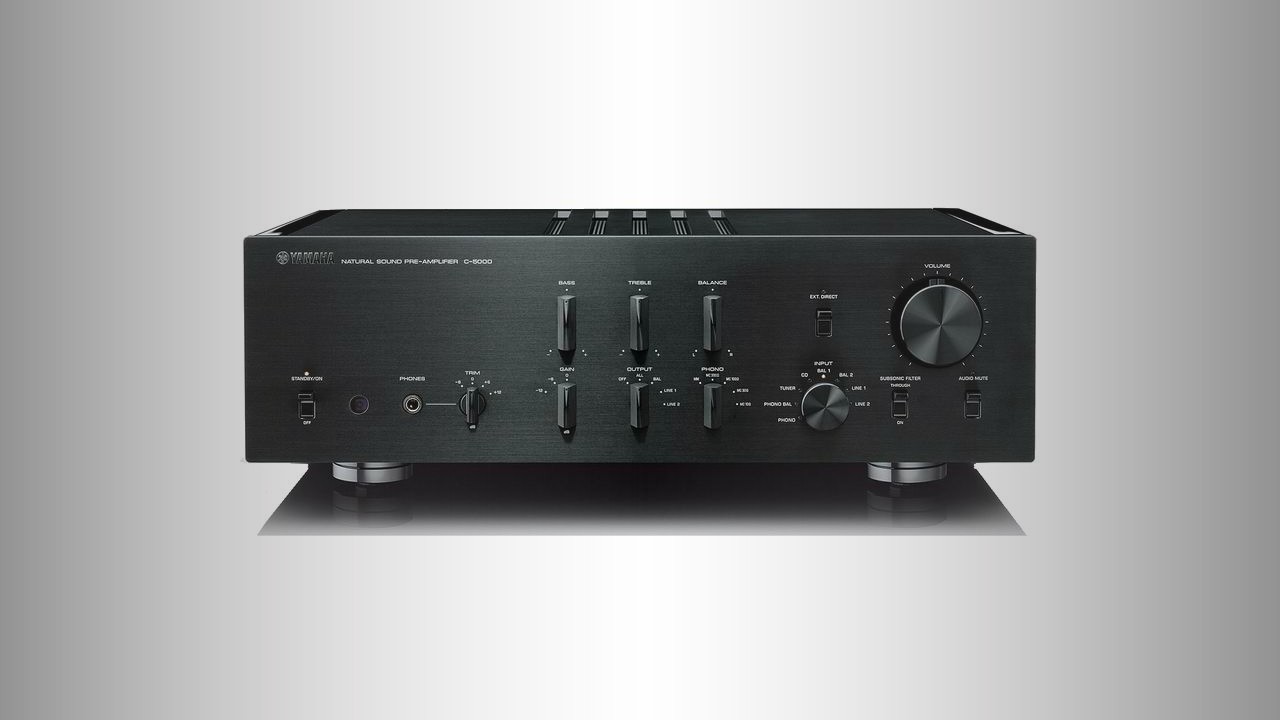
Yamaha C-5000 preamplifier with precision front-panel controls and balanced internal signal-path design.
The Yamaha C-5000 is a dedicated preamplifier rather than a power amplifier, intended to sit at the control point of a high-fidelity system.
The source describes balanced transmission with a discrete stage design throughout the signal path when tone control bypass is used, plus patented phono and line amplifier stages intended to reduce the effect of ground noise.
Yamaha also uses a mirrored left-right circuit-board layout to match channel paths, while the front panel is described as carefully crafted, with precision-feeling controls and optimized switches.
Best for: Systems needing a high-end preamplifier control stage
- Balanced transmission architecture
- Discrete stage design in tone bypass mode
- Patented phono and line amplifier stages
- Mirrored left and right signal paths
Verdict: The C-5000 is the right kind of shortlist entry when the amplifier upgrade is about signal control, balanced architecture, and preamplifier refinement rather than power output.

7. TAD TAD-M2500TX
TAD TAD-M2500TX stereo power amplifier with machined aluminum chassis and symmetry-focused internal architecture.
The TAD TAD-M2500TX is a two-channel power amplifier from TAD’s Evolution series, with a reengineered circuit design, enhanced transformers, and a machined aluminum chassis.
It is specified at 550 watts per channel into a 4-ohm load.
The source places particular emphasis on symmetry: a bridge-tied load design connects separate amplifiers in a balanced configuration, with positive and negative power supplies kept symmetrical and power-supply circuits separated for each channel. The chassis is described as jointless and redesigned to support a low-impedance ground reference.
Best for: High-power systems needing a serious two-channel power amplifier
- 550 watts per channel into 4 ohms
- Bridge-tied load balanced configuration
- Separate power-supply circuits for each channel
- Machined aluminum jointless chassis
Verdict: The TAD-M2500TX is a heavyweight stereo power amplifier defined by high stated output, symmetry-focused circuit design, and substantial mechanical construction.

8. Goldmund Telos 1800
Goldmund Telos 1800 monoblock power amplifier in the brand’s silver-gray finish with thick panel construction.
The Goldmund Telos 1800 is a monoblock power amplifier specified at 420 watts into 8 ohms at 1 percent THD.
The source also lists less than 0.05 percent THD at 30 V output, output noise below 3 microvolts across the audio range, 35 dB gain, 110 dB dynamic range, and a damping factor of 600 at 1 kHz into 8 ohms.
Construction is also a focus: the amplifier uses thick 12 mm housing panels, which the source says increase case rigidity and help dissipate vibrations. This is a specialist choice for systems built around separate mono amplification.
Best for: Reference-style systems using separate monoblock amplification
- 420 watts into 8 ohms
- Very low specified output noise
- 110 dB dynamic range listed
- Rigid 12 mm panel housing
Verdict: The Telos 1800 is a powerful monoblock option distinguished by its published performance figures and heavily built enclosure.

9. SMSL AO200 MKII
SMSL AO200 MKII compact Class D amplifier with Bluetooth, RCA and XLR inputs, and subwoofer output.
The SMSL AO200 MKII is a compact Class D digital amplifier using an Infineon MA5332MS amplification chip and specified at 2 x 160 watts into 4 ohms.
Its feature set is unusually broad for a small amplifier: the source lists RCA and balanced XLR inputs, Bluetooth 5.0, a subwoofer output for 2.1-channel systems, eight preset equalizers, and manual bass and treble adjustment.
For compact desktop, secondary-room, or simple stereo-plus-subwoofer systems, its combination of size, power, and input flexibility is the main attraction.
Best for: Compact systems needing flexible inputs and 2.1-channel support
- Compact Class D design
- 2 x 160 watts into 4 ohms
- RCA and balanced XLR inputs
- Bluetooth 5.0 and subwoofer output
Verdict: The AO200 MKII is a compact, feature-rich amplifier that balances balanced input support, wireless streaming, and subwoofer integration.

10. Premiera A3
Premiera A3 integrated amplifier with neo-vintage front-panel meters, analog controls, and extensive rear-panel connectivity.
The Premiera A3 is a neo-vintage integrated amplifier that combines classic front-panel styling with a modern feature set.
The source notes signal-level indicators and analog controls, while the rear panel includes MM or MC phono support, three line-level inputs, one balanced XLR input, coaxial and optical digital inputs, USB-B for a computer, and HDMI with Audio Return Channel support.
It also offers Bluetooth with aptX and AAC codec support plus a front USB port for portable storage containing audio files. The supplied title identifies it as a Class AB integrated amplifier with 110W power, making it a broad-function option for listeners who want one central stereo component.
Best for: One-box stereo systems needing analog, digital, TV, and phono connectivity
- MM and MC phono input support
- Balanced XLR and multiple line inputs
- HDMI ARC, USB-B, optical, and coaxial digital inputs
- Bluetooth with aptX and AAC support
Verdict: The Premiera A3 is a versatile integrated amplifier for users who want classic controls and a wide range of modern connection options in the same component.
How to choose from this amplifier shortlist
Start by deciding which kind of amplifier your system needs.
If you already own a preamplifier or DAC with volume control, a dedicated power amplifier such as the PS Audio Stellar M700, Quad Artera Stereo, TAD TAD-M2500TX, Goldmund Telos 1800, or Luxman MQ-300 may make sense.
If you want one component to handle source selection and amplification, integrated models such as the Mark Levinson No. 5805, NuPrime IDA-9, SMSL AO200 MKII, or Premiera A3 are more direct solutions. If the missing link is system control rather than speaker-driving power, the Yamaha C-5000 belongs in a different but important category: the dedicated preamplifier. Power ratings matter, but they are not the only deciding factor. The low-powered Luxman MQ-300 is a specialist single-ended tube amplifier, while the TAD and Goldmund entries are aimed at much more power-focused separate-amplifier systems. The Quad sits in the dedicated stereo power-amplifier camp with balanced connectivity and Current Dumping circuitry, while the PS Audio combines a Class A-style input stage with an efficient Class D output section. Connectivity should be treated as a system requirement, not a bonus. The Premiera A3 is the most broadly equipped in this group for users who need phono, HDMI ARC, USB, Bluetooth, and conventional analog inputs in one chassis. The NuPrime IDA-9 also offers a compact integrated route with a built-in DAC and modern digital support. The SMSL AO200 MKII is the practical small-amplifier option when Bluetooth, balanced input, equalization, and subwoofer output matter. Build and topology help separate the more specialist choices. The Mark Levinson emphasizes a substantial Class AB integrated platform with both analog and digital inputs. Yamaha’s C-5000 focuses on balanced preamplifier architecture and channel symmetry. TAD’s TAD-M2500TX places symmetry and separate channel power supplies at the center of its design, while Goldmund’s Telos 1800 highlights monoblock power, low-noise specifications, and a rigid enclosure. The right buy is the one whose role, connectivity, topology, and stated output match the speakers and sources already in the system.