
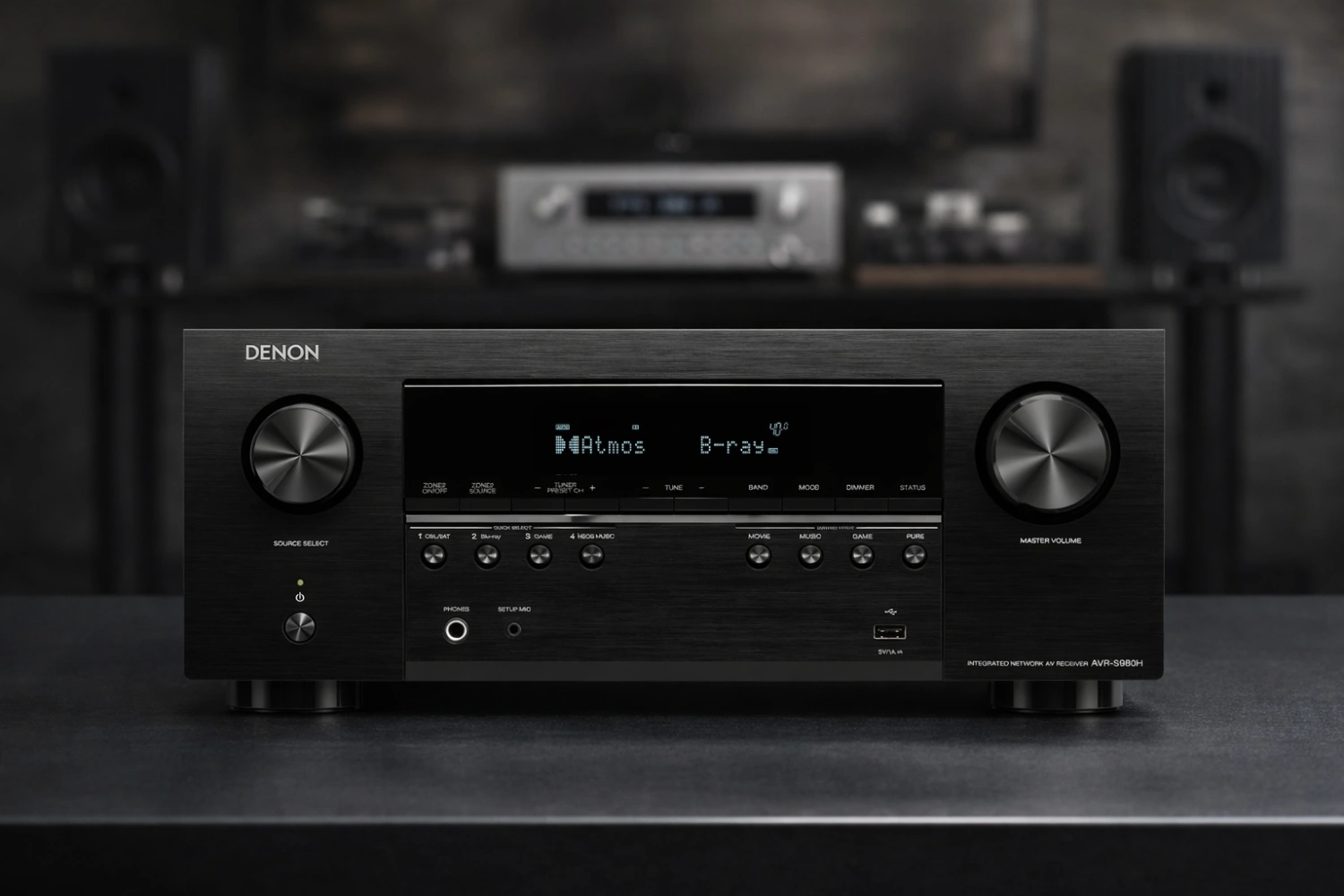
These five products do not all serve the same role. The Denon AVR-S980H, Arcam AVR31 and Block CVR-200 AV are integrated AV receivers, while the Marantz AV7706 is an AV processor that needs external amplification. The Canton Ergo 690 is a pair of passive floorstanding speakers, not an AV electronics product.
That distinction matters more than a simple specification count. The Denon is the most convincing all-round recommendation because it combines multichannel amplification, modern gaming support, streaming, straightforward setup and a clear upgrade path. The alternatives make better sense when you prioritise Blu-ray playback, advanced room correction, separates-based home cinema or a particular speaker system.
Quick verdict
- Best Overall: Denon AVR-S980H — the best balance of usability, home cinema, music streaming, gaming support and future expansion.
- Best for advanced processing and installation flexibility: Arcam AVR31 — a powerful 7.1-channel receiver with Dirac Live, 16-channel processing, 8K HDMI and extensive custom-install connections.
- Best for a disc-based all-in-one system: Block CVR-200 AV — uniquely combines a Blu-ray/DVD/CD drive, seven amplifier channels, radio and streaming.
- Best for separates-based home cinema: Marantz AV7706 — an 11.2-channel processor with balanced outputs, Audyssey MultEQ XT32 and extensive HDMI and streaming support, but no built-in power amplifiers.
- Speaker option: Canton Ergo 690 — a passive three-way floorstander for buyers building around a separate amplifier or AV receiver.
Comparison table
| Product | Role | Amplification or processing | Standout features | Best suited to |
|---|---|---|---|---|
| Denon AVR-S980H | 7.2-channel AV receiver | 90 W per channel | HEOS, Bluetooth, AirPlay 2, Spotify Connect, 1440p passthrough, AMD FreeSync, 5.1.2 Dolby Atmos expansion | Accessible, expandable family systems |
| Arcam AVR31 | 7.1-channel AV receiver | 7 x 100 W at 8 ohms; 180 W per channel at 4 ohms | Dirac Live, 16-channel processing, Dolby Atmos, DTS:X, IMAX Enhanced, 8K HDMI 2.1 | Advanced home cinema and custom installations |
| Block CVR-200 AV | AV receiver with integrated disc transport | 7 x 100 W at 4 ohms | Blu-ray, DVD and CD playback, FM, DAB+, internet radio, phono input, two-way Bluetooth | Disc collectors wanting one central component |
| Marantz AV7706 | 11.2-channel AV processor | No built-in power amplifiers | 11.2-channel RCA and XLR outputs, Audyssey MultEQ XT32, 8K/4K 120 Hz pass-through, HEOS | Separate power amplifiers and serious expansion |
| Canton Ergo 690 | Passive three-way floorstanding speaker | Requires an amplifier or AV receiver | 88.3 dB sensitivity, 4–8 ohm impedance, 20–40,000 Hz range, bi-wiring | Front-channel stereo or home cinema systems |
Denon AVR-S980H
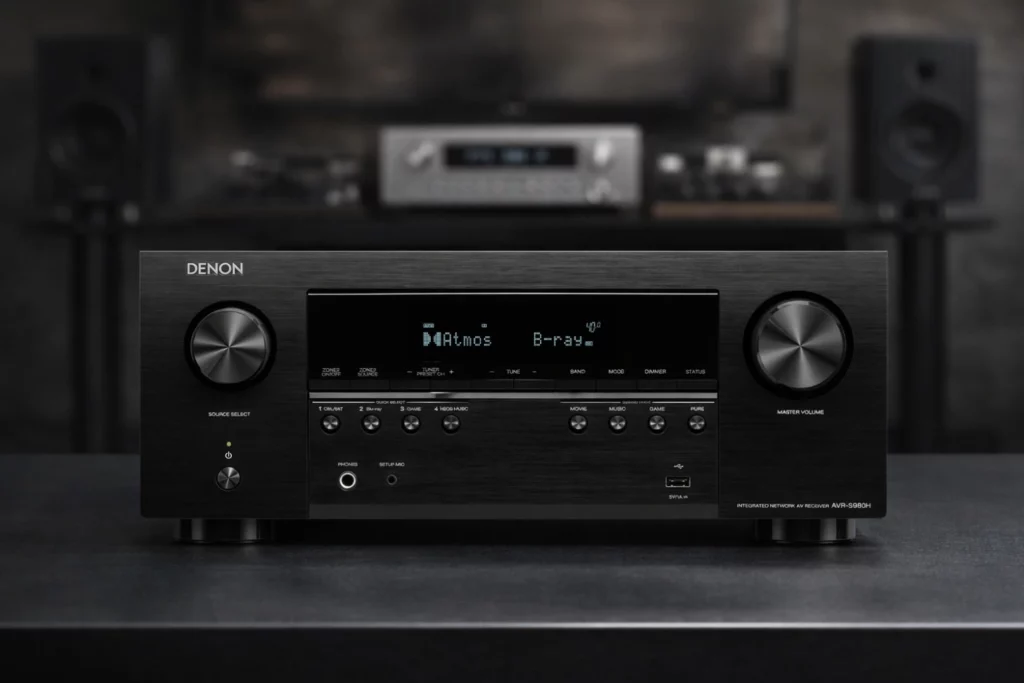
The Denon AVR-S980H is the strongest all-round choice in this group because it addresses the widest range of ordinary home-entertainment needs without requiring a separates system. It is a 7.2-channel AV receiver with 90 watts per channel, and the source describes it as suitable for both two-channel and multichannel sound. That makes it a more immediately complete proposition than the Marantz AV7706, which requires external power amplifiers, and more flexible for modern living rooms than the disc-focused Block.
Ease of use is central to the Denon’s appeal. On-screen instructions guide setup, and the receiver can subsequently be controlled through an app or web interface on a smartphone or PC. This is important for buyers moving beyond a soundbar or basic system but who do not want the installation burden associated with high-end separates. The receiver can begin as a two-speaker system, expand to 5.1, and ultimately support a 5.1.2 Dolby Atmos configuration.
Its wireless and network features are also unusually well balanced for the products here. HEOS supports multiroom audio and can link rooms or send television sound to Denon Home speakers. Bluetooth, AirPlay 2 and Spotify Connect are included. Denon also says that support for using Denon Home 200, 400 and 600 speakers as wireless surrounds will be added through a later firmware update; it is not available at launch. That makes this a useful option where running surround-speaker cable is difficult, provided the buyer understands that this particular feature depends on the future update.
Gaming is another reason to choose the Denon. The source specifically highlights 1440p passthrough and AMD FreeSync for smoother and more responsive gameplay. The article does not list the receiver’s complete HDMI specification, so it would be wrong to assume that it matches every feature of the Arcam or Marantz. Even so, the combination of gaming support, simple setup, streaming and expansion gives the AVR-S980H the broadest appeal.
Why buy it: You want one accessible receiver for films, music, gaming and multiroom use, with the option to add Dolby Atmos later.
Limitation: It has less elaborate processing and fewer installation-oriented features than the Arcam, and it does not include a disc drive like the Block.
Arcam AVR31
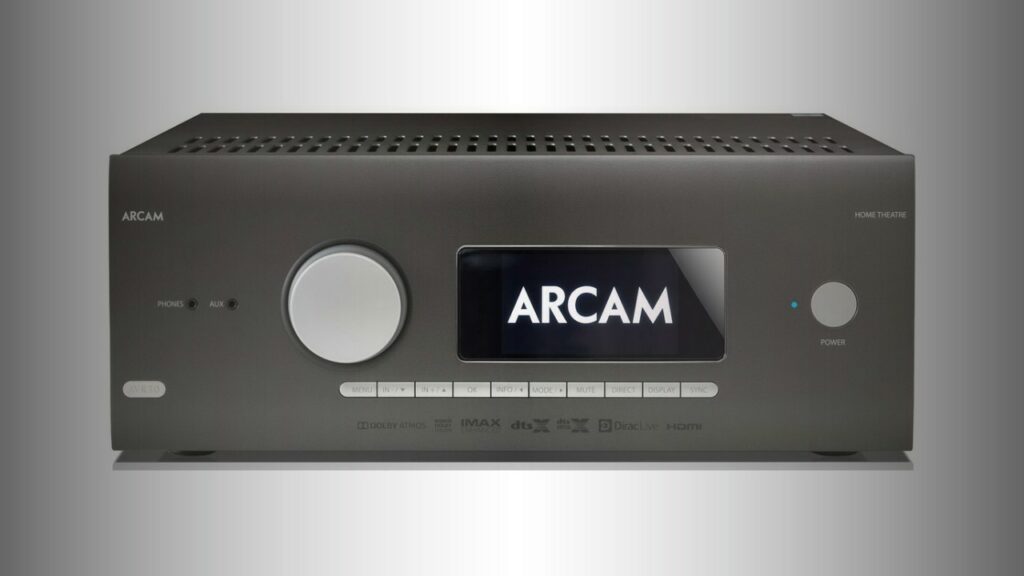
The Arcam AVR31 is the technically more ambitious integrated receiver. Its seven amplifier channels are rated at 100 watts per channel into 8 ohms and 180 watts per channel into 4 ohms, with all channels driven figures specified in the source. It also uses G-class amplifier stages and a large toroidal-transformer-equipped power supply. On paper, that gives the Arcam a stronger case for demanding speaker loads than the Denon, although the two products’ power figures are not stated under identical conditions and should not be treated as a direct laboratory comparison.
Processing is where the AVR31 most clearly separates itself. It has 16 processor channels, supports Dolby Atmos in a 5.1.2 configuration, and can operate in 7.1.4 with an additional four-channel or two two-channel power amplifiers. Dirac Live full 16-channel automatic calibration is built in. For a buyer who wants to optimise a complex installation rather than simply get a receiver running quickly, this is a major advantage.
The Arcam also supports DTS:X and IMAX Enhanced, along with Auro-3D and a broad selection of Dolby and DTS formats. Its HDMI section includes seven inputs and three outputs using HDMI 2.1, with 8K support, 4K Ultra HD at 120 Hz and HDR formats including HDR10+, HLG, Dolby Vision and Dynamic HDR. The source also lists HDCP 2.3 and upscaling to 8K for digital and analogue video.
Connectivity is aimed at serious system building. There is Ethernet, USB, RS-232, two trigger outputs, IR connections, seven pairs of speaker terminals and a 7.2.4-channel pre-out. Streaming includes Apple AirPlay 2, Google Chromecast, Spotify and vTuner internet radio. The receiver can be controlled by remote, IP control or the MusicLife application.
This feature set makes the AVR31 a better choice than the Denon for buyers planning external amplification, a larger Atmos system or a professionally integrated installation. It is not the obvious choice for everyone, however. The source presents the Denon as specifically designed to remain accessible and user-friendly, while the Arcam’s full capabilities are most valuable when the rest of the system is equally ambitious.
Why buy it: You want Dirac Live, extensive processing, 8K HDMI 2.1 support and the ability to build toward a more elaborate home cinema.
Limitation: Its additional processing and installation features may be unnecessary in a straightforward living-room system.
Block CVR-200 AV
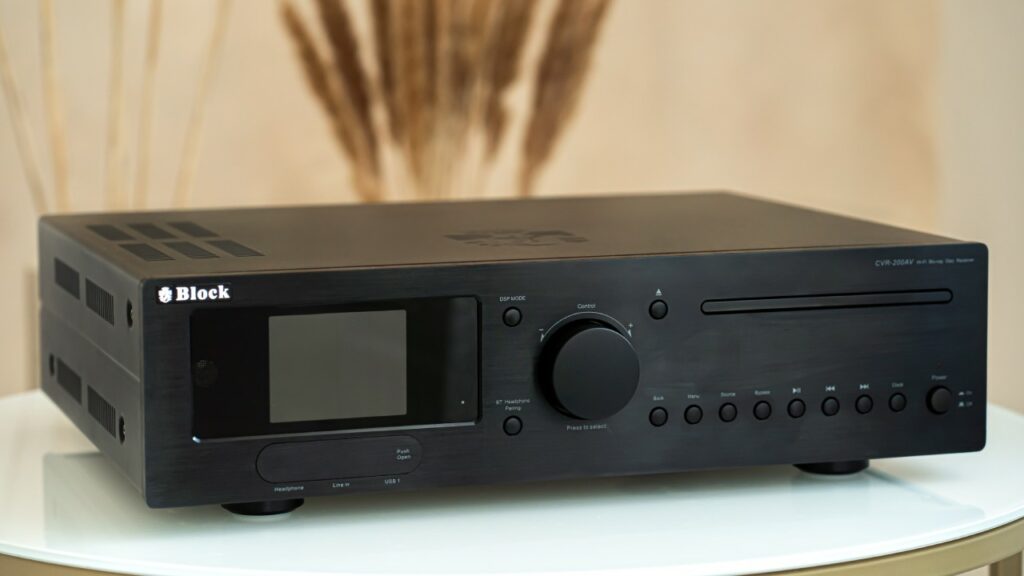
The Block CVR-200 AV is the most distinctive product here. Instead of treating the receiver as one part of a stack, Block combines a seven-channel amplifier, AV switching, streaming and a Blu-ray transport in one chassis. It plays Blu-ray discs as well as DVDs and CDs, supports Dolby Digital and DTS, and is designed for passive speakers. For anyone with a substantial physical disc collection, that integrated transport is the reason to consider it.
The Block also has a broader traditional-source offering than the Denon article describes. It includes three HDMI inputs and one HDMI output with ARC and HDMI CEC, three optical inputs, one coaxial S/PDIF input, two stereo RCA inputs, an MM phono input, USB-A, a front-panel line input and a headphone output. It also provides preamp, subwoofer and record outputs. That combination makes it unusually accommodating for a system that includes a turntable, older digital sources and physical media.
Streaming is not neglected. The CVR-200 AV supports UPnP, Spotify, Spotify Connect and Deezer, plus FM, DAB+ and internet radio. Its network connection is wireless only. Bluetooth works in both directions: a phone or tablet can send music to the receiver, while the receiver can send audio to Bluetooth headphones. Control is available from front-panel buttons, the supplied remote or an app.
The seven amplifier channels are rated at 100 watts each into 4 ohms, and the manufacturer claims a frequency response of 10 Hz to 26 kHz. The source gives dimensions of 430 x 121.5 x 375 mm and a weight of 11 kg. The recommended retail price is just under $2,000, which positions it as a substantial one-box purchase rather than a budget alternative.
Compared with the Denon, the Block’s advantage is not modern system expansion or gaming detail; it is convenience for disc owners and users with many legacy connections. Compared with the Arcam, it offers a much simpler feature proposition, while its wireless-only network connection may matter to buyers who specifically require Ethernet. It is the right specialist choice when the Blu-ray drive, radio tuners, phono input and two-way Bluetooth outweigh the need for advanced room correction.
Why buy it: You want Blu-ray, DVD, CD, radio, streaming and amplification in one component, with a built-in phono input.
Limitation: The source does not list Dolby Atmos, Dirac or HDMI 2.1 features for the Block, and network connection is wireless only.
Marantz AV7706
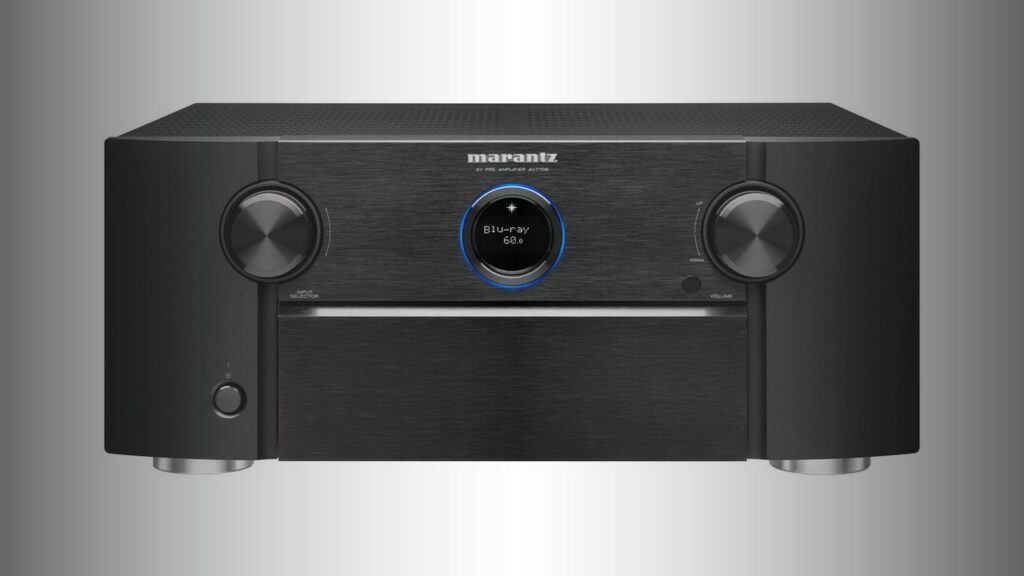
The Marantz AV7706 is not a direct substitute for the Denon, Arcam or Block. It is an AV processor with no built-in power amplifiers, so it must be partnered with external amplification. Marantz recommends its MM8077 seven-channel, MM7055 five-channel or MM7025 two-channel amplifiers. That immediately makes it a product for buyers who are intentionally building a separates-based system.
Its strongest argument is the scale and sophistication of its processing. The AV7706 provides an 11.2-channel preamp configuration and can handle Dolby Atmos and DTS:X systems up to 7.1.4 with additional amplification. It also supports Auro-3D and IMAX Enhanced. Audyssey MultEQ XT32 handles automatic speaker calibration, with Dynamic EQ, Dynamic Volume, LFC and Sub EQ HT included. Sub EQ HT is specifically intended to coordinate two subwoofers.
For connection flexibility, the Marantz is exceptionally well equipped. It has 11.2-channel RCA and 11.2-channel XLR outputs, eight HDMI inputs and three HDMI outputs, including an eARC output and one for Zone 2. HDMI pass-through supports 8K at 60/50 Hz and 4K at up to 120 Hz, with ALLM, HDR10+, VRR, QMS and QFT listed in the source. There are also component and composite video connections, a 7.1-channel RCA input, six line-level RCA inputs and an MM phono input.
Music features include an AKM AK4458 DAC for each channel, USB and network playback, HEOS multiroom, AirPlay 2, Bluetooth, Spotify Connect, Deezer, TuneIn, Amazon Music and TIDAL. The source states that the processor supports high-resolution playback, including DSD via USB and the local network, while its detailed format list gives DSD up to 5.6 MHz and PCM files up to 24-bit/192 kHz.
The AV7706 is therefore the better choice than any of the integrated receivers for a buyer who already owns, or intends to buy, suitable power amplifiers and wants balanced analogue outputs, 11.2-channel processing and Audyssey’s more advanced calibration package. It is poor value as a first component if those amplifiers are not already part of the plan, because the processor alone cannot drive passive speakers.
Why buy it: You are building a flexible separates system with external amplification, multiple subwoofers and a large immersive-audio layout.
Limitation: It has no built-in power amplifiers, so its total system cost and installation complexity will be higher.
Canton Ergo 690
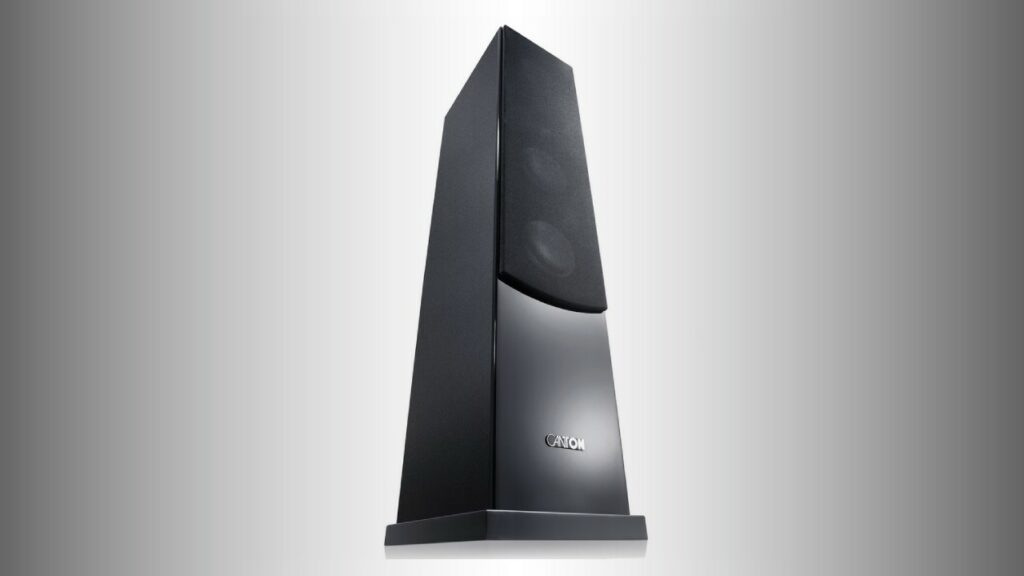
The Canton Ergo 690 belongs in this comparison as a potential speaker partner, not as an alternative AV receiver. It is a passive, bass-reflex, three-way floorstanding loudspeaker intended for front-channel use. It therefore needs one of the receivers above, or a separate amplifier and processor, to function in a system.
The published specification gives a recommended amplifier power of 170–320 watts, sensitivity of 88.3 dB and impedance of 4–8 ohms. Its stated frequency range is 20–40,000 Hz. The speaker uses a 25 mm aluminium/magnesium tweeter, a 180 mm aluminium midrange driver and two 180 mm aluminium bass drivers. Separate low- and high-frequency connections allow bi-wiring.
The source describes the Ergo series as a long-running design with a reputation for accurate, spatially resolved and dynamic reproduction. It also says the range is easy to match with amplifiers because of the crossover approach and impedance behaviour described by Canton. Those are useful reasons to consider the Ergo 690 with an AV receiver, but the article does not test it specifically with the Denon, Arcam, Block or Marantz. A precise receiver-speaker pairing claim would therefore go beyond the evidence.
As a practical matter, the Ergo 690’s 4–8 ohm impedance makes amplifier matching worth considering. The Arcam source provides explicit 4-ohm output figures, while the other receiver articles do not give equivalent speaker-load information. That does not prove that the Arcam is the only suitable match, but it makes the receiver’s published load information particularly relevant for buyers considering these floorstanders.
Why buy it: You need substantial passive front speakers for a stereo or home-cinema system and want a three-way floorstanding design with bi-wiring.
Limitation: It is not an AV receiver and does not provide amplification, processing, streaming or video switching.
How they differ
Integrated receiver versus processor: The Denon, Arcam and Block can power passive speakers directly. The Marantz AV7706 cannot. It is built around preamp outputs and external amplification, with the benefit of 11.2-channel processing and both RCA and XLR outputs.
Simple expansion versus advanced cinema: The Denon supports a practical path from two-channel listening to 5.1.2 Dolby Atmos. The Arcam and Marantz are designed for more ambitious processing configurations, including 7.1.4 when additional amplification is used. The Block’s source material focuses on Dolby Digital and DTS rather than the newer immersive formats listed for the Arcam and Marantz.
Physical media: Only the Block includes a Blu-ray drive, with DVD and CD playback too. None of the other receiver articles describes an integrated disc transport, so disc collectors should treat the Block as a fundamentally different kind of one-box solution.
Room correction: The Arcam includes full 16-channel Dirac Live calibration, while the Marantz uses Audyssey MultEQ XT32 with additional bass and volume-management functions. The Denon article does not specify an equivalent room-correction system, and the Block article does not mention automatic calibration.
Gaming and video: The Denon specifically highlights 1440p passthrough and AMD FreeSync. The Arcam lists seven HDMI 2.1 inputs, 8K upscaling and 4K/120 support, while the Marantz provides 8K/60/50 and 4K/120 pass-through alongside VRR, ALLM, QMS and QFT. The Block offers HDMI switching with ARC and CEC, but the source does not list the newer gaming and video specifications found in the other articles.
Streaming and networking: All three integrated receivers offer streaming in some form. Denon’s HEOS ecosystem is especially central to its design, Arcam uses Ethernet, AirPlay 2, Chromecast and MusicLife, and Block combines wireless networking with UPnP, Spotify, Deezer, radio and two-way Bluetooth. Marantz adds HEOS, AirPlay 2, Bluetooth and a broad list of streaming services, plus wired LAN and dual-band Wi-Fi.
Which one should you buy?
- Choose the Denon AVR-S980H for the best all-round system. It is the safest recommendation for a household that wants films, music, gaming, streaming and an upgrade route without starting with a complex installation. Its ability to begin with two speakers and grow to 5.1.2 is especially useful.
- Choose the Arcam AVR31 for advanced home cinema. Dirac Live, 16-channel processing, 8K HDMI 2.1, extensive control connections and the option of 7.1.4 operation with added amplification make it the specialist pick for a more ambitious room.
- Choose the Block CVR-200 AV if discs are central to your system. Its Blu-ray, DVD and CD transport, radio tuners, MM phono input and two-way Bluetooth make it the most complete one-box source component for physical-media users. It is also the only product here combining those features with seven amplifier channels.
- Choose the Marantz AV7706 if you are buying external amplifiers. Its 11.2-channel architecture, balanced outputs, Audyssey MultEQ XT32 and extensive HDMI connectivity are compelling in a separates system. Do not choose it as a standalone receiver for passive speakers.
- Choose the Canton Ergo 690 as a speaker option, not a receiver alternative. It is suited to buyers who need passive floorstanding front speakers and already have, or are selecting, the necessary amplification.
Final verdict
The Denon AVR-S980H is Best Overall because it offers the most convincing combination of accessible operation, built-in amplification, streaming, multiroom integration, gaming support and future Dolby Atmos expansion. The Arcam AVR31 is the stronger specialist choice for advanced processing and installation flexibility; the Block CVR-200 AV is the clear choice for an all-in-one disc-based system; and the Marantz AV7706 is the better foundation for a separates-based cinema with external amplifiers. The Canton Ergo 690 completes the picture as a substantial passive speaker option rather than an AV receiver.




Sound Off
0Join the discussion if you have something to add.