

Choosing between these five amplifiers is less about finding one universal specification winner and more about matching the hardware to the system you actually want to build. The Sonos Amp Multi, FiiO AIR AMP, PS Audio PMG Signature S400 and S200, Esoteric N-05XE and S-05XE, and Fosi Audio BT20A MAX cover almost every modern use case: multiroom audio, compact streaming hi-fi, high-end stereo amplification, Class A separates and small 2.1 systems.
That makes a direct comparison useful. Each product takes a different view of what an amplifier should be. Sonos prioritises scalable multi-zone installation, FiiO combines several source components in one compact chassis, PS Audio concentrates on dedicated stereo power, Esoteric builds a refined network source and Class A combination, and Fosi focuses on affordable-looking simplicity, wireless playback and subwoofer integration. The strongest all-round choice is the Sonos Amp Multi, but it is not automatically the best fit for every listener.
Quick verdict
- Best Overall: Sonos Amp Multi — the broadest combination of power, multi-zone flexibility, streaming convenience and installation features.
- Best compact all-in-one: FiiO AIR AMP — the most complete small-system hub, with network playback, local libraries, DAC functionality, EQ and headphone support.
- Best for high-power stereo: PS Audio PMG Signature S400 — the obvious choice here when a dedicated two-channel system needs 400 watts per channel into 4 ohms.
- Best for reference-style Class A separates: Esoteric N-05XE and S-05XE — a feature-rich network DAC/preamp paired with a 30-watt-per-channel Class A power amplifier.
- Best for a simple 2.1 system: Fosi Audio BT20A MAX — a small Bluetooth amplifier with a dedicated subwoofer output, selectable 80Hz high-pass filter and tone controls.
Comparison at a glance
| Product | Best suited to | Amplifier approach | Key system strength | Main limitation or consideration |
|---|---|---|---|---|
| Sonos Amp Multi | Large homes, multi-zone residential and light commercial installations | Eight-channel Class D | 125W per channel at 8 ohms; up to four independent zones | Designed primarily for scalable installations rather than a compact desktop system |
| FiiO AIR AMP | Desktops, shelves and small equipment racks | Class D using TI TPA3255 | Network playback, DAC, passive-speaker amplification and headphone use in one chassis | Full connector breakdown and protocol-by-protocol streaming list are not specified |
| PS Audio PMG Signature S400 | High-end two-channel systems needing substantial power | Dedicated stereo power amplifier | 400W per channel into 4 ohms | Requires a preamplifier or source with volume control |
| PS Audio PMG Signature S200 | High-end two-channel systems with lower power requirements | Dedicated stereo power amplifier | 200W per channel into 4 ohms | Like the S400, it is a power amplifier rather than a complete source and control hub |
| Esoteric N-05XE and S-05XE | Reference-quality digital playback and Class A stereo systems | 30W-per-channel Class A stereo power amplifier, with network DAC/preamp | Extensive digital platform and fully dual-mono S-05XE construction | The S-05XE prioritises Class A operation and system refinement over headline power |
| Fosi Audio BT20A MAX | Desktop or living-room passive speakers with a subwoofer | Class D using TI TPA3255 | 2.1 architecture, advanced Bluetooth and switchable 80Hz high-pass filter | Wireless and local analogue operation are central; it does not provide the networked multi-zone architecture of Sonos |
Sonos Amp Multi
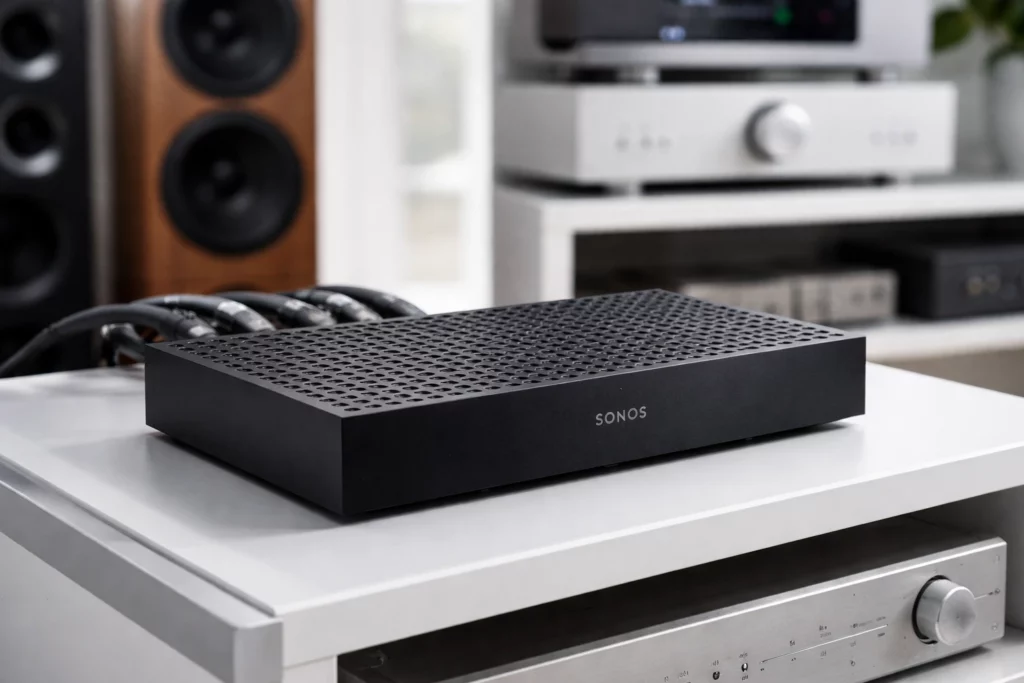
The Sonos Amp Multi is the strongest all-round choice because it addresses the widest range of system-level requirements without abandoning straightforward everyday operation. It is an eight-channel streaming amplifier rated at 125 watts per channel at 8 ohms, and those channels can be assigned across up to four independent zones. That architecture matters more than a simple power comparison: the unit can serve several rooms from one platform, with channels grouped, split or reassigned as an installation changes.
This is the clearest distinction between the Sonos and the other products here. The FiiO and Fosi are compact single-system solutions, while the PS Audio and Esoteric products are intended for serious two-channel setups. Sonos is built for a home or light commercial project that may contain several listening areas and may need to grow later. Multiple Amp Multi units can be stacked, allowing the system to scale without replacing its basic control approach.
The platform also combines installation flexibility with a familiar user experience. Listeners continue to use the Sonos app, supported streaming services and the existing Sonos multiroom logic. For integrators, Sonos adds ProTune tools for channel-level parametric EQ, level trimming, time alignment and zone width control. Dedicated DSP profiles for Sonos Architectural speakers add another layer of system tuning.
Hardware design reinforces that installation focus. The Amp Multi uses GaN-based Class D amplification with post-filter feedback, fanless convection cooling and a 1.5U chassis with recessed connectors and a flat rear panel. Optional rack-mount accessories are available. Connectivity includes wired Ethernet, Wi-Fi 6, Apple AirPlay 2 and Spotify Connect, while inputs comprise RCA analogue connections and a USB-C line input via an optional adapter. Subwoofer integration is available through RCA outputs or Sonos Sub, with configuration by zone.
Why does it win overall? No other product combines this level of multi-zone allocation, established app-based streaming, rack-friendly construction and installer-oriented DSP in the supplied comparison. It is not the natural choice for someone who wants a tiny desktop amplifier or a minimalist two-channel power stage. But as a complete, expandable amplifier platform, it is the most versatile option here.
FiiO AIR AMP
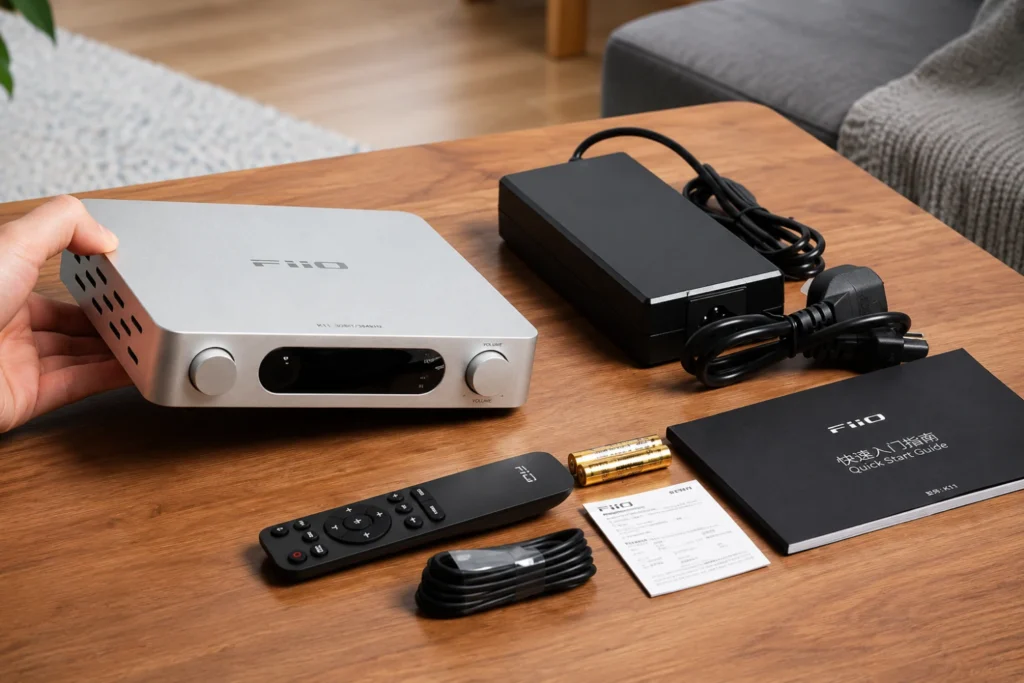
The FiiO AIR AMP is the better answer when the goal is a compact hi-fi system built around passive speakers rather than a whole-home installation. Its appeal is concentration: network playback, digital conversion and power amplification are combined in one metal chassis measuring 207 x 188 x 42mm. It is designed for desks, shelves and smaller equipment racks, where reducing boxes and interconnects is a genuine advantage.
FiiO describes the AIR AMP as a three-in-one component, but its role extends beyond a network amplifier. It can access music from USB storage, portable hard drives and network-attached storage, with library selection through the FIIO Control app. External sources can also be connected, and the unit supports headphones. The digital section uses an XMOS XU316 USB controller and ESS ES9020Q DAC.
Its amplification is based on the Texas Instruments TPA3255 Class D chip, with a rated 120 watts per channel into 4 ohms when used with the supplied 48V/5A power adapter. Post-filter feedback is intended to help stabilise performance with speakers having different impedance characteristics. The external power supply helps the main chassis retain its low-profile dimensions.
Control is unusually broad for a compact amplifier. The AIR AMP can be operated through the FIIO Control app, a web interface or the supplied infrared remote. Automatic EQ and a 10-band parametric equaliser are included, providing more system adjustment than the Fosi offers and a more integrated approach than either PS Audio power amplifier.
Its limitations are mostly about what the supplied information does not establish. FiiO states that the AIR AMP has seven inputs and three outputs, but does not provide the complete connector breakdown. It also mentions commonly used streaming protocols without listing compatibility protocol by protocol. That makes it harder to assess the unit against Sonos or Esoteric for a particular streaming ecosystem. Still, for a small system needing network and local playback, a built-in DAC, passive-speaker power and headphone facilities, the AIR AMP is the most complete compact alternative.
PS Audio PMG Signature S400 and S200
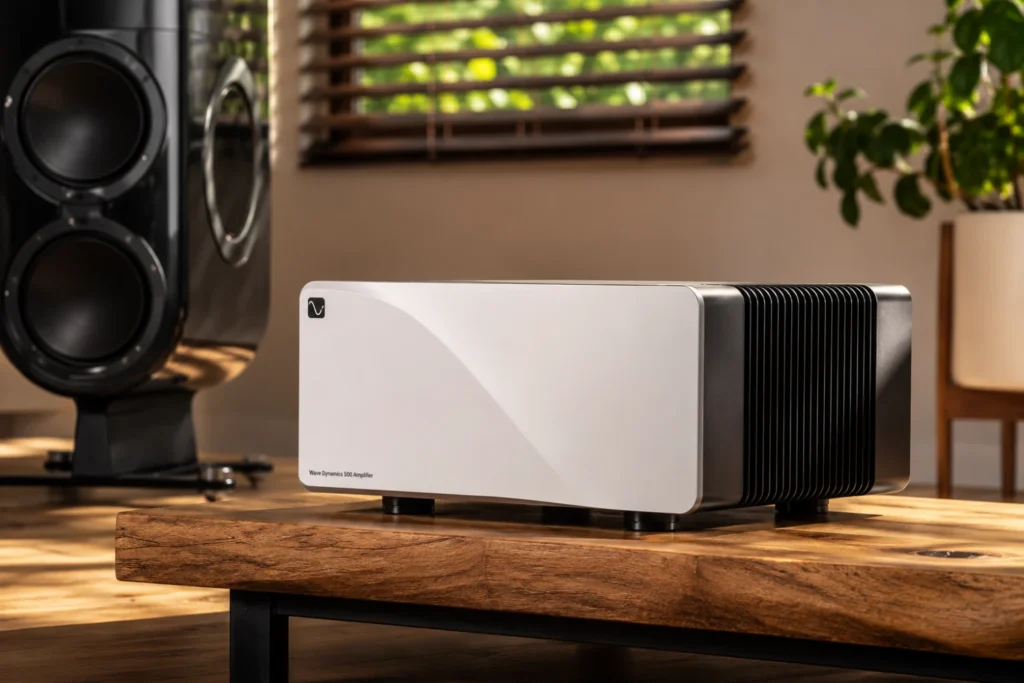
The PS Audio PMG Signature S400 and S200 take the opposite approach to the FiiO AIR AMP. They are dedicated stereo power amplifiers for high-end two-channel systems, not source components or complete streaming hubs. Both sit downstream of a preamplifier or another compatible source component with volume control, so they make sense when the rest of the system is already being built as separates.
The central choice between the two models is power. The PMG Signature S400 is rated at 400 watts per channel into 4 ohms, while the S200 delivers 200 watts per channel into the same load. PS Audio presents both as suitable for a broad range of loudspeakers, with the output difference allowing buyers to match the amplifier to their system requirements and room demands.
This makes the S400 the strongest alternative for listeners whose priority is dedicated stereo output capability. Its 400-watt rating is higher than the stated output figures of the Sonos Amp Multi and FiiO AIR AMP under their specified conditions, and it is in a different category from the 30-watt-per-channel Esoteric S-05XE. However, those numbers do not make it a better universal purchase: the S400 cannot replace a network player, DAC or preamplifier based on the supplied information.
The S200 offers the same basic design concept in a lower-output version. It is the more proportionate choice when a system does not call for the S400's stated power capability. Both amplifiers share an enclosure format and belong to the same PMG Signature family. PS Audio says the models are new designs rather than updates of existing amplifiers, and shipments of both had begun according to the supplied announcement.
Choose the S400 or S200 when the system's centre of gravity is a separate preamp and power amplifier arrangement. Between the two, select the S400 for the greater stated output into 4-ohm loads, and the S200 when 200 watts per channel is the more appropriate fit. Neither is a direct substitute for the Sonos, FiiO or Fosi because their system roles are fundamentally narrower.
Esoteric N-05XE and S-05XE
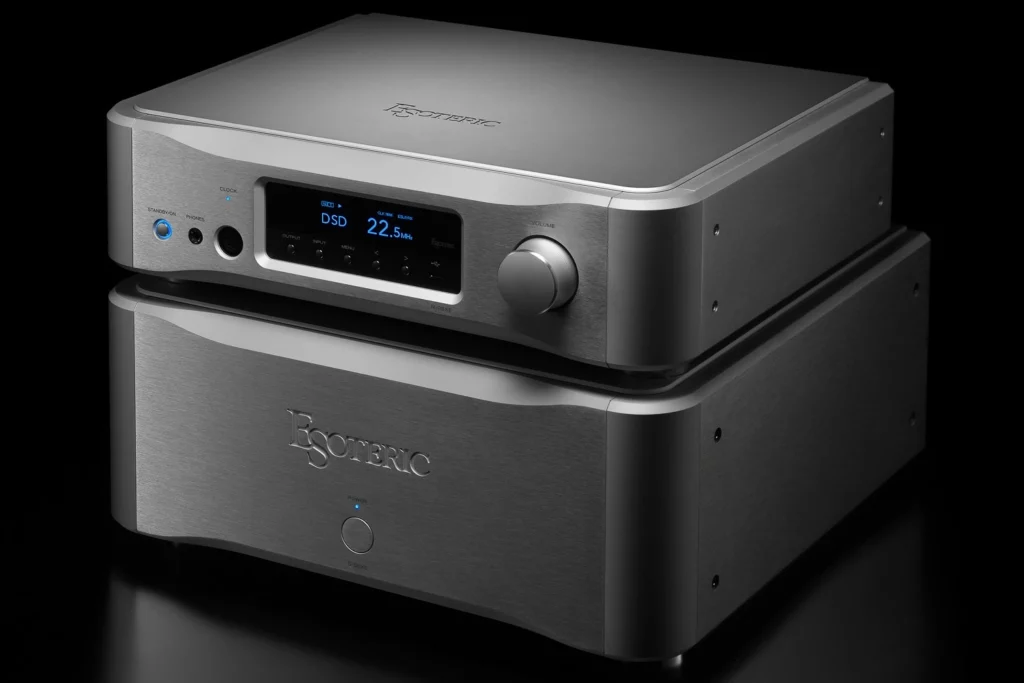
The Esoteric XE combination is the most ambitious two-box digital and amplification solution in this group. The N-05XE is simultaneously a network music player, DAC, balanced preamplifier and headphone amplifier. It is designed to pair with the S-05XE, a Class A stereo power amplifier rated at 30 watts per channel into 8 ohms.
The N-05XE is the most extensively specified digital component here. Its G4 network engine supports optical SFP connections, while the Master Sound Discrete DAC G2 uses an all-discrete FPGA architecture rather than standard DAC chips. The unit supports native DSD playback up to 22.5MHz, two directly connected USB drives, TIDAL Connect, Qobuz Connect, Spotify Connect, Roon and QQ Music. Bluetooth is included with LDAC, LHDC, aptX HD and AAC support.
Its analogue and headphone facilities also set it apart. The N-05XE uses independent left and right signal paths and power supplies, includes a balanced preamplifier stage and offers both 4-pin XLR and 6.35mm headphone outputs. The headphone amplifier is rated at up to 1.2 watts per channel into 32 ohms and supports headphone impedances from 6 to 600 ohms. An external 10MHz clock input and Esoteric's ES-Link analogue interface add further system options.
The S-05XE is not trying to win a power-output contest. Its 30 watts per channel into 8 ohms, fully dual-mono construction, independent power supplies and large custom-made toroidal transformer reflect a focus on Class A operation and channel independence. Bi-amp and BTL modes are supported. Esoteric also specifies vibration-control features including semi-floating top panels, rigid enclosures and Pinpoint isolation feet. Both components are manufactured in Tokyo and available in silver or black, with shipping expected globally in March 2026.
This is the specialist choice for listeners who want a carefully defined reference-style digital front end and Class A stereo amplifier in a two-component system. It is better equipped digitally than the PS Audio pair and more sophisticated as a headphone and preamplifier solution than the other separates. It is not the strongest all-round option because its amplifier output is modest and the system is oriented toward premium two-channel listening rather than multiroom flexibility.
Fosi Audio BT20A MAX
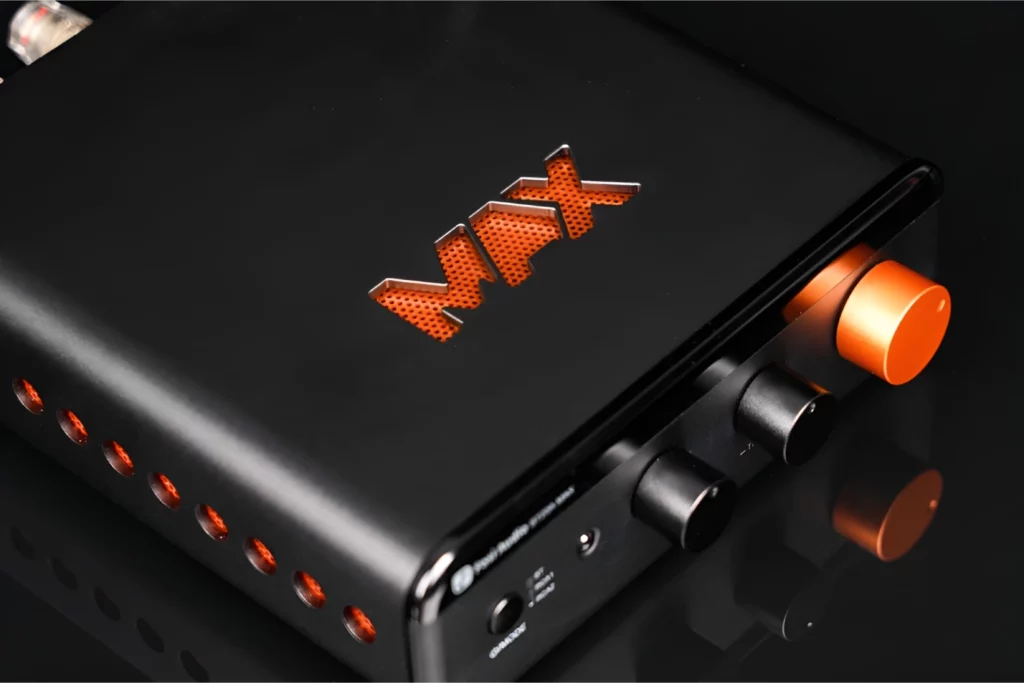
The Fosi Audio BT20A MAX is the most focused product in the comparison. It is a compact Class D amplifier built around a 2.1 system concept, intended to drive passive speakers while adding a subwoofer. That makes it particularly relevant to a desktop or living-room setup where simple controls, wireless playback and bass integration matter more than networked zones or a separate-component architecture.
Fosi quotes up to 300 watts per channel of peak power from the Texas Instruments TPA3255 platform. The amplifier has separate power supplies for its analogue and digital sections, and uses a feedback architecture intended to maintain consistent performance across different speaker loads. The source material does not provide a comparable continuous power rating under a specified impedance, so its quoted peak figure should not be treated as a direct like-for-like comparison with the Sonos, FiiO, PS Audio or Esoteric ratings.
The 2.1 facilities are the real reason to choose it. Alongside speaker terminals, the BT20A MAX includes a dedicated subwoofer output and a switchable high-pass filter set at 80Hz. Bass and treble controls are provided and can be bypassed for a purist signal path. This is more purpose-built for subwoofer use than the general-purpose compact amplifier alternatives in this comparison.
Connectivity is centred on two pairs of RCA inputs and Bluetooth via Qualcomm's QCC3095 platform. Supported Bluetooth formats include aptX, aptX HD, aptX Adaptive, aptX Lossless and LDAC. A motorised analogue volume control can be operated from the amplifier or the included remote, and a 12-volt trigger permits integration with automated or multi-component systems. Active cooling is used, with Fosi claiming that its newly developed fan remains quiet during long listening sessions.
The BT20A MAX is therefore the sensible pick for a listener who already knows the desired layout: passive speakers, a subwoofer and Bluetooth or analogue sources in a small system. It offers a clearer 2.1 proposition than the Sonos or FiiO, but it does not provide their networked multiroom or local-library architecture.
How they differ
System scale is the biggest dividing line. The Sonos Amp Multi is the only product here designed around multiple independent zones. Its eight channels can be allocated across up to four zones, and more units can be stacked as a project expands. None of the other products offers an equivalent architecture in the supplied material.
Source integration separates the compact products from the power amplifiers. The FiiO AIR AMP contains a network player, DAC and amplifier, and can access USB and NAS libraries. The Esoteric N-05XE goes further as a high-end network player, DAC, balanced preamplifier and headphone amplifier. The Fosi provides Bluetooth and analogue RCA inputs, but not the documented network and local-storage functions of FiiO or Esoteric. The PS Audio S400 and S200 are power stages only and need a compatible source or preamplifier.
Power figures must be read in context. Sonos is rated at 125W per channel at 8 ohms, FiiO at 120W per channel into 4 ohms with its specified adapter, PS Audio at either 400W or 200W per channel into 4 ohms, and Esoteric at 30W per channel into 8 ohms. Fosi quotes up to 300W per channel as peak power, without a matching continuous rating in the source. These are different rated conditions and amplifier roles, so a larger number alone does not establish the best product.
Installation priorities also vary. Sonos has fanless convection cooling, a 1.5U chassis, recessed connectors and optional rack-mount accessories. FiiO's 207 x 188 x 42mm metal chassis is the most obviously space-conscious networked option. Fosi is similarly aimed at small systems but adds active cooling and a 12-volt trigger. PS Audio and Esoteric are conventional premium stereo components, with the Esoteric pair adding dual-mono construction and vibration-control features.
DSP and adjustment are handled differently. Sonos provides installer-oriented channel-level tuning, including parametric EQ, level trimming, time alignment and zone width control. FiiO offers automatic EQ and a 10-band parametric equaliser. Fosi keeps adjustment simple with bass and treble controls plus an 80Hz high-pass filter. The supplied PS Audio information does not specify equivalent DSP features, while Esoteric's emphasis is on its analogue, digital and mechanical design rather than room-correction tools.
Which one should you buy?
- Buy the Sonos Amp Multi if you are building a multiroom system. It is the clear match for a large home, villa, multi-zone apartment, premium residential project or light commercial space. Its four-zone allocation, familiar Sonos control and installation tools make it the most adaptable platform here.
- Buy the FiiO AIR AMP if you want one compact box for a serious small system. It is the most convincing choice for a desk, shelf or small rack when network playback, local music storage, a DAC, passive-speaker amplification and headphone use all matter.
- Buy the PS Audio PMG Signature S400 if power is the priority in a separate two-channel system. Its stated 400W-per-channel output into 4 ohms makes it the high-output option. Choose the S200 instead when the 200W-per-channel version is the more suitable match for the system's requirements and room demands.
- Buy the Esoteric N-05XE and S-05XE if you want a premium digital front end with Class A amplification. The combination is aimed at listeners who value extensive network and digital support, balanced preamplification, headphone facilities and the S-05XE's dual-mono Class A design more than maximum power or multiroom convenience.
- Buy the Fosi Audio BT20A MAX if your target is a simple 2.1 setup. Its dedicated subwoofer output, switchable 80Hz high-pass filter, tone controls and broad Bluetooth codec support make it the most direct solution for compact passive speakers plus subwoofer.
Final verdict
Best Overall: Sonos Amp Multi. It is the most complete amplifier platform in this comparison, combining substantial stated output with eight-channel operation, four-zone flexibility, scalable installation, wired and wireless networking, familiar streaming control and useful integrator-level tuning. The FiiO AIR AMP is the better compact all-in-one, PS Audio is the better dedicated high-power stereo route, Esoteric is the more specialised Class A and digital reference combination, and Fosi is the sharper choice for a straightforward 2.1 system. But for the widest range of real-world systems, the Sonos Amp Multi is the strongest all-round purchase.


Sound Off
0Join the discussion if you have something to add.