
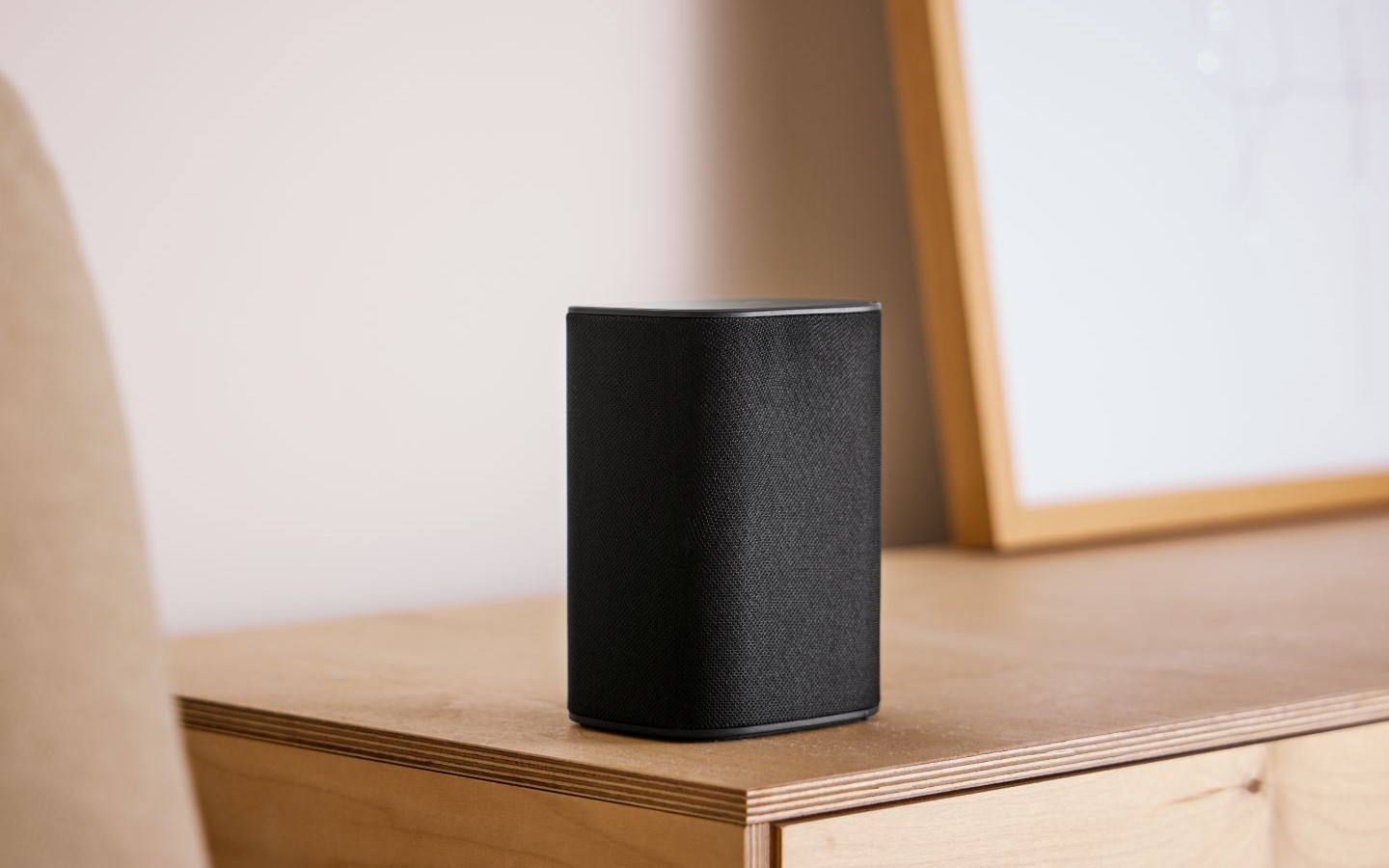
The Canton Smart Libero addresses a familiar home-audio challenge: adding speakers to a room without allowing the equipment or its cabling to dominate the space. Available in black or white, this compact wireless model is designed primarily to complement Canton Smart Soundbars, while also working with the Smart Connect 5.1 and Smart Amp 5.1. Its combination of restrained styling, wall-mounting capability and wireless audio-signal reception makes it an interesting expansion option for owners already invested in Canton's Smart ecosystem.
A speaker designed to blend into the room
The Smart Libero's most obvious design choice is its visual restraint. Rather than using exposed drivers, contrasting trim or decorative details, Canton has covered almost the entire enclosure in fabric. The result is a speaker intended to sit quietly within a living space instead of becoming a visual focal point.
That approach is especially relevant for soundbar-based systems. Soundbars are often chosen because they consolidate several functions into one relatively unobtrusive enclosure, so adding conspicuous supplementary speakers could undermine the original reason for selecting that format. The Libero follows the same domestic logic, offering compatible Canton users a compact speaker that can be integrated without introducing an entirely different design language.
The choice between black and white also supports practical room matching. Black may coordinate naturally with televisions, soundbars and darker furniture, while white can be less prominent against pale walls or shelving. Canton has not tried to turn the Libero into a decorative object; its appeal rests instead on being easy to accommodate visually.

Fabric surfaces balanced by practical glass panels
Although fabric defines most of the Smart Libero's appearance, Canton uses glass for the top and bottom surfaces. This adds a contrasting material without making the enclosure look ornate. More importantly, those smooth surfaces are easier to wipe clean than fabric, particularly in areas where dust is likely to settle.
This is a small but useful example of designing for long-term placement rather than showroom impact. A compact speaker may be positioned on furniture, a shelf or close to a wall, and accessible upper surfaces inevitably collect dust. Retaining fabric around most of the enclosure preserves the subdued look, while the glass panels make routine care more straightforward.
The fabric does not extend fully across the rear because the Smart Libero is designed to support wall mounting. That detail gives the enclosure a clear functional orientation rather than treating the back as another decorative surface. Canton does not specify mounting hardware in the supplied information, so owners would still need to select fixings appropriate for their particular wall construction.

Compact construction with wall-mounting flexibility
At 700 grams, the Smart Libero is notably light for a powered two-way speaker. Low weight can simplify placement and is particularly relevant when wall mounting, because it reduces the load that suitable anchors and the wall surface must support. Correct installation remains important, but the modest mass makes the speaker less demanding than a substantially heavier enclosure.
Wall mounting also helps preserve floor and furniture space. That can matter in rooms where a conventional speaker stand would obstruct a walkway or where shelves are already occupied. It also provides another way to keep the installation visually organized, especially when the speaker color is chosen to coordinate with the wall.
The product still requires access to mains power. There is no internal battery, which is consistent with its intended role as a fixed part of a home system rather than a portable wireless speaker. Prospective owners planning a wall installation should therefore consider the route and visibility of the power cable, even though a separate audio-signal cable is unnecessary.

A conventional two-way system inside
Behind the understated exterior is a two-way driver system comprising a 78mm cellulose-graphite midrange/woofer and a 25mm soft-dome tweeter. Dividing duties between two purpose-specific drivers is a conventional loudspeaker architecture, but it is significant in such a compact product because the Libero is not described as a single-driver wireless accessory.
The 78mm unit is responsible for the midrange and lower-frequency duties assigned to the speaker, while the 25mm soft dome handles the treble. Canton specifies a maximum system power of 70 watts. Without additional measurement conditions or performance data, that figure should not be used to predict volume capability or sound character, but it does establish the stated amplification parameter for the integrated system.
Because the Smart Libero receives its audio signal wirelessly, amplification and wireless reception are incorporated into the product concept. This reduces the amount of signal cabling required between the compatible Canton controller or soundbar and the speaker. It does not, however, make the installation cable-free: each speaker still needs electrical power.

Purpose-built for the Canton Smart ecosystem
The Smart Libero is not presented as a universal wireless speaker. Its documented compatibility is focused on all Canton Smart Soundbars, along with the Canton Smart Connect 5.1 and Smart Amp 5.1. That clearly defined system role is one of its most distinctive qualities, but it is also an important purchasing consideration.
For existing Canton Smart owners, dedicated compatibility can make the Libero a more coherent option than attempting to combine unrelated wireless products. The speaker has been designed as part of the same family, with matching wireless operation and an appearance intended to suit soundbar-centered installations.
The Smart Connect 5.1 and Smart Amp 5.1 compatibility also broadens its relevance beyond a single soundbar model. Owners using those Canton components can consider the Libero within their system planning without needing a physical signal cable to each speaker. The supplied information does not document compatibility with third-party wireless platforms, conventional Bluetooth sources or other multiroom ecosystems, so those capabilities should not be assumed.

Why wireless signal reception matters
Removing the signal cable can be especially helpful when a speaker is placed away from the main equipment position. In a conventional installation, an audio cable may need to run around skirting boards, beneath a rug or through a wall. Wireless reception reduces that particular requirement and can make it easier to preserve a tidy room.
The distinction between wireless audio and fully wireless operation is important. The Libero's fixed power requirement means placement still depends on access to a suitable outlet. A prospective owner should therefore plan the installation around both wireless communication with the compatible Canton component and practical power delivery.
For a wall-mounted arrangement, the power cable may be the main visible connection. For shelf or furniture placement, it may be easier to conceal behind nearby objects. Either way, the absence of a separate signal run provides more flexibility than a speaker requiring both power and wired audio connections.

Who the Canton Smart Libero is best suited to
The clearest audience is an owner of a compatible Canton Smart Soundbar, Smart Connect 5.1 or Smart Amp 5.1 who wants to expand the system with compact speakers designed for that ecosystem. It should also appeal to households that prioritize restrained styling, modest physical weight and the option of wall mounting.
The Smart Libero is particularly relevant where floorstanding speakers, stands or long signal-cable runs would be inconvenient. Its black and white finishes, near-complete fabric covering and compact form are all oriented toward living rooms and shared spaces where audio equipment needs to coexist discreetly with furniture and décor.
It is less suitable for someone seeking a battery-powered portable speaker, since it requires mains power. Nor should it be treated as a general-purpose wireless model without first confirming system compatibility. Buyers outside the Canton Smart platform may not benefit from its central design advantage: direct wireless integration with the named Canton components. Anyone planning a wall installation should also account for outlet locations and appropriate wall fixings before choosing a position.
Conclusion
The Canton Smart Libero is defined by focused integration rather than broad, stand-alone functionality. Its strongest documented qualities are its compact 700-gram construction, wall-mounting option, wireless audio-signal reception, two-way driver arrangement and discreet fabric-led design with easy-to-clean glass surfaces. For owners of compatible Canton Smart Soundbars, the Smart Connect 5.1 or the Smart Amp 5.1, it offers a visually restrained way to add speakers while avoiding separate signal-cable runs. Its need for mains power and its ecosystem-specific role require some installation planning, but for the intended Canton user, those trade-offs support a tidy and coherent fixed-room system.


Sound Off
0Join the discussion if you have something to add.