
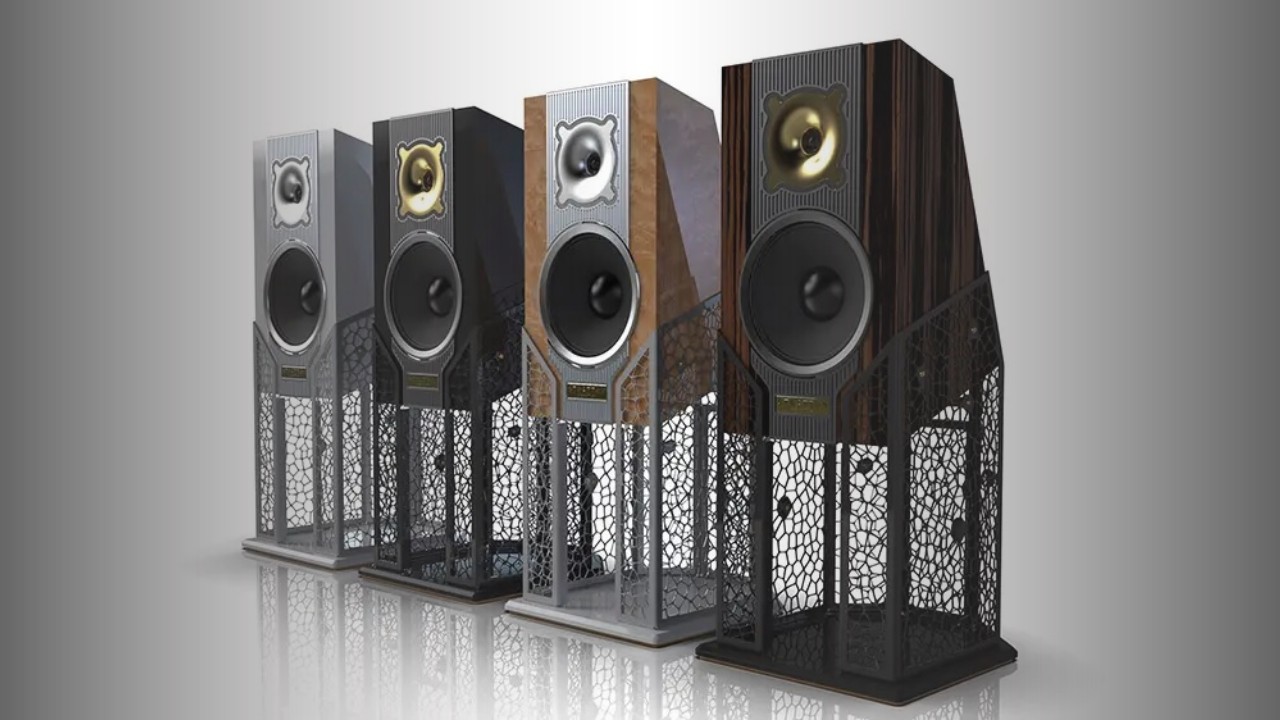
The Stratton Acoustics Element 12 is a loudspeaker shaped by an interesting compromise: it is intended to offer some of the physical presence and dynamic priorities associated with the British company’s larger work, but in a cabinet that is easier to accommodate. This is not a conventional compact monitor. Its two-way design uses a 12-inch paper-cone woofer, a 29mm soft-dome tweeter and an integral custom stand, giving the complete speaker the floor space and installed format of a floorstander. Designed by Stratton founder David Fowler and electro-acoustic engineer Phil Ward, the Element 12 also reflects the company’s emphasis on British handcrafting, substantial materials and visually expressive construction. At $38,000 per pair, it occupies a specialist part of the market where engineering choices, finish and artisanal production are central to the proposition.
A 12-inch woofer defines the concept
The Element 12 takes its name from its 12-inch paper-cone woofer. That is an unusually large bass driver for a modern two-way loudspeaker of relatively manageable cabinet height, and it gives the product a clear identity. Rather than dividing the lower and middle frequencies among multiple smaller drivers, Stratton has built the design around one large unit equipped with dual voice coils and a neodymium-iron-boron, or NeFeB, magnet.
For a prospective owner, the significance lies in the simplicity and scale of the arrangement. A two-way architecture limits the number of drive-unit sections that must be integrated, while the large woofer is consistent with Stratton’s stated focus on dynamics, rhythm and musical involvement. Those are manufacturer objectives rather than independent listening findings, but they explain why the company selected a large-format driver instead of following the more common slim-tower template.
The cabinet is bass-reflex loaded, with two ports positioned on its underside. Concealing the ports preserves the clean appearance of the visible cabinet surfaces and makes the reflex system less visually intrusive. Stratton specifies low-frequency extension to 38Hz, giving buyers a useful indication of the intended bandwidth without suggesting that this is a full-range design under every room and installation condition.
High sensitivity broadens amplifier options
Stratton specifies the Element 12’s sensitivity at 94dB. This is a notable figure because higher sensitivity generally means that less amplifier power is required to reach a given playback level. The company specifically identifies compatibility with smaller amplifiers, including tube designs, as one of the practical benefits.
That does not by itself establish how demanding the speaker’s electrical load may be, since no impedance specification is provided in the available information. Amplifier matching should therefore consider more than sensitivity alone. Even so, the stated 94dB figure gives the Element 12 a potentially wider role than many premium speakers designed around high-powered solid-state amplification. It may appeal to listeners who already own a lower-output amplifier or who want the freedom to consider one without automatically ruling out a physically substantial loudspeaker.
This flexibility is especially relevant at the Element 12’s price. A specialist speaker should support a coherent system rather than force an owner into a single amplification philosophy, and the high-sensitivity design at least creates scope for exploring a broader selection of amplifiers.
A familiar tweeter in an isolated assembly
High frequencies are handled by a 29mm soft-dome tweeter using a NeFeB magnet motor. The tweeter is shared with Stratton’s larger Elypsis 1512, creating a direct technical link between the company’s first loudspeaker and the smaller Element 12.
More distinctive than the dome itself is its installation. Stratton places the tweeter in a patented mechanically isolated construction. The purpose of mechanical isolation is to reduce the transfer of unwanted cabinet and bass-driver energy into the high-frequency assembly. In a speaker built around a large 12-inch woofer, separating the tweeter mechanically is a logical design priority.
The use of a soft dome also keeps the configuration recognizable and relatively straightforward despite the Element 12’s unusual proportions. The speaker does not depend on a complex multidriver array to make its case. Instead, its technical character comes from the scale of the woofer, the isolated tweeter mounting, the reinforced enclosure and the relationship between the cabinet and stand.
Bamboo cabinetry with concealed reinforcement
The internally reinforced cabinet is formed from bamboo panels measuring 26mm and 46mm in thickness. These are substantial dimensions, and the decision to use different panel thicknesses indicates that the enclosure is more than a decorative shell. Cabinet rigidity and internal reinforcement matter because a loudspeaker enclosure must provide a stable structure for the drive units while managing the mechanical energy generated during operation.
Bamboo also gives the Element 12 a material identity distinct from standard painted fiberboard construction. Stratton describes the speaker as precision designed and handcrafted in Britain by specialist technicians. That small-scale manufacturing approach is an important part of the product’s market position, particularly for buyers who value visible craftsmanship and less industrialized production.
Four high-gloss mirror finishes are specified: Piano White with Silver, Piano Black with Black and Gold, Maple with Silver, and Ziricote with Black and Gold. These combinations allow the owner to choose between relatively restrained monochrome treatments and more decorative wood-patterned or metallic presentations. With a speaker this visually assertive, finish choice will be an important part of matching it to a room.
The stand is part of the loudspeaker’s architecture
Although the Element 12 has a smaller cabinet than the Elypsis 1512, it should not be mistaken for a bookshelf speaker. Its integral custom-made stand turns it into a complete floorstanding installation, and Stratton notes that the overall footprint is comparable to that of a floorstander.
The stand is made from 3mm-thick powder-coated steel structural panels based on Voronoi geometry. This geometric approach creates an open, patterned support rather than a conventional solid pedestal. It is both a structural and visual element, giving the speaker an architectural appearance while preventing the cabinet from looking like a simple rectangular box placed on an unrelated accessory.
At the bottom, the stand incorporates a high-gloss bamboo layer and a base made from natural cork. These materials visually connect the support to the bamboo cabinet while creating a defined interface with the floor. Just as importantly, the stand removes uncertainty over stand selection. Owners do not need to find a third-party support of the correct height, footprint and load capacity, because the loudspeaker and stand have been conceived as one system.
Placement, ownership and system context
The downward-facing reflex ports help maintain a clean exterior, but the Element 12 still requires the kind of planning expected of a substantial loudspeaker. Its complete installation occupies floor space comparable to a floorstander, and the 12-inch woofer, broad front profile and sculptural stand will give it a strong presence in the room. It is more easily accommodated than Stratton’s larger model, but it is not intended to disappear physically like a small stand-mount monitor.
The integrated stand may simplify setup decisions, while the high sensitivity may make amplifier selection less restrictive in terms of power output. Prospective owners should nevertheless consider room dimensions, listening distance and amplifier compatibility as a complete system. The supplied specifications do not remove the need for careful placement or an appropriate electrical match.
The $38,000-per-pair price places the Element 12 firmly in the premium, low-volume loudspeaker market. Its appeal therefore rests not only on specifications but also on its British manufacture, substantial bamboo construction, specialized tweeter mounting, custom steel support and choice of elaborate finishes.

Who is the Element 12 for?
The Element 12 is most suitable for listeners who want the visual and engineering character of a large-driver loudspeaker without moving to Stratton’s larger cabinet format. It should be particularly relevant to owners interested in high-sensitivity speakers, including those considering lower-powered or tube amplification, provided that the amplifier is also suitable for the speaker’s full electrical requirements.
It also suits buyers who regard a loudspeaker as a significant piece of furniture and industrial design. The mirror finishes, bamboo cabinet, exposed geometric stand and metallic detailing are intentionally prominent. Someone seeking a narrow, visually discreet tower may find the Element 12 less appropriate, even though its cabinet is described as easier to accommodate than the Elypsis 1512.
Finally, the speaker is aimed at buyers comfortable with an artisanal product at a premium price. Its strengths are concentrated in distinctive construction, a relatively simple two-way format, a large woofer and an integrated visual concept rather than broad lifestyle connectivity or concealed installation. No wireless, active amplification or room-correction facilities are documented, so the Element 12 belongs in a conventional component hi-fi system.
Conclusion
The Stratton Acoustics Element 12 stands out through a coherent set of documented design decisions: a 12-inch paper-cone woofer, a mechanically isolated 29mm soft-dome tweeter, 94dB specified sensitivity, reinforced bamboo cabinetry and a custom steel stand that forms part of the speaker’s architecture. Its downward-firing reflex ports and integrated support keep the presentation visually organized, while four high-gloss finishes offer meaningful aesthetic choice. This is not a compact monitor despite its smaller cabinet, nor is it intended for buyers seeking an unobtrusive or inexpensive loudspeaker. It is best suited to listeners who value large-driver engineering, potential compatibility with modest-power amplification, British artisanal construction and a bold physical presence in a premium component system.

Sound Off
0Join the discussion if you have something to add.