

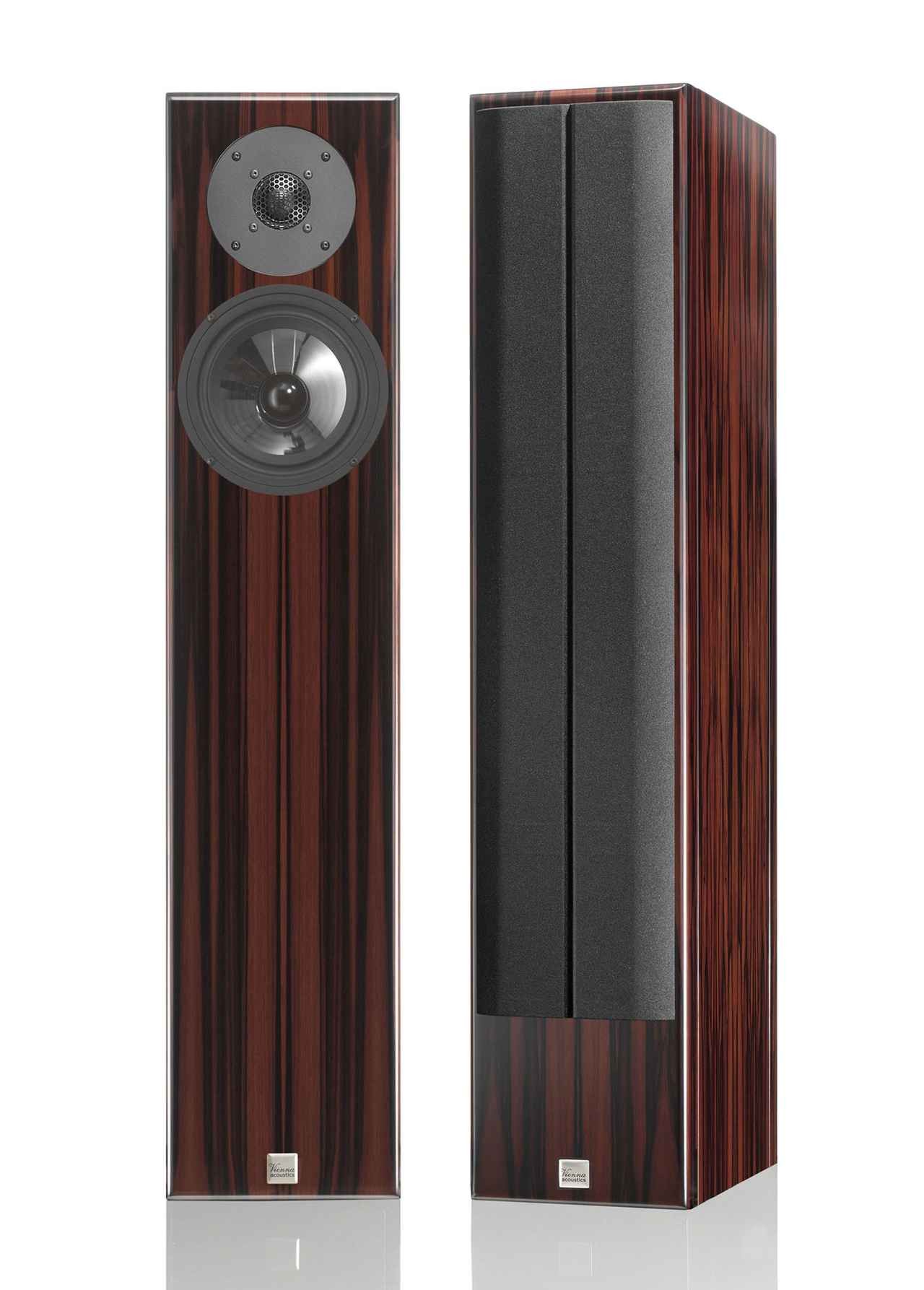
The BACH Ultimate is a commemorative loudspeaker with a deliberately focused specification. Rather than pursuing a large multi-driver format, Vienna Acoustics has built this limited edition around one 178mm XPP woofer, a 28mm silk-dome tweeter and a bass-reflex enclosure. Its $75,000 price places it firmly in the luxury end of the loudspeaker market, where materials, finish, exclusivity and long-term ownership appeal matter alongside engineering. The result is a relatively slender floorstanding design intended for listeners who want a visually refined speaker without the physical scale of a large reference system.
A compact two-way architecture
The BACH Ultimate is a two-way, two-driver floorstanding loudspeaker. That configuration gives each cabinet a straightforward division of labor: the 178mm woofer handles bass and midrange information, while the 28mm tweeter covers the upper frequencies. Although simple on paper, this format places substantial demands on the main driver because it must operate across a broad part of the audible range before handing over to the tweeter.
Vienna Acoustics’ choice of a single relatively large woofer is therefore central to the product. It allows the front baffle to remain narrow while giving the speaker more radiating area than a smaller mid-bass unit could provide. The cabinet measures 188mm wide, 911mm high and 264mm deep, including its spikes, making it notably slim and less visually dominant than many high-priced floorstanders. Its proportions could be useful in rooms where a full-height loudspeaker is desired but a broad enclosure would feel intrusive.
The distinctive XPP woofer
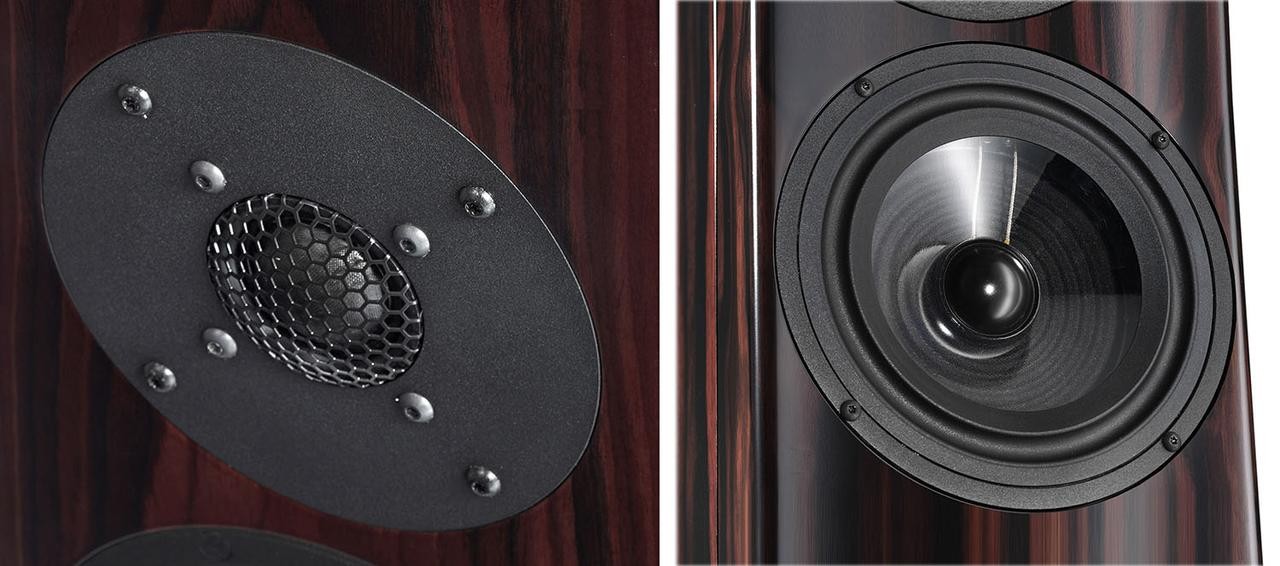
The 7-inch XPP cone is the BACH Ultimate’s principal technical feature. Its material combines Vienna Acoustics’ proprietary TPX thermoplastic resin with three varieties of polypropylene-based synthetic resin. The purpose of this composite formulation is to balance rigidity and stability with control of internal vibration. Those properties are especially relevant in a driver expected to reproduce both midrange and low-frequency information.
A cone needs sufficient stiffness to maintain its intended shape as it moves, but unwanted vibration within the material can add resonant behavior. Vienna Acoustics’ material strategy addresses those competing requirements rather than relying on a conventional single-formula polypropylene cone. The company also cites the material’s broad usable bandwidth as an important benefit, which makes sense in the context of a two-way speaker: the wider the woofer can operate cleanly, the more flexibility the designer has when integrating it with the tweeter.
The woofer uses a reverse rubber surround designed to reduce resonance around the cone’s outer edge. The surround is essential because it permits controlled movement, yet its geometry and behavior can also influence the driver near the perimeter. Vienna Acoustics’ reversed arrangement is intended to suppress unwanted edge effects and support the cone across its operating range. For a prospective owner, the significance lies less in the unusual appearance of the surround than in how closely the driver’s material, diameter and suspension have been developed as a complete system.
A silk-dome tweeter with a traditional foundation
High frequencies are handled by a hand-coated 28mm silk-dome tweeter. Soft-dome tweeters are a familiar loudspeaker technology, but the hand-applied coating gives Vienna Acoustics a means of controlling the dome’s physical behavior. The stated aim is to preserve fine high-frequency information while allowing a coherent transition from the XPP mid-bass driver.
That integration is particularly important in a two-way design. The woofer and tweeter must overlap successfully around the crossover region, where differences in dispersion, moving mass and diaphragm construction can become apparent. The broad bandwidth claimed for the XPP driver and the use of a coated textile dome suggest that Vienna Acoustics has prioritized a complementary driver pairing rather than novelty for its own sake. No crossover frequency or crossover topology is specified, so judgments about the exact implementation should be reserved, but the documented driver choices reveal a clear emphasis on controlled behavior and continuity.
Bass-reflex loading and practical system demands
The enclosure uses bass-reflex loading, and the specified frequency response extends from 35Hz to 20kHz. That lower figure is notable for a cabinet only 188mm wide and equipped with a single woofer. As always, actual in-room bass behavior will depend on placement, room dimensions and interaction with nearby boundaries, but the specification indicates that the BACH Ultimate is designed as a full-range floorstander rather than a stand-mounted speaker in a taller cabinet.
Sensitivity is specified at 90dB for 2.83V at one meter, while rated impedance is 4 ohms. The sensitivity figure suggests that exceptionally low efficiency is not part of the design, but the 4-ohm rating still makes amplifier compatibility an important consideration. A prospective owner should look for amplification designed to operate comfortably into a 4-ohm loudspeaker load. The supplied information does not include minimum impedance, recommended amplifier power or impedance phase, so these would be sensible details to confirm when planning a system.
Each speaker weighs 18kg. That is substantial enough to require care during unpacking and positioning, but it remains manageable compared with many larger luxury floorstanders. Spikes are included in the stated dimensions, indicating that the cabinet is intended to be mechanically supported as a conventional floorstanding design. Owners should still consider floor protection and final positioning before installation.
Furniture-grade rosewood presentation
The enclosure is finished in selected premium rosewood veneer and constructed to what Vienna Acoustics describes as furniture-grade standards. That treatment is particularly relevant at this price because the loudspeakers will function as prominent objects within a room even when the system is not playing. The narrow baffle and restrained two-driver layout keep the visual design uncomplicated, allowing the veneer and cabinet proportions to carry much of the aesthetic character.
Natural veneer can also give individual cabinets subtle variations in grain, reinforcing the sense that the BACH Ultimate is intended as a carefully finished object rather than an anonymous equipment enclosure. Its limited-edition status and connection to the original Bach model add a collectible dimension, although the supplied details do not state the production quantity. Buyers interested in exclusivity should therefore distinguish between the confirmed limited-edition designation and any assumptions about how many pairs will be made.
Who the BACH Ultimate is for
The BACH Ultimate is most suitable for an owner seeking a compact luxury floorstander with a distinctive material story and a traditional, highly finished exterior. Its narrow cabinet may appeal to listeners who do not want a physically imposing multi-woofer tower, while its 35Hz lower-frequency specification reduces the immediate assumption that a subwoofer must be part of every installation. The 90dB sensitivity also gives system builders some latitude, provided the selected amplifier is appropriate for a 4-ohm load.
It is less obviously suited to buyers who prioritize maximum driver count, very deep sub-bass specifications, extensive published technical data or value measured primarily by size. At $75,000, this is a specialist purchase whose appeal depends on more than the basic two-way specification. The limited-edition positioning, proprietary XPP woofer, hand-coated tweeter and rosewood cabinet are integral to its identity. Prospective owners should also account for room setup and suitable amplification, particularly because the available specifications do not disclose port orientation, minimum impedance or recommended power.
Conclusion
The Vienna Acoustics BACH Ultimate draws its strongest identity from disciplined design choices rather than complexity. Its proprietary 178mm XPP woofer combines several resin materials and a reverse rubber surround, while a hand-coated 28mm silk dome handles the upper frequencies. Bass-reflex loading, a specified 35Hz–20kHz response and 90dB sensitivity give the slim two-way floorstander a practical foundation, subject to pairing it with an amplifier comfortable driving 4 ohms. Premium rosewood veneer, furniture-grade construction and limited-edition status complete a product aimed at collectors and music-system owners who value compact proportions, specialized driver engineering and fine cabinet work as much as specification-sheet scale.


Sound Off
0Join the discussion if you have something to add.