

At just under $1,800, the Topping D900 represents a significant step beyond the company’s more familiar compact DAC designs. Its central attraction is a proprietary discrete 1-bit conversion architecture called Precision Stream Reconstruction Matrix, or PSRM, but the product’s broader appeal comes from how that technology has been integrated into a practical digital control center. Alongside its extensive input selection, the D900 provides separate fixed and variable balanced outputs, an active analog preamplifier stage, wireless playback and a 10-band parametric equalizer. The result is a component intended to serve equally well as a conventional source connected to an existing amplifier or as the control point in a streamlined digital-only system.
A proprietary approach to digital conversion
Rather than building the D900 around an off-the-shelf converter from ESS, AKM or Burr-Brown, Topping developed its own conversion algorithms and hardware. PSRM processes incoming audio through a 1-bit architecture that uses time-domain density modulation, applying the approach to both PCM and DSD material.
This distinguishes the D900 from several other established DAC categories. It is not an R2R ladder design, in which networks of precision resistors convert digital values into voltages, and it is not simply a conventional delta-sigma DAC based on a standard commercial chip. Topping also says PSRM uses discrete logic components operating at nanosecond speeds rather than relying on the FPGA implementation associated with some custom digital platforms.
For a prospective owner, the importance of PSRM is not that 1-bit conversion is automatically superior to every alternative. Its significance is that the D900 is designed as a complete conversion platform rather than as an enclosure built around a familiar DAC chip. Topping has also developed a matching current-to-voltage stage, combining low-distortion operational amplifiers with discrete components to turn the PSRM output into a usable line-level signal. That system-level engineering is one of the D900’s most distinctive documented qualities.
Connectivity for a wide range of digital systems
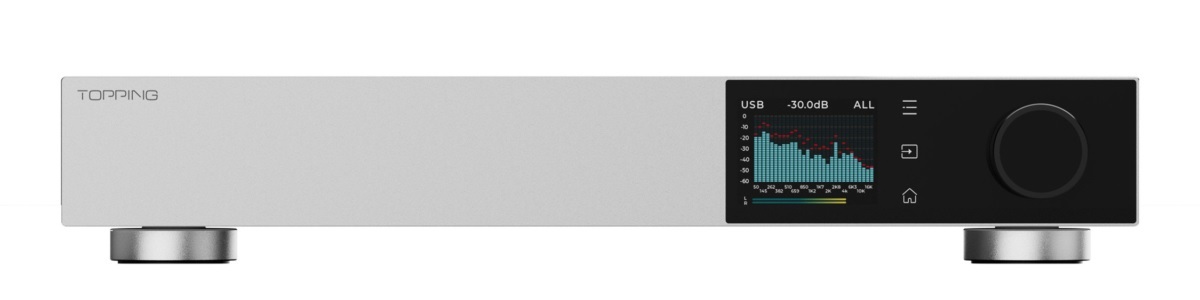
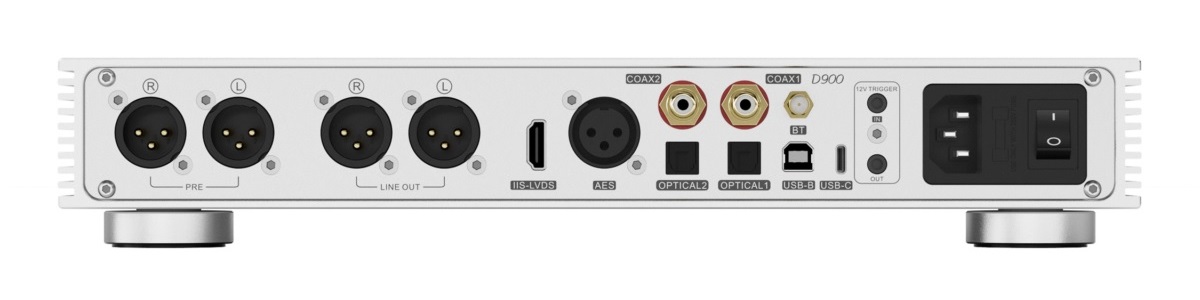
The D900 accommodates modern computers, dedicated transports and more traditional digital sources. Its wired input panel includes USB-B, USB-C, two optical S/PDIF connections, coaxial S/PDIF, AES/EBU and an HDMI-format connection carrying I2S in LVDS form. The latter should be understood as an I2S interface rather than a conventional television-oriented HDMI input.
USB and I2S support PCM data up to 32-bit/768 kHz and native DSD512. The optical, coaxial and AES/EBU inputs accept PCM up to 24-bit/192 kHz, as well as DSD64 through DoP. These capabilities allow the D900 to work with anything from a laptop or desktop computer to a CD transport, network bridge or another suitably equipped digital source.
Bluetooth 5.1 adds a more casual wireless option. Codec support includes LDAC, aptX Adaptive, aptX HD, aptX, AAC and SBC. Bluetooth is unlikely to replace the wired interfaces for every owner, but it makes the DAC easier to share with visitors and convenient for listening directly from phones, tablets and other portable devices.
Two balanced output paths for different system roles
Topping has equipped the D900 with two pairs of balanced XLR outputs using Neutrik connectors. One pair operates at a fixed line level, making it suitable for an integrated amplifier or a separate preamplifier. The second pair follows the D900’s volume control and can feed a power amplifier or active loudspeakers directly.
This separation is useful because owners do not have to treat the D900 as a single-purpose component. It can be inserted into a conventional system without duplicating volume controls, then reassigned to direct-amplifier duty if the system architecture changes. The variable outputs also create the possibility of a compact digital system built from the D900 and a pair of active speakers.
There are, however, two important limitations. The D900 has no RCA outputs, so systems based exclusively on unbalanced connections may require appropriate adapters. It also has no analog inputs. Although it can perform preamplifier duties for its digital sources, anyone using a turntable, tuner or other analog component will need a separate preamplifier or another method of analog source control.

An analog volume stage rather than simple digital attenuation
The variable output is supported by a discrete active analog preamplifier stage rather than a basic digital volume function or passive potentiometer. Its relay-switched control employs 18 relays, nine for each channel, and adjusts level in 0.5 dB increments.
Topping designed the stage with its own power-supply control and a consistent output impedance across the volume range. This matters when the D900 is connected directly to a power amplifier or active speakers, because it is intended to provide the impedance matching and signal control expected from a dedicated preamplifier. It also avoids adding a separate control component and another set of interconnects to a digital-only installation.
The fixed and variable XLR pairs consequently reflect more than connection convenience. They allow the D900 to address two distinct ownership models: listeners who already have an amplifier with satisfactory volume control, and those who want their DAC to become the central controller for digital playback.
Parametric EQ adds practical system flexibility
A 10-band parametric equalizer is one of the D900’s most useful features. Each band can be configured by center frequency, Q or bandwidth, and gain, offering considerably more precision than simple bass and treble controls.
Profiles are created through the free Topping Tune application for Windows and macOS. Multiple configurations can then be saved to the DAC’s internal memory and selected from its front panel without leaving a computer connected. This arrangement makes the feature relevant to permanent hi-fi installations rather than restricting EQ to desktop playback software.
Parametric EQ can be used for carefully targeted tonal adjustments, compensation for known loudspeaker or room behavior, or separate profiles for different listening requirements. The supplied information does not position the D900 as an automatic room-correction system, so setup remains in the user’s hands. Nevertheless, onboard profile storage makes the equalizer a meaningful tool for owners prepared to configure it.

A full-width chassis with considered controls
The D900 measures 330 x 57 x 210 millimeters and uses three-millimeter-thick aluminum chassis panels with an eight-millimeter front panel. Cooling fins run along both sides, while the feet are designed to absorb vibration. Its relatively wide, low-profile form should integrate more naturally with conventional hi-fi components than Topping’s smaller desktop products.
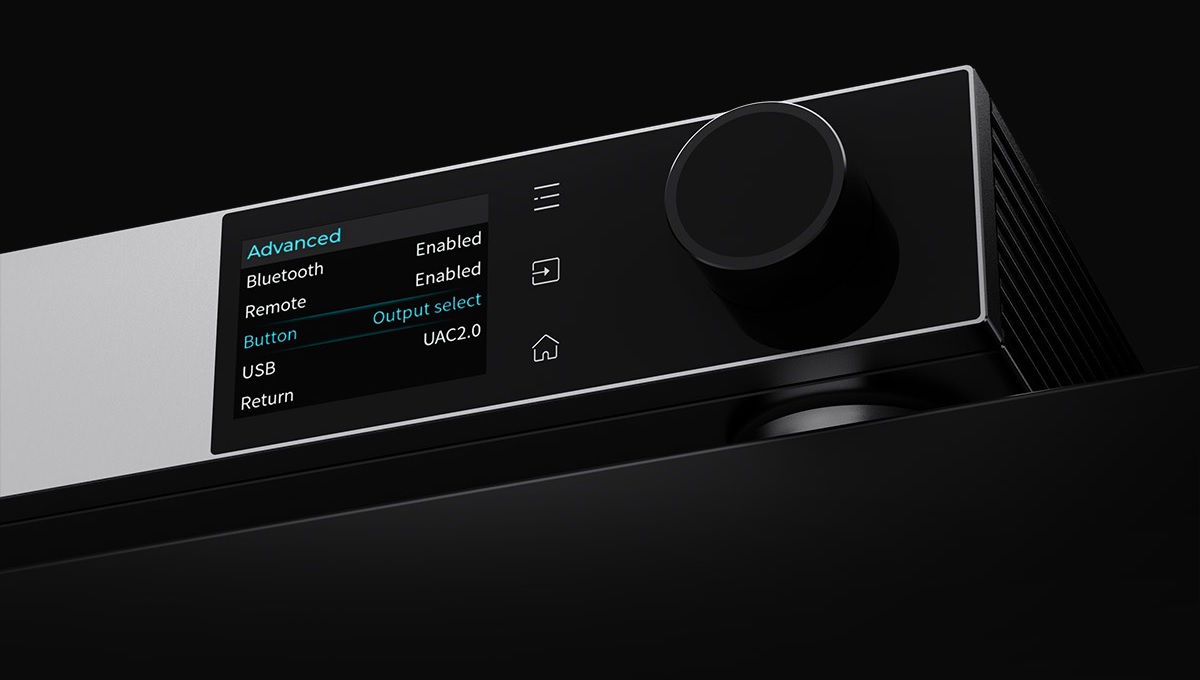
A two-inch color screen occupies the right side of the front panel and runs the company’s Aurora interface, with nine selectable color schemes. It can display sample rate and bit depth, a real-time spectrum analyzer or VU meters. Touch-sensitive controls flank a programmable rotary knob, which operates as the volume control by default but can be assigned to other functions.
The supplied remote is milled from a single block of aluminum rather than made from plastic with a metallic coating. That does not alter the D900’s technical capabilities, but it is a relevant usability and construction detail for a component likely to be operated from across a listening room.

Clock management and supporting circuitry
Digital timing is managed through a complex programmable logic device, or CPLD, used for clock optimization and jitter suppression. Topping’s stated rationale is that a CPLD’s internal architecture provides predictable timing for time-critical audio processing.
Topping claims total harmonic distortion of -140 dB and a signal-to-noise ratio of 131 dB. These are manufacturer figures rather than independent Stereoindex measurements, and exceptionally low published noise and distortion numbers have become increasingly common among modern DACs. Even so, the specifications show that PSRM is being presented alongside a low-noise analog implementation rather than as an isolated conversion concept.
Conclusion
The Topping D900 is best suited to listeners building a predominantly or entirely digital system who value balanced connectivity, detailed volume adjustment and configurable EQ. Its strongest documented qualities are the proprietary discrete 1-bit PSRM architecture, the choice of fixed or preamplifier-controlled XLR outputs, wide-ranging digital input support, Bluetooth codec selection and locally stored parametric EQ profiles. It is less naturally matched to systems that depend on RCA connections or analog sources, and its HDMI-format port is intended for I2S rather than ordinary television audio. For owners whose equipment aligns with those boundaries, the D900 offers an unusually integrated combination of custom conversion technology, digital-source flexibility and practical preamplifier control in a substantial aluminum chassis.