A good DAC is rarely just a format checklist.
The most convincing digital front ends combine conversion architecture, input flexibility, clocking, power supply design and analogue output stages in a way that suits a real system.
This selection brings together DACs and DAC-equipped devices that stood out in the supplied source material for clearly defined reasons, from uncompromising high-end engineering to compact portable practicality.

1. Esoteric D-05X: Uncompromising digital-to-analogue converter
Esoteric D-05X digital-to-analogue converter with proprietary ES-LINK connectivity and an advanced multi-DAC architecture.
The Esoteric D-05X is presented as a serious standalone DAC that draws on the philosophy of Esoteric’s Grandioso D1 while updating the earlier D-05 platform.
Its architecture is built around a powerful dual-mono-style power supply arrangement with two large toroidal transformers for the left and right channels, high-capacity capacitors and an enlarged DAC circuit using four differential subcircuits per channel.
The source also highlights proprietary ES-LINK4 digital transmission, 34-bit digital-to-analogue conversion, ESOTERIC-HCLD output buffer circuitry and ES-LINK analogue transmission. With eight AK4497 DAC chips and support for DSD 22.5 MHz, it is the most explicitly high-end, system-focused converter in this group.
Best for: Ambitious high-end digital systems
- Power supply uses separate large toroidal transformers for left and right channels
- Eight AK4497 DAC chips in a 4+4 configuration
- 34-bit digital-to-analogue conversion for PCM signals
- Supports DSD 22.5 MHz
Verdict: The D-05X is the choice here for listeners building around a dedicated, engineering-heavy DAC rather than a compact all-in-one device.

2. iBasso D16 Taipan: Portable and discrete DAC
iBasso D16 Taipan portable DAC with FPGA-Master 2.0 processing and a discrete PWM DAC array.
The iBasso D16 Taipan takes an unusually complex route for a portable DAC, using iBasso’s FPGA-Master 2.0 platform and a discrete 1-bit DAC arrangement made up of 16 cascaded sets of 8E PWM DACs, for a total of 128 PWM DACs.
The FPGA handles signal reorganisation and transcoding, generating PWM signals for the DAC stage and controlling timing at very fine resolution.
The source describes a measured THD+N ratio of 0.0001% and a super Class A transistor amplifier section similar to the DX320MAX amplifier. Its hardware analogue FIR filter approach, with multiple PWM DACs operating in parallel delay mode, gives it a strong technical identity among portable DACs.
Best for: Portable users who want advanced discrete DAC engineering
- Discrete 1-bit DAC architecture using 128 PWM DACs
- FPGA-Master 2.0 handles signal reorganisation and transcoding
- Measured THD+N ratio of 0.0001%
- Super Class A transistor amplifier section
Verdict: The D16 Taipan stands out as a portable DAC with a highly developed FPGA-controlled discrete conversion architecture.

3. Schiit Modi 5 DAC: American-Built Sound That Punches Above Its Price
Schiit Modi 5 desktop DAC with USB, optical and coaxial input options.
The Schiit Modi 5 is described as the company’s most affordable DAC yet, but the source makes clear that it is not treated as a stripped-down box.
It includes Schiit’s Mesh digital filter and Unison 384 USB interface, features said to have come from more expensive models.
The Mesh filter is Schiit’s own design, optimised in both the time and frequency domains, and it runs on a 32-bit Microchip processor paired with an ESS delta-sigma modulator. Practical flexibility is also part of the appeal: the Modi 5 can be powered directly through USB and accepts USB, optical and coaxial inputs.
Best for: Simple desktop systems with multiple digital sources
- Uses Schiit’s Mesh digital filter
- Includes Unison 384 USB interface
- Can be powered directly via USB
- Offers USB, optical and coaxial inputs
Verdict: The Modi 5 is a compact DAC for listeners who want Schiit’s current digital-filter thinking in an approachable desktop format.

4. NAD C658: Modular BluOS Streamer, DAC & Preamp with Dirac Live Room Correction and MQA Support
NAD C658 combines BluOS streaming, DAC operation and preamplifier functionality in a single component.
The NAD C658 is more than a DAC: it combines digital-to-analogue conversion, preamplifier functions and BluOS streaming in one component.
The BluOS platform gives access to a wide range of streaming and radio services named in the source, along with local and online music playback.
It supports files up to 32-bit/192 kHz and MQA, can index a large music collection and integrates with other BluOS players. AirPlay 2 support adds another route for multi-room streaming and playback from Apple devices, while the BluOS app is described as easy to navigate and robust.
Best for: Systems needing streaming, DAC and preamp functions in one unit
- Combines DAC, preamplifier and BluOS streamer functions
- Supports files up to 32-bit/192 kHz and MQA
- Works with other BluOS players
- Includes AirPlay 2 support
Verdict: The C658 is the most system-integrated option here, suited to users who want network streaming and control features alongside DAC duties.

5. Snowsky Retro Nano: Portable DAC disguised as a Walkman
Snowsky Retro Nano portable DAC and headphone amplifier with a Walkman-inspired design and animated cassette display.
The Snowsky Retro Nano is the most playful DAC in this selection, deliberately styled to resemble a classic portable cassette player while functioning as a portable DAC and headphone amplifier.
Its 0.96-inch TFT display can show an animated spinning cassette while music plays, reinforcing the retro concept.
Despite the visual joke, the device is described as genuinely compact and light at 28 grams, making it suitable for pairing with phones, tablets or laptops. It supports Bluetooth and USB use, with AAC mentioned for iPhone users and aptX HD and LDAC for Android users.
Best for: Portable listening with a nostalgic visual twist
- Distinctive retro cassette-player design
- 0.96-inch TFT display with spinning cassette animation
- Lightweight 28-gram construction
- Supports Bluetooth and USB connection
Verdict: The Retro Nano is a compact DAC for users who value pocketable convenience and personality as much as straightforward conversion duties.

6. FiiO K11 R2R: High-Performance Desktop DAC / Headphone Amplifier
FiiO K11 R2R desktop DAC and headphone amplifier built around a dedicated resistor-ladder conversion stage.
The FiiO K11 R2R is a desktop DAC and headphone amplifier built around a four-channel fully differential 24-bit R2R resistor matrix developed for this model.
The source specifies 48 ultra-thin film resistors per channel, for 192 resistors in total, with 0.1% accuracy.
It offers switchable NOS and OS modes: NOS preserves the original bit rate of the digital stream, while OS scales the input digital stream to 384 kHz. Format handling is also clearly stated, with PCM support up to 32-bit/384 kHz and DSD up to DSD256, followed by an amplifier stage using Ti OPA1642 low-pass filter chips and two SGM8262 operational amplifiers.
Best for: Desktop headphone setups interested in R2R conversion
- Four-channel fully differential 24-bit R2R resistor matrix
- Switchable NOS and OS operating modes
- Supports PCM up to 32-bit/384 kHz and DSD up to DSD256
- Headphone amplifier output rated up to 1.3 watts per channel
Verdict: The K11 R2R is a compact desktop DAC/amp with clearly defined R2R architecture and useful mode switching.

7. iFi Hip-Dac 3 Stealth Edition: New version of the portable DAC launched
iFi Hip-Dac 3 Stealth Edition portable DAC and headphone amplifier in matte black finish.
The iFi Hip-Dac 3 Stealth Edition is a limited-edition portable DAC and headphone amplifier with a matte black finish and hardware to match.
The source highlights up to 12 hours of playback time, upgraded components for a quieter power supply, the retained True Balanced circuit design and new capacitors for improved frequency response.
It also uses an updated GMT clock circuit with a new oscillator to reduce phase noise. Digital handling includes a Burr Brown DAC chip, True Native architecture, PCM decoding up to 384 kHz and DSD up to DSD256.
Best for: Travel and commuting with wired headphones
- Portable DAC and headphone amplifier format
- Up to 12 hours of playback time
- True Balanced circuit design
- Supports PCM up to 384 kHz and DSD up to DSD256
Verdict: The Hip-Dac 3 Stealth Edition is a portable DAC/amp for users who want iFi’s balanced circuit approach in a battery-powered design.
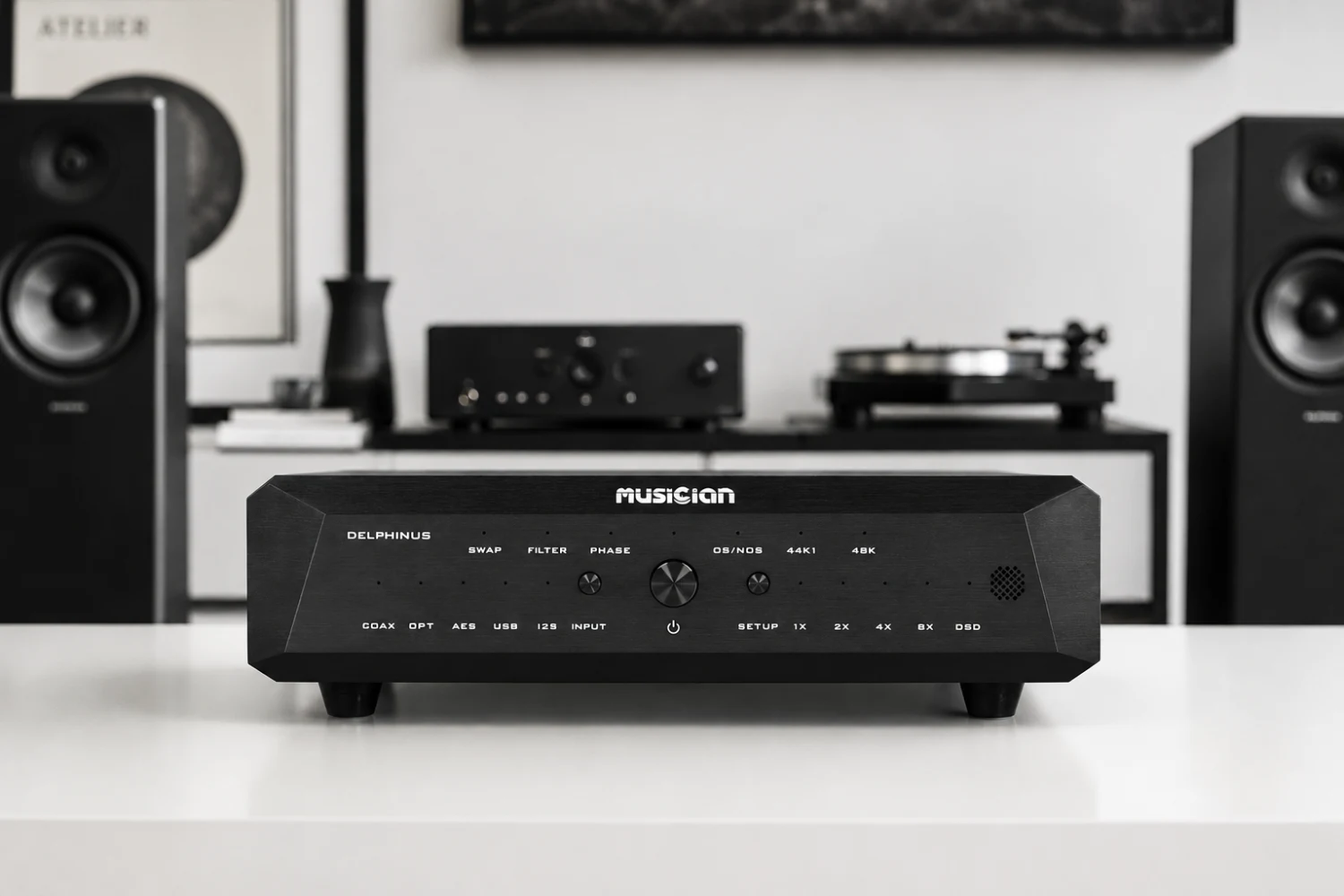
8. Musician Delphinus Pairs Discrete R-2R Conversion With DSD1024 Support
Musician Delphinus desktop DAC with discrete R2R conversion, separate DSD processing and multiple digital inputs.
The Musician Delphinus is a desktop DAC combining a discrete R-2R resistor ladder with a separate DSD section.
Its resistor ladder is assembled with resistors specified to 0.005% precision, and users can choose OS or NOS operation, along with Fast and Slow digital filter settings and phase inversion.
Connectivity is broad: USB, I2S, coaxial, optical and AES/EBU are included. USB and I2S accept PCM up to 32-bit/1536 kHz and DSD up to DSD1024, while coaxial, optical and AES/EBU support PCM up to 24-bit/192 kHz and DSD64 via DoP. Eight selectable I2S compatibility modes make it especially relevant for systems using digital transports.
Best for: Desktop systems using USB or I2S digital sources
- Discrete R2R resistor ladder with 0.005% precision resistors
- Separate section for DSD signals
- USB and I2S support PCM up to 32-bit/1536 kHz and DSD up to DSD1024
- Eight selectable I2S compatibility modes
Verdict: The Delphinus is a feature-rich desktop DAC for listeners who want R2R conversion, extensive I2S configuration and very high stated format support.

9. Shanling EH1: A straightforward and user-friendly DAC and headphone amplifier
Shanling EH1 compact desktop DAC and headphone amplifier with rotary controls and an aluminium chassis.
The Shanling EH1 is positioned as a compact desktop DAC and headphone amplifier with a deliberately simple interface.
It is described as more powerful than Shanling’s UA Line, simpler than the H Line and smaller than the EH3 Desktop DAC & Amplifier.
The minimalist design omits a display and instead uses buttons and rotary encoders for everyday control. Its aluminium chassis is offered in black or silver, and the front panel includes a volume encoder plus bass and tone controls, making it one of the more straightforward desktop options in the source material.
Best for: Users wanting a simple compact desktop DAC/amp
- Compact desktop DAC and headphone amplifier
- Minimalist control layout without a display
- Aluminium chassis offered in black or silver
- Front-panel volume, bass and tone controls
Verdict: The EH1 is the uncomplicated choice for a desktop listener who wants direct controls and a small footprint rather than a feature-heavy interface.

10. Luxman DA-250: DAC that delivers high-quality audiophile sound
Luxman DA-250 DAC with all-metal casework, display, input selector and front headphone output.
The Luxman DA-250 is a standalone DAC with DSD support and a built-in headphone amplifier, positioned as a development of the earlier DA-200 line.
It uses the Burr-Brown/Texas Instruments PCM1795 converter chip, supporting PCM up to 32-bit/192 kHz and DSD64 and DSD128.
The all-metal case follows Luxman’s restrained house style, with a 6.3 mm headphone output, LECUA precision analogue volume control, input selector and a two-line LED display showing input and sample rate. The headphone amplifier uses a discrete buffer circuit and is rated at 130 mW per channel into 600 ohms and 400 mW per channel into 32 ohms.
Best for: Traditional hi-fi systems needing a DAC with headphone output
- Uses Burr-Brown/Texas Instruments PCM1795 conversion
- Supports PCM up to 32-bit/192 kHz and DSD64/DSD128
- Includes LECUA precision analogue volume control
- Headphone amplifier uses a discrete buffer circuit
Verdict: The DA-250 is a neatly specified Luxman DAC for listeners who want DSD support, analogue volume control and a proper front-panel headphone facility.
How to choose the right DAC from this shortlist
Start with the role the DAC must play in your system.
If you already have a full preamp and amplifier, a dedicated converter such as the Esoteric D-05X or Musician Delphinus makes the most sense.
The Esoteric is the most overtly high-end design in the supplied material, with its elaborate power supply, multi-DAC arrangement and proprietary Esoteric transmission systems. The Delphinus is more about desktop flexibility, with discrete R2R conversion, a separate DSD section, extensive input options and configurable I2S behaviour. Luxman’s DA-250 sits in a more traditional hi-fi space, adding analogue volume control and a serious headphone output to a standalone DAC format. For headphone-first desktop systems, focus on the DAC/amp combinations. The FiiO K11 R2R offers a dedicated resistor-ladder architecture, switchable NOS and OS modes and stated high-resolution PCM and DSD support. Shanling’s EH1 is the simpler alternative, favouring compactness, an aluminium chassis and direct physical controls over a display-led interface. Schiit’s Modi 5 is different again: it is a small desktop DAC rather than a full headphone amplifier solution, but its USB-powered operation, USB, optical and coaxial inputs, Mesh digital filter and Unison 384 USB interface make it attractive for straightforward digital-source switching. Portable buyers should separate serious technical ambition from lifestyle convenience. The iBasso D16 Taipan is the technically dense portable option, using FPGA-Master 2.0 control, a discrete PWM DAC array and a super Class A transistor amplifier section. The iFi Hip-Dac 3 Stealth Edition is the travel-focused DAC/amp, with battery operation, balanced circuit design and support for PCM and DSD formats named in the source. Snowsky’s Retro Nano is the lightest and most visually distinctive portable choice, pairing Bluetooth and USB use with a playful cassette-inspired screen animation. If network streaming and system control matter as much as conversion, the NAD C658 is the outlier. It combines DAC, preamp and BluOS streamer functions, adds AirPlay 2 support and is designed to work with other BluOS players. That makes it less of a purist standalone DAC and more of a digital control hub. The most sensible choice is therefore not the most heavily specified model overall, but the one whose architecture, controls and connectivity match the way the system will actually be used.