
A digital-to-analog converter can be a simple bridge between a computer and an amplifier, a pocketable headphone companion, or the control center of an ambitious digital system.
The right choice depends less on headline resolution figures than on how the converter fits the sources, amplification, headphones, speakers, and listening habits already in place.
This selection spans dedicated high-end converters, affordable desktop designs, portable DAC and headphone amplifiers, and integrated components with broader system roles. It also includes a premium conversion chip intended for product designers rather than end users, illustrating why the chip itself is only one part of a finished DAC’s performance. The recommendations below are grounded in the supplied product information. Where sonic characteristics originate from manufacturer descriptions rather than independent listening findings, that distinction is made clear.
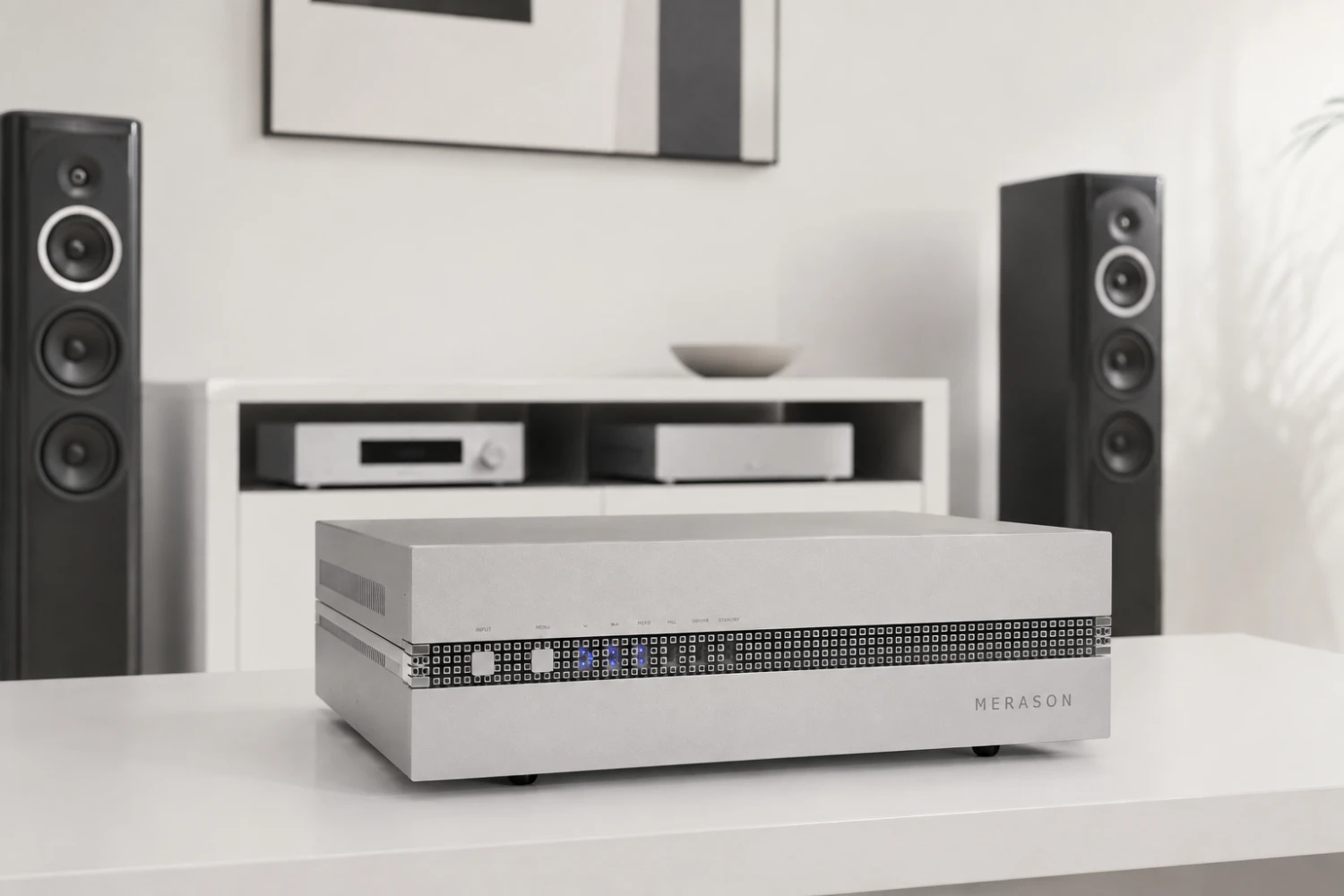
1. Merason Mountain Flagship DAC
The Swiss-made Merason Mountain flagship DAC, designed to feed a separate preamplifier or integrated amplifier.
Developed and manufactured in Switzerland, the Merason Mountain sits at the top of the company’s converter range.
It is a dedicated DAC for high-end systems, supplying both balanced and unbalanced analog outputs for connection to a separate preamplifier or integrated amplifier.
Format support extends to PCM at up to 24-bit/192kHz and DSD64 or DSD128. Merason describes its priorities as neutral tonal balance, natural presentation, wide dynamic range, and a broad, deep soundstage, although these remain manufacturer claims rather than independent listening conclusions.
Best for: High-end systems with separate amplification
- Balanced and unbalanced analog outputs
- PCM support up to 24-bit/192kHz
- Handles DSD64 and DSD128
- Dedicated high-end converter design
Verdict: The Mountain is a focused flagship DAC for listeners who value dedicated conversion and conventional balanced or unbalanced system integration.

2. Fiio KA5
The Fiio KA5, an affordable DAC presented as a competitive choice within its price class.
The Fiio KA5 is presented as a comprehensive, affordable DAC that reversed the reviewer’s recent skepticism about the brand’s budget sound quality.
That favorable assessment places it firmly in the value-oriented part of the market and suggests it deserves consideration alongside competing devices at a similar level.
The supplied source does not provide enough complete technical information to make detailed claims about connectivity, supported formats, or output power, so its case here rests on the reviewer’s positive overall response and competitive positioning.
Best for: Value-conscious portable-audio buyers
- Affordable positioning
- Positive reviewer assessment
- Competitive value focus
Verdict: The KA5 stands out as an affordable option that made a notably stronger impression on the reviewer than some earlier Fiio products.

3. iFi Hip-Dac 3 Stealth Edition
The matte-black iFi Hip-Dac 3 Stealth Edition portable DAC and headphone amplifier.
The iFi Hip-Dac 3 Stealth Edition combines a portable DAC with a headphone amplifier in a matte-black limited-edition enclosure.
It offers up to 12 hours of playback and retains iFi’s True Balanced circuit design and Burr-Brown DAC platform.
Updated components include a quieter power-supply arrangement, new capacitors, and a revised GMT clock circuit with a new oscillator intended to reduce phase noise. It supports PCM decoding up to 384kHz and DSD up to DSD256, making it suitable for high-resolution listening away from a full-size system.
Best for: Headphone listening during travel and commuting
- Up to 12 hours of playback
- PCM support up to 384kHz
- DSD support up to DSD256
- Portable DAC and headphone amplifier
Verdict: This Stealth Edition combines substantial format support, battery-powered portability, and updated internal circuitry in a distinctive black finish.

4. SMSL DAC MINI
The aluminum SMSL DAC MINI positioned as a footprint-matched audio companion for the Mac mini.
The SMSL DAC MINI is shaped specifically to sit beneath a Mac mini, with a matching footprint and a CNC-milled aluminum enclosure that provides rigidity, passive heat dissipation, and a visually coherent desktop stack.
Its unusual mechanical power system lets the front control wake the computer without scripts or USB wake procedures.
Conversion is built around the ESS ES9039Q2M, while the product also incorporates a balanced headphone amplifier and USB hub, allowing it to consolidate several desktop functions into one compact component.
Best for: Mac mini-based desktop audio systems
- Mac mini-matched footprint
- ESS ES9039Q2M conversion
- Integrated balanced headphone amplifier
- Built-in USB hub
Verdict: The DAC MINI is the most purpose-built choice here for turning a Mac mini workspace into a tidy headphone and digital-audio station.

5. PS Audio PMG Signature 512 DAC
The PS Audio PMG Signature 512 DAC, featuring proprietary DSD conversion, streaming, and analog volume control.
PS Audio’s PMG Signature 512 DAC takes an unconventional processing approach by converting incoming PCM and DSD signals into an 8x DSD stream through the proprietary PureStream DSD512 engine.
Its SpectraWave 64-Tap Sequencer is intended to address jitter and noise before the signal reaches a fully balanced, direct-coupled analog output stage with RCA and XLR connections.
Galvanically isolated inputs, an integrated streamer, and precision analog volume control expand its role beyond that of a basic converter, allowing it to operate as the digital center of a high-end system.
Best for: Reference digital systems needing source and volume control
- PureStream DSD512 conversion engine
- Fully balanced direct-coupled output stage
- Built-in high-performance streamer
- Precision analog volume control
Verdict: The PMG Signature 512 is a system-level digital component for buyers drawn to PS Audio’s proprietary all-signals-to-DSD architecture.

6. AKM AK4498EXVQ Stereo Premium DAC Chip
AKM’s AK4498EXVQ premium stereo conversion chip, intended for integration into finished DAC products.
The AK4498EXVQ is a premium stereo DAC chip from Asahi Kasei Microdevices rather than a finished consumer component.
It uses AKM’s Switched Capacitor Filter Voltage Output Velvet Sound technology and is intended for manufacturers developing digital-to-analog converters.
Its inclusion is useful context for buyers: a recognizable chip can indicate the foundation of a design, but the surrounding power supply, clocking, analog stage, circuit implementation, and other electronics also influence the performance of the completed product.
Best for: Audio manufacturers and technically curious buyers
- Premium stereo DAC architecture
- Switched Capacitor Filter Voltage Output technology
- Designed for manufacturer implementation
Verdict: The AK4498EXVQ is relevant as a building block for future DAC designs, not as a standalone converter for an audio system.

7. Shanling UA1 II
The compact Shanling UA1 II USB DAC with aluminum construction, glass panels, physical controls, and a color display.
The Shanling UA1 II brings features associated with larger portable DACs into a device weighing just under 18 grams.
Its aluminum body incorporates dual glass windows, including one for a small color display, while physical controls allow volume, playback, and menu navigation without relying entirely on a connected phone or app.
The design also features dual DACs and balanced power, according to the source title. Its combination of compact dimensions, direct controls, and visible status information differentiates it from simpler USB dongles.
Best for: Pocketable USB audio with direct controls
- Weight under 18 grams
- Built-in color display
- Standalone physical controls
- Dual-DAC design
Verdict: The UA1 II is a particularly practical compact option for listeners who want a screen and hardware controls rather than a bare-bones dongle.

8. OSD DAC-X200
The slim OSD DAC-X200 combines ESS-based digital conversion with Class AB speaker amplification.
Despite its DAC-focused name, the OSD DAC-X200 is an integrated Class AB amplifier as well as a digital converter.
Its onboard ESS ES9018K2M supports PCM up to 32-bit/384kHz and DSD up to 11.2MHz through its USB input.
An optical digital input and two RCA analog inputs broaden source compatibility, while two sets of speaker outputs support stereo and distributed-audio applications. Amplifier output is specified as 100 watts per channel into 8 ohms, 200 watts into 4 ohms, or 320 watts in mono mode, making this a substantially different proposition from a line-level standalone DAC.
Best for: Systems needing conversion and speaker amplification
- Integrated Class AB amplification
- PCM support up to 32-bit/384kHz
- DSD support up to 11.2MHz
- Two sets of speaker outputs
Verdict: The DAC-X200 is the practical choice for buyers who need a DAC and a capable integrated speaker amplifier in the same chassis.

9. Schiit Modi+
The Schiit Modi+ desktop DAC, offering coaxial, optical, and Unison USB connectivity in a focused PCM design.
The Schiit Modi+ is a straightforward desktop DAC built around a custom-tuned ESS ES9018 implementation.
Its coaxial, TOSLINK optical, and Unison USB inputs accommodate computers and conventional digital sources, while USB-C connections handle USB data and external power.
PCM playback is supported up to 24-bit/192kHz. The absence of MQA and DSD support reflects a deliberately focused design rather than a comprehensive format checklist, making input requirements and library formats important considerations before purchase.
Best for: Affordable PCM-focused desktop systems
- Coaxial, optical, and Unison USB inputs
- PCM support up to 24-bit/192kHz
- USB-C data and power connections
- Straightforward desktop design
Verdict: The Modi+ is a sensible, uncomplicated DAC for listeners whose sources are PCM-based and who do not require DSD or MQA support.

10. Topping D70 Pro SABRE
The Topping D70 Pro SABRE desktop DAC with color display, balanced outputs, selectable filters, and Bluetooth reception.
The Topping D70 Pro SABRE is a full-size desktop DAC based on the ESS ES9039 PRO and an XMOS XU316 USB controller.
Its balanced signal path leads to RCA and XLR outputs, with two selectable voltage levels available for each connection type to help match downstream amplifiers.
Three filter settings provide additional configuration, while Bluetooth 5.1 supports LDAC, aptX Adaptive, and aptX HD. A built-in volume control enables preamplifier operation, and the color display reports the active input, selected filter, and sampling frequency up to 768kHz.
Best for: Flexible desktop systems with wired and wireless sources
- ESS ES9039 PRO converter
- RCA and XLR outputs with selectable levels
- LDAC, aptX Adaptive, and aptX HD Bluetooth
- Preamplifier mode with volume control
Verdict: The D70 Pro SABRE offers the broadest configuration options here for buyers balancing high-resolution desktop playback, amplifier matching, and Bluetooth convenience.
Quick comparison
These products serve markedly different roles, so direct ranking is less useful than matching each design to its intended system.
Dedicated converters such as the Merason Mountain emphasize focused integration, portable models add headphone amplification, and products such as the OSD DAC-X200 or PS Audio PMG Signature 512 can assume broader system duties.
The AKM entry is a component for manufacturers rather than a finished DAC.
| Product | Best for | Verdict |
|---|---|---|
| Merason Mountain Flagship DAC | High-end systems with separate amplification | A dedicated Swiss-made flagship with balanced and unbalanced outputs plus PCM and DSD support. |
| Fiio KA5 | Value-conscious portable-audio buyers | An affordable DAC that earned a notably favorable response from the source reviewer. |
| iFi Hip-Dac 3 Stealth Edition | Headphone listening during travel and commuting | A battery-powered DAC and headphone amplifier with up to 12 hours of playback and broad high-resolution format support. |
| SMSL DAC MINI | Mac mini-based desktop audio systems | A footprint-matched Mac mini companion combining ESS conversion, a balanced headphone amplifier, and a USB hub. |
| PS Audio PMG Signature 512 DAC | Reference digital systems needing source and volume control | A high-end digital hub built around proprietary DSD512 processing, streaming, and analog volume control. |
| AKM AK4498EXVQ Stereo Premium DAC Chip | Audio manufacturers and technically curious buyers | A premium conversion chip intended for integration into finished audio products rather than direct consumer use. |
| Shanling UA1 II | Pocketable USB audio with direct controls | An unusually compact USB DAC with dual DACs, physical controls, and a built-in color screen. |
| OSD DAC-X200 | Systems needing conversion and speaker amplification | An integrated Class AB amplifier with ESS conversion, high-resolution USB support, and multiple speaker outputs. |
| Schiit Modi+ | Affordable PCM-focused desktop systems | A simple desktop DAC with three digital input types, USB-C connectivity, and no DSD or MQA support. |
| Topping D70 Pro SABRE | Flexible desktop systems with wired and wireless sources | A configurable ESS-based desktop DAC with XLR, RCA, Bluetooth, selectable output levels, and preamplifier operation. |
Frequently asked questions
Should I choose a portable DAC or a desktop model?
Choose a portable DAC when headphones, commuting, or travel are central to your listening.
A desktop model is generally more appropriate when you need fixed connections to an amplifier, balanced outputs, several digital inputs, preamplifier functions, or integration with active speakers.
Do supported sample rates determine which DAC will sound better?
No.
Format support confirms compatibility but does not establish sound quality by itself.
Circuit implementation, power supply, clocking, digital processing, analog output design, and system matching all matter; even products using the same conversion chip can differ substantially.
Do I need balanced XLR outputs?
Balanced outputs are useful when the receiving amplifier or active speakers provide matching XLR inputs, particularly in systems where robust line-level connectivity is desirable.
They are not automatically necessary for a short, uncomplicated desktop setup, and a well-implemented RCA connection may be entirely suitable.
Can a DAC replace a preamplifier or integrated amplifier?
Only when it provides the required functions.
A DAC with volume control and preamplifier mode may connect directly to suitable power amplifiers or active speakers, while an integrated model such as the OSD DAC-X200 can drive passive speakers.
A fixed-output converter such as the Merason Mountain is intended to feed separate amplification.
How to Choose the Right DAC for Your System
Begin with system role rather than converter technology.
A headphone listener working from a phone or laptop will benefit more from portability, suitable headphone amplification, physical controls, and battery life than from features intended for a rack-based system.
The iFi Hip-Dac 3 Stealth Edition addresses battery-powered listening, while the Shanling UA1 II emphasizes minimal size, a display, and direct controls. The Fiio KA5 occupies the affordable end of the portable field, although the supplied material provides fewer technical details for close comparison. For a conventional hi-fi system, check inputs and outputs before studying supported resolutions. The Schiit Modi+ covers USB, coaxial, and optical PCM sources without adding DSD or MQA. The Merason Mountain is a more ambitious dedicated converter with RCA and balanced connections, while the Topping D70 Pro SABRE adds Bluetooth, output-level adjustment, filters, and preamplifier control. Mac mini users have an unusually specific option in the SMSL DAC MINI, which combines matching industrial design with headphone and USB-hub functions. Consider whether the DAC should remain a source component or replace other boxes. The PS Audio PMG Signature 512 combines conversion, streaming, and analog volume control, whereas the OSD DAC-X200 adds speaker amplification. Those broader products may simplify a system, but a dedicated DAC can be preferable when amplification and source control are already settled. Finally, avoid selecting a finished converter solely by the logo on its DAC chip. The AKM AK4498EXVQ demonstrates the importance of the conversion component, but the accompanying electronics and implementation determine how that chip functions in a complete product. Confirm format compatibility, connection types, output behavior, volume-control requirements, and headphone or speaker duties before deciding which architecture belongs in your system.


Sound Off
0Join the discussion if you have something to add.