
A well-planned home cinema depends on more than a single headline specification.
Display brightness, speaker layout, room correction, source compatibility and amplification all influence how successfully the system works in its intended space.
This selection covers several distinct roles rather than interchangeable products. The Optoma is a high-brightness projector; the OPPO is a disc player; the Onkyo and Marantz models are amplified AV receivers; and the Lyngdorf is a surround processor for a more specialised system. Start with the component your room or existing equipment requires, then check every connection and channel requirement before deciding. Projector buyers should consider screen size and ambient light, while receiver and processor buyers need to account for speaker count, subwoofers, external amplification and room-calibration options.
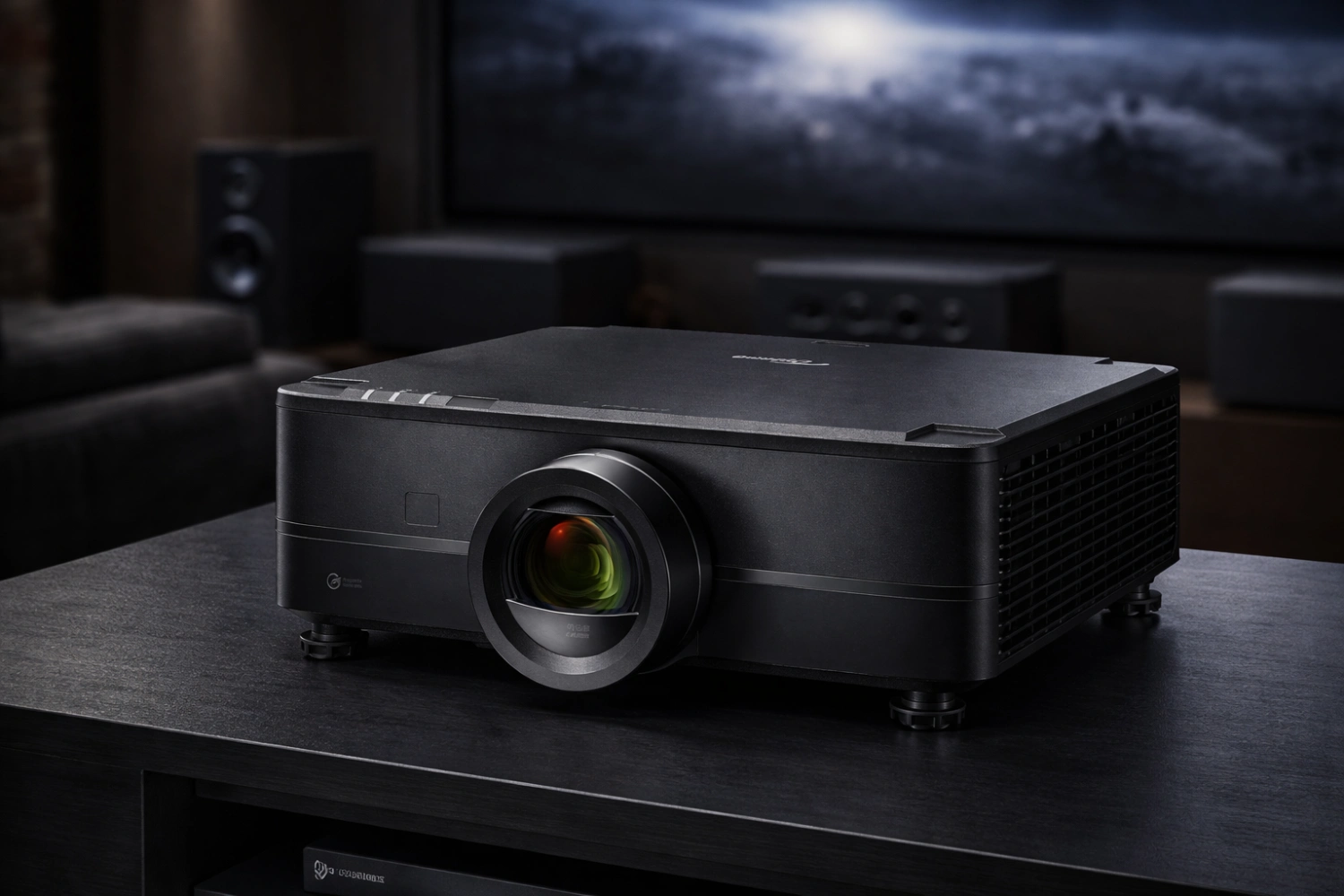
1. Optoma UHZ78LV 4K Laser Projector
The Optoma UHZ78LV combines a 3RGB laser light source with Dolby Vision, HDR10+ and flexible installation options.
The Optoma UHZ78LV is aimed at home cinemas that need substantial light output for a large projection screen.
Its manufacturer-stated peak brightness is 5,000 lumens, while the 3RGB laser system claims 98% coverage of the DCI-P3 colour space and a lifespan of up to 30,000 hours.
Support for both Dolby Vision and HDR10+ broadens its compatibility with dynamic HDR content, and front, rear or ceiling installation options give integrators useful placement flexibility.
Best for: Large-screen projection installations
- Manufacturer-stated 5,000-lumen peak brightness
- Dolby Vision and HDR10+ support
- Claimed 98% DCI-P3 colour coverage
- Front, rear or ceiling installation
Verdict: A notably bright 4K laser projector with broad HDR support and flexible mounting options for ambitious home cinema rooms.

2. Onkyo TX-RZ50
The Onkyo TX-RZ50 supports several immersive speaker layouts and can expand to 7.2.4 with an external two-channel amplifier.
The Onkyo TX-RZ50 is a flexible AV receiver for systems that may grow beyond its built-in amplification.
It can power 5.2.4 or 7.2.2 speaker configurations, while 11-channel processing and 11.2-channel pre-outs allow a 7.2.4 layout when an external two-channel power amplifier is added.
Dolby Atmos, DTS:X and IMAX Enhanced cover the principal immersive formats listed in the source, and Dolby Surround or DTS Neural:X can derive height information from older soundtracks.
Best for: Expandable immersive-audio systems
- Built-in support for 5.2.4 or 7.2.2 layouts
- 11-channel processing and 11.2-channel pre-outs
- Dolby Atmos, DTS:X and IMAX Enhanced
- Upmixing options for older soundtracks
Verdict: The TX-RZ50 is a strong system hub for listeners who want useful built-in channel capacity with a route to a larger 7.2.4 installation.

3. OPPO UDP-203
The OPPO UDP-203 offers dual HDMI outputs, an HDMI input and internal digital-to-analogue conversion for flexible system integration.
The OPPO UDP-203 is a straightforward 4K disc player with unusually flexible signal routing.
It decodes 4K video with HDR10 and Dolby Vision, while separate HDMI 2.0a and HDMI 1.4 outputs let video and audio take different paths when required.
An HDMI input can accommodate another source, and the internal Asahi Kasei AK4458VN DAC provides an analogue-output option for systems built around separate power amplification.
Best for: Disc-based systems needing flexible signal paths
- 4K playback with HDR10 and Dolby Vision
- Separate HDMI outputs for flexible routing
- HDMI input for an additional source
- Internal Asahi Kasei AK4458VN DAC
Verdict: The UDP-203 remains an appealingly versatile player for installations that benefit from separate video and audio routing or analogue output.

4. Marantz SR8015
The Marantz SR8015 integrates 11 amplified channels, immersive-format decoding and Audyssey MultEQ XT32 calibration.
The Marantz SR8015 is an 11.2-channel AV receiver designed to run an extensive immersive system without immediately requiring an additional power amplifier.
It can decode Dolby Atmos in a 7.1.4 configuration using its internal amplification and also supports DTS:X and Auro-3D.
Audyssey MultEQ XT32 handles speaker calibration, supported by Dynamic Volume, Dynamic EQ, LFC and Sub EQ HT, the latter intended to correct the operation of two subwoofers. Its construction includes a copper-plated chassis, shielded toroidal transformer and discrete HDAM amplifier modules.
Best for: Self-contained 7.1.4 home cinemas
- 11.2-channel architecture
- 7.1.4 Dolby Atmos without an external amplifier
- DTS:X and Auro-3D support
- Audyssey MultEQ XT32 calibration
Verdict: The SR8015 combines extensive internal amplification with broad immersive-format support and detailed Audyssey room-calibration tools.

5. Onkyo TX-NR7100 B M2
The Onkyo TX-NR7100 B M2 combines nine-channel amplification, Dirac Live and comprehensive HDMI and network connectivity.
The Onkyo TX-NR7100 B M2 brings nine-channel amplification and Dirac Live room correction together in a receiver capable of driving 7.1.2 or 5.1.4 systems.
Its seven HDMI inputs and two outputs support the listed 8K, HDCP 2.3, Dolby Vision, HDR10+ and eARC standards.
Dolby Atmos and DTS:X decoding are joined by THX certification and IMAX Enhanced compatibility, while Ethernet, dual-band Wi-Fi, DTS Play-Fi, AirPlay 2 and Chromecast provide several routes to network playback. An MM phono input also accommodates a compatible turntable.
Best for: Feature-rich nine-channel systems
- Nine-channel amplification
- Dirac Live room correction
- Seven HDMI inputs and two outputs
- Broad wired and wireless streaming support
Verdict: The TX-NR7100 B M2 is a well-equipped receiver for buyers seeking nine-channel immersive audio, Dirac Live and extensive connectivity in one component.

6. Lyngdorf MP-40 2.1
The Lyngdorf MP-40 2.1 is a 12-channel digital surround processor built around RoomPerfect and HDMI 2.1 connectivity.
The Lyngdorf MP-40 2.1 is a fully digital 12-channel surround processor intended to act as the control centre of a serious separate-component cinema.
RoomPerfect is its defining system feature, addressing the interaction between the loudspeakers and listening room.
HDMI 2.1 and 8K support accommodate contemporary video sources, while support for immersive audio formats suits multichannel installations. Because this is a processor rather than an amplified AV receiver, it belongs on a shortlist for systems planned around separate power amplifiers.
Best for: Separate-amplifier cinemas prioritising room correction
- 12-channel surround processing
- RoomPerfect room correction
- Fully digital signal architecture
- HDMI 2.1 and 8K support
Verdict: The MP-40 2.1 is a focused surround processor for dedicated systems where RoomPerfect and a fully digital architecture take priority over built-in amplification.
Frequently asked questions
Should I choose an AV receiver or a surround processor?
Choose an AV receiver when you want processing and power amplification in one chassis.
A surround processor such as the Lyngdorf MP-40 2.1 is intended for a system using separate power amplifiers, which adds cost and complexity but allows amplification to be selected independently.
How many receiver channels do I need for Dolby Atmos?
Count the main speakers, subwoofers and height channels in your intended layout.
A 5.2.4 or 7.2.2 system needs nine amplified speaker channels, while 7.2.4 requires eleven; also check whether the receiver can power every channel internally or needs an external amplifier.
Why does room correction matter in a home cinema?
Room-correction systems analyse how the speakers interact with the room and adjust their output to improve integration at the listening position.
Dirac Live, Audyssey MultEQ XT32 and RoomPerfect are represented here, but careful speaker placement and suitable room layout remain important.
What should I check before buying a home cinema projector?
Match brightness and installation flexibility to the room, screen size and expected ambient light.
Also confirm support for the HDR formats you use and verify that the available throw distance and mounting position are suitable before installation.
How to Choose the Right Home Cinema Component
Begin by identifying the missing role in your system.
A projector such as the Optoma UHZ78LV addresses the picture, the OPPO UDP-203 handles physical media, AV receivers combine surround processing with amplification, and the Lyngdorf MP-40 2.1 requires separate power amplifiers.
For an AV receiver, plan the complete speaker layout before comparing features. Nine amplified channels are sufficient for arrangements such as 5.1.4 or 7.1.2, whereas a 7.1.4 system needs eleven. Processing capacity and amplification are not always the same, as the TX-RZ50 demonstrates: it can process eleven channels but requires an additional two-channel amplifier for 7.2.4. The Marantz SR8015 can operate a 7.1.4 Dolby Atmos layout with its internal amplification. Connectivity should reflect both current sources and likely system changes. Check the number and capabilities of HDMI inputs and outputs, HDR compatibility, eARC requirements, network playback options and any legacy analogue connections. Owners of mixed-generation equipment may particularly value the UDP-203’s separate HDMI outputs, which allow audio and video to be routed independently. Finally, treat room setup as part of the purchase rather than an afterthought. Dirac Live, Audyssey MultEQ XT32 and RoomPerfect offer different approaches to calibration, but none removes the need for sensible speaker positioning. Projector buyers should likewise confirm screen dimensions, throw distance, mounting position and ambient-light conditions rather than selecting on brightness alone.



Sound Off
1Join the discussion if you have something to add.
You know you only listed a DLP single chip projector and people suffer from rainbow effect cannot watch these projectors you should have offered an alternative as well some sort of three chip LCD projector like an Epson of some sort!