
Choosing an AV receiver for serious listening requires more than counting channels.
Amplifier architecture, supported surround formats, room-system flexibility, HDMI connectivity and music playback options all affect whether a receiver will suit a particular installation.
A dedicated cinema room may need extensive processing and expansion, while a living-room system can be better served by fewer channels and a carefully chosen feature set. The strongest direct candidates here cover distinct priorities. The Yamaha RX-A6A combines object-based surround processing with dedicated DAC and noise-reduction technologies. JBL Synthesis targets elaborate cinema rooms with 16-channel processing and nine internal amplifiers, while the Denon AVR-X2900H DAB offers a more conventional 7.1-channel foundation with current video, radio and wireless music features. Not every source in this selection is a conventional AV receiver. Yamaha’s R-N1000A is a network stereo receiver with TV-friendly HDMI ARC, the Teufel Concept models integrate 5.1 amplification into active subwoofers, and the Sunfire and Audio-Technica articles cover related home-cinema and source-component territory. They remain useful points of comparison, but buyers seeking a multichannel receiver should distinguish them from the three direct AVR choices.

1. Yamaha R-N1000A: Build a modern music system with this stereo receiver
The Yamaha R-N1000A combines stereo amplification, network playback, FM radio and HDMI ARC in a traditional full-width receiver.
The Yamaha R-N1000A is a music-focused network stereo receiver rather than a multichannel AV receiver.
It combines a discrete integrated amplifier, FM tuner and MusicCast network player in one metal enclosure, with digital and optical inputs for external sources.
An HDMI input supporting ARC allows a television to feed sound back to the receiver, making it relevant to listeners who want improved TV audio without building a surround system. Yamaha also specifies symmetrical amplifier boards, discrete components, a custom transformer and selected filter capacitors, while the double-chassis construction is intended to protect the circuitry from vibration and electrical interference.
Best for: Music-first stereo systems connected to a TV
- HDMI input with ARC
- MusicCast network playback
- Discrete symmetrical amplifier construction
- Digital and optical inputs
Verdict: Choose the R-N1000A when two-channel music and convenient TV integration matter more than multichannel surround sound.

2. Teufel Concept 8 and Concept 12: Active subwoofer with integrated 5.1 amplifier technology
Teufel’s Concept 8 and Concept 12 active subwoofers incorporate amplification for a complete 5.1-channel speaker system.
Teufel’s Concept 8 and Concept 12 offer an unconventional alternative to a separate AV receiver by placing 5.1-channel amplification inside an active subwoofer.
The internal amplifier stages can power the subwoofer and connected satellite speakers, including compatible Teufel packages or other speakers attached through standard terminals.
HDMI is the preferred connection for a 5.1 system, while optical, USB digital, stereo RCA and Bluetooth broaden the available source options. The Concept 8 uses an 8-inch down-firing driver rated at 120 watts; the Concept 12 moves to a 12-inch front-firing driver rated at 150 watts. A remote control and 25-metre speaker-cable roll are included.
Best for: Simplified 5.1 systems without a separate receiver
- Integrated 5.1 amplification
- HDMI, optical and USB digital inputs
- Bluetooth receiver
- Standard speaker terminals
Verdict: The Concept 8 and Concept 12 suit buyers who want subwoofer and system amplification consolidated into a single component.

3. Yamaha RX-A6A: AV Receiver with artificial intelligence
The Yamaha RX-A6A pairs immersive surround processing with an ESS ES9026PRO DAC and Yamaha’s SURROUND:AI technology.
The Yamaha RX-A6A is a direct AV-receiver choice for listeners interested in object-based surround sound and detailed digital processing.
It supports Dolby Atmos and DTS:X and uses Yamaha’s SURROUND:AI system to analyse content and adjust the treatment of dialogue, music and effects.
Its digital section is built around the Qualcomm QCS407 chipset and a 32-bit ESS SABRE PRO Premier ES9026PRO DAC. Yamaha’s DOPG circuit concept is intended to reduce potential differences between audio stages and lower background noise. The receiver also supports high-resolution video handling, including 8K and 4K formats with higher refresh-rate options through its HDMI platform.
Best for: Immersive cinema systems with advanced Yamaha processing
- Dolby Atmos and DTS:X support
- SURROUND:AI processing
- ESS ES9026PRO DAC
- 8K and 4K video handling
Verdict: The RX-A6A is the music-conscious surround option here, combining object-based formats with dedicated DAC and noise-reduction technologies.

4. JBL Synthesis SDR-40: A 16-channel powerhouse built for modern cinema rooms
The JBL Synthesis SDR-40 combines 16-channel processing, nine Class-G amplifier stages and room-correction facilities in one chassis.
The JBL Synthesis SDR-40 is aimed at dedicated, high-performance cinema rooms rather than conventional living-room installations.
It provides 16-channel processing and nine integrated Class-G amplifier stages, allowing it to power a substantial speaker layout while retaining pre-out expansion for larger systems.
Supported formats include Dolby Atmos, DTS:X Pro, IMAX Enhanced and AURO-3D. Flexible matrix channel assignment allows the configuration to be adapted to the room, while advanced room correction is included for installation-level system tuning. Its combination of processing, amplification and expansion is positioned as a more compact alternative to assembling a separate processor and multiple power amplifiers.
Best for: Dedicated cinema rooms and expandable installations
- 16-channel processing
- Nine Class-G amplifier stages
- Dolby Atmos, DTS:X Pro, IMAX Enhanced and AURO-3D
- Pre-out expansion
Verdict: The SDR-40 is the most installation-oriented receiver in the group, with the processing scale and expansion options required for elaborate speaker layouts.

5. Sunfire
Sunfire is known in the supplied material for compact subwoofers, home-cinema speakers and efficient amplifier power-supply technology.
This source is a company overview rather than a review of a specific AV receiver, so it cannot support a direct receiver recommendation.
Sunfire is associated particularly with compact, high-output subwoofers designed around long-excursion bass drivers capable of moving substantial volumes of air.
The article also describes the company’s Tracking Downconverter power-supply technology, which responds to the instantaneous load and supplies the energy required at a given moment. These technologies are relevant when researching subwoofer and power-amplifier partners for a home cinema, but the source does not identify an AV-receiver model, channel configuration, connectivity package or surround-format support.
Best for: Background research on subwoofers and power amplification
- Compact long-excursion subwoofer designs
- Tracking Downconverter power-supply technology
- Home-cinema speaker ranges
Verdict: Sunfire is relevant to the wider cinema system, but this company profile does not provide enough product-specific evidence for an AV-receiver recommendation.
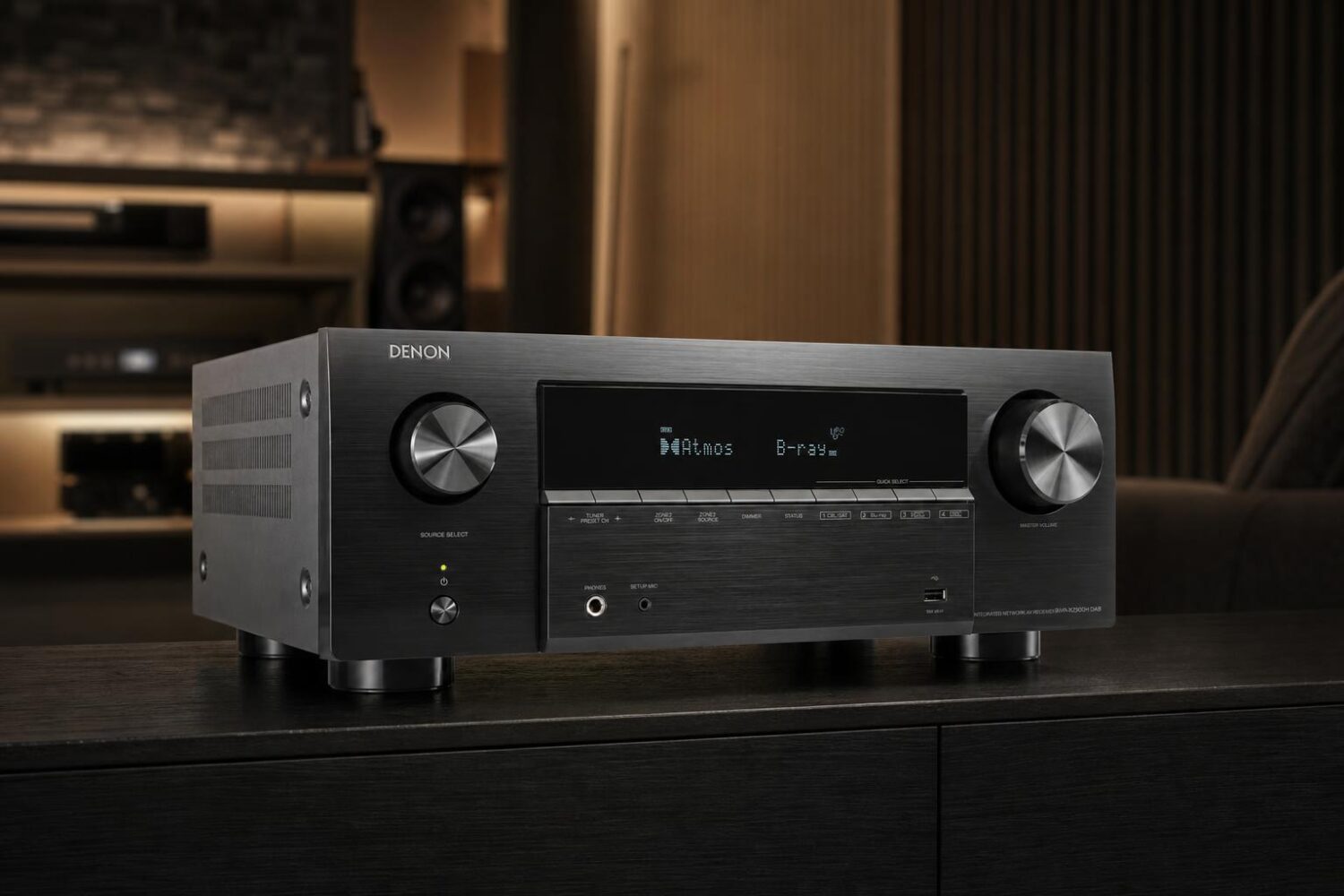
6. Denon AVR-X2900H DAB Brings 8K HDMI, HEOS and DAB Radio to 7.1-Channel Home Cinema
The Denon AVR-X2900H DAB provides seven amplifier channels, dual-subwoofer connections, six HDMI inputs and integrated broadcast radio.
The Denon AVR-X2900H DAB is a 7.1-channel receiver designed to serve as the central hub of a compact surround system.
Its seven matching analogue amplifier blocks support a 7.1 layout, and two subwoofers can be connected.
Dolby Atmos and DTS:X handle compatible object-based soundtracks, while Dolby Atmos Height Virtualization and DTS Virtual:X provide alternatives where physical height speakers are impractical. The HDMI 2.1 platform supports 8K video and includes six inputs. HEOS adds wireless music functionality, and built-in DAB+ and FM tuners cover broadcast radio. Denon also specifies separated analogue and digital sections and an Enhanced SHARC+ Dual Core DSP.
Best for: Versatile 7.1-channel film and music systems
- Seven-channel amplification
- Dolby Atmos and DTS:X
- Six HDMI inputs with 8K support
- HEOS and DAB+/FM radio
Verdict: The AVR-X2900H DAB is the balanced conventional choice for buyers who need seven channels, modern HDMI handling and broad music access in one receiver.

7. Audio-Technica AT-LP120X: Direct drive turntable perfect for DJs
The Audio-Technica AT-LP120XUSB features direct drive, an adjustable S-shaped tonearm, a switchable phono stage and USB output.
The Audio-Technica AT-LP120XUSB is a direct-drive turntable and source component, not an AV receiver.
It supports 33⅓, 45 and 78 rpm records, with pitch adjustment, quartz lock and selectable adjustment ranges.
Its S-shaped tonearm provides adjustable tracking force, anti-skating and a hydraulic lift, and it is supplied with an AT-HS6 removable headshell and AT-VM95E moving-magnet cartridge. The switchable integrated phono stage allows connection to equipment with or without a dedicated phono input. A USB output can connect the turntable to a computer for vinyl digitisation, making it relevant to an AV system only as an analogue and digital source.
Best for: Adding vinyl playback to a compatible receiver system
- Three playback speeds
- Switchable integrated phono stage
- USB output for vinyl digitisation
- Adjustable tonearm setup
Verdict: The AT-LP120XUSB is a flexible turntable source, but it must be paired with amplification and speakers rather than treated as an AV-receiver alternative.
Frequently asked questions
Do I need an AV receiver if I only use two speakers?
Not necessarily.
A stereo receiver such as the Yamaha R-N1000A can combine music streaming, radio and TV sound through HDMI ARC without adding surround channels.
Choose a multichannel AV receiver only if you plan to build a surround layout or need its wider cinema-processing features.
How many amplifier channels should an AV receiver have?
Match the receiver to the speaker layout you intend to install.
The Denon AVR-X2900H DAB supplies seven amplifier channels for a 7.1 system, while the JBL Synthesis SDR-40 processes 16 channels but contains nine amplifier stages, using pre-outs when further external amplification is required.
Are physical height speakers essential for immersive audio?
They are not essential for accessing every height-related feature, although the result differs from installing dedicated speakers.
The Denon includes Dolby Atmos Height Virtualization and DTS Virtual:X for systems where ceiling or height speakers are impractical; buyers planning physical height channels should verify that the chosen receiver can amplify or process the full intended layout.
Which connections matter most when choosing an AV receiver?
Start with enough HDMI inputs for current and planned video sources, then check video-format support and the required TV return-audio connection.
Music listeners should also consider network playback, radio and analogue or digital inputs.
A turntable without a usable phono stage needs an external phono preamplifier, although the supplied Audio-Technica model includes a switchable one.
How to choose the right receiver for serious listening
Begin with the room and speaker layout rather than the longest feature list.
A 7.1-channel design such as the Denon AVR-X2900H DAB provides a conventional route into object-based cinema, including virtual-height processing where additional speakers cannot be installed.
The Yamaha RX-A6A places greater emphasis on Yamaha’s surround analysis, ESS DAC implementation and associated noise-reduction design. For a dedicated room with a much larger channel plan, the JBL Synthesis SDR-40 offers 16-channel processing, nine internal amplifiers and pre-outs for expansion. Two-channel listeners should not assume that a multichannel receiver is automatically the better purchase. The Yamaha R-N1000A offers network music, discrete stereo amplification and HDMI ARC for television sound without the complexity of a surround installation. Teufel’s Concept 8 and Concept 12 take a different approach by incorporating 5.1 amplification into the active subwoofer, reducing the need for a separate receiver but also departing from the conventional component format. Before deciding, map every source, display, speaker and subwoofer connection. Confirm how many channels are processed, how many are actually amplified, whether external power amplifiers may be added, and whether the HDMI facilities suit the intended video sources. Room correction or adaptive surround processing can be valuable, but it does not replace sensible speaker placement. Finally, treat turntables, subwoofers and power amplifiers as supporting components: they may shape the complete system, but they do not provide the switching, decoding and multichannel control expected from an AV receiver.


Sound Off
0Join the discussion if you have something to add.