
Amplifiers may share a category, but they do not necessarily perform the same job.
This selection spans integrated amplifiers, dedicated power amplifiers, a line preamplifier, a tube headphone amplifier, a portable DAC and even an active loudspeaker system with amplification built in.
Comparing them sensibly therefore begins with system role rather than headline power. At one end are compact, flexible products such as the TEAC AI-303 and Hidizs S9 Pro Plus Martha. At the other are ambitious power-amplifier designs from Goldmund, Accuphase and Octave, each intended to sit within a larger separates system. The Original Audio OPA-5A adds speaker and headphone amplification to a tube platform, while the Ultrafide Audio SP500 combines substantial output with a comparatively compact enclosure. The entries below retain their original order while clarifying their principal functions, connections and distinguishing design choices. Manufacturer descriptions are identified as such, and specifications are included only where supplied by the source material.
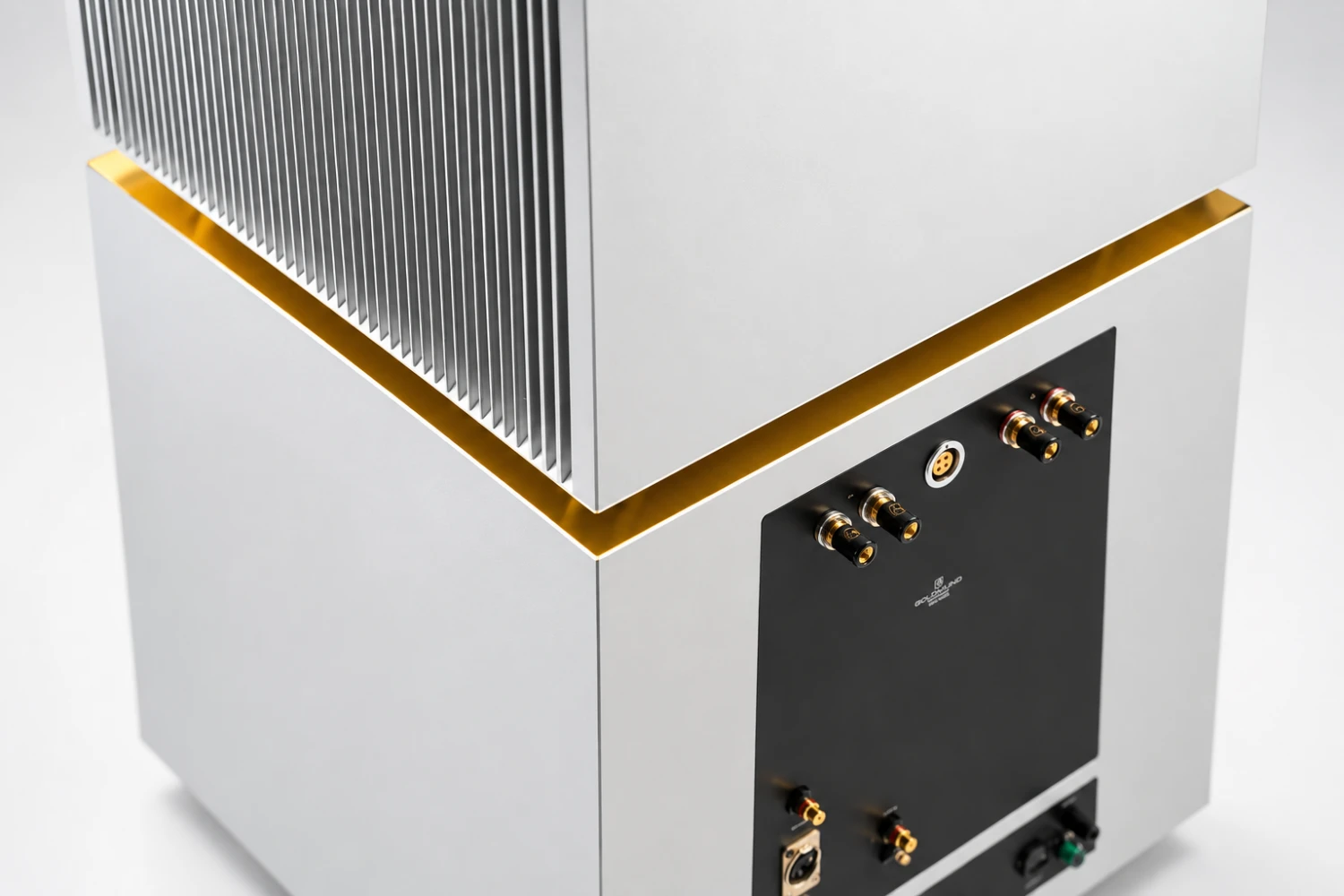
1. Goldmund Telos 9800 Separates Power and Amplification in a New Flagship
The Goldmund Telos 9800 uses linked but physically separate modules for its power supply and stereo amplification stage.
The Telos 9800 is a flagship stereo power amplifier built around an unusual two-module structure.
Goldmund places the power supply and amplification stage in separate but interconnected enclosures, allowing each section to operate under conditions intended to suit its function.
A redesigned power-management system and the largest capacitor bank yet used by the company support an output rating of up to 1,550 watts into 8 ohms. This is a dedicated power amplifier rather than an all-in-one solution, and its architecture is the central reason to consider it.
Best for: Large separates systems requiring very high stated power
- Up to 1,550 watts into 8 ohms
- Separate power-supply and amplification modules
- Redesigned power-management system
- Goldmund’s largest product capacitor bank
Verdict: The Telos 9800 stands apart through its physically separated power and amplification sections, backed by an exceptionally high stated output.

2. Ultrafide Audio SP500: Compact 500W Stereo Power Amplifier with Ultra Sigma Technology
The compact Ultrafide Audio SP500 provides RCA and XLR inputs, XLR loop connections and SpeakON speaker outputs.
Ultrafide Audio developed the SP500 as a smaller and visually simpler alternative to its U500DC while retaining the same stated power output and closely related internal electronics.
Its Ultra Sigma output topology draws on engineering associated with parent companies MC2 Audio and XTA Electronics.
RCA and XLR inputs accommodate unbalanced and balanced sources, XLR loop connections support signal routing, and SpeakON sockets handle loudspeaker output. The combination of substantial power, straightforward styling and professional-style connectivity gives the SP500 a clearly defined place in this varied group.
Best for: Space-conscious separates systems needing substantial stereo power
- Compact, minimalist enclosure
- RCA and XLR inputs
- XLR loop connections
- Ultra Sigma output topology
Verdict: The SP500 is a focused stereo power amplifier that combines a compact enclosure with flexible input and loop connections.

3. Original Audio OPA-5A: Tube amplifier with Bluetooth
The Original Audio OPA-5A combines visible tube amplification with Bluetooth, balanced inputs and two headphone connections.
The OPA-5A combines a Class A tube speaker amplifier with two forms of headphone output.
Its circuit uses two 12AU7 tubes in the preamplifier stage and two KT88 tubes in the power stage, delivering a stated 8 watts per channel into 4 to 8 ohms.
Connectivity is unusually broad for this type of amplifier: Bluetooth sits alongside RCA and balanced XLR inputs, while headphones can use either a 6.35 mm single-ended socket or a four-pin balanced XLR output. The modest speaker output makes loudspeaker sensitivity and room requirements especially important.
Best for: Headphone listeners and efficient-speaker systems seeking tube amplification
- Speaker and headphone amplification
- RCA, balanced XLR and Bluetooth inputs
- Single-ended and balanced headphone outputs
- Class A circuit using 12AU7 and KT88 tubes
Verdict: The OPA-5A is a versatile tube design, provided its 8-watt-per-channel speaker output suits the intended loudspeakers and listening level.

4. 8 Best Integrated Amplifiers right now
The integrated-amplifier guide includes models that combine speaker amplification with features such as DACs, phono stages, Bluetooth or network streaming.
This source is a multi-product integrated-amplifier guide rather than a single component.
Its cited examples illustrate why integrated amplifiers can simplify a system: the Leak Stereo 230 combines amplification with a phono stage, DAC and aptX Bluetooth, while the Denon PMA-900HNE adds network streaming and digital conversion.
The Leak is rated at 115 watts per channel into 4 ohms, and the Denon at 85 watts per channel into 4 ohms. Treat this entry as a starting point for comparing complete amplifiers by facilities, output and system fit rather than as one product recommendation.
Best for: Readers comparing feature-rich integrated amplifiers across different system needs
- Covers multiple integrated-amplifier choices
- Includes models with analog and digital facilities
- Considers network streaming and Bluetooth options
- Provides stated 4-ohm output figures for cited models
Verdict: This broader guide is most useful for identifying which integrated features matter before narrowing the choice to a particular model.

5. Hidizs S9 Pro Plus Martha: DAC/headphone amplifier on ES9038Q2M
The Hidizs S9 Pro Plus Martha is a portable USB DAC and headphone amplifier with 3.5 mm and balanced 4.4 mm outputs.
The Hidizs S9 Pro Plus Martha is not a speaker amplifier but a portable USB DAC and headphone amplifier.
Its fully balanced circuit incorporates a USB interface processor, an ES9038Q2M DAC, an independent headphone-amplifier stage and a system intended to reduce power-on and power-off noise.
Listeners can choose between 3.5 mm and balanced 4.4 mm headphone outputs, with the latter rated at 180 mW into 32 ohms. It is the smallest and most narrowly focused option here, intended to sit between a digital source and wired headphones.
Best for: Portable digital listening with wired headphones
- 3.5 mm and balanced 4.4 mm outputs
- ES9038Q2M DAC
- Fully balanced circuit architecture
- 180 mW into 32 ohms from the balanced output
Verdict: The S9 Pro Plus Martha is a compact DAC and headphone amplifier for users who need both conventional and balanced headphone outputs.
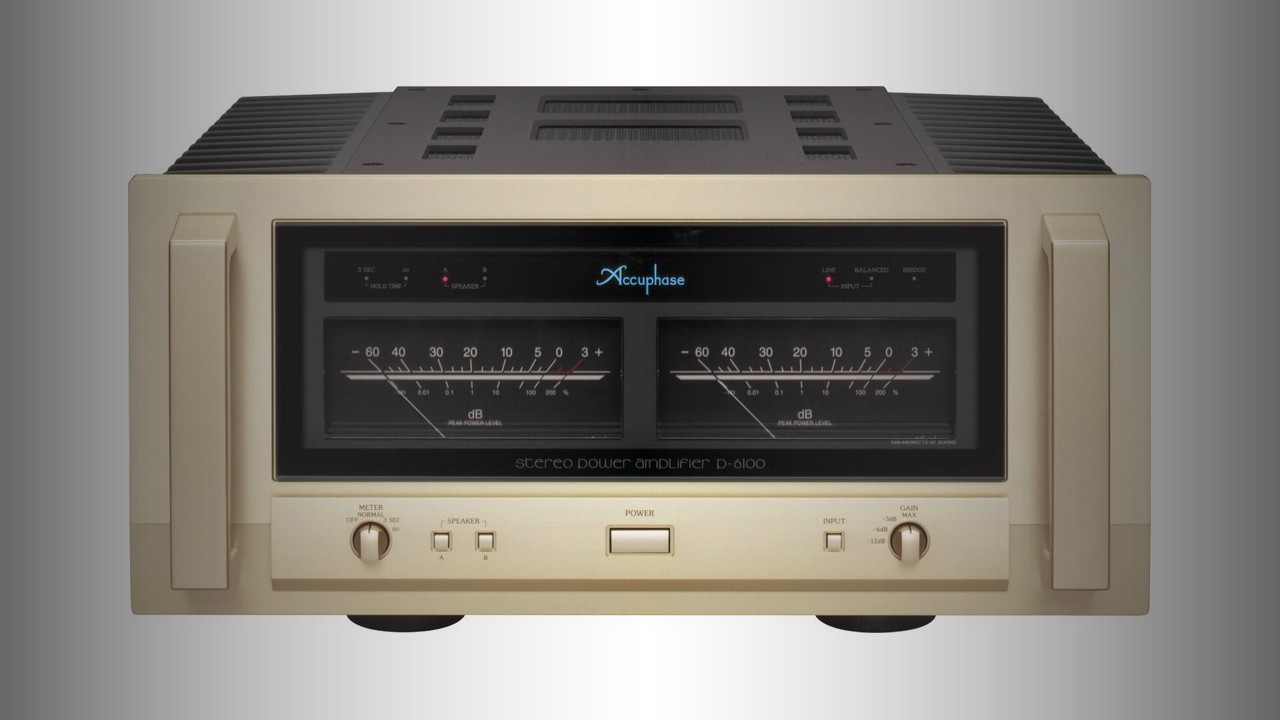
6. Accuphase P-7300: Anniversary edition power amplifier
The Accuphase P-7300 features analog power meters and front-panel controls for gain, operating mode and speaker selection.
The Accuphase P-7300 is a dedicated power amplifier built around a symmetrical circuit, current feedback and parallel high-power MOSFET output devices.
Its specified output rises from 125 watts per channel into 8 ohms to 250 watts into 4 ohms, 500 watts into 2 ohms and 800 watts into 1 ohm.
Operating choices include stereo, dual-mono and bridged modes, while selectable gain settings and front-panel switching for two pairs of speakers add installation flexibility. A shielded toroidal transformer with independent windings and two 56,000 µF capacitors forms the basis of its power supply.
Best for: Separates systems that need configurable operation and broad stated load support
- Stereo, dual-mono and bridged modes
- Selectable gain reduction
- Connections for two switchable speaker pairs
- Output specified down to a 1-ohm load
Verdict: The P-7300 combines substantial specified output with unusually useful mode, gain and speaker-switching controls.
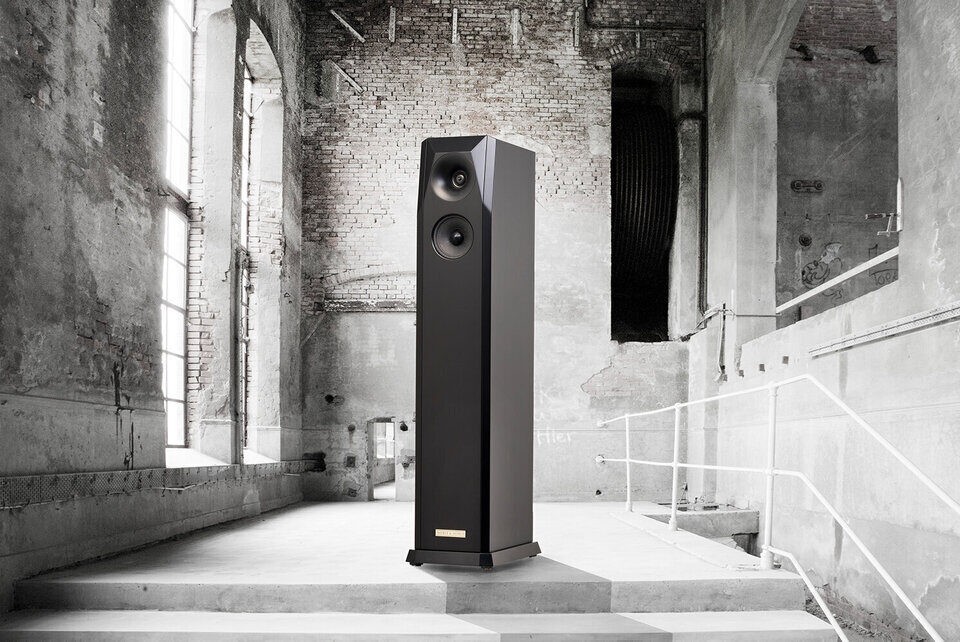
7. Noble & Noble Nobilis Sonum 98: Antiphase Dual Midwoofers in Seven-way Enclosures
The Noble & Noble Nobilis Sonum 98 integrates amplification and DSP within a distinctive seven-sided floorstanding enclosure.
The Nobilis Sonum 98 is an active floorstanding loudspeaker system rather than a conventional standalone amplifier.
Its built-in amplifiers and DSP remove the need to select an external power amplifier, while three digital and two analog inputs allow sources to connect directly.
The seven-sided enclosure uses an additional L-shaped front panel, and the paired low-mid-frequency drivers operate in antiphase in an arrangement intended to counter unwanted vibration. A wireless remote is supplied for system control.
Best for: Listeners who prefer active loudspeakers over separate amplification
- Built-in amplifiers and DSP
- Three digital inputs
- Two analog inputs
- Wireless remote control
Verdict: The Nobilis Sonum 98 offers an alternative system strategy by integrating amplification, DSP and source inputs into the loudspeakers.

8. Octave MRE 220 SE: Power amplifier using KT88 tubes
The Octave MRE 220 SE uses four KT88 S4-A tubes and provides chassis controls for damping and negative feedback.
The Octave MRE 220 SE is a tube power amplifier using four KT88 S4-A carbon tubes and carrying a stated 220-watt output rating.
Its revised output stage is complemented by chassis switches that let the user select low or high damping and adjust negative feedback.
Those controls are intended to help tailor the amplifier’s behavior to different loudspeakers, making system matching a more active part of setup than it is with many fixed-configuration designs. The supplied specifications include a frequency range of 20 Hz to 70 kHz and both RCA and XLR input-impedance figures.
Best for: Tube-based separates systems requiring adjustable loudspeaker matching
- Stated 220-watt output
- Four KT88 S4-A tubes
- Selectable low or high damping
- Adjustable negative-feedback settings
Verdict: The MRE 220 SE distinguishes itself through high stated tube-amplifier output and user-selectable damping and feedback controls.

9. Audio Research LS-2: Pure Class A Tube Preamplifier with Modern Touchscreen Control
The Audio Research LS-2 combines a pure Class A tube line stage with a modern touchscreen interface.
The Audio Research LS-2 is a line-level tube preamplifier, so it controls sources and feeds a separate power amplifier rather than driving loudspeakers directly.
Its full Class A signal path contains no semiconductors and uses no global negative feedback.
Two 6H30 double triodes operate in a cathode-follower configuration designed to maintain low output impedance, while the circuit follows a fully balanced architecture. The modern touchscreen control contrasts with the deliberately purist tube signal path.
Best for: Separates systems needing a purist tube line preamplifier
- Full Class A tube signal path
- No semiconductors in the signal path
- No global negative feedback
- Fully balanced architecture
Verdict: The LS-2 pairs a deliberately simple, fully balanced tube signal path with contemporary touchscreen operation.

10. TEAC AI-303: Compact integrated amplifier
The compact TEAC AI-303 integrates Class D speaker amplification, a 32-bit DAC, HDMI ARC and USB-C connectivity.
The TEAC AI-303 is a compact integrated amplifier designed for desktop or television-based systems.
A Hypex Class D output stage delivers a stated maximum of 50 watts per channel into 4 ohms, while the internal 32-bit DAC accepts DSD up to 11.2 MHz and PCM up to 32-bit/384 kHz.
HDMI ARC, USB-C, optical and coaxial digital inputs sit alongside a pair of analog RCA inputs. Automatic power control in response to a digital signal is particularly relevant when the amplifier is connected to a television.
Best for: Compact desktop or television audio systems
- Compact desktop-friendly dimensions
- HDMI ARC and USB-C connectivity
- Analog, optical and coaxial inputs
- Automatic operation with digital signals
Verdict: The AI-303 is the most straightforward all-in-one choice here for a small system combining television, computer and conventional audio sources.
Frequently asked questions
What is the difference between an integrated amplifier, preamplifier and power amplifier?
An integrated amplifier combines source control and speaker amplification in one enclosure.
A preamplifier, such as the Audio Research LS-2, selects and controls sources but requires a separate power amplifier.
A dedicated power amplifier, such as the Goldmund Telos 9800 or Accuphase P-7300, receives a controlled line-level signal and drives the loudspeakers.
Should amplifier power be the main selection criterion?
No.
Check loudspeaker impedance and sensitivity, room size, listening distance and desired volume before comparing wattage.
An 8-watt tube amplifier such as the OPA-5A has very different matching requirements from the much more powerful power amplifiers in this selection, and quoted outputs should be compared at the same load impedance.
When is an integrated amplifier preferable to separates?
An integrated model is useful when space, simplicity and source connectivity matter.
The TEAC AI-303 combines speaker amplification with digital conversion and HDMI ARC, whereas separate preamplifiers and power amplifiers allow each stage to be selected independently but require more components and connections.
Do balanced connections automatically provide better sound?
Not automatically.
XLR connections can be useful with compatible balanced equipment and longer cable runs, but circuit implementation and system compatibility remain important.
Confirm whether the source and amplifier are genuinely balanced and whether both devices provide the required connectors.
How to choose the right amplifier format
Begin by identifying the missing function in the system.
A passive loudspeaker setup needs speaker amplification; a dedicated power amplifier also needs a source with volume control or a separate preamplifier.
Headphones require an appropriate headphone output, while an active loudspeaker such as the Nobilis Sonum 98 already contains its own amplification. Next, match the amplifier to the loudspeakers rather than comparing wattage in isolation. Consider the stated output at the relevant impedance, the speakers’ sensitivity and impedance behavior, the intended listening level and the size of the room. Lower-powered designs such as the Original Audio OPA-5A warrant especially careful matching. Configurable products such as the Accuphase P-7300 and Octave MRE 220 SE provide additional setup options, but those controls do not remove the need to confirm compatibility. Connectivity should reflect the sources actually in use. HDMI ARC and automatic digital-signal operation make the TEAC AI-303 well suited to television duty; Bluetooth broadens the OPA-5A’s convenience; RCA and XLR inputs give the Ultrafide SP500 flexibility within a separates system. A portable DAC and headphone amplifier such as the Hidizs is a different purchase entirely and should not be treated as a substitute for speaker amplification. Finally, account for installation. Large multi-module power amplifiers require suitable space, ventilation and supporting equipment, while tube products bring exposed or internally fitted valves and potentially different maintenance considerations. Choosing the correct amplifier type, connections and loudspeaker match will usually matter more than selecting the model with the longest specification list.



Sound Off
0Join the discussion if you have something to add.