
An AV receiver should be selected around the system it will operate, not simply by the length of its feature list.
Speaker layout, HDMI requirements, room-correction software, streaming support and expansion plans all matter.
A straightforward 5.2-channel receiver may be entirely sufficient for one room, while a nine-channel model makes more sense when height speakers and additional amplification are part of the plan. This selection covers receivers ranging from the accessible Sony STR-DH590 and Pioneer VSX-835 to more elaborate Yamaha and Marantz designs. It also includes a Marantz receiver family and several related stereo alternatives from Klipsch, ELAC, Pioneer and Yamaha. Those alternatives are identified clearly because they do not perform the same multichannel switching, decoding and amplification duties as an AV receiver. Power figures are not directly comparable unless the impedance, channel count, frequency range and distortion conditions are also equivalent. For most buyers, the more useful questions are whether a receiver supports the intended speaker configuration, has enough suitable HDMI inputs and offers the calibration, video and streaming functions the room actually needs.

1. Yamaha RX-A3080: Fully equipped flagship AV Receiver
The Yamaha RX-A3080 is a nine-channel AVENTAGE receiver with ESS SABRE conversion and a reinforced anti-resonance chassis.
The Yamaha RX-A3080 is a nine-channel AVENTAGE receiver built around conventional class AB amplification, a substantial transformer and two heat sinks.
Its digital section uses ESS SABRE ES9026PRO DAC chips specified at 32-bit/768 kHz, while the stated stereo output is 150 watts per channel into eight ohms from 20 Hz to 20 kHz.
Yamaha also addresses mechanical vibration with its anti-resonance ART chassis and fifth support, which mechanically decouples the transformer. At 19.6 kilograms, this is a substantial receiver intended for systems that can use its broad feature set and nine amplified channels.
Best for: Elaborate nine-channel home theaters
- Nine channels of class AB amplification
- ESS SABRE ES9026PRO DAC section
- Anti-resonance chassis with fifth support
- Substantial transformer-based power supply
Verdict: A substantial Yamaha receiver combining extensive digital processing with traditional class AB amplification and vibration-control measures.

2. Denon AVC-X2850H: 7.2-channel AV receiver with HEOS
The Denon AVC-X2850H provides 7.2-channel operation, HEOS streaming and six HDMI inputs, including three for 8K signals.
The Denon AVC-X2850H combines seven-channel amplification with dual-subwoofer connectivity, Dolby Atmos and DTS:X decoding, and integrated HEOS streaming.
Its output is stated as 95 watts per channel into eight ohms with two channels operating.
Connectivity is a particular strength: six HDMI inputs are provided, three of which accommodate 8K signals, alongside two HDMI outputs and eARC on one output. VRR, ALLM and QFT address gaming requirements, while Audyssey MultEQ XT automatically calibrates the connected speakers for the room.
Best for: Connected 7.2-channel systems with gaming sources
- 7.2-channel configuration
- Three HDMI inputs for 8K signals
- VRR, ALLM and QFT gaming support
- HEOS streaming and Audyssey MultEQ XT
Verdict: A versatile Denon that balances multichannel playback, modern HDMI functions, room calibration and HEOS streaming.

3. Sony STR-DH590: 5.2-channel AV receiver that supports 4K resolution
The Sony STR-DH590 is a 5.2-channel receiver supporting 4K video, multiple HDR standards and DCAC speaker calibration.
The Sony STR-DH590 is a 5.2-channel receiver for comparatively straightforward home-theater installations.
It passes 4K video and supports HDR10, HLG and Dolby Vision, while its surround-format compatibility includes Dolby TrueHD, DTS-HD Master Audio and DTS-HD High-Resolution Audio.
Sony's DCAC system handles automatic speaker calibration, and S-Force PRO Front Surround can create a virtual surround presentation from a 2.1-channel arrangement. Bluetooth 4.2 and an FM tuner cover basic wireless listening and radio playback.
Best for: Straightforward 5.2-channel home theaters
- 5.2-channel speaker support
- 4K video with HDR10, HLG and Dolby Vision
- DCAC automatic calibration
- Bluetooth and FM tuner included
Verdict: A focused receiver for buyers who need core 4K, HDR, surround-decoding and calibration features without a larger channel count.

4. Klipsch R-41PM: Reference active speakers
The Klipsch R-41PM powered speakers combine built-in amplification, a phono stage and aptX Bluetooth in a compact stereo system.
The Klipsch R-41PM is not an AV receiver but a compact active-speaker alternative for TV, computer, Bluetooth and turntable listening.
Each speaker is rated at 35 watts, while the driver complement pairs a 0.75-inch aluminum compression tweeter and Tractrix horn with a four-inch copper-coated IMG midwoofer.
A phono preamplifier in the right speaker permits direct turntable connection, and Bluetooth supports the aptX codec. This arrangement saves space and removes the need for a separate receiver, although it should not be confused with a multichannel home-theater hub.
Best for: Compact stereo TV and music systems
- Built-in amplification
- Integrated phono preamplifier
- Bluetooth with aptX support
- Connections for several source types
Verdict: A convenient powered-speaker system for stereo sources rather than a substitute for multichannel AV decoding and switching.
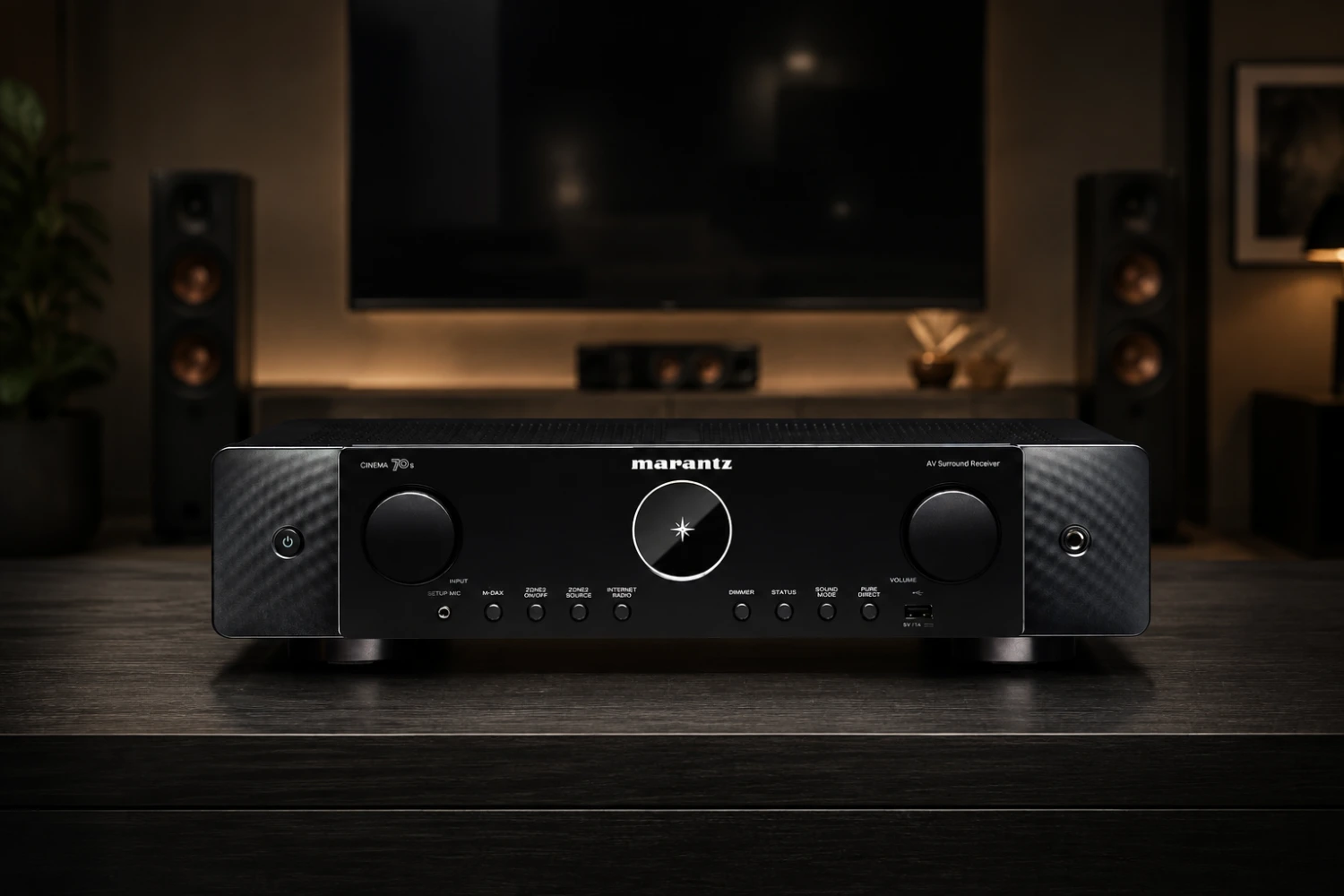
5. Marantz Cinema Series 2 Expands AV Receiver Lineup
The Marantz Cinema Series 2 family includes Cinema 50, Cinema 60, Cinema 60 DAB and slimline Cinema 70s receiver variants.
This entry covers a receiver family rather than one model.
The Marantz Cinema Series 2 comprises the Cinema 50 Series 2, Cinema 60 Series 2, Cinema 60 DAB Series 2 and slimline Cinema 70s Series 2, providing several chassis and system options within a shared design language.
Every model uses a newly developed eight-channel, 32-bit DAC architecture intended to perform high-resolution conversion simultaneously across its channels. The Cinema 50 Series 2 offers nine amplified channels and 11.4-channel processing, while the Cinema 70s Series 2 packages the revised conversion and connectivity platform in a lower-profile chassis. Preamplifier outputs are included for every channel across the range.
Best for: Buyers comparing several Marantz system sizes
- Eight-channel 32-bit DAC architecture across the range
- Full-channel preamplifier outputs
- Nine-channel amplification and 11.4 processing on Cinema 50 Series 2
- Slimline Cinema 70s Series 2 option
Verdict: A varied Marantz receiver family that spans nine-channel, more accessible and slimline configurations while retaining a common conversion platform.

6. Marantz SR7015: IMAX Enhanced 9.2-channel AV receiver
The Marantz SR7015 combines 9.2-channel amplification, IMAX Enhanced certification and Audyssey MultEQ XT32 room calibration.
The Marantz SR7015 is a 9.2-channel, IMAX Enhanced receiver supporting Dolby Atmos, DTS:X, Auro-3D and DTS Virtual:X.
It can accommodate a 7.1.4-channel Atmos arrangement when supplemented by an external stereo power amplifier.
Its video support includes 8K at 60 Hz, 4K at 120 Hz, HDR10+, Dolby Vision, Dynamic HDR, HLG and HDR10, along with QFT and ALLM. Marantz specifies 125 watts per channel into eight ohms, while Audyssey MultEQ XT32 manages speaker configuration and calibration. Network and USB playback include high-resolution audio and DSD at 2.8 or 5.6 MHz.
Best for: Immersive systems requiring broad format support
- 9.2-channel amplification
- Dolby Atmos, DTS:X and Auro-3D support
- 8K/60 Hz and 4K/120 Hz video handling
- Audyssey MultEQ XT32 calibration
Verdict: A feature-dense Marantz for ambitious multichannel installations, including 7.1.4 systems with added stereo amplification.

7. Pioneer VSX-835: Wallet-Friendly AV Receiver with 4K Ultra HD and 8K Resolution Support
The Pioneer VSX-835 is a seven-channel receiver supporting 5.2.2 playback, 8K HDMI signals and MCACC calibration.
The seven-channel Pioneer VSX-835 supports a 5.2.2 speaker configuration with Dolby Atmos and DTS:X decoding.
Dolby Atmos Height Virtualizer and DTS Virtual:X are also available for systems that need simulated height effects rather than physical ceiling speakers.
Pioneer's MCACC system provides automatic calibration, including attention to the subwoofer channel and 3D audio formats. Four HDMI inputs support 8K video, Dolby Vision and HDR10, and the receiver can upscale 1080p material to 4K. Its discrete power-amplifier design is also intended to operate reliably with four-ohm speakers.
Best for: Value-conscious 5.2.2 home theaters
- Seven channels for a 5.2.2 layout
- Dolby Atmos and DTS:X decoding
- Four HDMI inputs with 8K support
- MCACC automatic calibration
Verdict: A practical seven-channel foundation with immersive-audio decoding, modern video support and automatic speaker calibration.

8. ELAC Debut Reference DBR62: High-quality bookshelf speakers
The ELAC Debut Reference DBR62 uses a reinforced-fiber woofer, waveguided soft-dome tweeter and front Dual Flared Slot Port.
The ELAC Debut Reference DBR62 is a bookshelf speaker rather than an AV receiver.
Its two-way design uses a 6.5-inch reinforced-fiber bass driver in a revised basket intended to reduce resonances and front-panel vibration, paired with a one-inch soft-dome tweeter mounted in a new waveguide.
A front-mounted Dual Flared Slot Port is designed to reduce turbulent airflow noise, while the MDF enclosure uses internal bracing to suppress unwanted wall vibration. These speakers belong on the loudspeaker side of an AV system and therefore need to be partnered with suitable amplification and source electronics.
Best for: Bookshelf-based music and movie systems
- 6.5-inch reinforced-fiber bass driver
- One-inch soft-dome tweeter with waveguide
- Front-mounted Dual Flared Slot Port
- Internally braced MDF enclosure
Verdict: A carefully engineered passive bookshelf speaker to pair with appropriate amplification, not an alternative to an AV receiver's processing and connectivity.

9. Pioneer P2-K: Impressive music center that packs a punch
The Pioneer P2-K music center includes a network file player, stereo receiver and two-way speakers, with a 3.5-inch color display.
The Pioneer P2-K is a complete stereo music center rather than a surround receiver.
It combines two-way speakers with separate stereo-receiver and network-player units, replacing a conventional CD player with a source component designed for network files and high-resolution streaming, including DSD material.
The player's 3.5-inch color LCD displays track information, album artwork, folders and file lists. Its four-line limit may make navigation through a large library less convenient, but the system remains a self-contained option for listeners focused on network music rather than multichannel cinema.
Best for: Network-based stereo music libraries
- Separate network player and stereo receiver
- Two-way speakers included
- High-resolution and DSD file support
- Color display with album artwork
Verdict: A complete network-music package whose stereo focus and included speakers distinguish it clearly from a conventional AV receiver.

10. Yamaha MCR-N870: The most complete music center
The Yamaha MCR-N870 combines a stereo amplifier, network playback, CD, digital radio, MusicCast and a computer-ready USB DAC.
The Yamaha MCR-N870 is another stereo music center rather than a multichannel AV receiver.
Its source options include network and USB playback, CD, digital radio, Bluetooth, Wi-Fi and AirPlay, while MusicCast provides network integration and app-based control.
The included A-U670 amplifier has a USB DAC for computer connection. DLNA 1.5 support enables playback from computers and NAS devices, including FLAC and WAV files at up to 24-bit/192 kHz, with Ethernet and Wi-Fi available for network access.
Best for: All-in-one stereo music playback
- CD, USB, network and digital-radio playback
- Bluetooth, Wi-Fi and AirPlay
- MusicCast integration
- USB DAC in the included amplifier
Verdict: A broadly connected stereo music center for physical and network sources, but not a multichannel home-theater receiver.
Frequently asked questions
How many receiver channels do I need?
Match the receiver to the intended speaker layout.
A 5.2-channel model suits a conventional five-speaker system with up to two subwoofers, while seven channels can support layouts such as 5.2.2.
Nine-channel receivers allow more elaborate arrangements, although a 7.1.4 setup may still require external amplification, as specified for the Marantz SR7015.
Which HDMI features should I prioritize?
Check the number of compatible inputs before considering headline resolutions.
Buyers using newer displays, consoles or gaming computers may need 8K signal handling, 4K at 120 Hz, VRR, ALLM, QFT or eARC, but support differs between receivers and sometimes between individual HDMI sockets.
What does automatic room calibration do?
Systems such as Sony DCAC, Pioneer MCACC and Audyssey measure the connected speakers and adjust their configuration for the room.
They simplify initial setup and can address level, timing and tonal balance, but sensible speaker placement remains important.
Can powered speakers or a music center replace an AV receiver?
They can replace one in a compact stereo system, particularly for music or basic TV audio.
Products such as the Klipsch R-41PM, Pioneer P2-K and Yamaha MCR-N870 do not provide the same multichannel decoding, HDMI switching and surround-speaker expansion as a dedicated AV receiver.
How to narrow the choice
Begin with the required speaker layout.
The Sony STR-DH590 addresses relatively simple 5.2-channel installations, while the Denon AVC-X2850H and Pioneer VSX-835 provide seven-channel platforms.
The Yamaha RX-A3080 and Marantz SR7015 move into nine-channel territory, and the Marantz Cinema Series 2 offers several configurations within one product family. Next, audit every video source and display connection. Count the HDMI inputs that support the formats actually required rather than assuming all sockets have identical capabilities. Gaming-oriented systems should pay particular attention to 4K/120 Hz, VRR, ALLM and QFT, while TV-based installations may benefit from eARC. HDR compatibility should also be checked against the display and source equipment. Room correction and streaming can then separate otherwise similar candidates. Audyssey, MCACC and DCAC provide different automatic-calibration routes, while HEOS and MusicCast address network playback and multiroom integration. Power ratings should be treated cautiously because the quoted figures use different loads and operating conditions; speaker compatibility and appropriate system scale are more useful than comparing wattage alone. Finally, decide whether an AV receiver is genuinely necessary. The Klipsch R-41PM offers a compact powered stereo route, the ELAC DBR62 is a passive speaker for use with separate electronics, and the Pioneer and Yamaha music centers concentrate on two-channel playback. These can be sensible solutions for music and basic TV sound, but a dedicated receiver remains the appropriate hub when multichannel decoding, HDMI switching and expandable surround sound are priorities.



Sound Off
0Join the discussion if you have something to add.