

Choosing an amplifier starts with defining the job it needs to perform.
A traditional integrated amplifier combines source selection and power amplification, while a power amplifier requires a separate preamplifier.
Streaming amplifiers add network playback and digital conversion, compact headphone amplifiers serve personal listening systems, and active loudspeakers place amplification inside the cabinets. This selection reflects that breadth. It ranges from the pure Class A Musical Fidelity A1 and high-output NAD M23 to the network-ready Cambridge Audio EVO 150, portable DDHIFI TC44 Pro, and powered loudspeaker systems from Klipsch, Linn, and Steinway & Sons. Those active speakers are not substitutes for standalone amplifiers, but they are relevant for listeners who would rather buy a complete, amplification-inclusive system. Power ratings alone should not decide the purchase. Speaker impedance and sensitivity, room size, source requirements, analogue and digital connectivity, heat, system expansion, and physical dimensions all matter. The products below take notably different approaches, making careful matching more useful than choosing the largest number on a specification sheet.

1. Musical Fidelity A1: A piece of Hi-Fi history
The Musical Fidelity A1 integrated amplifier, built around a fully discrete and symmetrical pure Class A circuit.
The Musical Fidelity A1 revisits a historically significant integrated-amplifier design while retaining fully discrete, fully symmetrical pure Class A circuitry.
It delivers 25 watts into 8 ohms and can supply a maximum output current of 25 amps, with the ability to move into Class B operation when a temporary demand for additional current arises.
Its transformer follows the original concept but uses more efficient dual monorail windings, updated components, and improved thermal management. Independent power supplies for the left and right amplification stages are intended to improve power management and stereo imaging. The modest headline wattage makes speaker matching important, but the current capability gives the A1 more flexibility than its power rating might initially suggest.
Best for: Class A enthusiasts with carefully matched speakers
- Fully discrete, symmetrical Class A circuitry
- Independent supplies for left and right channels
- Maximum output current of 25 amps
- Updated transformer and thermal management
Verdict: The Musical Fidelity A1 is a distinctive integrated amplifier for listeners who value its pure Class A architecture and historic design philosophy over headline power.

2. Klipsch The Fives McLaren Edition: Limited Edition Bookshelf Speakers
Klipsch The Fives McLaren Edition powered bookshelf speakers with orange horn accents and carbon-fibre woofer cones.
Klipsch The Fives McLaren Edition is a powered bookshelf-speaker system rather than a conventional standalone amplifier.
Each driver has dedicated amplification: 60 watts for the carbon-fibre-cone woofer and 20 watts for the one-inch tweeter mounted in a Tractrix horn.
The two speakers operate in a master-and-slave arrangement, creating an amplification-inclusive system in a relatively compact format. McLaren-specific details include orange accents, a coordinated connecting cable, rubber bases, and the revised woofer cone. Buyers should approach The Fives as a complete speaker-and-amplifier package, not as electronics intended to drive separate passive loudspeakers.
Best for: Listeners seeking a compact powered speaker system
- Dedicated amplification for each driver
- Carbon-fibre woofer cone
- Tractrix horn-loaded one-inch tweeter
- Compact master-and-slave configuration
Verdict: The Fives McLaren Edition combines dedicated amplification and Klipsch horn technology in a visually distinctive alternative to a separate amplifier and passive speakers.
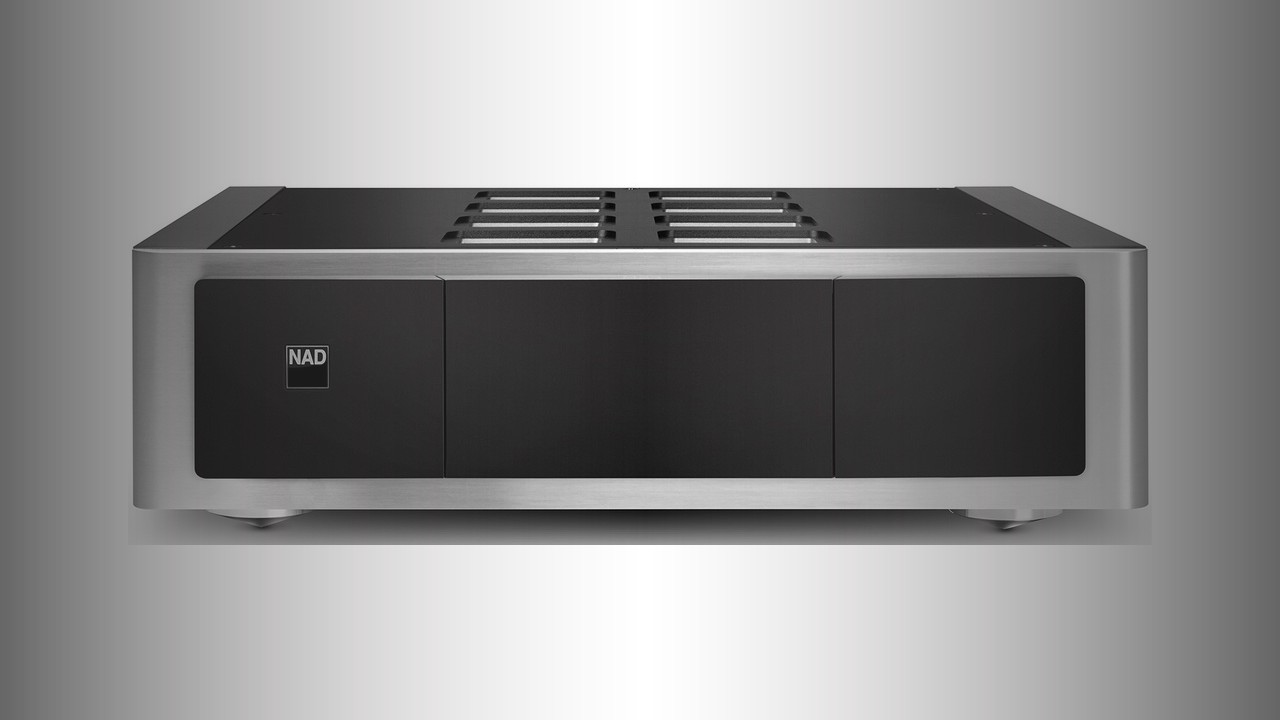
3. NAD M23: But unlike most Class D amplifier
The NAD M23 stereo power amplifier, featuring Purifi Eigentakt technology and optional bridged operation.
The NAD M23 is a stereo power amplifier using Eigentakt technology manufactured by NAD under licence from Purifi.
Rated to deliver at least 200 watts per channel, it also provides dynamic power exceeding 260 watts per channel into 8 ohms and 520 watts into 4 ohms.
NAD attributes its flat, wide, load-independent response and very low harmonic and intermodulation distortion to the Eigentakt implementation. Switch-mode power supplies and Class D output stages support high efficiency and consistent operation across different speaker loads. Bridged mode also allows the M23 to serve as an expansion partner for the NAD M33, although any bridged configuration requires careful system and speaker matching.
Best for: High-performance systems with demanding loudspeakers
- At least 200 watts per channel
- High dynamic power into 8- and 4-ohm loads
- Efficient Eigentakt Class D design
- Bridged operation available
Verdict: The NAD M23 pairs substantial power reserves with an efficient Class D architecture suited to ambitious systems and difficult speaker loads.

4. DDHIFI TC44 Pro: External DAC and amplifier for smartphones
The DDHIFI TC44 Pro portable DAC and headphone amplifier with aluminium construction and a 4.4 mm headphone output.
The DDHIFI TC44 Pro addresses mobile listening rather than loudspeaker amplification.
This nine-gram dongle combines a dual Cirrus Logic CS43131 digital-to-analogue stage with a headphone amplifier delivering up to 120 mW into 32 ohms.
It accepts PCM data up to 32-bit/384 kHz and native DSD256, and its 4.4 mm headphone output is joined to the board with silver solder. Separate USB-C and Lightning versions accommodate different source devices, while the aluminium-alloy body, carbon-fibre rear panel, and strap eyelet support portable use. Prospective buyers should confirm that their headphones use a compatible 4.4 mm connection.
Best for: Portable listening from compatible smartphones
- Dual Cirrus Logic CS43131 DAC chips
- Up to 120 mW into 32 ohms
- PCM and native DSD support
- Compact nine-gram construction
Verdict: The TC44 Pro is a highly compact DAC and headphone amplifier for listeners who need a 4.4 mm output and a choice of USB-C or Lightning connectivity.

5. Linn 360 Exakt Integrated and Passive loudspeakers launched
The Linn 360 loudspeaker range, offered in Exakt Integrated and Passive with Aktiv Bass configurations.
The Linn 360 range approaches amplification at the system level.
It includes the 360 Exakt Integrated and the 360 Exakt Passive with Aktiv Bass, both based on a four-way loudspeaker concept.
The driver complement comprises a 19 mm beryllium-dome tweeter, a 64 mm woven-carbon-fibre midrange dome, a 190 mm upper-bass driver, and a 220 mm low-frequency driver. Linn says its driver and amplification technologies are designed to reduce distortion, while Linn Power DAC technology contributes to low-frequency reproduction. Because the range includes integrated and partly passive configurations, buyers need to establish exactly where amplification is incorporated and what additional electronics their chosen version requires.
Best for: Listeners considering a Linn-centred active speaker system
- Four-way driver configuration
- Beryllium-dome tweeter
- Woven-carbon-fibre midrange driver
- Linn Power DAC bass technology
Verdict: The Linn 360 range is relevant to amplifier buyers who prefer a tightly integrated loudspeaker architecture rather than selecting every amplification stage separately.

6. Cambridge Audio EVO 150: 150W Class D Streaming Amp with ESS DAC, HDMI ARC, and Full Network Integration
The Cambridge Audio EVO 150 streaming amplifier with its large colour display and multifunction rotary control.
The Cambridge Audio EVO 150 combines Class D amplification, streaming, digital conversion, and broad network integration in one component.
Its ESS Sabre Reference ES9018K2M DAC handles PCM data up to 32-bit/384 kHz and DSD256, while network access is available through dual-band Wi-Fi or Ethernet.
Bluetooth 4.2 with aptX HD provides another wireless option, and HDMI ARC makes the amplifier easier to incorporate into a television-based system. A 6.8-inch colour display dominates the front panel, accompanied by a rotary-push control for volume, input selection, and menu navigation. This is the most overtly all-in-one amplifier in the selection, making it particularly relevant where fewer separate boxes are preferred.
Best for: Networked music and television systems
- Class D amplification rated at 150 watts
- Integrated network streaming
- ESS ES9018K2M DAC
- HDMI ARC and aptX HD connectivity
Verdict: The EVO 150 is a comprehensive streaming amplifier for buyers who want amplification, digital conversion, network playback, and HDMI ARC in a single chassis.

7. SMSL A50: Extremely compact Amplifier with Bluetooth 5.0
The compact SMSL A50 Class D amplifier, equipped with Bluetooth 5.0, equaliser presets, and tone controls.
The SMSL A50 is a compact Class D integrated amplifier based on two Texas Instruments TPA3116 chips.
It is rated at 60 watts per channel into 4 ohms or 33 watts per channel into 8 ohms, with both figures specified at 1% THD+N.
Bluetooth 5.0 enables wireless playback from a phone or tablet and can reconnect automatically to a previously paired device when the amplifier is switched on. Preset equaliser modes and manual bass and treble adjustment over a 14 dB range give users more control over tonal balance than a minimalist amplifier would provide. Its appeal lies in compactness, wireless convenience, and adjustment flexibility rather than elaborate system integration.
Best for: Compact systems needing Bluetooth and tone adjustment
- Compact Class D construction
- Bluetooth 5.0 with automatic reconnection
- Preset equaliser modes
- Adjustable bass and treble controls
Verdict: The SMSL A50 is a practical small-system amplifier with useful wireless playback and unusually flexible tonal controls.

8. Steinway & Sons Model D 15th Anniversary Edition: The anniversary version of the legendary acoustics
The Steinway & Sons Model D 15th Anniversary Edition active loudspeaker with integrated Class D amplification and RoomPerfect calibration.
The Steinway & Sons Model D 15th Anniversary Edition is a fully active flagship loudspeaker system, not a standalone amplifier.
Each speaker contains two 400-watt Class D amplifiers, a DSP-based active crossover, and Lyngdorf RoomPerfect automatic room calibration.
Four low-frequency drivers, two midrange drivers, and a ribbon tweeter operate in an open acoustic design. The aluminium frame and piano-lacquer panels reflect the visual connection with Steinway & Sons grand pianos. This architecture removes the need to choose an external power amplifier, but it also makes the amplification, crossover, room correction, and speakers part of a tightly integrated platform.
Best for: Fully active statement systems with room correction
- Two 400-watt Class D amplifiers per speaker
- DSP-based active crossover
- RoomPerfect automatic room calibration
- Multi-driver open acoustic design
Verdict: The Model D 15th Anniversary Edition is a highly integrated active loudspeaker for buyers who want amplification, DSP, crossover control, and room calibration engineered as one system.

9. Unison Research Triode 25 Black Edition: Tube Integrated Amplifier with Bronze Finish
The Unison Research Triode 25 Black Edition valve integrated amplifier in black with contrasting bronze details.
The Unison Research Triode 25 Black Edition is a valve integrated amplifier distinguished by a polished black front panel, dark anodised chassis, and bronze accents.
The manufacturer says the Black Edition circuit has been refined through work on the signal path, power supply, grounding, and physical separation of the channels.
High-quality shielded cables are used for the audio signal where feasible, while the input selector relies on electromagnetic relays. Adjustable bias, two feedback settings, and selectable triode and output-stage configurations give the amplifier a more hands-on operating character than a set-and-forget solid-state design. At 20 kg, it also requires a suitably stable and well-ventilated support.
Best for: Valve enthusiasts who value configuration flexibility
- Selectable output-stage configurations
- Adjustable bias voltage
- Two feedback settings
- Refined grounding and channel separation
Verdict: The Triode 25 Black Edition combines traditional valve amplification with adjustable operating parameters and a carefully revised internal layout.
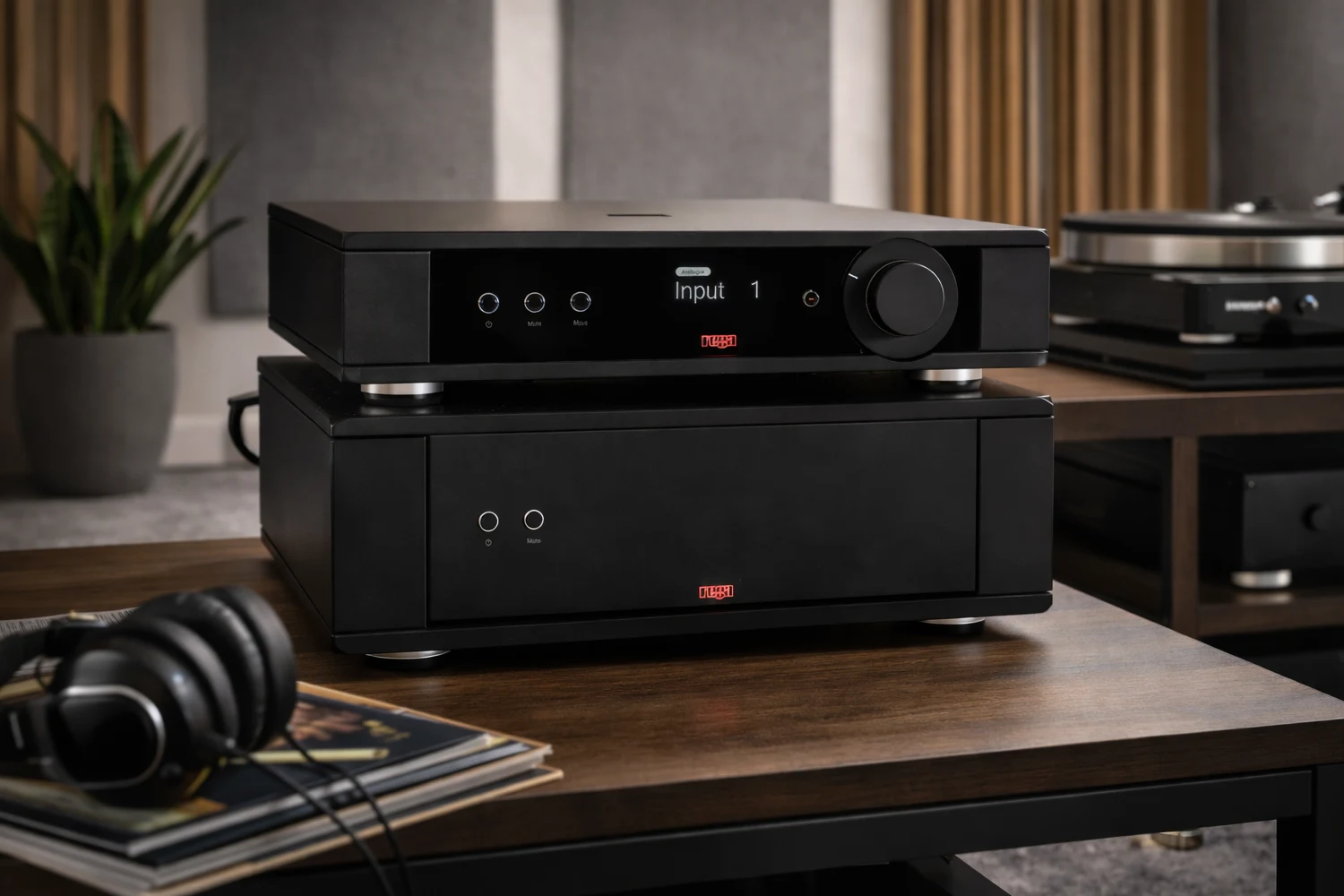
10. Rega Mercury & Solis: British-Built High-End Preamplifier and Power Amplifier
The Rega Mercury preamplifier and Solis stereo power amplifier, designed as a technically matched high-end separates pairing.
Rega designed the Mercury preamplifier and Solis stereo power amplifier as a technically matched, separately housed pair.
The Solis uses a fully symmetrical and fully discrete signal path, delivering 168 watts per channel into 8 ohms and 305 watts per channel into 4 ohms.
Its internal layout physically separates sensitive low-voltage circuitry from the high-current output stage to reduce interference. Balanced XLR and unbalanced inputs, a 12-volt trigger, and protection against short circuits, thermal overload, and DC offset support integration into a serious separates system. The Mercury provides the corresponding preamplifier stage, with an analogue core and digital flexibility, making the pairing more modular than an all-in-one integrated amplifier.
Best for: Audiophile systems built around separate components
- Matched preamplifier and power-amplifier design
- Fully discrete, symmetrical Solis circuitry
- Balanced and unbalanced Solis inputs
- Short-circuit, thermal, and DC protection
Verdict: The Rega Mercury and Solis pairing offers a modular pre-power route with substantial rated output and careful separation of low-level and high-current circuitry.
Frequently asked questions
How much amplifier power do I actually need?
Power requirements depend on speaker sensitivity and impedance, listening distance, room size, and preferred volume.
Do not compare wattage figures without checking the stated load and test conditions: the SMSL A50, for example, has different ratings into 4 and 8 ohms, while the NAD M23 and Rega Solis specify substantial output into both loads.
What is the difference between an integrated amplifier and a power amplifier?
An integrated amplifier combines source control and power amplification in one chassis, as represented by the Musical Fidelity A1 and Unison Research Triode 25 Black Edition.
A power amplifier such as the NAD M23 or Rega Solis needs a separate preamplifier or another component with suitable volume control and source selection.
Should I choose Class A, Class D, or a valve amplifier?
Choose according to the complete system rather than the class label alone.
The Class A Musical Fidelity A1 has modest rated power and requires attention to heat and speaker matching; Class D designs such as the NAD M23 prioritise efficiency and power; and the valve-based Unison Research offers adjustable operating parameters but demands a more involved ownership approach.
Can active speakers replace a separate amplifier and passive speakers?
Yes, if their connectivity and system architecture suit your sources.
Klipsch The Fives, Linn 360 Exakt Integrated, and Steinway & Sons Model D incorporate amplification into the speaker system, reducing the need to match a separate power amplifier but limiting the ability to change speakers and amplification independently.
How to choose the right amplification route
Begin by deciding whether you need a conventional integrated amplifier, a separate pre-power system, a streaming amplifier, a headphone dongle, or active loudspeakers.
These categories solve different problems.
The Cambridge Audio EVO 150 consolidates streaming, digital conversion, HDMI ARC, and amplification, while the Rega Mercury and Solis divide control and power duties between separate chassis. The DDHIFI TC44 Pro is intended for headphones and smartphones rather than passive loudspeakers, and the Klipsch, Linn, and Steinway & Sons models include amplification as part of their speaker architecture. For passive speakers, verify impedance, sensitivity, and recommended amplifier power before buying. The Musical Fidelity A1 illustrates why wattage is not the only consideration: its 25-watt Class A rating is accompanied by notable current capability, but it still needs thoughtful matching. The NAD M23 and Rega Solis provide considerably more rated output for systems requiring greater reserves. When comparing figures, check whether they are continuous or dynamic ratings and note the impedance at which they were measured. Connectivity should reflect both present and likely future sources. HDMI ARC is useful when a television forms part of the system, network streaming can eliminate an external source component, balanced inputs may suit longer cable runs or compatible separates, and Bluetooth offers convenience without replacing every wired or network option. Physical considerations matter as well: allow ventilation for amplifiers that generate significant heat, confirm shelf dimensions and weight limits, and ensure that controls and displays remain accessible. Finally, treat system compatibility as more important than any single specification. A compact Bluetooth amplifier, a pure Class A design, a high-output Class D power amplifier, and an active DSP-controlled loudspeaker can all be sensible choices, but only when their power, connections, format support, and operating requirements match the intended system.



Join the discussion
Share your thoughts, listening impressions or product experience.