Mulidine Alma: A Compact Bookshelf Speaker with Serious Engineering Intent
Mulidine’s Alma is a compact two-way bookshelf speaker from the Romantique series, combining a teardrop-shaped cabinet, AMT high-frequency driver, isobaric bass arrangement, and premium copper terminals in a format aimed at carefully matched hi-fi systems.

The Mulidine Alma is a bookshelf loudspeaker that appears designed to do more than simply fit into a smaller room or onto a stand. As part of the French company’s Romantique series, it brings together several choices that point toward a considered, compact high-end monitor: a low and deep cabinet without parallel edges, a two-way driver layout, an AMT ribbon-type high-frequency unit, and an isobaric low-frequency arrangement using two 130 mm ceramic-cone drivers, one of which is mounted inside the enclosure. On paper, the Alma is not a casual plug-and-play speaker for any amplifier. Its 86 dB sensitivity and 4-ohm nominal impedance indicate that it is intended to be partnered with a sufficiently capable, stable amplifier. For the listener planning a focused two-channel system around compact loudspeakers, those details are central to understanding the Alma’s appeal.
A compact cabinet with a deliberate shape
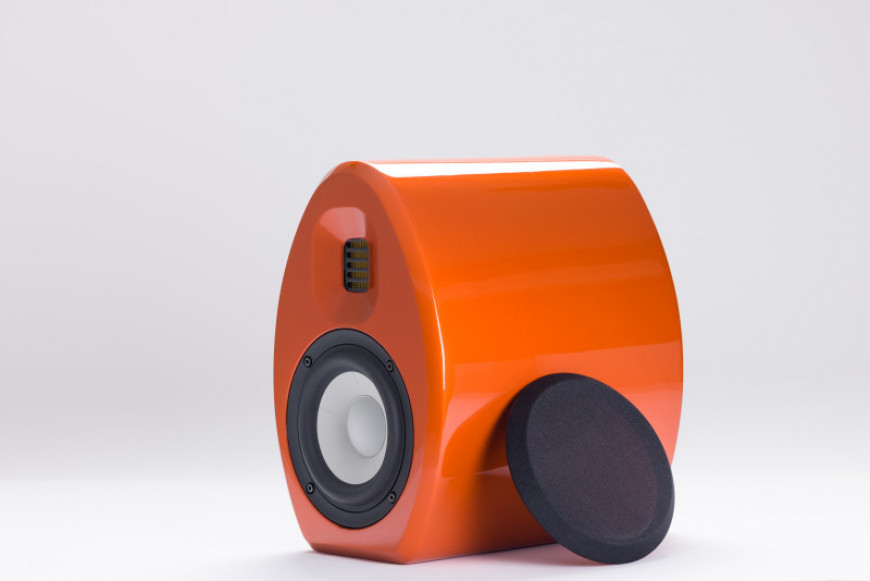
The Alma’s cabinet is one of its most distinctive documented features. Rather than using a conventional rectangular box, Mulidine has chosen a low, deep, teardrop-shaped enclosure without parallel edges. This matters because loudspeaker cabinets are not just containers for drivers; their shape and internal geometry can influence how energy behaves inside the box. Parallel walls can encourage standing waves, while more complex geometry is often used to reduce the predictability of internal reflections.
The proportions are also notable. At 300 x 200 x 308 mm, the Alma is compact in frontal area but relatively deep for a bookshelf design. That gives it the visual character of a small monitor while allowing the cabinet volume and internal layout needed for its driver system. The 10.8 kg weight per speaker suggests a physically substantial product for its size, which may be relevant for owners choosing stands, shelves, or furniture capable of supporting it securely.
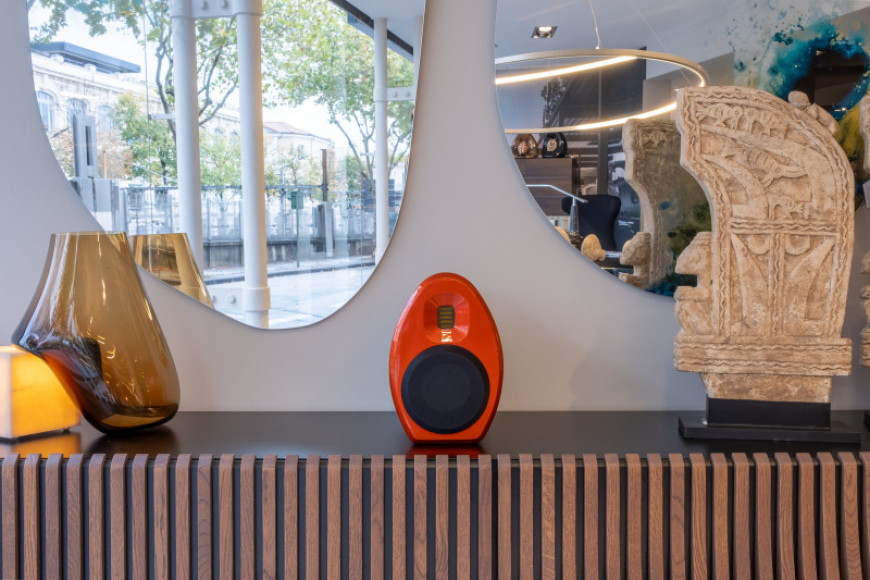
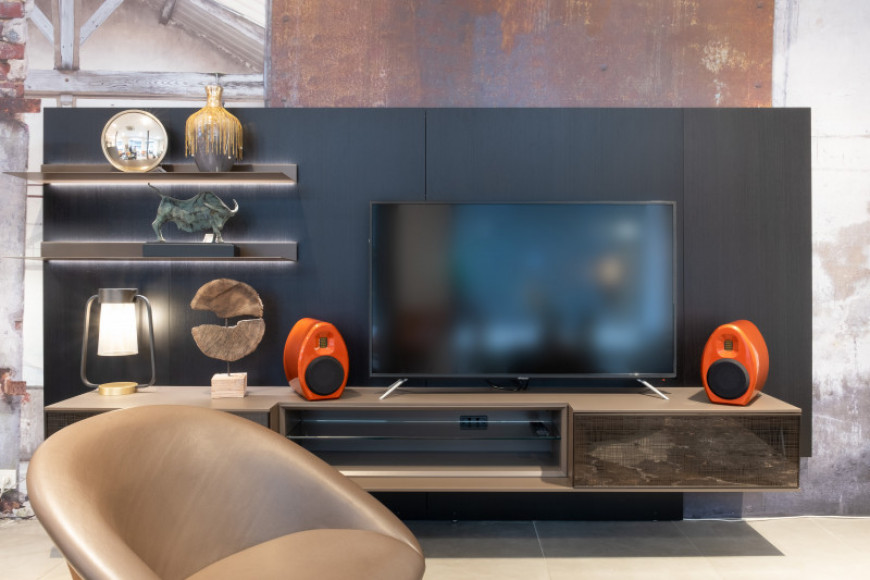
The teardrop form also gives the Alma a more sculptural identity than many traditional bookshelf speakers. While finish preference is personal, the availability of six colors gives system builders more latitude when integrating the speakers into a living room, dedicated listening space, or design-led interior. For a product likely to be placed prominently in a room, that flexibility is not trivial.
AMT high frequencies in a two-way architecture
The Alma is a two-way loudspeaker, with high frequencies handled by an AMT, or Air Motion Transformer, driver. An AMT is often described as ribbon-like in operation, although its folded diaphragm works differently from a simple ribbon. Instead of moving like a conventional dome, the pleated diaphragm squeezes and expands air as it operates. The key point for a prospective owner is that Mulidine has selected a high-frequency technology associated with low moving mass and a different radiation and motion principle from common dome tweeters.
In a compact two-way speaker, the high-frequency driver has an especially important role. It must integrate with the mid-bass section while covering the upper range cleanly and consistently. The use of an AMT therefore helps define the Alma’s technical character. Without making claims about how the speaker sounds in practice, it is fair to say that this is a more specialized choice than fitting a basic dome tweeter, and it signals that the high-frequency system is a central part of the design brief.
The two-way layout also keeps the speaker conceptually simple. There is one high-frequency section and one low-frequency/midrange section, rather than a more complex three-way array. For compact speakers, that can be an advantage in terms of cabinet size and system integration, provided the crossover and driver matching are executed appropriately by the manufacturer.
Isobaric bass loading in a small enclosure
For the lower frequency range, the Alma uses two 130 mm ceramic-cone drivers in an isobaric arrangement, with the second driver located inside the cabinet. This is one of the most technically interesting aspects of the speaker. In an isobaric configuration, two bass drivers are used together so that they work as a coupled system rather than as two separate outward-facing woofers. The visible external driver is supported by a second internal driver, allowing the design to pursue bass performance from a comparatively compact enclosure.
This kind of solution is more complex than simply placing a single mid-bass driver on the front baffle. It requires additional driver cost, more internal engineering, and careful cabinet planning. The benefit for the owner is not a guaranteed sound signature, but a clear indication that Mulidine is using enclosure and driver architecture to address the constraints of a compact bookshelf speaker. Small speakers face unavoidable physical limits, and an isobaric system is one way designers can work within those limits while maintaining a manageable cabinet size.
The use of ceramic cones for the 130 mm drivers is another meaningful material choice. Ceramic diaphragms are typically selected for their stiffness and controlled behavior, though the final result depends on the complete driver, crossover, and enclosure system. In the Alma, the material choice sits alongside the isobaric loading as part of an engineering-led approach to the low-frequency section.
Connection hardware chosen for signal integrity
On the rear panel, the Alma is fitted with screw terminals from ETI Research. These are made entirely of copper and plated with gold. Speaker terminals are not the most glamorous part of a loudspeaker, but they form the physical interface between amplifier and speaker cable, and their quality affects long-term usability as much as initial setup.
Copper is used for its conductivity, while gold plating is commonly applied to resist oxidation at the contact surface. The inclusion of branded, all-copper ETI Research terminals suggests attention to the supporting hardware around the drivers and cabinet, rather than treating the binding posts as an afterthought. For users who regularly experiment with cables, reposition systems, or maintain equipment over many years, robust and well-specified terminals can make ownership more reassuring.
The source information describes screw terminals for speaker wires, so buyers should expect a traditional passive-speaker connection rather than built-in amplification, streaming, or wireless functionality. That positions the Alma firmly within conventional component hi-fi, where amplifier choice, cable routing, stand selection, and room placement remain part of the setup process.
Amplifier matching deserves attention
The Alma’s published electrical figures are important. With sensitivity specified at 86 dB and nominal impedance at 4 ohms, this is not a speaker that should be assumed to thrive on any low-powered or marginally stable amplifier. The low sensitivity means it will generally require more amplifier power to reach a given level than a more sensitive design, while a 4-ohm nominal impedance asks more current capability from the amplifier than an easier 8-ohm load.
This does not make the Alma impractical, but it does make system matching more important. A prospective owner should consider an amplifier that is comfortable driving 4-ohm loudspeakers and has enough power reserve for the intended room size and listening habits. The speaker’s compact dimensions might suggest an easy desktop-style load, but the specifications point toward more serious amplification.
This is also part of the Alma’s identity. It is a compact passive loudspeaker for owners who are prepared to build a system around it, not an all-in-one lifestyle speaker. That can be attractive to hi-fi enthusiasts who value the ability to choose their own amplification and source components, but it is less suited to buyers seeking a minimal, self-contained audio solution.
Who the Mulidine Alma is most suitable for
The Alma is likely to make the most sense for listeners who want a compact speaker with unusual engineering rather than a conventional rectangular bookshelf design. Its combination of AMT high-frequency driver, isobaric low-frequency section, ceramic-cone bass drivers, and non-parallel teardrop cabinet gives it a distinctive technical profile within the passive monitor category.
It should also suit owners who are willing to think carefully about setup. The depth and weight of the cabinet make stand or furniture choice important, while the 4-ohm nominal impedance and 86 dB sensitivity make amplifier selection a key part of the ownership equation. Those already using, or planning to buy, a stable and sufficiently powerful integrated amplifier or power amplifier will be better positioned to take advantage of what the design offers.
The Alma may be less appropriate for someone seeking a very easy-to-drive speaker, a low-cost entry point, or a speaker with built-in streaming and amplification. It is also not aimed at buyers who judge compact speakers mainly by how small they look from the front; its deeper cabinet and substantial weight are integral to the design. Instead, it is best understood as a compact high-end passive loudspeaker for a considered two-channel system.
Conclusion
The Mulidine Alma stands out through a set of documented design choices that are purposeful rather than decorative: a low, deep teardrop cabinet without parallel edges, an AMT high-frequency driver, an isobaric bass system using two 130 mm ceramic-cone drivers, and quality copper-and-gold ETI Research terminals. Its compact dimensions make it suitable for rooms and systems where floorstanding speakers may not be ideal, but its 86 dB sensitivity and 4-ohm nominal impedance mean it deserves capable amplification. For listeners building a serious passive hi-fi system around compact loudspeakers, and for those who value distinctive cabinet design and thoughtful driver architecture, the Alma is a carefully specified option within Mulidine’s Romantique series.