Weiss Helios Brings Professional Digital Architecture Home
Weiss Engineering’s Helios is more than a digital-to-analog converter. Its combination of proprietary DSP, network playback, volume control and headphone facilities allows it to serve as the digital center of a high-end audio system.

The Weiss Helios reflects a distinctly professional approach to domestic digital audio. Rather than treating conversion, streaming, signal processing and volume control as jobs for separate components, Weiss Engineering brings them together on a common platform. The result is a flagship DAC that can also operate as a preamplifier, network playback endpoint and headphone amplifier. Its appeal lies not in a single headline specification, but in the way its architecture supports several different listening arrangements. Multiple digital input formats, balanced and unbalanced outputs, sampling-rate support up to 384 kHz, compatibility with DSD64 and DSD128, and browser-based configuration give owners considerable freedom when building or simplifying a system. Inside, parallel conversion channels, proprietary discrete operational-amplifier modules and a high-precision clock generator demonstrate the engineering attention given to the signal path.
A conversion architecture built around parallel channels
At the center of the Helios is an eight-channel, 32-bit DAC implementation. Four conversion channels operate in parallel for each of the two audio channels. This is a more elaborate arrangement than simply assigning one DAC channel to the left output and another to the right, and it distinguishes the Helios from Weiss Engineering’s DAC501 and DAC502, despite the three models sharing the same underlying digital audio platform.
The distinction is important for prospective owners comparing products within the Weiss range. Helios is not merely a differently packaged version of those models: it has its own D/A converter and analog output section. All analog processing is handled by Weiss OP2-BP proprietary discrete operational-amplifier modules. The published design also includes an internal high-precision, low-jitter clock generator intended to provide stable timing for the conversion circuitry. Together, these choices show where Weiss has concentrated its hardware development: conversion, clocking and the analog stages that follow the digital section.
Professional DSP adapted for a home system
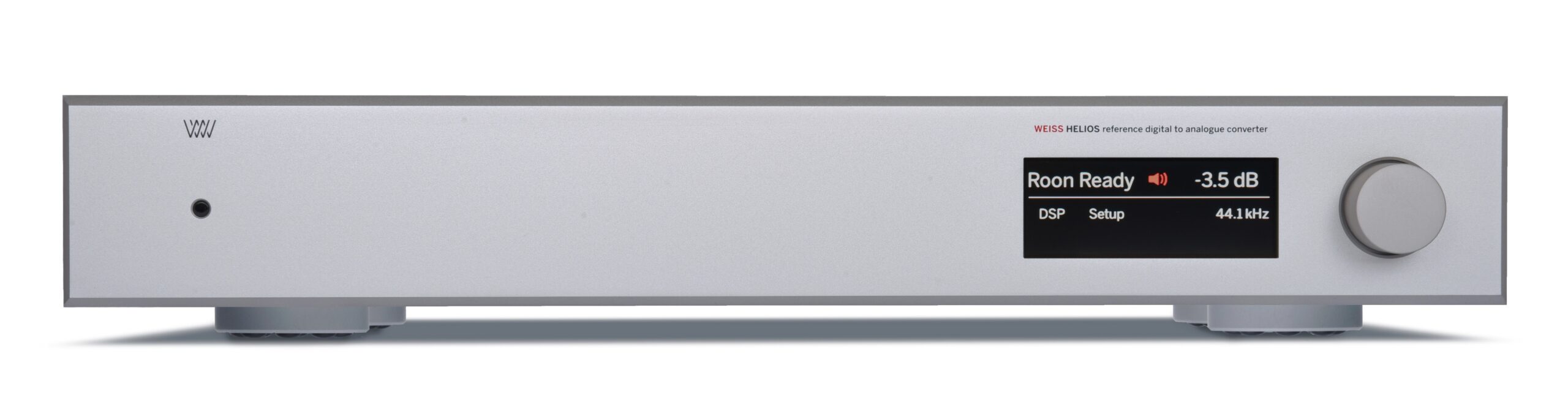
Digital signal processing is a central part of the Helios rather than a peripheral convenience. Its algorithms were developed by Weiss Engineering and are also used in the company’s professional audio tools. This gives home users access to processing based on the same technical platform used in production environments, while keeping those facilities inside the DAC.
The processing can be configured differently for speaker and headphone use. That distinction is practical because the requirements of a loudspeaker system do not necessarily match those of personal listening. Instead of forcing one group of settings across every output, the Helios allows processing to be adjusted according to the active listening mode. DSP presets can be selected from the remote control, while more detailed processing and preset configuration is available through a web browser. This combination keeps routine operation accessible without limiting deeper setup options.
DAC, preamplifier and headphone hub
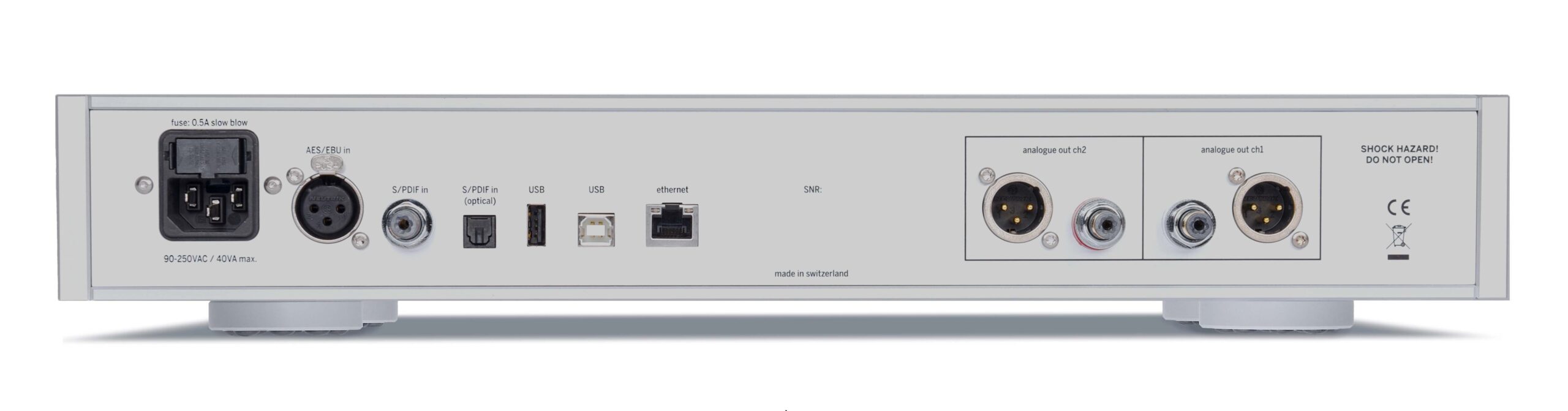
The Helios can serve as more than a source component. Its balanced XLR and unbalanced RCA outputs can connect directly to amplifier line inputs, allowing the unit to function as a preamplifier in an all-digital system. For an owner who does not need analog source switching, this can reduce component count and shorten the path between digital sources and a power amplifier or active loudspeakers.
A built-in headphone output and dedicated headphone amplification extend that flexibility to personal listening. The ability to move between speaker and headphone modes, including corresponding DSP settings, makes the Helios relevant to systems in which both are used regularly. It also means a separate headphone amplifier may not be necessary, depending on the owner’s connectivity and system requirements. Crucially, these functions are integrated into one control architecture rather than added as unrelated features.

Broad digital access and network playback
The Helios accepts digital sources in multiple formats and supports standard sampling rates up to 384 kHz, along with DSD64 and DSD128. That coverage makes it suitable for systems assembled from varied digital sources and libraries, without making any particular high-resolution format mandatory.
Network playback is addressed through UPnP streaming and Roon integration. These options allow the Helios to participate in a network-based music system as well as accommodate conventionally connected digital hardware. Roon users can incorporate it into an established Roon environment, while UPnP provides another route to music stored and served across a home network. Combining streaming and physical digital inputs makes the unit useful to listeners whose collections span local files, network libraries and separate source components.

Two levels of control
Weiss provides both immediate and detailed ways to operate the Helios. The supplied infrared remote handles frequently used functions, including selecting active inputs and outputs, choosing DSP presets, switching the unit on or off and making routine adjustments. This helps the Helios behave like a conventional hi-fi component during everyday listening.
For configuration beyond those regular commands, the browser interface provides access to DSP management and preset setup. A browser-based approach avoids placing every adjustment on the front panel or remote, while giving users a larger and more familiar interface for complex settings. It also supports the Helios’s dual identity: operation can remain straightforward after setup, but owners who want to explore its processing capabilities retain more extensive control.

Physical construction with a layered approach
The enclosure follows a double-frame design. A stainless-steel inner frame forms the internal structure, while a robust aluminum outer frame completes the chassis. This layered construction is intended to provide durability and stability while giving the Helios the substantial physical format expected of a flagship home component.
The design also reflects the product’s movement from Weiss Engineering’s professional background into domestic hi-fi. Its internal architecture draws on technology associated with the company’s studio products, but the enclosure, remote operation and browser controls address the practical expectations of a home installation. Helios is therefore positioned as a domestic component informed by professional engineering rather than as studio hardware placed unchanged in a listening room.
Who the Weiss Helios is most suitable for
The Helios is most relevant to listeners building a predominantly digital system and looking for one component to manage conversion, volume control, streaming, signal processing and headphones. It should be particularly attractive to owners of power amplifiers or active loudspeakers who want to connect a digital front end directly, as well as Roon or UPnP users seeking network playback within the same device.
Its extensive DSP and browser configuration also suit users who value system tailoring and reusable presets. Conversely, someone who relies heavily on analog sources may require additional switching or preamplification not documented here. Listeners who want only a basic DAC, with no need for streaming, headphone operation or digital processing, may also find that much of the Helios’s architecture goes unused. Its strongest case is therefore made in an integrated digital system where its multiple roles can replace several separate components.
Conclusion
The Weiss Helios stands out through the depth and integration of its documented engineering. Its eight-channel, 32-bit conversion arrangement uses four parallel DAC channels per stereo channel, supported by proprietary discrete analog modules and a high-precision clock generator. Yet its practical scope is equally significant: multiple digital inputs, support for PCM up to 384 kHz and DSD64/128, UPnP and Roon integration, preamplifier operation, headphone amplification and configurable DSP all reside in one chassis. Remote control keeps daily use manageable, while browser access opens the more detailed settings. For listeners seeking a configurable digital centerpiece with professional technology, network playback and both speaker and headphone functionality, Helios presents a notably comprehensive approach.