
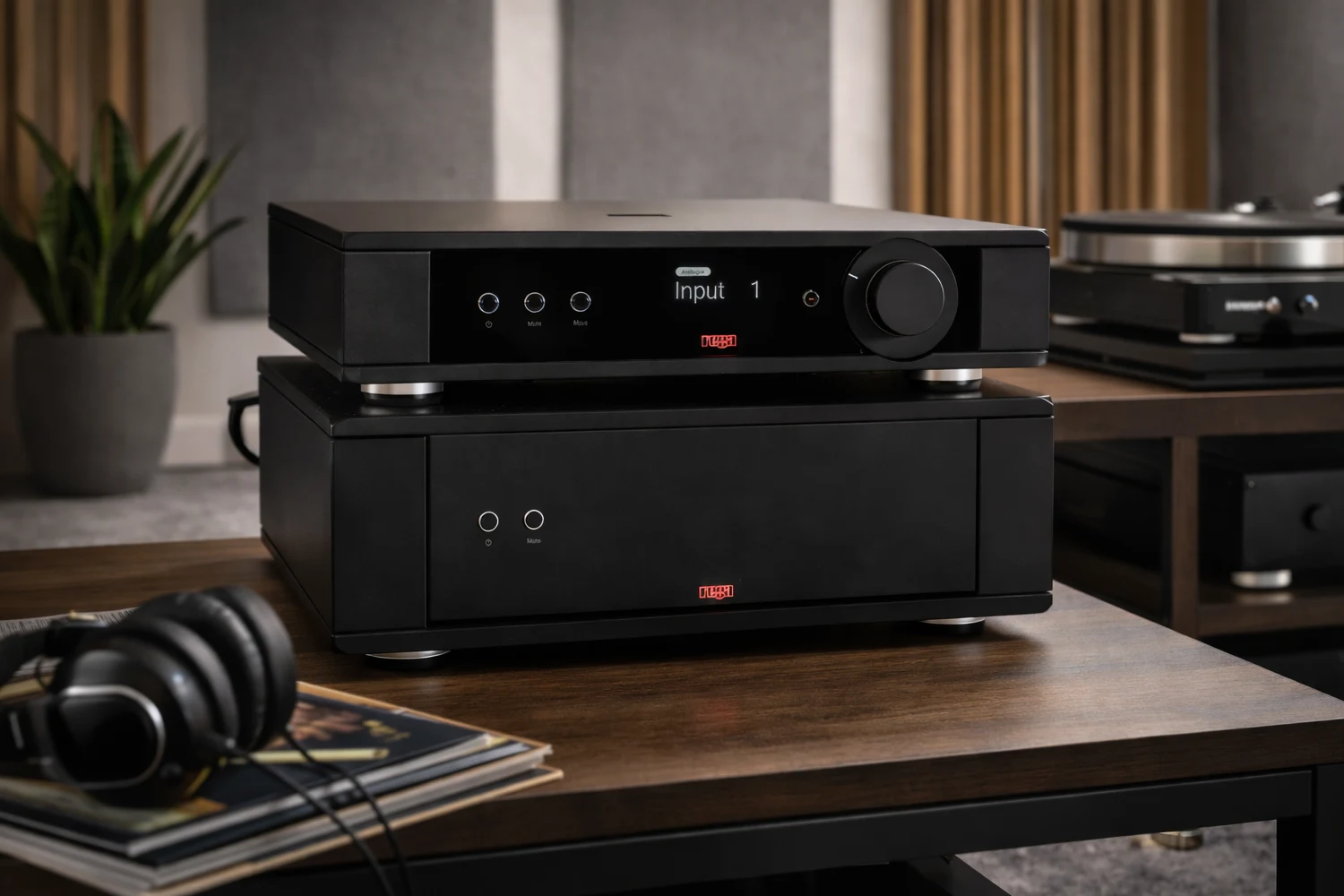
The Rega Mercury preamplifier and Solis stereo power amplifier are not simply two separate components launched at the same time. They are presented as a technically matched pair, designed and manufactured in England for systems where the preamplifier and power amplifier are expected to perform distinct but complementary roles. The Solis supplies the current and speaker-driving capability, while the Mercury acts as the system’s control hub, combining an analogue preamplifier architecture with digital input support and headphone listening. What makes the pairing interesting is not one headline feature alone, but the way Rega has combined traditional analogue circuit priorities with the practical needs of contemporary source-heavy systems.
A matched pre/power concept
Separating preamplification and power amplification remains attractive for many serious hi-fi systems because it allows each component to be optimized for its own job. The preamplifier handles source selection, volume control, signal management, and, in the Mercury’s case, digital conversion. The power amplifier can then be built around output delivery, load stability, thermal behavior, and protection. Rega’s decision to develop the Mercury and Solis as a natural pairing gives the system a clear engineering identity rather than treating the two boxes as unrelated electronics.
For prospective owners, this approach can be useful when building a system around demanding loudspeakers or multiple sources. The Mercury provides centralized control, while the Solis concentrates on delivering power to the speakers. That separation also creates a pathway for users who prefer a more modular system than an integrated amplifier can offer, while still keeping the electronics within one manufacturer’s design language.
Fully discrete, symmetrical analogue circuits
Both the Mercury and Solis are based around fully discrete, symmetrical circuit designs in their analogue signal paths. In practical terms, a fully discrete approach means the circuits are built from individual components rather than relying primarily on integrated amplifier chips for the main signal path. This can give a manufacturer more control over layout, component choice, and circuit behavior, although the result depends heavily on execution.
The symmetrical aspect is also central to Rega’s stated design direction. In the Solis power amplifier, the signal path is described as fully symmetrical and fully discrete throughout. Rega says this has been chosen to support signal purity and stability under load. In the Mercury preamplifier, the same design philosophy is used for the analogue stage, where the goal is a very low noise floor and wide dynamic range. For users assembling high-resolution systems, that emphasis on low-level signal integrity may be especially relevant, because the preamplifier often determines how cleanly source information is passed downstream.

Solis power amplifier: output capability with system flexibility
The Solis is rated at 168 watts per channel into 8 ohms and 305 watts per channel into 4 ohms. Those figures position it as a substantial stereo power amplifier within Rega’s electronics range, and they indicate that it has been designed with more than easy-to-drive loudspeakers in mind. The higher output into 4 ohms is particularly relevant because many loudspeakers present lower impedance loads at certain frequencies, even if their nominal rating suggests otherwise.
Power ratings do not describe everything about amplifier behavior, but they do help prospective owners understand intended use. A stereo amplifier with this level of rated output is suited to systems where headroom, speaker control, and compatibility with a broader range of loudspeaker designs are priorities. The inclusion of both balanced XLR and unbalanced inputs also supports flexible system matching. Owners using the Mercury can connect in the manner Rega intended, while those integrating the Solis into an existing system have more connection options.
Internal layout designed to reduce interference
One of the more distinctive documented aspects of the Solis is its physical separation of circuit areas inside the chassis. Rega places the sensitive low-voltage circuitry and the high-current output stage in distinct housing sections. This is not an ornamental detail; it addresses a practical issue in power amplifier design. Low-level input and voltage gain stages can be vulnerable to interference from high-current sections, transformer activity, and output-stage demands.
By separating these areas, the Solis is designed to help maintain a cleaner signal environment inside the amplifier. For an owner, the benefit is not something that should be reduced to a simple specification, but it does reveal a deliberate approach to layout discipline. The inclusion of protection circuits against short circuits, thermal overload, and DC offset also adds an important layer of operational security, especially in systems using valuable loudspeakers or in installations where the amplifier may be used for long listening sessions.

Mercury preamplifier: analogue control with digital reach
The Mercury is fundamentally an analogue preamplifier, but it has been designed for systems that are unlikely to be analogue-only. Its integrated digital section is built around a high-performance DAC, and its inputs include S/PDIF as well as a galvanically isolated, asynchronous USB connection. This allows the Mercury to accept digital sources directly, including computer-based audio via USB, without requiring a separate external DAC in every installation.
The galvanic isolation of the USB input is a meaningful design choice because USB connections can carry electrical noise from computers or other digital devices. Isolation is intended to help separate the audio circuitry from such unwanted electrical interaction. Asynchronous USB operation is also important in modern DAC design because it allows the receiving audio device to manage timing rather than simply following the source device’s clock. Rega has not presented the Mercury merely as a line-level analogue controller; it is meant to serve as the command center for mixed analogue and digital systems.
Headphone listening and day-to-day control
The Mercury also includes a discrete headphone amplifier. That matters because headphone listening is no longer a secondary use case for many hi-fi owners. A dedicated headphone stage within the preamplifier makes it possible to listen privately without adding another box to the rack, and the fact that it is described as discrete places it in line with the Mercury’s broader circuit philosophy.
Usability is supported by a clean, minimalist front panel with an integrated IPS color display. This is a practical combination: the visual presentation remains restrained, while the display can provide useful feedback during source selection and system operation. Control is available from the front panel or through Rega’s backlit Orbit remote control. A backlit remote is a small but valuable feature in real-world listening rooms, where low light is common and frequently used controls should be easy to identify without disrupting the session.

Connectivity and integration in a serious system
Taken together, the Mercury and Solis offer a connectivity set that reflects both conventional hi-fi practice and newer source habits. The Solis accepts balanced and unbalanced inputs, giving users options depending on cable runs, partnering equipment, and preferred system configuration. The 12V trigger input is also a practical inclusion, allowing the amplifier to be powered on and off in step with compatible control components rather than being managed manually every time.
On the Mercury side, the combination of analogue preamplification, S/PDIF digital inputs, isolated asynchronous USB, headphone output, display, and remote control makes it more than a minimalist line stage. It is intended to reduce the number of support components required around it, especially for listeners who use both traditional digital transports and computer audio. For many owners, the appeal will be the ability to keep the system orderly while still accommodating several source types.
Conclusion
The Rega Mercury and Solis are most suitable for listeners building a serious two-channel system around separate amplification, multiple sources, and loudspeakers that may benefit from substantial rated power. They will particularly appeal to owners who value British manufacture, discrete symmetrical analogue circuit design, balanced and unbalanced connectivity, digital input flexibility, integrated headphone listening, and practical control features. They are less likely to be the right fit for someone seeking a compact all-in-one amplifier or a system with the lowest possible box count. Their strongest documented qualities are their matched pre/power architecture, careful circuit and layout priorities, robust Solis output rating, versatile Mercury source handling, and Rega’s lifetime warranty against manufacturing defects.



Sound Off
0Join the discussion if you have something to add.