

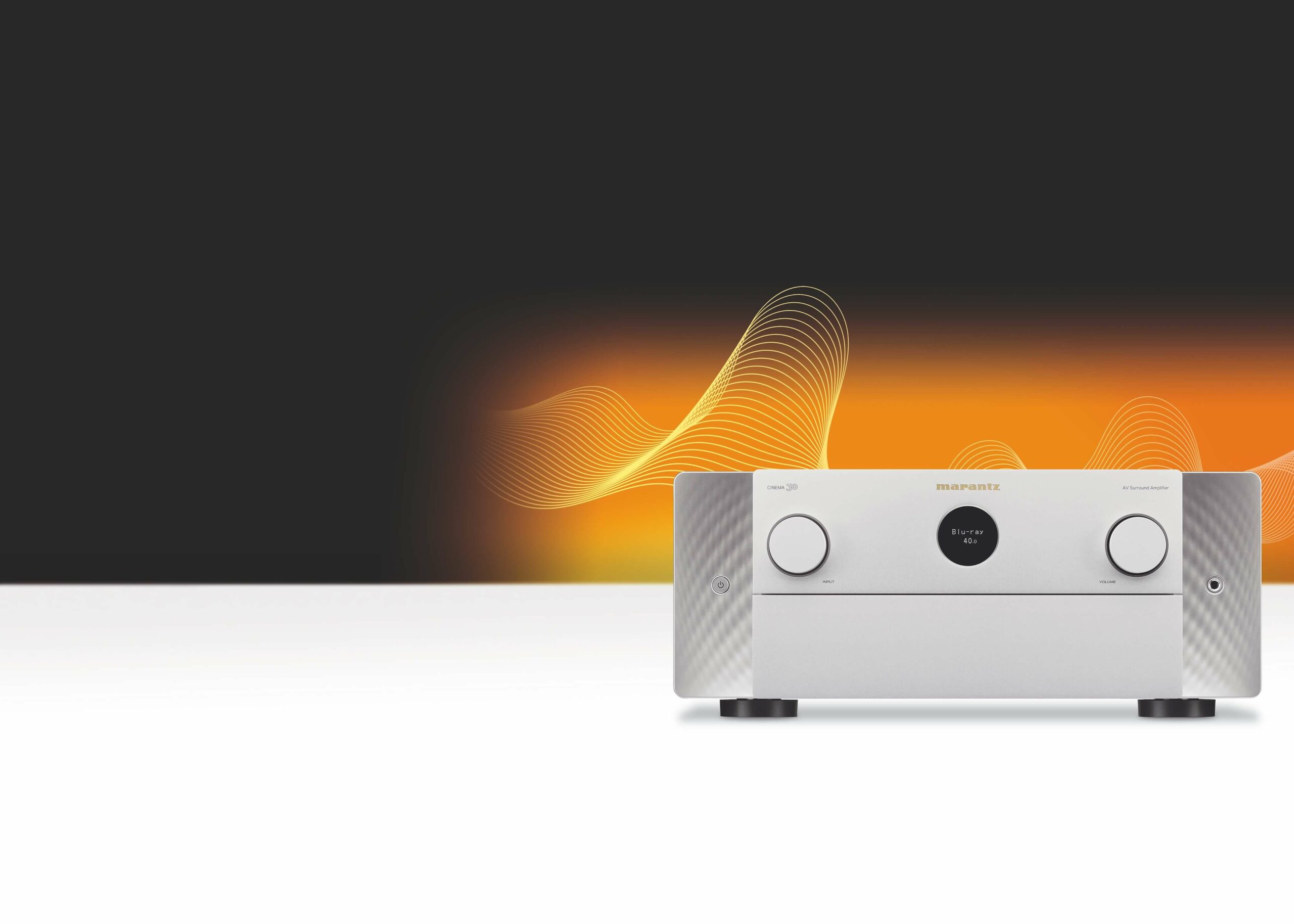
The Marantz CINEMA 30 sits in the demanding part of the AV receiver market: the space where a component is expected to be both the control center and the power source for a serious home theater. Its appeal is not based on one headline feature alone, but on the way several design choices work together: a 13.4-channel processor, an 11-channel power amplifier, advanced room-calibration options, modern HDMI support and integrated streaming through the HEOS ecosystem. For users planning a high-end cinema room or a living-room theater with extensive speaker layouts, the CINEMA 30 is designed to reduce the need for separate boxes while still offering considerable setup flexibility.
A receiver designed around large immersive layouts
The defining specification of the Marantz CINEMA 30 is its combination of 13.4-channel processing and 11 channels of built-in power amplification. That matters because modern home theater systems often go well beyond a basic 5.1 arrangement. Dolby Atmos and DTS:X installations can use height, overhead or elevation speakers to create a more enveloping soundfield, and a receiver needs both processing capability and amplifier channels to make those layouts practical.
With 13.4 processing, the CINEMA 30 gives system builders room to plan a sophisticated speaker configuration, including multiple subwoofer channels as part of the system architecture. The onboard 11-channel amplifier section means many installations can be powered directly from the receiver itself, without immediately requiring a separate multichannel power amplifier. For owners, that can simplify cabling, rack space and system planning, while still supporting an ambitious surround layout.
This does not make the CINEMA 30 a casual plug-in accessory. It is clearly intended for installations where the owner is thinking carefully about speaker placement, calibration and source integration. Its value lies in being able to serve as the central hub for a large home theater rather than merely adding surround decoding to a television setup.
Processing and amplification in one chassis
A key attraction of an AV receiver is integration. Separate home theater processors and power amplifiers can be powerful and flexible, but they also add complexity. The Marantz CINEMA 30 takes the alternative route: it places advanced surround processing and a substantial 11-channel amplifier section in one component. For many prospective owners, that combination is useful because it keeps the system easier to assemble and operate while still supporting a high-end theater configuration.
The source material highlights the receiver’s high power reserves and wide dynamic range. In practical ownership terms, reserve power is important because film soundtracks can shift rapidly from quiet dialogue to large-scale effects. A receiver intended for this role needs to handle those transitions confidently across multiple channels. Marantz positions the CINEMA 30 as a component developed with careful attention to detail, and its architecture reflects that broad ambition: decoding, amplification, calibration, HDMI switching and streaming are all treated as core parts of the same product.
For users who want one component to handle the essential home cinema tasks, this kind of integration can be more appealing than building a system from many separate electronics. It also makes the CINEMA 30 relevant to dedicated rooms as well as premium living-room installations, provided the speaker system and room ambitions justify its scale.
Dual room-correction options add setup flexibility
Room correction is one of the most important tools in contemporary home theater. Speaker choice matters, but the room strongly affects bass behavior, tonal balance and the precision of the surround field. The CINEMA 30 is documented as supporting both Dirac Live and Audyssey MultEQ XT32 calibration options, which is one of its most useful design choices.
The presence of both systems gives installers and experienced owners more flexibility. Some users may prefer Audyssey MultEQ XT32 because of its established role in AV receiver setup workflows. Others may be drawn to Dirac Live for its approach to room correction and system tuning. The important point is not that one is universally better, but that the receiver does not lock the owner into a single calibration path.
That flexibility can be especially valuable in a high-channel-count system. As speaker numbers increase, setup becomes more sensitive to distances, levels, room acoustics and low-frequency integration. A receiver with capable calibration options can help the system adapt to real rooms, where speaker positions may be limited by furniture, screen placement or architectural constraints. The CINEMA 30’s calibration support therefore contributes directly to usability, not just to its specification sheet.
8K HDMI and modern source handling
An AV receiver has to manage more than speakers. It also needs to sit between modern video sources and a display, which is why the inclusion of 8K HDMI support is important. The CINEMA 30 is built for systems where video switching and audio decoding are expected to happen in one place, helping the receiver function as the main entertainment hub rather than only as an audio component.
For a home theater owner, this matters because HDMI capability can determine how comfortably a receiver fits into a current or future system. Source devices, televisions and projectors continue to evolve, and a receiver with advanced HDMI support is better aligned with high-resolution video setups. The source does not specify every HDMI detail, so it would be unwise to infer more than is documented, but the stated 8K HDMI support clearly places the CINEMA 30 in the modern AV category.
This is also part of the receiver’s broader usefulness. A high-end AV receiver must support cinema sound formats, provide enough channels for the speaker system, and handle the video side of the installation without becoming a bottleneck. The CINEMA 30’s HDMI capability supports that role.
HEOS streaming broadens everyday use
While the CINEMA 30 is clearly home-theater focused, it is not limited to film soundtracks. Support for streaming music through the HEOS ecosystem gives it a more everyday role. For many households, the main AV system is also the most capable music system in the home, and built-in streaming avoids the need to add a separate streamer just to access networked music features.
HEOS integration is useful because it connects the receiver to a broader control and streaming platform. Instead of treating music playback as a secondary function, the CINEMA 30 includes it as part of the product’s core convenience. That can make the receiver more relevant outside movie nights: background listening, focused stereo playback through the main speakers, or music distributed within a HEOS-based environment are all supported by the documented ecosystem integration.
This versatility is part of what makes a modern AV receiver attractive. A component at this level is a significant system anchor, so it helps when it can serve multiple listening habits rather than being idle whenever the television or projector is off.
Retro styling with contemporary technology
The CINEMA 30 is described as having a retro look, which gives it a distinctive visual identity among AV receivers. Home theater electronics are often visually restrained, and for good reason: many are installed in racks or cabinets. Still, design matters, especially when the receiver is visible in a living space. A retro-inspired appearance can make the component feel more like part of a hi-fi system than a purely utilitarian cinema processor.
What makes that styling notable is the contrast with the technology inside. The CINEMA 30 combines its traditional design cues with 8K HDMI, advanced calibration choices and HEOS streaming. That balance may appeal to buyers who like Marantz’s established visual language but do not want a product that feels dated in function.
Good industrial design in this category is not only about appearance. It is also about making a complex product feel coherent. The CINEMA 30 has to be an amplifier, processor, switcher, streamer and calibration platform. A recognizable, confidently styled chassis helps present that complexity as a single integrated component rather than a stack of unrelated features.

Who the Marantz CINEMA 30 is most suitable for
The CINEMA 30 is most suitable for home theater owners planning a substantial immersive speaker system and wanting the convenience of an integrated AV receiver. Its 13.4-channel processing and 11-channel amplifier section make the most sense in systems where surround and height channels are part of the plan. It is also well matched to users who value room calibration and want access to both Dirac Live and Audyssey MultEQ XT32 rather than a single tuning platform.
It may also appeal to owners who use one main system for both movies and music. HEOS streaming support gives the receiver a broader daily purpose, while the HDMI and surround-processing features keep it focused on cinema use. In that sense, the CINEMA 30 is not only for a dedicated theater room; it can also suit a premium multipurpose room, provided the owner is prepared to build the speaker system around it.
It is less relevant for someone seeking a simple soundbar alternative, a compact stereo amplifier, or a minimal two-channel setup. The strengths documented here are tied to scale, flexibility and integration. Buyers who will only use a small speaker layout may not take full advantage of what the CINEMA 30 is designed to do.
Conclusion
The Marantz CINEMA 30 is attractive because it brings together the major requirements of a serious modern home theater in one component: 13.4-channel processing, 11 channels of onboard amplification, 8K HDMI support, HEOS streaming and a choice of Dirac Live or Audyssey MultEQ XT32 room calibration. Its retro-influenced styling gives it a recognizable Marantz character, while its feature set is aimed squarely at contemporary immersive cinema systems. The ideal audience is the enthusiast or system builder who wants a high-capability AV receiver to anchor a large surround setup without moving immediately to separate processor and amplifier components.



Sound Off
0Join the discussion if you have something to add.