

The Luxman DA-07X is positioned as a serious standalone DAC for listeners who want to place digital conversion at the center of a hi-fi system rather than treat it as an accessory function inside a streamer, disc player, or amplifier. Its appeal lies in a combination of modern format support, a dedicated conversion architecture, multiple input types, and analog output design that is intended to integrate cleanly with high-quality downstream electronics. Rather than focusing on one narrow source, Luxman has given the DA-07X the tools to serve computers, streamers, transports, and professional-style digital sources within one chassis.
A Digital Core Derived from Luxman’s D-10X Platform
One of the DA-07X’s most notable design choices is its digital processing circuit, which is derived from Luxman’s flagship D-10X CD player. That matters because the DAC is not presented as a generic digital box built only around input convenience. It inherits a digital architecture from a higher-tier Luxman source component, suggesting that the company has aimed to give the DA-07X a clear place within its established approach to digital playback.
For prospective owners, this kind of lineage can be important when system consistency is a priority. A standalone DAC is often chosen because the user wants more control over the conversion stage than an all-in-one device allows. By basing the DA-07X’s digital processing on technology associated with the D-10X, Luxman gives the component a defined technical identity inside its own product ecosystem, while still making it usable with a wide range of external digital sources.
Dual-Mono ROHM Conversion Architecture
At the heart of the DA-07X is ROHM’s BD34301EKV DAC chip, used here in a dual mono configuration. Dual mono operation is a significant architectural choice because it treats the left and right channels with a higher degree of separation than a simpler shared configuration. The source material specifically notes that the DAC chip’s differential output is used in mono operation, feeding a fully balanced I/V conversion stage.
This is the kind of implementation detail that will interest owners building systems around balanced signal paths. In a DAC, the conversion chip is only one part of the result; the current-to-voltage conversion and analog output stage determine how the converted signal is handed off to the rest of the system. Luxman’s use of fully balanced I/V conversion indicates that the DA-07X is designed with attention not only to digital compatibility, but also to the quality and structure of the analog circuitry that follows the conversion process.
High-Resolution USB Playback for Modern Libraries
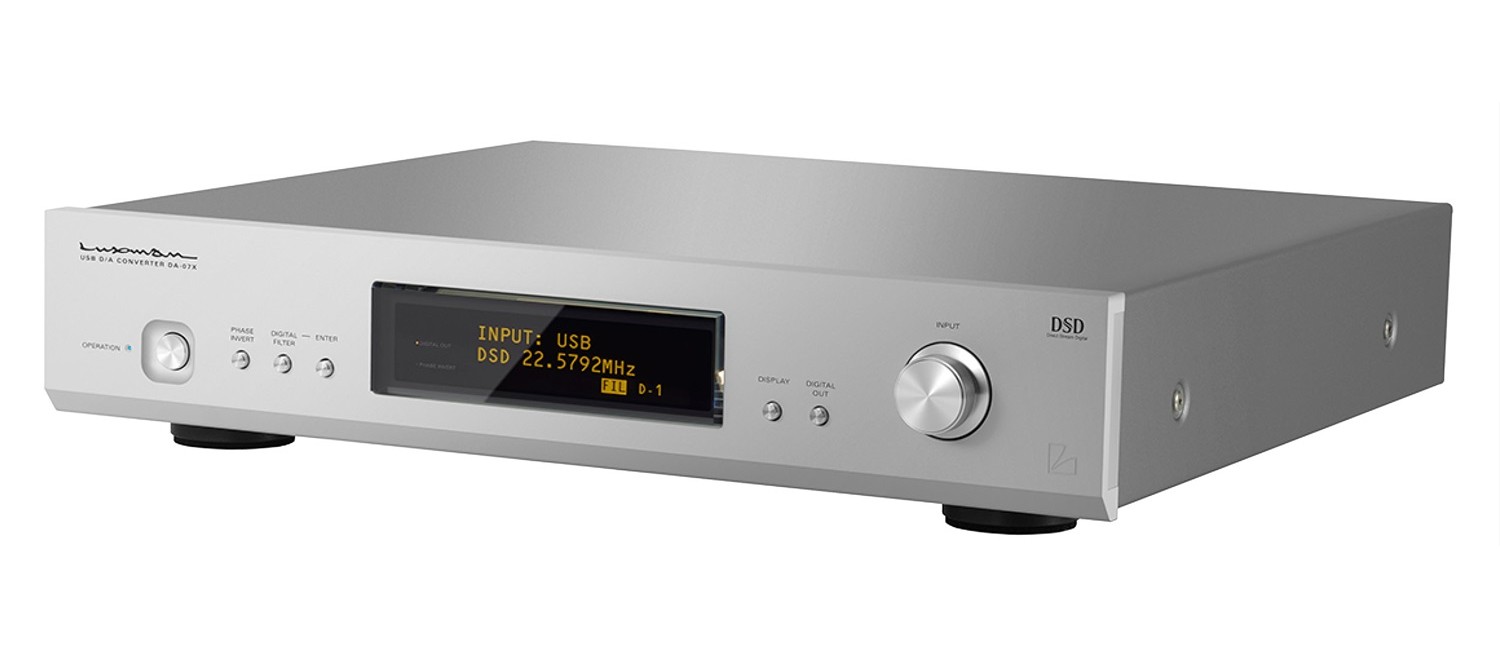
The USB DAC input is the DA-07X’s most capable digital interface. Through its USB-B connection, it supports PCM files up to 768kHz/32-bit and DSD up to 22.5MHz. Those figures cover a very broad range of contemporary high-resolution material, including formats that exceed the limits of many conventional digital inputs. The inclusion of a comprehensive MQA decoder further expands its compatibility for users who have MQA-encoded content in their library or playback chain.
This level of USB support makes the DA-07X particularly relevant for systems where a computer, server, or compatible digital transport is used as the main source. It gives the owner room to handle standard-resolution material and very high-resolution files without immediately encountering format ceilings. Even for listeners whose libraries are mostly conventional PCM, broad format support can provide long-term flexibility, especially as playback software, archived recordings, and digital releases vary in resolution and encoding.
Multiple Inputs for Mixed Digital Sources
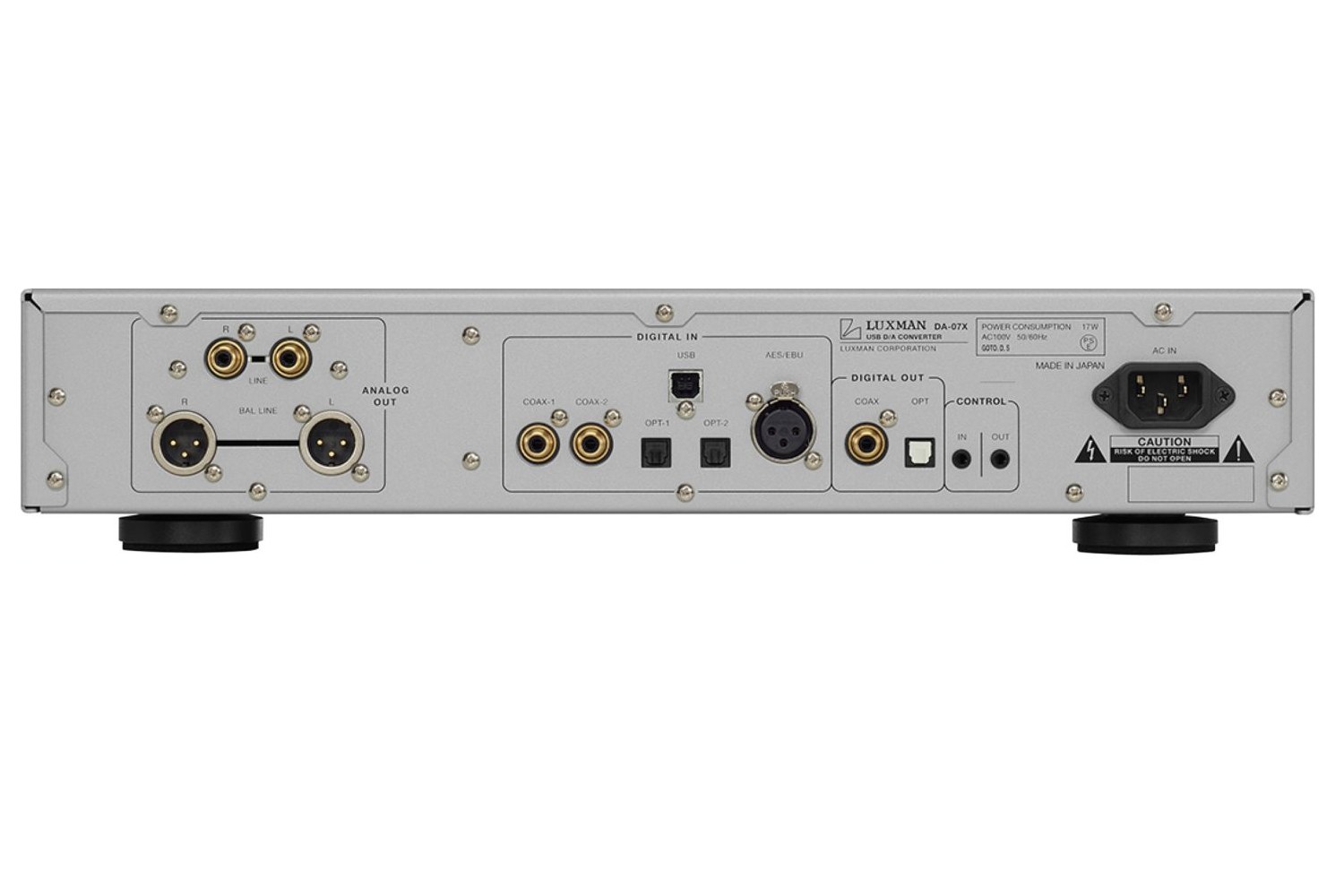
Beyond USB, the DA-07X provides two coaxial digital inputs, two optical digital inputs, and one AES/EBU input. This input set gives the DAC a practical advantage in multi-source systems. A user might connect a CD transport via coaxial, a television or secondary streamer via optical, and a higher-end digital transport or source with AES/EBU output, while reserving USB for a computer-based library.
The inclusion of AES/EBU is especially useful for systems that include equipment with professional-style or higher-end balanced digital outputs. Meanwhile, the paired coaxial and optical inputs make the DA-07X more accommodating for everyday source variety. The important point is not merely the number of inputs, but the way the mix supports different digital environments: legacy disc playback, modern streaming hardware, computer audio, and digital components with balanced connections can all be considered within the same system plan.
Analog Output Design and System Integration
On the analog side, the DA-07X sends signal to both RCA and XLR outputs. This is a practical and valuable choice because it allows the DAC to work with a wide range of integrated amplifiers, preamplifiers, and line stages. RCA outputs keep it compatible with traditional single-ended hi-fi systems, while XLR outputs support balanced system layouts where the partnering electronics provide suitable inputs.
Luxman also specifies a discrete buffer circuit that functions as a low-pass filter and is intended to drive the following stages effectively. In a DAC, the output stage is not simply a connector panel; it is the interface between delicate conversion circuitry and the input stage of the next component. A discrete buffer used in this role suggests that Luxman has given attention to how the DA-07X behaves as part of a real system, not just how it reads a file or locks to a digital signal.
Filter Switching and Anti-Jitter Measures
The DA-07X includes filter switching capability, giving users a degree of control over digital filtering behavior. The source material does not specify the number or character of the filters, so it would be inappropriate to assign sonic descriptions to them. What can be said is that filter selection is a useful feature for owners who prefer some adjustability in a DAC rather than a completely fixed conversion path.
Anti-jitter technology is also provided for each input. Jitter management is a common concern in digital playback because the timing of digital data delivery and clocking can affect the conversion process. By applying anti-jitter measures across the input set, Luxman has addressed this issue not only for USB but also for the coaxial, optical, and AES/EBU pathways. For users with several digital sources of varying age and quality, this broad application is a sensible design decision.
Digital-to-Digital Conversion and Output Control
The DA-07X is not limited to analog conversion. It also includes a digital-to-digital conversion function that can output the incoming digital signal, supporting PCM up to 192kHz/24-bit. This feature can be useful in more complex systems where a digital signal needs to be passed onward to another component, recorder, processor, or distribution path while the DA-07X also serves as the main DAC.
Luxman has also provided the option to disable the digital outputs, including optical and coaxial, with the stated goal of enhancing the quality of the analog outputs by blocking unnecessary signal paths. This is a thoughtful usability feature because it recognizes two different user priorities. Some owners may value digital pass-through and routing flexibility. Others may prefer to shut off unused circuitry or paths when the DAC is being used purely as an analog source feeding an amplifier or preamplifier.
Conclusion
The Luxman DA-07X is best suited to listeners building a dedicated digital front end around multiple sources, high-resolution files, and high-quality analog output options. Its strongest documented qualities are its D-10X-derived digital processing, dual-mono ROHM BD34301EKV conversion, wide USB format support, balanced analog architecture, RCA and XLR outputs, multiple digital inputs, per-input anti-jitter provisions, filter switching, and controllable digital output functions. It will be most attractive to owners who want a flexible standalone DAC with both modern computer-audio capability and traditional hi-fi connectivity, especially in systems where careful integration with downstream amplification is as important as broad file compatibility.



Sound Off
0Join the discussion if you have something to add.