Gustard R30 DAC: Discrete Conversion for Ambitious Digital Systems
The Gustard R30 is a high-end DAC built around discrete R-2R conversion for PCM and a dedicated True 1-Bit path for DSD, supported by precision clocking, dual toroidal transformers, and fixed RCA/XLR outputs.
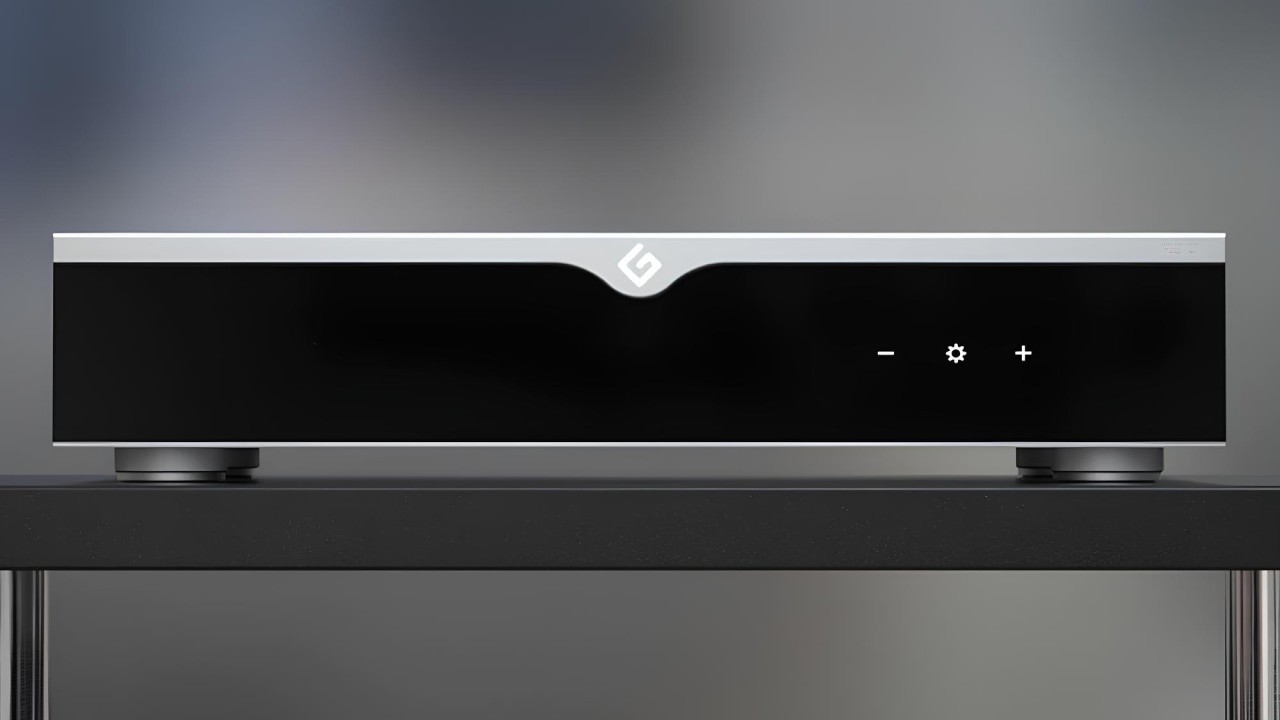
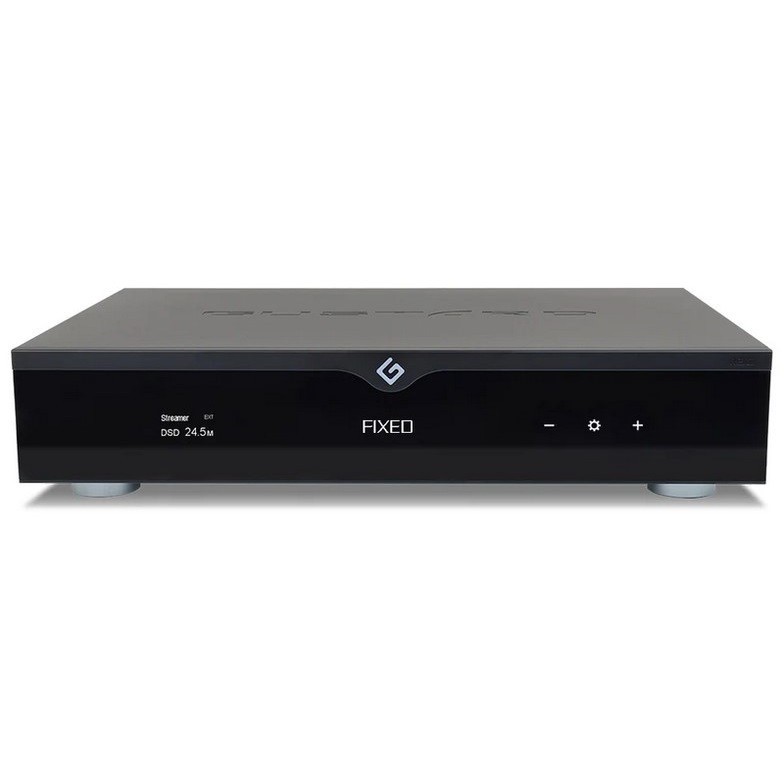
The Gustard R30 is aimed at listeners building a serious digital front end around a dedicated DAC rather than an all-in-one streaming or preamplifier component. Its appeal lies in a design brief that favors specialized conversion architecture, clock stability, separated power supply sections, and conventional high-quality analog outputs. At $3,600, it sits in a market where prospective owners are often looking beyond basic file compatibility and are paying close attention to how digital signals are converted, synchronized, and delivered to the rest of the system. The R30’s most distinctive point is that it does not rely on a conventional delta-sigma DAC chip for its core PCM conversion. Instead, Gustard specifies a discrete R-2R architecture, paired with a separate True 1-Bit converter for DSD playback up to DSD1024. That combination gives the R30 a clear identity: it is a DAC for users who care about conversion topology as much as they care about headline format support.
Discrete R-2R conversion as the foundation
The central engineering decision in the Gustard R30 is its use of a discrete R-2R architecture. In practical terms, an R-2R DAC uses a resistor network to translate a digital signal into an analog voltage. Gustard’s implementation is described as a resistor matrix that directly converts the digital signal, avoiding the use of conventional delta-sigma DAC chips for this part of the process.
For a prospective owner, the attraction is not simply that R-2R is different. It is that this topology represents a deliberate approach to conversion, one that appeals to listeners and system builders who prefer a more hardware-defined signal path. Discrete conversion also places importance on resistor precision, circuit layout, thermal behavior, power quality, and clocking. The R30’s supporting design choices, including its clock system and separated power supplies, should be understood in that context: the conversion method is only one part of a larger architecture.
It is important not to treat topology alone as a guarantee of sonic character. The value of the R30’s R-2R design is that it gives the product a clear technical direction and differentiates it from the many DACs built around off-the-shelf chip-based conversion stages. For buyers comparing DACs at this level, that distinction may be central to the appeal.
A separate True 1-Bit path for DSD
The R30’s DSD handling is another significant part of its identity. Gustard specifies its own True 1-Bit converter for DSD playback, with support up to DSD1024. The key point is that the R30 is designed to work with DSD without intermediate conversion to PCM. For users with a DSD library, or for those who use playback software capable of outputting high-rate DSD, this is a meaningful feature rather than a minor checkbox.
Many DACs support DSD as a format, but the internal treatment of that signal can vary. The R30’s documented approach suggests that Gustard has treated DSD playback as a core design priority, not just a compatibility requirement. Avoiding conversion to PCM may matter to owners who want their DSD files handled in a signal path tailored to that format.
Support up to DSD1024 also gives the R30 headroom for enthusiasts who use advanced playback chains. Not every owner will need such a high ceiling, and not every music library will contain material at those rates. Still, the specification indicates that the DAC is intended for demanding digital setups where format flexibility and native-style DSD processing are part of the purchasing decision.

Digital processing and upsampling choices
Gustard also highlights multi-level upsampling algorithms in the R30. These are described as being intended to reduce distortion, increase detail, and support a clean, smooth presentation. In an editorial product context, the important point is not to assume a particular listening result, but to recognize the role of digital processing in shaping how a DAC handles incoming data before conversion.
Upsampling can be used to move processing artifacts, manage filtering behavior, and prepare the signal for a specific conversion architecture. In a DAC such as the R30, it is part of the broader attempt to control the digital-to-analog process rather than leave it entirely to generic receiver and conversion stages. Users who like to understand what happens inside a DAC may find this level of design attention attractive.
This also means the R30 is not positioned as a minimalist box that simply accepts a data stream and passes it through with the least possible intervention. Its design includes active digital processing decisions. For some owners, that will be a benefit; for others who prefer fully user-configurable or purist processing options, it is a point to investigate further before purchase.
Clocking, synchronization, and external clock flexibility
Clocking is a major part of the R30’s specification. The DAC uses a highly stable SC-Cut OCXO generator together with a GCLK-02 module. Gustard specifies this system for reduced jitter and precise frequency matching, with an error of 1 Hz. In digital audio, clock stability is relevant because timing accuracy affects how digital samples are converted into a continuous analog output.
The use of an OCXO, or oven-controlled crystal oscillator, points to a more elaborate clocking approach than a basic oscillator implementation. The goal is stability, and the inclusion of the GCLK-02 module reinforces the idea that synchronization is not an afterthought in this design.
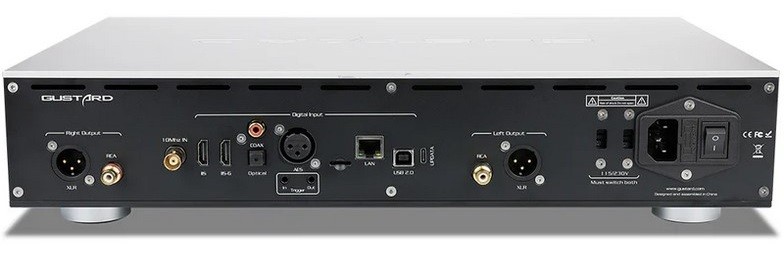
The R30 also allows connection of an external clock. That is an important flexibility feature for advanced systems. Owners who use multiple digital components, studio-influenced clock distribution, or a dedicated master clock may appreciate being able to integrate the DAC into a wider timing architecture. At the same time, not every home system needs an external clock, and many users may simply rely on the R30’s internal clocking. The value is that the option exists for those building more complex digital playback chains.
Separated power supplies for digital and analog circuits
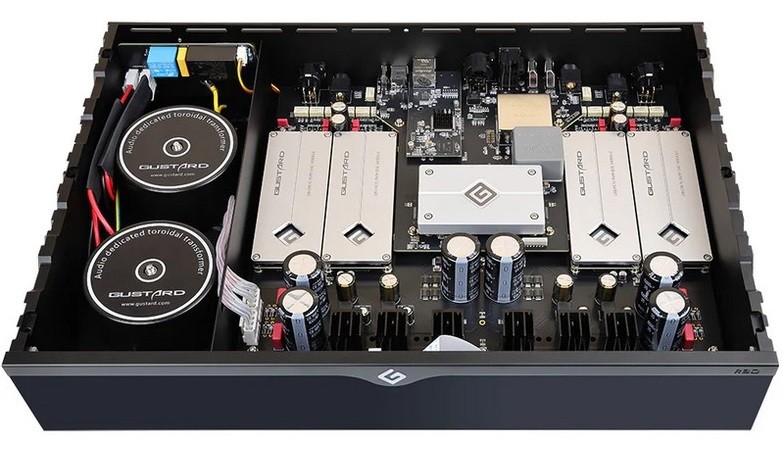
Power supply design is often less visible than decoding formats or output numbers, but it can be central to a DAC’s engineering. The Gustard R30 uses two toroidal transformers, with separate responsibility for digital and analog circuits. This arrangement is intended to reduce mutual influence between sections and help the device operate cleanly under load.
Separating the digital and analog supplies makes sense in a component where sensitive analog output stages share a chassis with high-speed digital processing and clock circuitry. Digital stages can introduce switching noise and other disturbances, while analog stages benefit from stable, low-noise supply conditions. Using separate transformers is a straightforward way to support isolation between these domains.
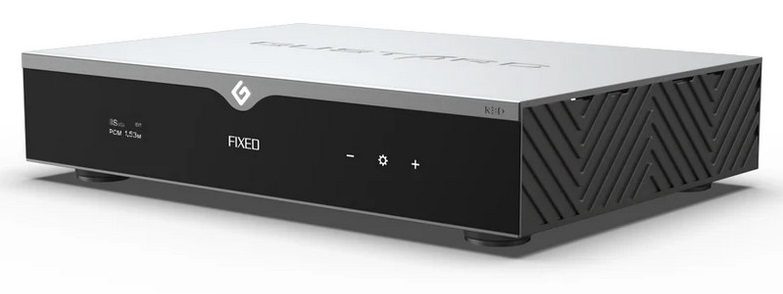
The R30’s power consumption is specified at less than 35 watts, and it supports 115/230V, 50/60Hz operation. Its chassis dimensions are 430 x 300 x 80 mm, which places it in full-width hi-fi territory rather than compact desktop hardware. The packaged weight is listed at 10 kg, suggesting a physically substantial component, though the exact unpacked unit weight is not specified.
Analog output structure and system matching
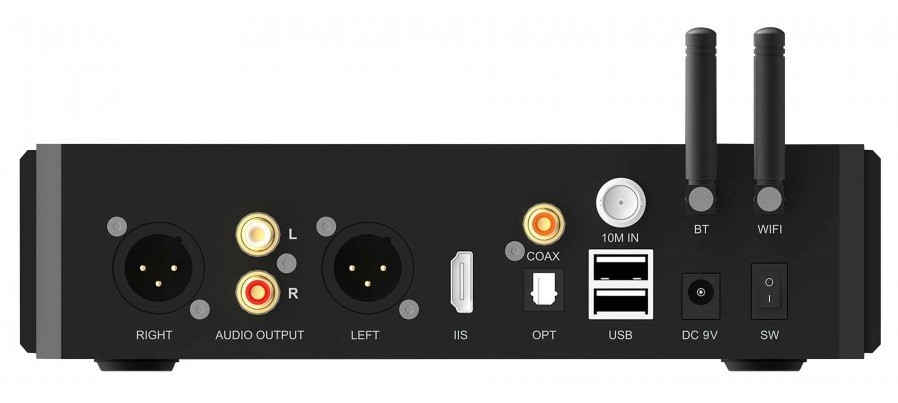
The R30 provides fixed-level analog outputs via RCA and XLR. The RCA output level is specified at 2.5 Vrms with a 100-ohm output impedance, while the balanced XLR output is specified at 5.1 Vrms, also with a 100-ohm output impedance. The XLR pinout follows the US standard: pin 1 ground, pin 2 hot, and pin 3 cold.
These figures matter because the R30 is not documented here as a variable-output preamplifier or streaming hub. Its fixed outputs make it most naturally suited to feeding an integrated amplifier, preamplifier, headphone amplifier, or active speaker system with appropriate input level handling. The higher XLR output level may be useful in balanced systems, but owners should ensure that the downstream component has suitable input sensitivity and volume control range.
The inclusion of both RCA and XLR outputs improves practical flexibility. Single-ended systems can use the RCA outputs, while balanced systems can take advantage of the XLR connection where appropriate. The 100-ohm output impedance on both output types is a useful specification for assessing compatibility with typical line-level inputs and cable runs.
Measured performance indicators
The R30’s published specifications include a frequency range of 20 Hz to 20 kHz within ±0.2 dB, dynamic range greater than 123 dB, signal-to-noise ratio greater than 121 dB, and channel separation of -139 dB at 10 kHz. Distortion figures are listed as THD+N of no more than 0.00145% at 1 kHz and intermodulation distortion of approximately 0.002% at -1 dBFS.
These numbers provide useful context for the R30’s intended performance level. They indicate a DAC designed with low noise, strong channel separation, and controlled distortion as measurable priorities. Measurements cannot fully describe how a component will integrate into a given system, but they do help prospective owners understand the engineering targets behind the product.
The channel separation figure is especially relevant for users who value stereo precision, while the dynamic range and signal-to-noise specifications point to a low-noise design suitable for revealing downstream equipment. As always, the final system result will depend on source quality, gain structure, amplification, loudspeakers or headphones, room conditions, and setup.
Conclusion
The Gustard R30 is best suited to digital-audio enthusiasts who want a dedicated DAC with a distinctive conversion architecture, serious DSD capability, fixed line-level outputs, and attention to clocking and power supply separation. Its strongest documented qualities are its discrete R-2R PCM conversion, dedicated True 1-Bit DSD path up to DSD1024, SC-Cut OCXO-based synchronization with external clock support, dual toroidal transformer power supply, and both RCA and XLR outputs. It will make the most sense in a system that already includes proper volume control and amplification, and for owners who value specialized DAC engineering over all-in-one convenience.