
The strongest AV receivers combine multichannel amplification, current surround decoding, flexible video connectivity, room correction and enough expansion capacity for the intended speaker system.
This ranking gives priority to products that perform all of those core receiver duties, with channel count, calibration, HDMI functionality, networking and system flexibility separating the leading choices.
Five supplied products are genuine multichannel AV receivers: the Denon AVC-X3800H, Yamaha RX-A4A, Pioneer VSX-LX305, Denon AVR-S760H and Pioneer VSX-835. They occupy the first five positions because they can serve as the control center of a surround-sound home theater. The Denon leads through its combination of nine amplified channels, 11.2-channel processing outputs, Audyssey calibration and extensive HDMI connectivity. The other five sources cover adjacent but materially different categories, including stereo integrated amplifiers, a custom-installation power amplifier, a compact music system and a turntable. They are retained and clearly labeled as niche system components rather than presented as equivalent AV receivers. Their lower positions reflect category relevance, not an assumption that they are inferior within their intended roles.

1. Denon AVC-X3800H
Denon AVC-X3800H nine-channel AV receiver.
The Denon AVC-X3800H offers the most complete home-theater proposition in the supplied material.
Its nine amplification channels can support 7.2.2 or 5.2.4 Dolby Atmos and DTS:X layouts, while 11.2-channel processor outputs provide a route to a larger system through external power amplifiers.
Audyssey MultEQ XT32 addresses room-dependent setup, and IMAX Enhanced certification adds another relevant home-cinema credential. Connectivity is similarly comprehensive. The receiver has seven HDMI inputs and three outputs with HDCP 2.3, HDR10+, Dolby Vision and Dynamic HDR support. The source also identifies 8K signal handling, upscaling, eARC, Variable Refresh Rate and Quick Frame Transport. This combination of built-in capability and future expansion makes the AVC-X3800H the most broadly recommendable receiver here.
Best for: Expandable Dolby Atmos and DTS:X home theaters
- Nine amplified channels for 7.2.2 or 5.2.4 immersive-audio systems
- 11.2-channel processor outputs support expansion with external amplifiers
- Audyssey MultEQ XT32 room calibration
- Seven HDMI inputs, three outputs and extensive HDR support
Verdict: The Denon AVC-X3800H is the strongest overall choice for its balance of channel capacity, room correction, video connectivity and expansion potential.
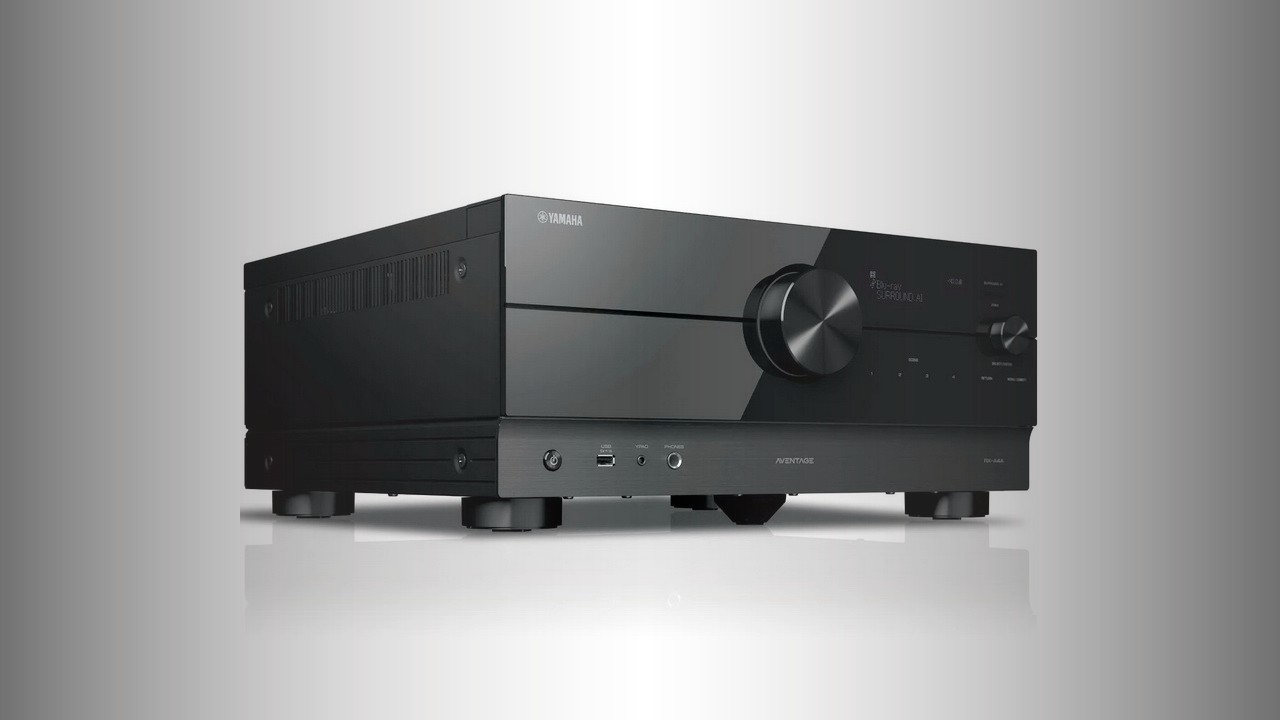
2. Yamaha RX-A4A
Yamaha RX-A4A 7.2-channel network AV receiver.
The Yamaha RX-A4A is a 7.2-channel receiver built around a particularly extensive collection of Yamaha processing technologies.
Dolby Atmos and DTS:X cover the principal object-based formats, while Cinema DSP HD3 and SURROUND:AI are intended to adapt the presentation of dialogue, effects and background music to the content.
A Qualcomm QCS407 chipset and an ESS SABRE ES9007S DAC form the core of its digital platform. Yamaha also addresses physical construction through its Anti Resonance Technology fifth foot, designed to reduce vibration from internal components and the surrounding environment. Wi-Fi and Bluetooth add wireless flexibility. It cannot match the Denon's nine onboard channels or 11.2-channel expansion path in the supplied information, but it is a compelling option for a 7.2-channel system and for listeners who value Yamaha's proprietary surround processing.
Best for: Seven-channel theaters using Yamaha surround processing
- 7.2-channel architecture with Dolby Atmos and DTS:X
- Cinema DSP HD3 and SURROUND:AI processing
- ESS SABRE ES9007S digital-to-analog converter
- Anti Resonance Technology fifth foot
Verdict: The Yamaha RX-A4A is a well-equipped 7.2-channel receiver distinguished by its sophisticated DSP platform and vibration-conscious construction.

3. Pioneer VSX-LX305
Pioneer VSX-LX305 9.2-channel AV receiver.
The Pioneer VSX-LX305 stands out through its 9.2-channel architecture, giving it a clear channel-count advantage over the seven-channel receivers ranked below it.
Pioneer uses Direct Power amplification in a chassis described as relatively compact, while the product's premium positioning reflects its focus on both movie sound and music reproduction.
Wireless integration is another important part of its appeal. The source identifies compatibility with Sonos and support for prominent streaming services including Deezer, TIDAL and Amazon Music. IMAX Enhanced capability is also discussed, although the source describes it as dependent on a software update rather than as an unqualified out-of-box feature. That caveat and the limited HDMI detail in the supplied material keep the Pioneer behind the more comprehensively documented Denon and Yamaha models.
Best for: High-channel-count systems with strong wireless integration
- 9.2-channel receiver architecture
- Direct Power amplifier design
- Sonos compatibility for multiroom integration
- Support for multiple major streaming services
Verdict: The Pioneer VSX-LX305 is a versatile 9.2-channel receiver whose channel capacity and network features outweigh the source's firmware caveat around IMAX Enhanced.

4. Denon AVR-S760H
Denon AVR-S760H 7.2-channel AV receiver.
The Denon AVR-S760H brings the essential elements of an immersive home theater into a 7.2-channel receiver.
Its seven discrete amplifier channels support a 5.1.2 Dolby Atmos or DTS:X layout, while Dolby Atmos Height Virtualization and DTS Virtual:X can simulate height effects when dedicated elevation or ceiling speakers are impractical.
The source also describes 8K video handling and compatibility with 4-ohm speakers. Its connected-audio platform is unusually broad for a receiver positioned below the flagship-oriented models. Network playback supports FLAC, WAV and ALAC at up to 24-bit/192 kHz, along with DSD at 2.8 or 5.6 MHz. Dual-band Wi-Fi, Bluetooth, AirPlay 2 and HEOS support both direct streaming and multiroom playback. It ranks below the nine-channel models but remains one of the most rounded choices for a moderate-size theater.
Best for: Accessible 5.1.2 theaters and HEOS multiroom systems
- Seven discrete amplifier channels with 5.1.2 immersive-audio support
- Dolby Atmos, DTS:X and virtual-height processing
- 8K video compatibility
- HEOS, AirPlay 2, Wi-Fi and Bluetooth connectivity
Verdict: The Denon AVR-S760H is a balanced 7.2-channel choice with useful immersive-audio, 8K and network playback features.

5. Pioneer VSX-835
Pioneer VSX-835 seven-channel AV receiver.
The Pioneer VSX-835 is a seven-channel receiver capable of driving a 5.2.2 Dolby Atmos or DTS:X system.
Dolby Atmos Height Virtualizer and DTS Virtual:X provide alternatives for rooms without physical height speakers, and Pioneer's MCACC system handles automatic surround calibration with provisions for the subwoofer channel and 3D audio formats.
All four HDMI inputs are described as supporting 8K video, Dolby Vision and HDR10, while 1080p material can be upscaled to 4K. The receiver also uses discrete power-amplifier components and includes Direct mode for bypassing additional sound processing. Four HDMI inputs may be restrictive for source-heavy systems, but the combination of immersive audio, calibration and modern video support gives it a legitimate place among the true AV receivers in this ranking.
Best for: Value-focused 5.2.2 home theaters
- Seven-channel amplification for a 5.2.2 speaker layout
- Dolby Atmos, DTS:X and virtual-height modes
- MCACC automatic surround calibration
- Four HDMI inputs with 8K, Dolby Vision and HDR10 support
Verdict: The Pioneer VSX-835 covers the principal requirements of a modern 5.2.2 theater, although its four HDMI inputs limit larger source collections.

6. Lyngdorf TDAI-2170
Lyngdorf TDAI-2170 stereo integrated amplifier with RoomPerfect.
The Lyngdorf TDAI-2170 is an advanced stereo integrated amplifier rather than a multichannel AV receiver.
Its digital amplifier is rated in the source at 2 x 170 watts into 4 ohms with 0.07 percent distortion, and it converts an incoming PCM signal into pulse-width modulation before forming the analog signal at the speaker outputs.
The design uses a 400 kHz PWM clock frequency and avoids conventional global feedback. RoomPerfect correction is its most relevant feature for an AV-oriented audience. The system includes Focus modes intended to optimize listening in defined positions, giving the Lyngdorf a strong role in a room-corrected two-channel installation. The supplied material does not establish multichannel decoding, surround amplification or AV video switching, so it should not be treated as a substitute for the five receivers above.
Best for: Room-corrected two-channel systems
- RoomPerfect room-correction system
- 2 x 170-watt rating into 4 ohms in the supplied source
- Direct digital signal path using pulse-width modulation
- Compact 8 kg chassis relative to its stated output
Verdict: The Lyngdorf TDAI-2170 is a sophisticated stereo integrated amplifier, but its two-channel focus places it outside the core AV receiver category.

7. Yamaha WXA-50
Yamaha WXA-50 network integrated amplifier.
The Yamaha WXA-50 is a compact network integrated amplifier designed around stereo and multiroom playback rather than surround sound.
Its Direct mode supports files at up to 24-bit/192 kHz without additional processing.
An adaptive equalizer adjusts bass and treble in relation to volume, while Advanced Bass Extension is intended to help compact speakers and Compressed Music Enhancer addresses compressed audio sources. MusicCast is the central feature, allowing compatible Yamaha products to operate independently or as parts of a whole-home audio system. The WXA-50 can receive music from smartphones, computers, network storage and connected external devices, with Bluetooth providing another input route. It is relevant where networked stereo is the priority, but the source does not present it as a multichannel decoder or home-theater switching hub.
Best for: Compact MusicCast stereo and multiroom installations
- MusicCast multiroom integration
- Direct playback at up to 24-bit/192 kHz
- Adaptive equalization and Advanced Bass Extension
- Bluetooth and network-audio support
Verdict: The Yamaha WXA-50 is a capable network stereo amplifier for MusicCast systems, not a direct replacement for a surround-sound AV receiver.

8. Yamaha XDA-AMP5400RK
Yamaha XDA-AMP5400RK eight-channel rack-mount amplifier.
The Yamaha XDA-AMP5400RK is an eight-channel custom-installation power amplifier housed in a slim 1U chassis.
It was designed primarily to complement the Yamaha XDA-QS5400RK, accepting up to four source feeds from that component and supporting multiple speaker and zone arrangements.
Its four amplification zones can also be operated in bridge mode when a different power configuration is required. Its connection to the AV receiver category is strictly as an expansion component. The amplifier can work with Yamaha receivers equipped with zone preamplifier outputs, increasing speaker coverage in a distributed-audio installation. It does not take the place of a receiver's source selection, surround decoding, room calibration or video switching, but it can be useful in a professionally integrated multizone system.
Best for: Custom-installation multizone audio expansion
- Eight amplification channels in a 1U rack chassis
- Four configurable amplification zones
- Bridge-mode operation for each zone
- Can expand Yamaha AV receivers equipped with zone preamplifier outputs
Verdict: The Yamaha XDA-AMP5400RK is a specialized rack amplifier for expanding zones and speaker coverage rather than a standalone AV receiver.

9. Pioneer P2-K
Pioneer P2-K compact stereo system with separate network player and receiver.
The Pioneer P2-K is a complete compact stereo music system rather than an AV receiver.
It combines two separate electronics units, a network file player and a stereo receiver, with a pair of two-way speakers.
The network player supports high-resolution streaming audio and DSD files, replacing the conventional optical-disc player used in many compact systems. A 3.5-inch color display shows file information, album artwork and folder lists, although the four-line list view can make navigation through large libraries less convenient. The inclusion of speakers makes the P2-K a self-contained music solution, but the supplied source does not establish multichannel surround decoding or AV video switching. It therefore serves a different audience from the home-theater receivers ranked above.
Best for: Self-contained compact stereo listening
- Complete system with stereo receiver, network player and speakers
- High-resolution network audio support
- DSD file compatibility
- Color display for artwork and library information
Verdict: The Pioneer P2-K is a convenient networked music system, but its stereo package format is not directly comparable with a multichannel AV receiver.

10. Denon DP-300F
Denon DP-300F fully automatic turntable with dust cover.
The Denon DP-300F is a fully automatic vinyl turntable and is the least category-relevant product in the supplied set.
After record size is selected and Start is pressed, the turntable positions the stylus at the beginning of the record and returns the tonearm to its rest when playback finishes.
This automation makes it approachable for listeners who value convenience. Its 5.5 kg enclosure uses 4 mm-thick plastic walls, anti-vibration feet and a dust cover. Those are useful turntable attributes, but the DP-300F provides none of the receiver functions documented for the leading products: it is a source component that would need to be connected to an appropriate audio system. Its final position reflects that fundamental category mismatch rather than its merits as a record player.
Best for: Convenient automatic vinyl playback
- Fully automatic start, playback completion and tonearm return
- Selectable operation for 12-inch and 7-inch records
- Anti-vibration feet
- Included dust cover
Verdict: The Denon DP-300F is an approachable automatic turntable, but it is a source component and not an AV receiver.


Sound Off
0Join the discussion if you have something to add.