A good AV receiver is the control center of a home theater: it has to decode surround formats, route video sources, provide enough amplifier channels for the speaker layout you actually plan to use, and offer setup tools that make the system behave properly in the room.
The strongest receiver entries in this selection are the models with clearly stated surround processing, room calibration, HDMI connectivity, streaming options, and amplifier configurations.
Several supplied sources are not AV receivers at all; they are speakers, subwoofers, a soundbar, a stereo receiver, or an editorial roundup. Rather than force them into the category, we identify where they fit in an AV receiver-centered system and where they should be treated as alternatives or supporting components. That distinction matters. A compact speaker or subwoofer can be highly relevant to a theater build, but it does not replace the switching, decoding, and system-management role of an AV receiver. The notes below keep that boundary clear while preserving the source order and article identity.

1. Arcam AVR20
Arcam AVR20 AV receiver with a curved front panel, traditional volume control, and connectivity aimed at surround and streaming use.
The Arcam AVR20 is one of the clearest AV receiver fits in the source set.
It is described as a 7.1-channel receiver with Dolby Atmos support in a 5.1.2-channel configuration, plus the option to expand to 7.1.4 by adding external amplification.
Its codec support covers major home-cinema formats including DTS-HD Master Audio, Dolby TrueHD, DTS:X, and IMAX Enhanced, while full 16-channel Dirac calibration is included for system tuning. The source also highlights Apple AirPlay 2, Google Chromecast, an FM tuner, DAB support, a traditional front-panel volume knob, and a powerful toroidal transformer with a stated 7 x 90 W output at 8 ohms.
Best for: Enthusiast surround systems with room correction
- Dolby Atmos in 5.1.2 configuration
- Expandable to 7.1.4 with extra amplification
- Full 16-channel Dirac calibration
- Apple AirPlay 2 and Google Chromecast support
Verdict: Choose the Arcam AVR20 if you want a receiver-oriented home-theater hub with serious calibration tools and a clear upgrade path for more height and surround channels.

2. Cambridge Audio MINX MIN22
Cambridge Audio MINX MIN22 compact speaker designed for rooms where small size and unobtrusive placement are priorities.
The Cambridge Audio MINX MIN22 is not an AV receiver, but it is relevant as a compact speaker option for a receiver-based room.
The source positions the Minx line as a solution for listeners who want small speakers without abandoning music, movie, and TV performance.
It also points to acoustic engineering, an acoustically damped thermopolymer and extruded aluminum construction, and a design intended to fit easily into a room.
Best for: Compact satellite speakers for discreet systems
- Very compact speaker concept
- Designed for music, movies, and TV
- Acoustically damped thermopolymer construction
- Extruded aluminum construction
Verdict: The MINX MIN22 should be considered as a space-saving speaker partner rather than as an AV receiver recommendation in its own right.

3. Marantz CINEMA 30
Marantz CINEMA 30 AV receiver, highlighted in the source for 13.4-channel processing and an 11-channel amplifier section.
The source article is an awards roundup, but the relevant AV receiver entry is the Marantz CINEMA 30.
It is described as having a 13.4-channel processor and a powerful 11-channel power amplifier, positioning it for high-end home theater use.
The supplied jury summary also emphasizes high power reserves and a wide dynamic range, making this the most ambitious receiver cited in the source material by channel-processing scope.
Best for: High-end home theater receiver shortlists
- 13.4-channel processing
- 11-channel power amplifier
- High power reserves
- Wide dynamic range
Verdict: The Marantz CINEMA 30 stands out in the supplied material as the premium AV receiver candidate for larger, more complex theater layouts.

4. Yamaha YAS-408
Yamaha YAS-408 soundbar system with a low-profile main bar and separate rectangular subwoofer for discreet TV audio setups.
The Yamaha YAS-408 article centers on the Yamaha MusicCast BAR 400 soundbar, so it should not be confused with an AV receiver.
The source describes a simple black soundbar with a rectangular subwoofer, a discreet appearance, low profile, modest indicators, and the option to hang the speaker under a TV.
It is framed as a universal home-theater system for users who prefer a soundbar approach rather than a separate receiver and speaker package.
Best for: Soundbar-based theater simplicity
- Discreet black soundbar design
- Includes a rectangular subwoofer
- Low-profile TV-friendly form
- Can be mounted under a TV
Verdict: The Yamaha YAS-408 is best treated as a simplified soundbar alternative, not as a substitute for an AV receiver in a component system.

5. Canton SUB 501
Canton SUB 501 active subwoofer with front-firing driver, rear-panel controls, and a down-firing passive radiator.
The Canton SUB 501 is a subwoofer, not an AV receiver, but it can play an important supporting role in a receiver-based home cinema or stereo setup.
The source describes it as a 12-inch active subwoofer with a reengineered 750-watt power amplifier, rear-panel adjustment for volume, crossover frequency, and phase, plus automatic on/off operation.
Its front-firing driver is assisted by a down-firing passive radiator, and the source emphasizes robust, accurate bass performance and flexible integration.
Best for: Adding bass to home cinema or stereo systems
- 12-inch active subwoofer design
- 750-watt power amplifier
- Volume, crossover, and phase adjustment
- Automatic on/off feature
Verdict: The Canton SUB 501 is a system-building component to pair with an AV receiver when stronger, adjustable low-frequency output is the priority.

6. Denon AVR-X3600H
Denon AVR-X3600H AV receiver with front-panel HDMI access and connectivity for multi-source home theater systems.
The Denon AVR-X3600H is a strong category match because the source details both its surround-audio and video-switching roles.
It supports Dolby Atmos and DTS:X and can be used for a 7.2.2 system with height channels or a 9.2 layout for traditional surround formats.
The article also notes high-current output stages, a powerful power supply, a 4-core DSP, 32-bit AKM DACs in each channel, Audyssey MultEQ XT32 room calibration, eight HDMI inputs, three HDMI outputs, 4K video support with HDR, Dolby Vision, and HLG, plus front-panel HDMI for quick source connection.
Best for: Fully featured surround systems with substantial HDMI needs
- Dolby Atmos and DTS:X support
- Audyssey MultEQ XT32 calibration
- Eight HDMI inputs and three HDMI outputs
- Front-panel HDMI input
Verdict: The Denon AVR-X3600H is the pragmatic AV receiver pick here for buyers who need broad surround-format support, room calibration, and extensive HDMI connectivity.

7. Devialet Astra and Astra Opéra de Paris
Devialet Astra integrated amplifier, cited in the source as a stereo component rather than a multichannel AV receiver.
This source is a readership roundup rather than an AV receiver review, and the relevant product mentioned in the excerpt is the Devialet Astra integrated amplifier.
It is described as having analog and digital inputs and a stated output of 2 x 150 watts into 8 ohms, with a 23-carat gold-plated Astra Opéra de Paris version also mentioned.
Because the article does not present this as an AV receiver, it belongs outside the main home-theater receiver shortlist.
Best for: Stereo amplifier context rather than AV receiver shopping
- Analog and digital inputs
- 2 x 150 watts into 8 ohms
- Gold-plated Opéra de Paris version mentioned
Verdict: The Devialet Astra is relevant to stereo amplification discussions, but the supplied material does not support treating it as an AV receiver recommendation.
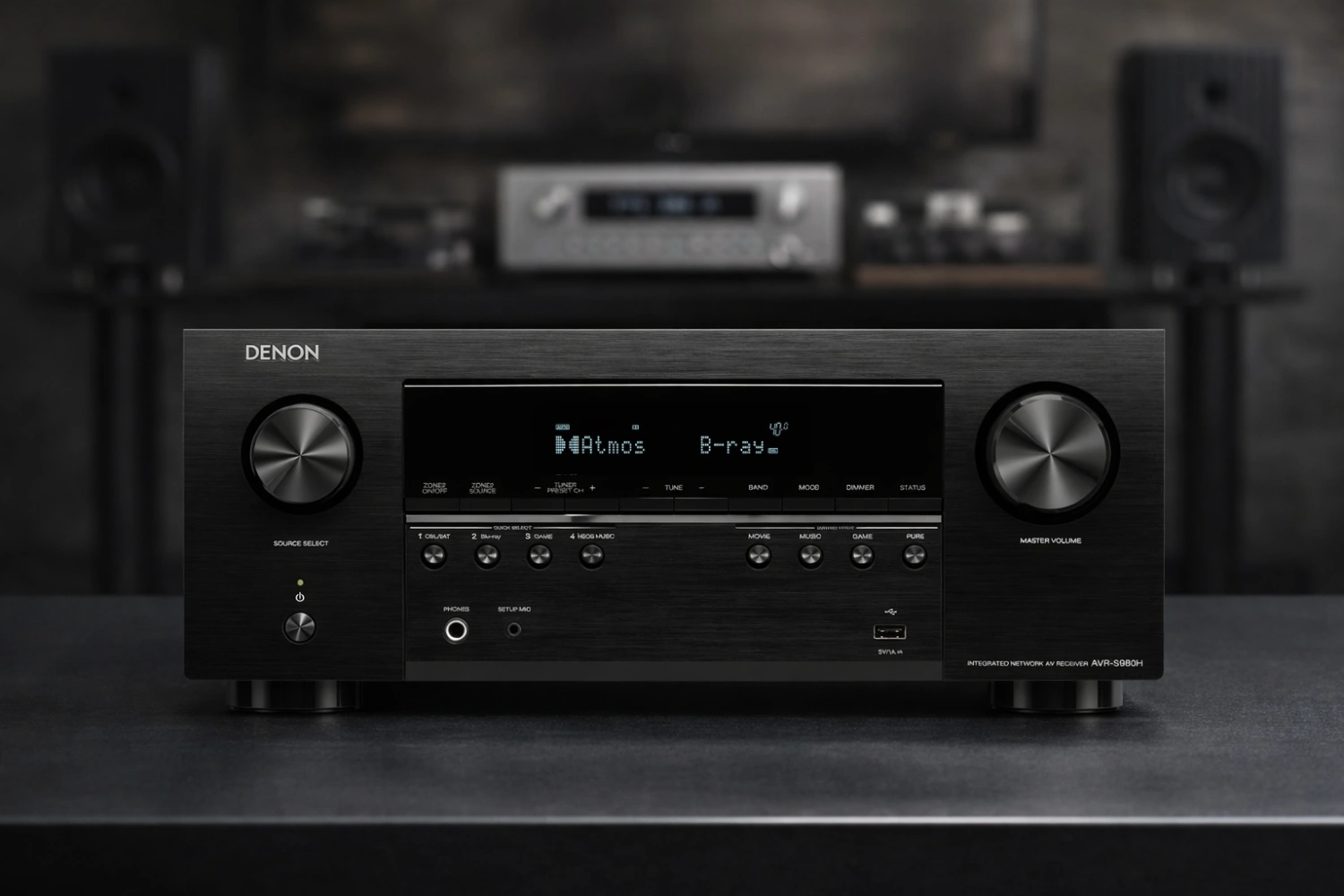
8. Denon AVR-S980H
Denon AVR-S980H 7.2-channel AV receiver designed for users stepping up from simpler TV-audio systems.
The Denon AVR-S980H is a direct AV receiver recommendation for users moving beyond a soundbar or basic setup while keeping usability in view.
The source describes it as a 7.2-channel receiver that is flexible for both two-channel and multi-channel sound, with HEOS multiroom and a wireless surround upgrade named in the article title.
Its amplifier is specified at 90 watts per channel, and the article frames the model around versatility, simplicity, and everyday home entertainment rather than specialist complexity.
Best for: Accessible upgrades from a soundbar or basic setup
- 7.2-channel AV receiver layout
- HEOS multiroom support
- Wireless surround upgrade noted
- 90 watts per channel
Verdict: The Denon AVR-S980H is the approachable AV receiver choice in this set, especially for households wanting multi-channel flexibility without making the system feel intimidating.

9. Cocktail Audio N25Amp
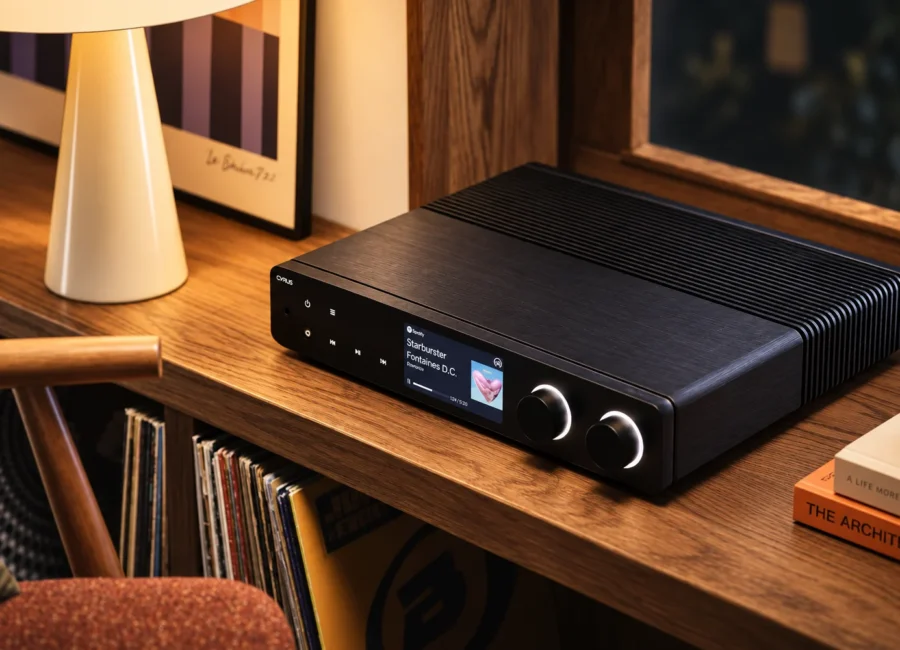
Cocktail Audio N25Amp slim all-in-one stereo receiver with front display, rotary controls, and network audio functions.
The Cocktail Audio N25Amp is identified in the source as an all-in-one network player and stereo receiver, not an AV receiver.
It includes a built-in amplifier rated at 75 watts per channel, a slim standard-width chassis, a color LCD display, two rotary knobs, programmable presets, gigabit LAN, and Bluetooth support for SBC, AAC, aptX, aptX LL, and aptX HD.
Wi-Fi requires a separate USB dongle, and the device can be upgraded with a second Bluetooth module for streaming to wireless headphones.
Best for: Networked stereo systems
- 75 watts per channel
- Color LCD display
- Gigabit LAN connectivity
- Bluetooth with SBC, AAC, aptX, aptX LL, and aptX HD
Verdict: The N25Amp is useful for stereo listeners who want streaming and amplification in one box, but it is not supported by the source as a home-theater AV receiver.

10. JBL Studio 140P
JBL Studio 140P active subwoofer with downward-firing driver, bass reflex design, and practical setup controls.
The JBL Studio 140P is another supporting component rather than an AV receiver.
The source describes it as an active subwoofer designed for JBL Studio and ES line systems, using a 200 mm downward-firing low-frequency driver with bass reflex loading and a 150 W amplifier.
It also includes volume control, automatic turn-on when a signal is received, and a phase switch, all of which are useful integration features when adding a subwoofer to a theater package.
Best for: Bass support for JBL-based theater packages
- Active subwoofer design
- 200 mm downward-firing driver
- 150 W amplifier
- Volume control, auto-on, and phase switch
Verdict: The JBL Studio 140P is a focused subwoofer addition for compatible speaker packages, not a receiver, processor, or source-switching component.
Buying advice: choose the receiver first, then build the system around it
Start with the speaker layout you actually want to run.
If you are planning a Dolby Atmos system with height channels, the channel configuration matters immediately: the Arcam AVR20 is described with 5.1.2 Atmos operation and an external-amplification path to 7.1.4, while the Denon AVR-X3600H is described for 7.2.2 or 9.2 layouts.
If your room and speaker plan are simpler, the Denon AVR-S980H offers a 7.2-channel route that the source frames as approachable for users moving beyond a soundbar. Room correction should be high on the checklist. The Arcam AVR20 includes full 16-channel Dirac calibration, while the Denon AVR-X3600H includes Audyssey MultEQ XT32. Those systems are not interchangeable details; they are part of how a receiver adapts a multi-speaker installation to a real listening room. If setup precision is important, prioritize the receiver with the calibration approach and channel capacity that match your system plan. Video switching is another practical divider. The Denon AVR-X3600H source gives the most detailed HDMI account, with eight HDMI inputs, three HDMI outputs, 4K support, and front HDMI access. If you have several source components, that kind of connectivity may matter as much as amplifier power. Streaming and everyday usability also differ: the Arcam AVR20 includes Apple AirPlay 2 and Google Chromecast, while the Denon AVR-S980H source highlights HEOS multiroom and a wireless surround upgrade. Be careful not to compare every product here as if it performs the same role. The Cambridge Audio MINX MIN22, Canton SUB 501, and JBL Studio 140P can help complete or tailor a receiver-based system, but they do not decode surround formats or switch HDMI sources. The Yamaha YAS-408 is a soundbar-style alternative for simplicity, and the Cocktail Audio N25Amp and Devialet Astra are stereo-focused components rather than home-theater AV receivers. For a true AV receiver purchase, the most source-supported shortlist here is Arcam AVR20, Marantz CINEMA 30, Denon AVR-X3600H, and Denon AVR-S980H, with the final choice driven by channel requirements, calibration, connectivity, and how much system expansion you expect to need.