
Amplifiers now cover far more ground than the traditional two-channel integrated design.
This selection ranges from network-ready models and a custom-installation power amplifier to a configurable tube integrated, a dedicated phono stage and a USB headphone amplifier.
The right choice depends less on a single specification than on the system around it. Some of these products prioritize speaker-driving power and broad connectivity, while others focus on vinyl flexibility, room correction, installation efficiency or headphone listening. Our recommendations below concentrate on those practical distinctions. Power figures and performance statements are taken from the supplied source articles rather than independent measurements, and the preview-stage StormAudio model is identified accordingly.
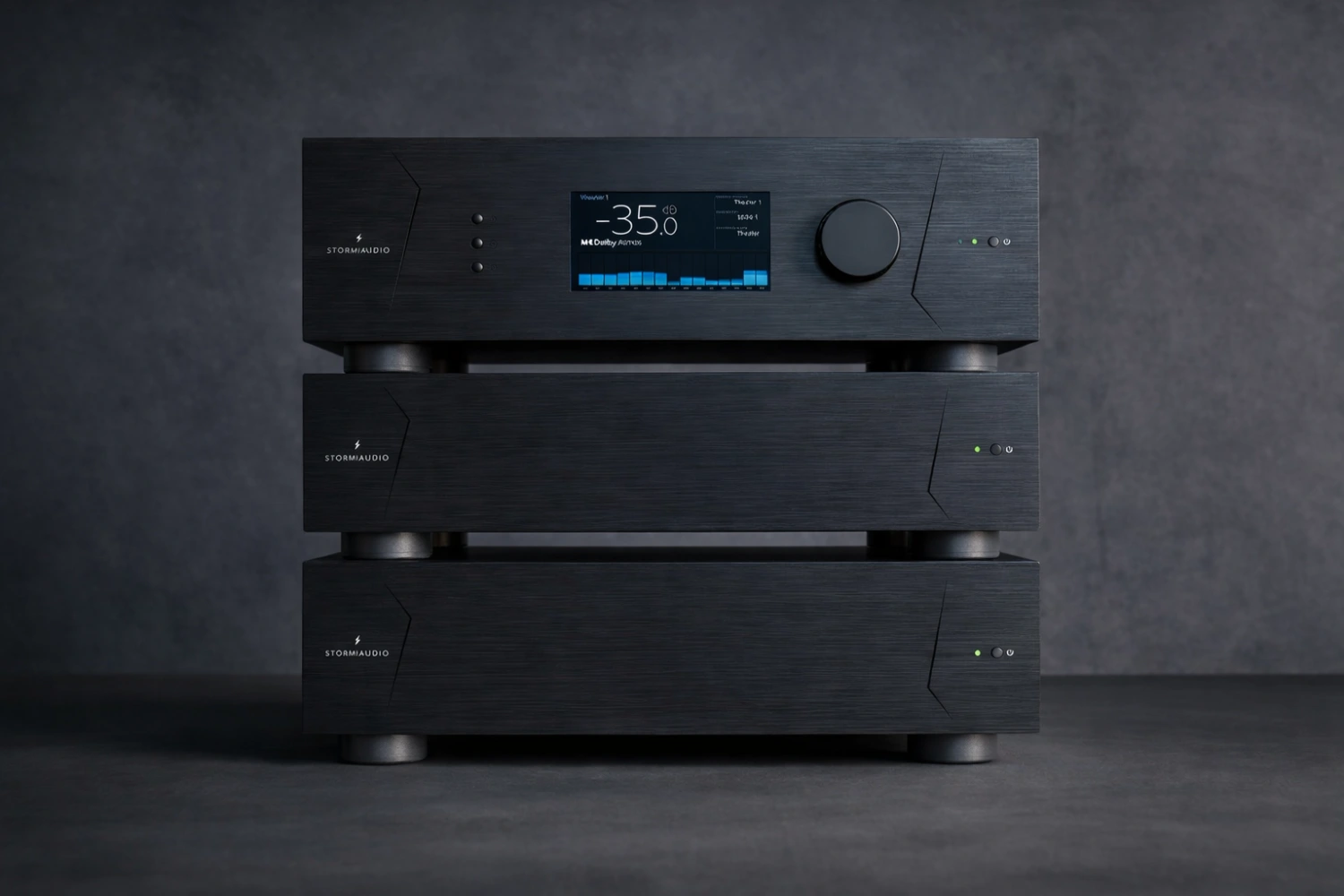
1. StormAudio Impulsion 8
The StormAudio Impulsion 8 combines eight Class D channels, DSP and Audio-over-IP connectivity in a 2U chassis.
The Impulsion 8 is aimed squarely at professionally designed immersive cinema and custom-installation systems.
Its eight Class D channels are joined by DSP and native Audio-over-IP connectivity, with both AES67 and Dante support intended to simplify digital routing and reduce reliance on long analog cable runs.
StormAudio specifies up to 200 watts per channel into eight ohms, while bridge mode is rated at up to 800 watts into eight ohms or 1,200 watts into four ohms. A compact 2U enclosure helps in rack-based systems. The source describes a prototype, so these details should be treated as preview specifications rather than an assessment of finished production hardware.
Best for: Networked custom cinema systems
- Eight Class D amplifier channels
- Native AES67 and Dante connectivity
- Bridge-mode configuration
- Compact 2U enclosure
Verdict: A promising system-oriented amplifier for complex installations, although its prototype status leaves the final implementation unconfirmed.

2. Arcam A15
The Arcam A15 is an 80-watt-per-channel integrated amplifier with MM phono, digital inputs and adaptive aptX Bluetooth.
Arcam’s A15 is a conventional integrated amplifier with enough connectivity to accommodate both established and newer sources.
Its specified 80 watts per channel make it the more powerful alternative to the A5, and the source positions it for large floorstanding speakers as well as low-impedance bookshelf designs.
An MM phono stage serves turntables, while two coaxial inputs, one optical input and USB cover digital equipment. Adaptive aptX Bluetooth supports playback from compatible devices and connection to Bluetooth headphones, a useful option when loudspeaker listening is impractical. A preamplifier output also leaves room for system expansion.
Best for: Mixed digital and vinyl systems
- 80 watts per channel
- Built-in MM phono stage
- Adaptive aptX Bluetooth
- Analog, coaxial, optical and USB inputs
Verdict: A well-equipped integrated amplifier for listeners who want useful power, turntable support and convenient Bluetooth listening in one unit.

3. Marantz PM-KI Ruby
The Marantz PM-KI Ruby pairs a discrete two-stage amplifier architecture with an MM/MC phono section and reinforced chassis.
Developed under Ken Ishiwata’s guidance, the PM-KI Ruby is built for listeners seeking a substantial integrated amplifier with serious attention paid to both line-level and vinyl sources.
Its fully discrete two-stage architecture uses separate supplies for the preamplifier and power-amplifier sections.
Output is specified at 100 watts per channel into eight ohms and 200 watts per channel into four ohms. The MM/MC phono section employs Marantz Musical Premium Phono EQ technology, while proprietary HDAM modules are used in the signal path. A dual-layer chassis, aluminum panels, nickel-plated inputs and high-purity copper speaker terminals complete the construction.
Best for: High-end integrated vinyl systems
- 100 watts per channel into eight ohms
- Integrated MM and MC phono stage
- Separate preamplifier and power-amplifier supplies
- Dual-layer vibration-resistant chassis
Verdict: A powerful, carefully constructed Marantz integrated amplifier with unusually strong provision for both moving-magnet and moving-coil cartridges.

4. Premiera D2S
The compact Premiera D2S provides network amplification, a phono preamplifier, extensive digital connectivity and a front headphone output.
The D2S suits listeners who want streaming, digital playback, vinyl support and speaker amplification without a full-width stack of components.
Premiera retains the compact 270 × 70 × 277 mm enclosure of the earlier D1S while increasing specified output to 2 × 168 watts into four ohms and adding a phono preamplifier.
It can accommodate as many as ten sources, including seven digital inputs, and provides Bluetooth 5.0 with aptX, aptX HD and AAC support. A front-mounted 3.5 mm headphone output adds another practical listening option. Most functions are accessed through software menus, an approach designed to permit feature changes through firmware.
Best for: Compact all-in-one hi-fi systems
- 2 × 168 watts into four ohms
- Integrated phono preamplifier
- Support for up to ten sources
- aptX HD and AAC Bluetooth support
Verdict: The D2S brings high specified output, broad source handling and vinyl support to a notably compact network-integrated design.

5. Rotel RA-1592 MKII
The Rotel RA-1592 MKII combines preamplifier and power-amplifier circuitry with extensive analog, digital, USB and Bluetooth connectivity.
Rotel’s RA-1592 MKII is intended for systems with a particularly broad mixture of sources.
It combines circuitry derived from the RC-1590 preamplifier and RB-1582 MkII power amplifier in one chassis, with independent power supplies and an internal layout designed to reduce crosstalk.
Analog provision includes an MM phono input and a balanced XLR input. Three optical and three coaxial connections accept signals up to 24-bit/192 kHz, while the asynchronous USB input supports formats up to 24-bit/384 kHz and MQA decoding according to the source. aptX Bluetooth and a front USB connection for an iPhone or iPod extend its everyday flexibility.
Best for: Systems with numerous analog and digital sources
- MM phono and balanced XLR inputs
- Three optical and three coaxial inputs
- Asynchronous USB input
- aptX Bluetooth connectivity
Verdict: A connectivity-rich integrated amplifier that reduces the need for separate source-switching, conversion and amplification components.

6. Lab12 Integre4 Mk2 Toroid
The Lab12 Integre4 Mk2 Toroid uses a dual-mono layout, twin toroidal transformers and an OLED-guided automatic bias system.
The Integre4 Mk2 Toroid is for tube listeners who value configuration flexibility but would rather avoid manual biasing equipment.
Its revised dual-mono architecture uses two high-current, low-noise toroidal transformers and redesigned power-supply stages.
KT150 output tubes are supplied as standard, but the amplifier also supports EL34, 6550, KT88 and KT120 types, allowing owners to change tubes according to their system and preferences. A processor-controlled bias system handles adjustment through the front OLED display. The upgraded transformers also feed the headphone circuit, extending the tube-amplifier architecture to private listening.
Best for: Tube enthusiasts seeking easy configuration
- Dual-mono architecture
- Two toroidal transformers
- Supports five output-tube types
- Processor-controlled bias adjustment
Verdict: A flexible tube integrated amplifier that combines broad valve compatibility with a more approachable processor-managed bias system.

7. Musical Fidelity M8x Vinyl
The Musical Fidelity M8x Vinyl offers adjustable gain and selectable RIAA, DECCA and COLUMBIA equalization through front-panel controls.
Unlike the integrated amplifiers in this guide, the M8x Vinyl is a dedicated phono amplifier for systems that require extensive cartridge and equalization control.
Its fully balanced, discrete architecture provides separate amplification stages for the positive and negative signals in each channel.
Gain can be adjusted from 40 dB to 69 dB to accommodate cartridges with differing output levels. Front-panel controls also provide access to standard RIAA equalization and the alternative DECCA and COLUMBIA curves. Musical Fidelity further specifies a redesigned three-stage gain section, discrete input filtering and an encapsulated transformer intended to reduce susceptibility to electromagnetic interference.
Best for: Vinyl systems requiring extensive adjustment
- Adjustable gain from 40 dB to 69 dB
- RIAA, DECCA and COLUMBIA EQ curves
- Fully balanced discrete architecture
- Encapsulated power transformer
Verdict: A specialized phono amplifier for listeners who need finer control over cartridge gain and record equalization than a typical built-in stage provides.

8. Hidizs S9 Pro Plus Martha
The Hidizs S9 Pro Plus Martha combines an ES9038Q2M DAC with independent headphone amplification and 3.5 mm and 4.4 mm outputs.
The S9 Pro Plus Martha addresses a different use case from a loudspeaker amplifier: it combines USB conversion and headphone amplification for direct personal listening.
Its fully balanced circuit is divided into a USB interface processor, ES9038Q2M DAC, independent headphone amplifier and pop-noise reduction system.
Both 3.5 mm and balanced 4.4 mm headphone outputs are provided, avoiding the need to commit to one connection type. Hidizs specifies 180 mW into 32 ohms through the balanced output. That combination makes it most relevant to listeners who want a single USB-connected device for both conventional and balanced headphones.
Best for: USB-based balanced headphone listening
- 3.5 mm and 4.4 mm headphone outputs
- Fully balanced circuit architecture
- ES9038Q2M DAC
- 180 mW into 32 ohms from the balanced output
Verdict: A focused DAC and headphone amplifier that provides both single-ended and balanced outputs from one USB audio device.

9. Aiyima A07 MAX
The Aiyima A07 MAX is a compact TI TPA3255-based Class D amplifier with switchable stereo and mono operation.
The A07 MAX is a small Class D amplifier for straightforward analog systems, with a configurable design that can operate in stereo or mono.
Its TI TPA3255 platform is specified at up to 2 × 225 watts into four ohms in stereo or 1 × 450 watts into four ohms in mono.
A switch on the underside activates monaural operation, allowing multiple units to be used in a modular arrangement. The DIP8-mounted NE5532 op-amps are replaceable, which will appeal to users interested in component substitution. Connectivity is intentionally simple: an RCA line input, speaker terminals and a 3.5 mm auxiliary output for another amplifier or an active subwoofer.
Best for: Simple or modular analog systems
- Switchable stereo and mono operation
- Replaceable DIP8 op-amps
- Auxiliary output for an amplifier or subwoofer
- Compact Class D design
Verdict: A flexible compact power amplifier for users who value stereo-to-mono conversion and replaceable op-amps more than extensive source connectivity.

10. Nubert nuConnect ampXL
The Nubert nuConnect ampXL integrates Class D amplification, network streaming, room calibration and MM/MC phono support.
Nubert’s nuConnect ampXL is designed as the control center of a connected speaker system.
It combines Class D amplification, a DAC and network streaming, with output specified at up to 340 watts per channel.
Its DSP includes a five-band equalizer and Nubert X-Room Calibration, operated through the X-Remote application. Source compatibility covers optical and coaxial digital inputs, RCA and balanced XLR analog inputs, plus an MM/MC phono stage. Active subwoofers can be connected conventionally or through Nubert X-Connect, while HDMI ARC requires an optional adapter. The source describes TIDAL Connect as firmware-dependent, making software support an important part of the product’s feature set.
Best for: Connected systems needing room correction
- Up to 340 watts per channel
- Five-band EQ and X-Room Calibration
- Built-in MM and MC phono stage
- Wired and wireless subwoofer connectivity
Verdict: A comprehensive network integrated amplifier for listeners who want powerful amplification, source flexibility and DSP-based room optimization in one component.


Sound Off
0Join the discussion if you have something to add.