
The right home cinema choice depends on the role a component must perform.
A soundbar addresses space and installation constraints, while an AV receiver supports a conventional speaker system and an AV processor belongs in a more ambitious separates-based installation.
Disc playback, speaker quantity and music performance can be equally important, depending on how the system will be used. This guide matches the supplied products and articles to distinct setups. The Denon and Marantz receivers suit expansive multichannel systems, Yamaha offers both automated surround processing and a focused seven-channel alternative, and the Anthem processor is intended for systems built around external amplification. Soundbar and receiver roundups provide broader shopping references, while the speaker guide explains channel notation before equipment is selected. Not every entry is a purchasable product. Two are comparative buying guides, one explains speaker configurations, and the reported Sonos Pinewood remains an unconfirmed prospect rather than a current recommendation. Those distinctions are essential when deciding which information can support an immediate purchase.

1. Denon AVC-X6800H: Premium AV receiver equipped with 11 built-in power amplifiers
The Denon AVC-X6800H combines 11 channels of built-in amplification with processing for larger externally amplified systems.
The Denon AVC-X6800H is the most natural fit here for an expandable immersive-audio system.
Its 11 built-in power amplifiers can support substantial speaker layouts without immediately requiring separate amplification, while the 13.4-channel processor output allows a system to grow with additional power amplifiers.
Dolby Atmos, DTS:X and Auro-3D decoding support configurations including 9.2.4 and 7.4.4, and connections for as many as four subwoofers are intended to improve low-frequency distribution. ARC and eARC simplify TV-audio playback, with eARC accommodating formats including Dolby TrueHD, DTS-HD Master Audio and Dolby Atmos.
Best for: Large, expandable immersive theaters
- Eleven built-in power amplifiers
- 13.4-channel processor output for expansion
- Connections for up to four subwoofers
- Dolby Atmos, DTS:X and Auro-3D decoding
Verdict: Choose the AVC-X6800H when extensive speaker and subwoofer support matters more than keeping the system simple.

2. Best soundbars
The soundbar guide compares all-in-one home cinema options, including the compact Bose Smart Soundbar 600 and the Sonos Arc.
This article is a comparative soundbar guide rather than a recommendation for one model.
The supplied section illustrates two useful directions: the compact Bose Smart Soundbar 600 emphasizes Dolby Atmos presentation and clear dialogue, while the Sonos Arc combines film and music use with integration into the Sonos ecosystem.
It is the relevant starting point for rooms where an all-in-one design is preferable to installing an AV receiver and multiple speakers, but individual format support still needs attention because the Bose example does not support DTS:X.
Best for: Simpler systems with fewer separate speakers
- Dolby Atmos-focused selection
- Includes compact and ecosystem-oriented options
- Considers dialogue, film and music performance
Verdict: Use this guide to compare space-saving Dolby Atmos soundbars while checking each model’s format and ecosystem limitations.
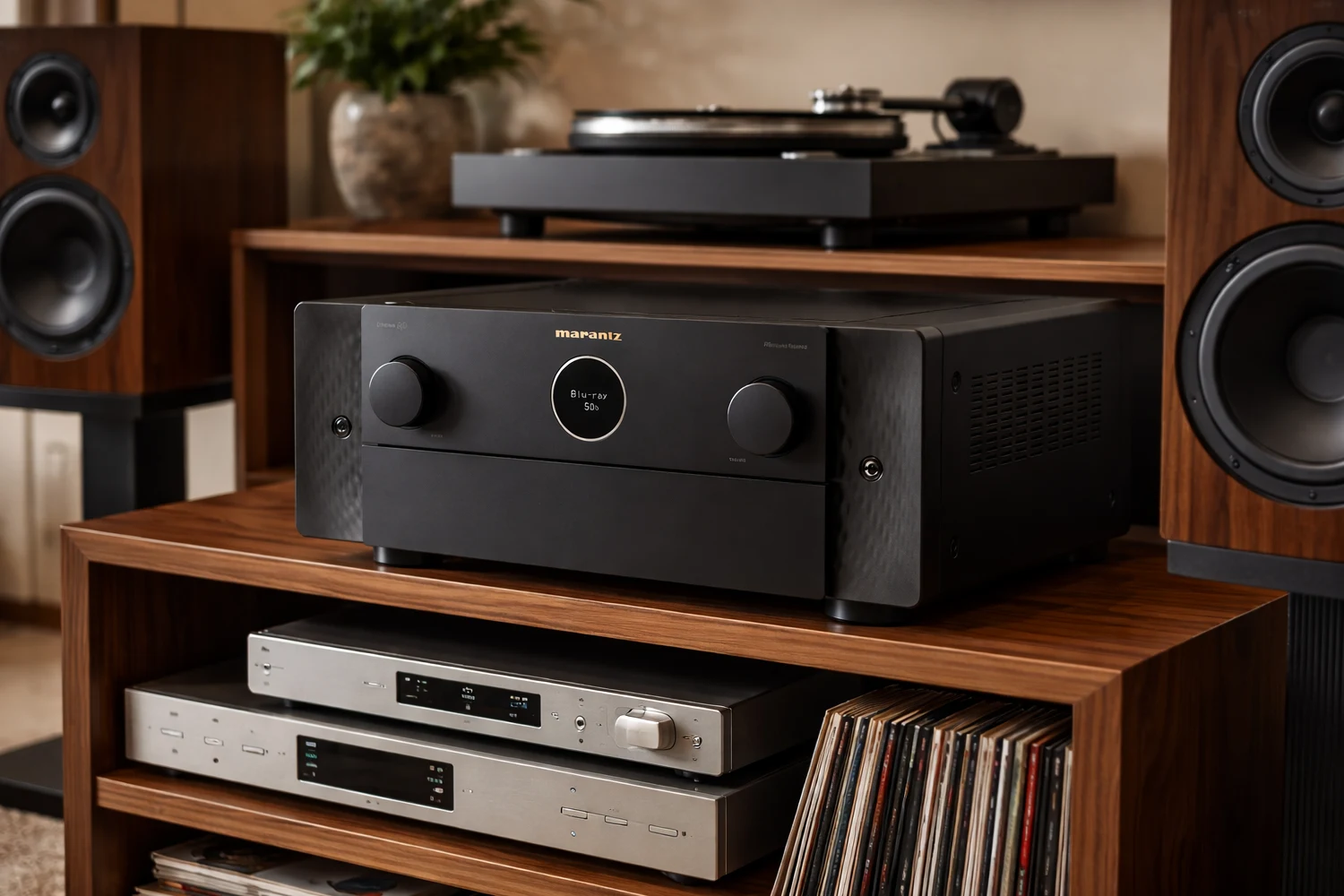
3. Marantz CINEMA 40: High-End 9.4-Channel AV Receiver with Real Hi-Fi Power
The Marantz CINEMA 40 is a 9.4-channel receiver with an aluminum front panel and the brand’s distinctive circular display.
The Marantz CINEMA 40 suits a home cinema that must also serve as a serious music system.
It is a 9.4-channel receiver rated at 125 watts per channel, and the source emphasizes a warm, present presentation with vocals and instruments as well as the scale required for film soundtracks.
Its aluminum front panel, concealed controls and circular display also distinguish it from receivers designed to disappear into a cabinet. This combination makes the CINEMA 40 particularly relevant when musical character, multichannel capability and visible build quality all influence the decision.
Best for: Music-conscious 9.4-channel cinemas
- 9.4-channel configuration
- Rated at 125 watts per channel
- Music-oriented sonic emphasis
- Aluminum front panel with concealed controls
Verdict: The CINEMA 40 is the strongest match for listeners who want one premium receiver to handle both film soundtracks and dedicated music sessions.

4. Yamaha RX-A6A: AV Receiver with artificial intelligence
The Yamaha RX-A6A uses SURROUND:AI to analyze dialogue, music and effects while supporting Dolby Atmos and DTS:X.
The Yamaha RX-A6A is aimed at systems where automated surround adjustment is a priority.
SURROUND:AI analyzes elements such as dialogue, background music and effects, then optimizes their surround treatment during playback.
Dolby Atmos and DTS:X provide the underlying immersive formats, while a Qualcomm QCS407 chipset and 32-bit ESS ES9026PRO DAC form the digital audio platform. Support for 8K and higher-refresh-rate 4K signals also makes it relevant to systems combining cinema playback with demanding video sources.
Best for: Automated surround processing and advanced video
- SURROUND:AI processing
- Dolby Atmos and DTS:X support
- 32-bit ESS ES9026PRO DAC
- 8K and high-refresh-rate 4K video support
Verdict: Choose the RX-A6A when intelligent real-time surround optimization and high-bandwidth video support are central to the system plan.

5. Best AV Receiver: Choosing the very best for your home cinema
The AV receiver guide compares channel layouts, amplification, surround formats, video support and network features.
This receiver guide is useful for shoppers who have not yet settled on a channel count or feature level.
Its entries are organized around practical specifications such as amplification, supported audio formats and video capabilities.
The supplied Yamaha RX-V4A example shows the value of that approach: it combines a 5.2 layout and five channels rated at 80 watts with Dolby Atmos, DTS:X, 8K at 60 Hz, 4K at 120 Hz and multiple HDR formats. Bluetooth, Wi-Fi, AirPlay 2 and MusicCast are also covered, along with the ability to redirect amplification to a second zone or bi-amp the front speakers.
Best for: Shoppers comparing AV receiver tiers
- Concrete channel and power information
- Audio and video format coverage
- Wireless and multiroom details
- Explains channel reassignment options
Verdict: Consult this guide when building an AV receiver shortlist, then match each candidate’s channel allocation and connectivity to the intended system.

6. How many speakers should a home theater system have?
The speaker-count guide explains how full-range speakers, subwoofers and height channels are represented in system labels.
This explainer should be read before choosing amplification if channel labels such as 7.2 or 7.1.4 are unfamiliar.
It defines the first number as the count of full-range channels, the second as the number assigned to subwoofers and the third as the height-channel count.
Understanding that notation makes it easier to estimate the required speakers and determine how many amplified and processed channels a receiver or processor must provide. It is therefore a planning resource rather than a product recommendation.
Best for: First-time multichannel system planning
- Explains home cinema channel notation
- Separates full-range, subwoofer and height counts
- Helps determine the required speaker quantity
Verdict: Start with this guide if speaker counts and channel labels need to be understood before choosing a receiver or processor.

7. Rumor: Sonos Pinewood – Will Sonos Introduce Video Streaming?
The reported Sonos Pinewood concept would combine video-service access with wireless audio delivery to Sonos speakers.
Pinewood is not a current buying recommendation because the source describes an unconfirmed Sonos project that had not been shown publicly.
Reports suggest a universal interface for services including Netflix, HBO Max and Disney+, together with wireless audio transmission to Sonos speakers.
That concept could be relevant to an existing Sonos household seeking closer integration between video streaming and whole-home audio, but the reported features and eventual availability should not be treated as established product facts.
Best for: Sonos users monitoring possible video integration
- Reported universal streaming interface
- Expected wireless audio connection to Sonos speakers
Verdict: Treat Pinewood as an indication of a possible Sonos direction, not as a product around which to plan an immediate home cinema purchase.

8. Yamaha RX-A1080: High-performance AV receiver
The Yamaha RX-A1080 is a seven-channel Aventage receiver with an aluminum front panel and ART Wedge chassis support.
The Yamaha RX-A1080 fits a more focused seven-channel installation.
Rated at 110 watts per channel into 8 ohms with two channels driven, it can be configured for a 5.1-based system with height channels or used to bi-amp the front speakers.
Its Aventage construction includes an aluminum front panel and an additional central ART Wedge support intended to control vibration. The design brief covers both full-bodied film sound and detailed music reproduction, making this a sensible match for a conventional room where flexible use of seven amplifier channels is more valuable than a very large speaker layout.
Best for: Focused seven-channel or bi-amped systems
- Seven built-in amplifier channels
- Rated at 110 watts per channel with two channels driven
- Height-channel or front-speaker bi-amping options
- Aventage vibration-control construction
Verdict: The RX-A1080 suits listeners who want a solid seven-channel receiver with flexible amplifier assignment and attention to mechanical construction.
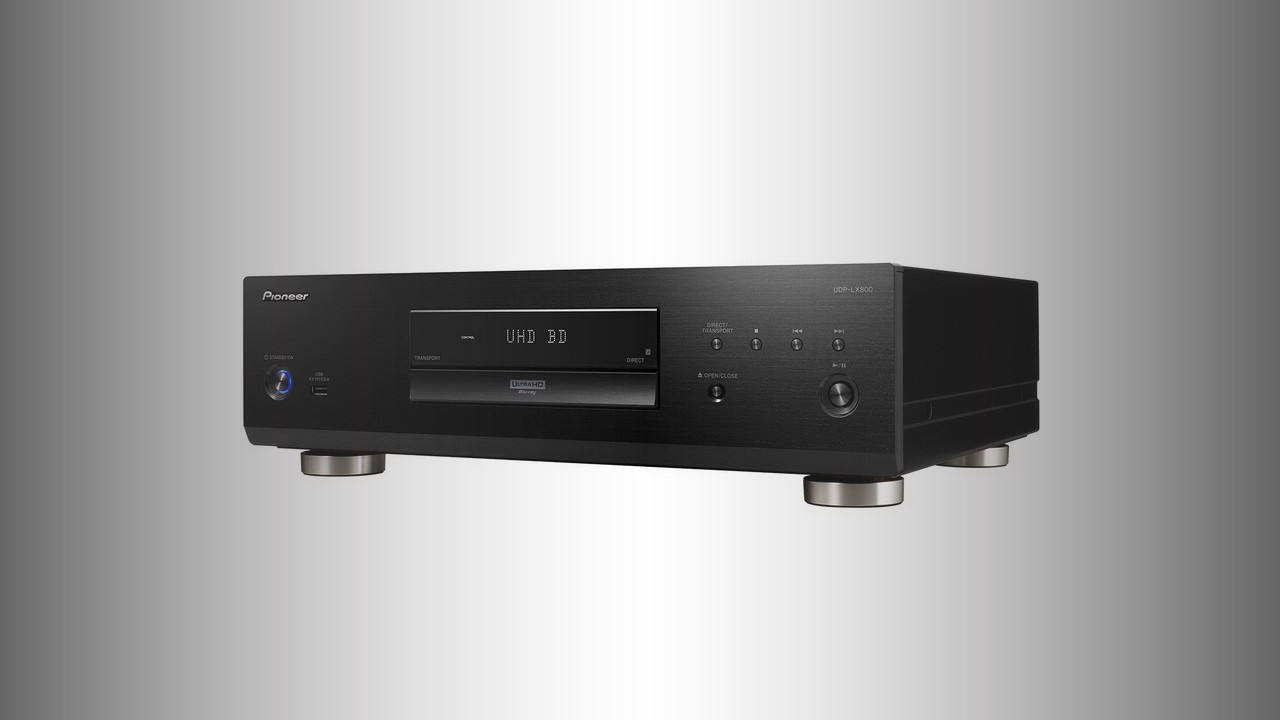
9. Pioneer UDP-LX800: Top-class universal player
The Pioneer UDP-LX800 is a universal disc player with dual HDMI outputs and an extensively isolated drive and internal layout.
The Pioneer UDP-LX800 is the specialist choice for a cinema built around physical media.
It plays CD, DVD, DVD-Audio, DVD-Video, SACD and Ultra HD Blu-ray, while supporting Dolby Vision and HDR10 for compatible video material.
Separate HDMI outputs allow audio and video to be routed independently, and PQLS is intended to reduce jitter when the player is connected to a compatible Pioneer AV receiver. Its floating drive, anti-vibration enclosure and internally isolated power, digital and analog sections reflect a source component designed for both demanding video playback and high-quality disc audio.
Best for: Physical-media and universal-disc collections
- Plays CD, DVD, SACD and Ultra HD Blu-ray
- Dolby Vision and HDR10 support
- Separate HDMI outputs for audio and video
- Extensive drive and chassis isolation
Verdict: Choose the UDP-LX800 when disc compatibility, isolated construction and separate audio and video signal routing justify a dedicated player.

10. Anthem AVM 90: Powerful fifteen-channel AV processor
The Anthem AVM 90 provides 15.4-channel processing, balanced XLR outputs and ARC Genesis room correction for large home theaters.
The Anthem AVM 90 belongs in a large separates-based home cinema rather than a straightforward receiver system.
It supports object-based audio processing for as many as 15.4 channels and provides balanced XLR audio outputs for connection to external amplification.
ARC Genesis room correction is accompanied by an upgraded calibration microphone, while the video section includes seven HDMI inputs, two outputs, Dolby Vision, HDR, Hybrid Log Gamma and eARC support. Chromecast and AirPlay 2 add networked audio options, and the redesigned web interface supports remote configuration.
Best for: Large theaters built with separate power amplifiers
- Processing for up to 15.4 channels
- Balanced XLR audio outputs
- ARC Genesis room correction with upgraded microphone
- Seven HDMI inputs and two outputs
Verdict: The AVM 90 is the appropriate option when extensive channel processing, balanced outputs and room correction are required for a separates-based installation.


Sound Off
0Join the discussion if you have something to add.