
Amplifier choice starts with system requirements rather than a single hierarchy.
This selection covers monoblock and stereo power amplifiers, traditional integrated models, a dedicated preamplifier, and feature-rich designs able to accommodate vinyl, digital sources, headphones, or wireless playback.
Each recommendation is matched to the listener and system it suits best. The distinctions are based on the supplied information about amplification class, power delivery, connectivity, circuit architecture, volume control, and load compatibility rather than unsupported comparisons or listening claims. One supplied entry, retained at position four, is an overview of loudspeakers made from unusual materials rather than an amplifier. It is identified accordingly and treated as related reading, not as a direct amplifier recommendation.

1. Merrill Audio ELEMENT 110: Powerful monoblock with a large touch screen
The Merrill Audio ELEMENT 110 combines a seven-inch color touchscreen with a vibration-resistant black case and rose-gold-plated front panel.
The ELEMENT 110 is intended for systems built around separate monophonic power amplifiers, particularly where loudspeaker impedance can fall sharply.
It is rated at 150 W into 8 ohms, 300 W into 4 ohms, and 600 W into 2 ohms, while Merrill Audio specifies operation with loads down to 1 ohm.
A published damping factor of 4,000 further emphasizes the design’s focus on speaker control. Its seven-inch capacitive touchscreen is unusually comprehensive for a power amplifier, providing mute, brightness, and VU-meter functions.
Best for: Demanding loudspeakers in monoblock systems
- Power ratings rise from 150 W at 8 ohms to 600 W at 2 ohms
- Specified to handle loads down to 1 ohm
- Seven-inch touchscreen with mute, brightness, and VU-meter functions
- IsoAcoustics GAIA III isolation mounts
Verdict: The ELEMENT 110 suits separates-based systems that need substantial low-impedance capability and value an informative touchscreen interface.

2. Arcam A25: Integrated amplifier that differs from its predecessor
The Arcam A25’s anodized aluminum front panel features backlit controls, a rotary source selector, and a mini-jack headphone output.
Arcam’s A25 is a practical choice for listeners seeking a modern integrated amplifier without moving to separate components.
Its Class G implementation is rated at 100 W per channel and operates in pure Class A up to 20 W per channel before transitioning to Class AB operation.
Compared with its predecessor, the A25 introduces a redesigned exterior, Bluetooth 5.2, USB-C, and a rotary source selector. A front-panel mini-jack headphone output and included compact remote add everyday convenience.
Best for: Modern integrated-amplifier systems
- Class G amplification rated at 100 W per channel
- Pure Class A operation up to 20 W per channel
- Bluetooth 5.2 and USB-C connectivity
- Front-panel headphone output
Verdict: The A25 is well matched to listeners who want Arcam’s Class G architecture alongside updated wired and wireless connectivity.

3. Burson Timekeeper Voyager: Class AB power amplifier with high current efficiency
The Burson Timekeeper Voyager houses its high-current Class AB circuitry in the company’s heat-managing Cool Case enclosure.
The Timekeeper Voyager is a compact Class AB power amplifier for systems that prioritize high-current operation over low idle consumption.
It delivers up to 200 W per channel into 4 ohms and runs at a high idle current to keep its transistors within what Burson describes as their most linear operating range.
The design combines an enhanced MCPS power system, Silent Power 02 regulators, a discrete input buffer using Supreme Sound V7 Vivid operational amplifiers, and an EXICON MOSFET output stage. Prospective owners should note that idle consumption exceeds 100 W.
Best for: Compact, high-current Class AB systems
- Up to 200 W per channel into 4 ohms
- Compact Class AB construction
- EXICON MOSFET output stage
- Choice of Super Charger or Fusion Core power supplies
Verdict: The Voyager is a specialist power amplifier for users who value high-current biasing and compact construction more than minimal idle energy use.

4. 7 awesome speakers made from unusual materials
Le Pavé Parisien is one featured example, using a 10 cm reinforced-concrete enclosure, a 9 cm full-range driver, and a built-in 20 W Class D amplifier.
This entry is not an amplifier recommendation but a survey of loudspeakers that use unconventional materials for their cabinets or drive units.
Examples in the supplied material include Le Pavé Parisien, a compact wireless speaker with a reinforced-concrete enclosure and built-in 20 W Class D amplifier, and the three-way BetonArt Arrivato Active, which combines a concrete cabinet with ribbon, ceramic, and aluminum-diaphragm drivers.
It is relevant to readers interested in loudspeaker construction, but it should not be compared directly with the amplifiers elsewhere in this guide.
Best for: Readers exploring unusual speaker construction
- Explores unconventional cabinet and driver materials
- Includes both compact wireless and larger active-speaker examples
Verdict: This is useful background on material experimentation in loudspeakers, but it is not a substitute for an amplifier recommendation.
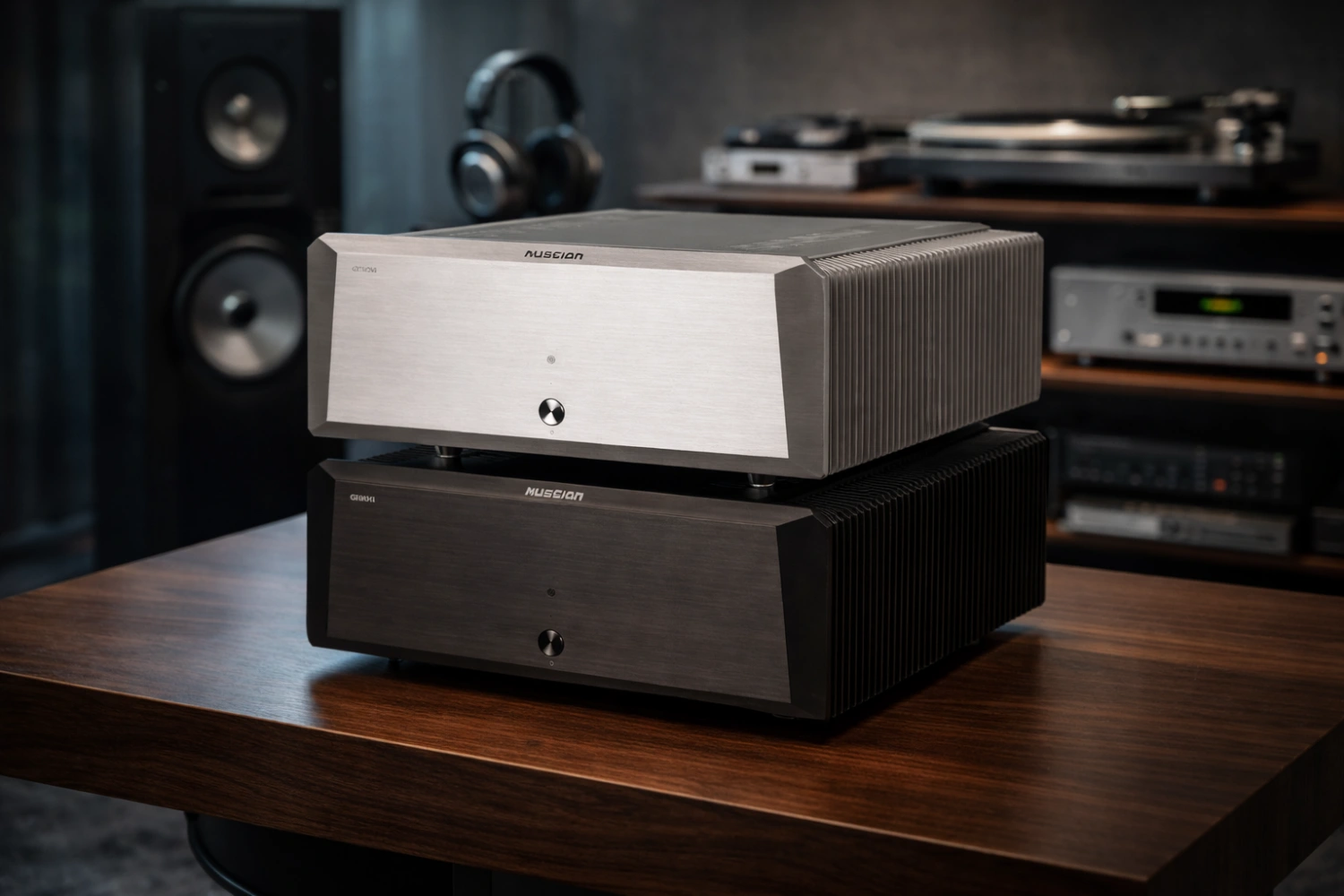
5. Musician GEMINI Power Amplifier: Balanced Muscle with Precision Control
The Musician GEMINI is a fully balanced Class AB stereo power amplifier supported by a 600 VA transformer and a 36-capacitor supply stage.
The Musician GEMINI is aimed at systems that can make full use of a balanced XLR signal path.
This Class AB stereo power amplifier uses a fully balanced, discrete architecture that processes the positive and negative signal phases independently.
Its power supply is built around a shielded 600 VA toroidal transformer, 36 storage capacitors, and fast Schottky diodes. Four pairs of high-current output transistors are fitted to each channel, with the supplied material specifying compatibility with both 8-ohm and 4-ohm loudspeaker loads.
Best for: Balanced separates with XLR connectivity
- Fully balanced, discrete Class AB architecture
- XLR inputs fitted as standard
- Shielded 600 VA toroidal transformer
- Four pairs of output transistors per channel
Verdict: The GEMINI is a logical fit for listeners assembling a fully balanced system around a dedicated stereo power amplifier.
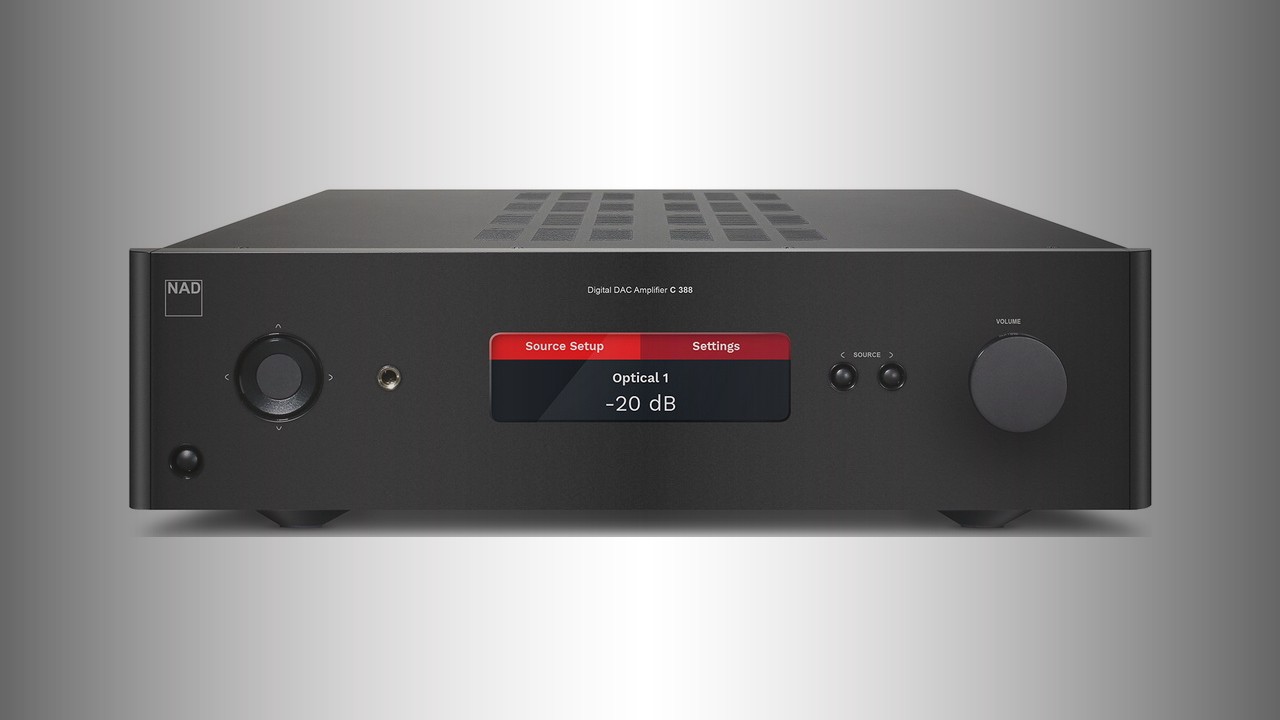
6. NAD C 388: Integrated amplifier and wireless multiroom center
The NAD C 388 combines Hypex UcD amplification with an integrated DAC, moving-magnet phono stage, and separate headphone amplifier.
The NAD C 388 brings several system roles into one chassis.
Its custom Hypex UcD Class D modules are specified to deliver more than 150 W per channel into 8 ohms, while the integrated DAC addresses digital playback.
Vinyl users receive a low-noise moving-magnet phono stage with an accurate RIAA response and a subsonic filter designed to suppress infrasonic oscillation. NAD also provides a separate low-impedance, high-voltage headphone amplifier rather than deriving the headphone output from the bridged speaker-output stage.
Best for: Mixed digital, vinyl, and headphone systems
- More than 150 W per channel into 8 ohms
- Custom Hypex UcD Class D modules
- Built-in moving-magnet phono stage
- Dedicated low-impedance headphone amplifier
Verdict: The C 388 is best suited to listeners who need strong integrated power together with dedicated provisions for digital sources, moving-magnet cartridges, and headphones.

7. Holo Audio Serene: High-performance preamplifier
The Holo Audio Serene is a fully balanced discrete preamplifier with independent channel modules and an 84 dB stepped volume system.
The Holo Audio Serene is a dedicated preamplifier for listeners who already have a suitable power amplifier and want precise analog level control.
Its fully balanced, discrete design separates the left and right channels into independent amplifier modules and uses a separate power-stage structure for the audio circuitry.
Volume is controlled through an 84 dB analog stepped system covering minus 78 dB to plus 6 dB in 1 dB increments, with a stated channel-matching error of plus or minus 0.1 dB. Both balanced XLR and single-ended RCA connections are provided.
Best for: Separates requiring precise analog control
- Fully balanced discrete architecture
- Independent left- and right-channel modules
- One-decibel stepped analog volume control
- Balanced XLR and single-ended RCA connections
Verdict: The Serene is a focused preamplifier for systems that benefit from balanced circuitry, channel separation, and closely matched stepped attenuation.

8. Leema Stellar Pulse IV: Integrated amplifier equipped with everything you need
The Leema Pulse IV places an 80 W integrated amplifier, ESS DAC, MM/MC phono stage, Bluetooth, USB, and multiple digital inputs in a full-metal case.
The Leema Pulse IV is the most connectivity-focused integrated amplifier in this selection.
Its 80 W output rating into 8 ohms is accompanied by an ESS-based 32-bit/384 kHz DAC, XMOS USB input, DSD support, Bluetooth, and six conventional digital inputs split between optical and coaxial connections.
Analog support is similarly broad, with five line-level inputs and a phono stage compatible with both moving-magnet and moving-coil cartridges. A front headphone jack and multiple rear-panel outputs strengthen its credentials as a central system hub.
Best for: Systems with many analog and digital sources
- Moving-magnet and moving-coil phono stage
- 32-bit/384 kHz ESS DAC with DSD support
- USB, Bluetooth, optical, and coaxial connectivity
- 80 W output rating into 8 ohms
Verdict: The Pulse IV is the strongest fit here for listeners who want vinyl, computer audio, conventional digital sources, Bluetooth, and headphones handled by one integrated amplifier.

9. Sabaj A20A: 340 W mono amplifier with Bluetooth 5.0
The Sabaj A20A combines an Infineon MA5332M Class D stage with stereo and BTL modes, balanced XLR input, RCA input, and Bluetooth 5.0.
The Sabaj A20A offers unusual configuration flexibility for a Class D amplifier.
It can operate as a stereo unit rated at 170 W per channel into 4 ohms or 90 W per channel into 8 ohms, or be switched into bridged mono operation.
RCA and XLR inputs are joined by a Bluetooth 5.0 receiver, and the amplifier also provides a dedicated mode for subwoofer control. There is a specification inconsistency in the supplied source: the headline states 340 W in mono operation, while the article body and specification list state 350 W in BTL mode.
Best for: Flexible stereo, mono, or subwoofer installations
- Stereo and bridged-mono operating modes
- Rated at 170 W per channel into 4 ohms in stereo
- RCA and XLR inputs
- Bluetooth 5.0 and a dedicated subwoofer mode
Verdict: The A20A suits systems that value configurable Class D power and several input options, although its conflicting published mono ratings warrant clarification.

10. Circle Labs AS100: Minimalist Integrated Amplifier Built for Signal Purity
The Circle Labs AS100 is a dual-mono integrated amplifier using separate channel transformers and a relay-controlled 63-step volume ladder.
Circle Labs takes a deliberately focused approach with the AS100, emphasizing its internal architecture rather than a long feature list.
The integrated amplifier is built in dual-mono form, with an individual toroidal transformer for each channel.
Its volume control uses a 63-step relay-switched resistor ladder populated with 0.1 percent tolerance resistors, an arrangement intended to improve channel matching and repeatability over a conventional potentiometer. Low-noise Burr-Brown J-FET devices serve the input stage, while bipolar output transistors and 200,000 µF of total filter capacitance support the output and power-supply sections.
Best for: Minimalist systems prioritizing circuit architecture
- Complete dual-mono construction
- Separate toroidal transformer for each channel
- Relay-controlled 63-step resistor-ladder volume system
- 200,000 µF total filter capacitance
Verdict: The AS100 is suited to listeners who prefer a focused integrated amplifier with dual-mono construction and precisely stepped volume control over extensive convenience features.


Sound Off
0Join the discussion if you have something to add.