
Choosing a turntable starts with how and where it will be used.
A DJ needs responsive direct drive and hands-on speed control, while a home listener may place greater value on simple connectivity, cartridge flexibility, vibration management or compatibility with an existing phono stage.
This selection includes complete turntables alongside a cartridge, tonearm, cleaning machine and an overview of vinyl’s renewed appeal. Its positions therefore should not be interpreted as a like-for-like performance ranking. Instead, each entry is assessed according to the particular role it can play in a vinyl system. Before deciding, consider whether you need a complete record player or a specialist upgrade. Check speed support, cartridge provision, phono-stage requirements, output connections, installation demands and available space. Those practical distinctions will usually narrow the field more effectively than headline specifications alone.
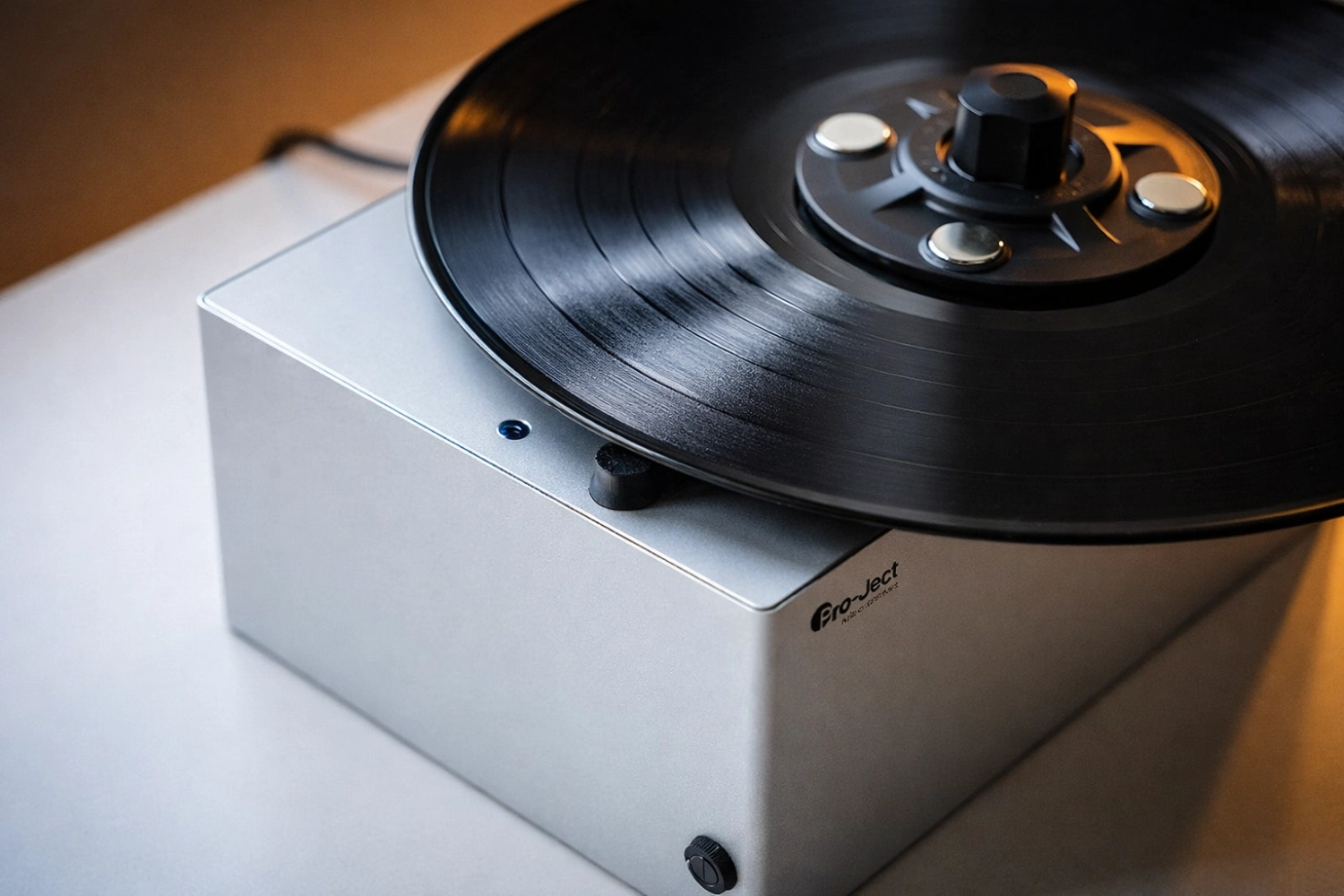
1. Pro-Ject VC-E Mini
The compact Pro-Ject VC-E Mini uses a bottom-mounted vacuum and an internal tank to collect used cleaning fluid.
The VC-E Mini is not a turntable but a compact maintenance machine intended for vinyl enthusiasts with relatively small collections.
Its bottom-mounted vacuum system reduces mechanical complexity, while a brushless DC motor removes cleaning fluid from the record surface.
Pro-Ject also includes an internal tank for the collected liquid and describes the machine as quieter than its larger VC-E2 and VC-S3 models.
Best for: Small collections and limited spaces
- Ultra-compact, space-saving design
- Bottom-mounted vacuum system
- Brushless DC vacuum motor
- Built-in collection tank
Verdict: A focused record-care option for listeners who want vacuum cleaning without accommodating a full-size machine.

2. Dynavector 10XA
The red-bodied Dynavector 10XA moving-coil cartridge is offered in separate high- and low-output versions.
The Dynavector 10XA is a moving-coil cartridge rather than a complete record player.
It updates the long-running 10X series with a newly developed magnetic circuit using Dynavector’s Special Magnetic Annealing technology.
Buyers can choose between high- and low-output versions, while the high-output 10XA-H is specified at 2.8 mV. The series also uses a Shibata III line-contact stylus, making system compatibility and preferred output level the key selection points.
Best for: Moving-coil cartridge upgrades with output choice
- High- and low-output versions
- Newly developed magnetic circuit
- Shibata III line-contact stylus
- Solid aluminium headstock
Verdict: A flexible cartridge option for vinyl systems that can be matched carefully to the appropriate output configuration.

3. Vinyl Revival: Why More People Are Choosing Turntables
Vinyl records and turntables appeal to listeners interested in physical collecting as well as the format’s perceived sound character.
This overview is contextual reading rather than a hardware recommendation.
It links vinyl’s resurgence to record collecting as a hobby and to the physical format’s appeal across different age groups.
It also discusses the warmer, richer presentation that many listeners associate with vinyl while contrasting that perception with the clarity and precision commonly attributed to digital formats. Those motivations may explain why someone wants a turntable, but they do not determine which model will suit a particular system.
Best for: Understanding the appeal of vinyl
- Explains vinyl’s renewed popularity
- Considers record collecting as a hobby
- Discusses perceived analog sound qualities
Verdict: Useful background for prospective record collectors, but not a substitute for comparing turntable features and system requirements.

4. Vertere Acoustics SG-II PTA
The Vertere Acoustics SG-II PTA is a top-of-the-line tonearm designed to complement the company’s SG-1 and RG-1 turntables.
The SG-II PTA is a high-end tonearm, not a complete turntable.
Vertere developed it for customers seeking an arm positioned to complement the company’s SG-1 and RG-1 record players.
Although it resembles the SG-1 PTA range, the source says it shares only the fine tracking-force weight, lift/lower mechanism and silicon-nitride triple-bearing assembly with the less ambitious models. Its specialist nature makes turntable and cartridge matching central to the decision.
Best for: High-end SG-1 and RG-1 system upgrades
- Silicon-nitride triple-bearing assembly
- Fine tracking-force weight
- Dedicated lift/lower mechanism
- Versatile anti-skate adjustment
Verdict: A specialist Vertere tonearm aimed at systems that justify careful matching and installation rather than plug-and-play simplicity.

5. Pro-Ject Xtension 9 Evolution
The Pro-Ject Xtension 9 Evolution combines a heavy MDF plinth, carbon-fibre tonearm and electronic speed switching.
The Xtension 9 Evolution is a substantial 16-kilogram turntable built around a resonance-damping MDF plinth and a carbon-fibre tonearm with a one-piece headshell and arm construction.
It is supplied without a cartridge, leaving the owner free to select a moving-magnet or moving-coil model.
Four counterweights and multiple adjustment options broaden cartridge compatibility, while electronic switching between 33 and 45 rpm avoids moving the belt by hand. A dust cover is included.
Best for: Audiophiles who want to choose their own cartridge
- Carbon-fibre Evolution tonearm
- Choice of MM or MC cartridge
- Electronic 33 and 45 rpm switching
- Dust cover included
Verdict: A substantial and highly adjustable turntable for buyers who value cartridge freedom, resonance control and convenient speed selection.

6. Technics SL-1210 MK7
The Technics SL-1210 MK7 pairs a high-torque direct-drive motor with an S-shaped tonearm and professional manual controls.
The SL-1210 MK7 retains the direct-drive architecture, high starting torque and statically balanced S-shaped tonearm associated with Technics professional turntables.
Its motor omits an iron core from the stator, a change intended to improve rotational smoothness, while adjustable speed and manual braking support hands-on DJ use.
The source also identifies a cast-aluminium chassis with an ABS lower section, reinforcing the model’s emphasis on a stable professional platform.
Best for: DJs and hands-on professional use
- High-torque direct drive
- Adjustable speed and manual braking
- Statically balanced S-shaped tonearm
- Cast-aluminium chassis
Verdict: The most clearly DJ-oriented turntable here, with direct drive and manual controls suited to active cueing and speed manipulation.

7. Dual CS 800
The Dual CS 800 uses a spring-suspended aluminium subchassis and damped feet to isolate the record-playing mechanism.
The manual Dual CS 800 places isolation at the centre of its design.
Its aluminium subchassis floats on four parabolic springs to decouple it from the main chassis, while the weighted structure is intended to limit the effect of external noise and vibration on tracking.
Three damped aluminium feet aid levelling, and the cardanic tonearm incorporates revised wiring, an improved bearing, precise anti-skating and tracking-force adjustment. Speed selection is electronically controlled and indicated by an LED.
Best for: Manual playback with an emphasis on isolation
- Four-spring floating subchassis
- Three damped aluminium feet
- Improved cardanic tonearm bearing
- Electronic speed control
Verdict: A considered option for listeners who prioritise mechanical decoupling, precise setup and fully manual operation.

8. TEAC TN-5BB
The TEAC TN-5BB combines a multi-material hybrid chassis, a SAEC-developed tonearm and selectable playback at three speeds.
The TN-5BB is TEAC’s flagship turntable in this source, distinguished by balanced outputs and the absence of an integrated phono preamplifier.
Its 36-millimetre hybrid structure combines artificial marble, MDF and traditional Japanese Washi paper for vibration management.
An optical sensor monitors platter speed through TEAC’s PRS3 servo system, and push-button selection covers 33, 45 and 78 rpm. The tonearm was developed with Japanese specialist SAEC.
Best for: Balanced systems and three-speed playback
- Balanced audio outputs
- Hybrid multi-material chassis
- Optically monitored platter speed
- Push-button 33, 45 and 78 rpm selection
Verdict: A versatile flagship design for listeners who specifically want balanced outputs, external phono amplification and support for three record speeds.

9. Audio-Technica AT-LPW50BT
The Audio-Technica AT-LPW50BT provides Bluetooth, wired outputs, a built-in phono stage and an included AT-VM95E cartridge.
The manual, belt-driven AT-LPW50BT is the most connectivity-focused turntable in the selection.
Bluetooth allows wireless playback through compatible equipment, while a switchable phono preamplifier and detachable RCA cable support wired systems with or without a dedicated phono input.
Its 30-millimetre MDF plinth carries a cast-aluminium platter and straight carbon-fibre tonearm. An included AT-VM95E moving-magnet cartridge can accept other replacement styli from the VM95 range.
Best for: Simple and flexible home systems
- Bluetooth and wired connectivity
- Switchable built-in phono preamplifier
- Carbon-fibre tonearm
- Upgrade-friendly VM95 cartridge platform
Verdict: A practical choice for listeners who want manual vinyl playback with Bluetooth, an integrated phono stage and a clear stylus-upgrade path.

10. Wilson Benesch Greenwich
The Wilson Benesch Greenwich applies the company’s Omega Direct Drive motor and Alpha Drive electronics at the entry point of the GMT range.
The Greenwich is the entry point to Wilson Benesch’s GMT turntable line, but the available source is a product preview rather than a review or full technical assessment.
It uses the patented Omega Direct Drive motor under the control of Alpha Drive electronics, sharing the fundamental Alpha-Omega architecture found in the Prime Meridian and GMT One turntables.
That platform connection is the principal reason to consider it, although the source does not supply comparative listening evidence or a complete specification set.
Best for: Exploring Wilson Benesch’s direct-drive platform
- Patented Omega Direct Drive motor
- Alpha Drive control electronics
- Shared Alpha-Omega platform architecture
Verdict: A technically notable entry point to the GMT family, though the available information supports a platform overview rather than a performance judgment.


Sound Off
0Join the discussion if you have something to add.