
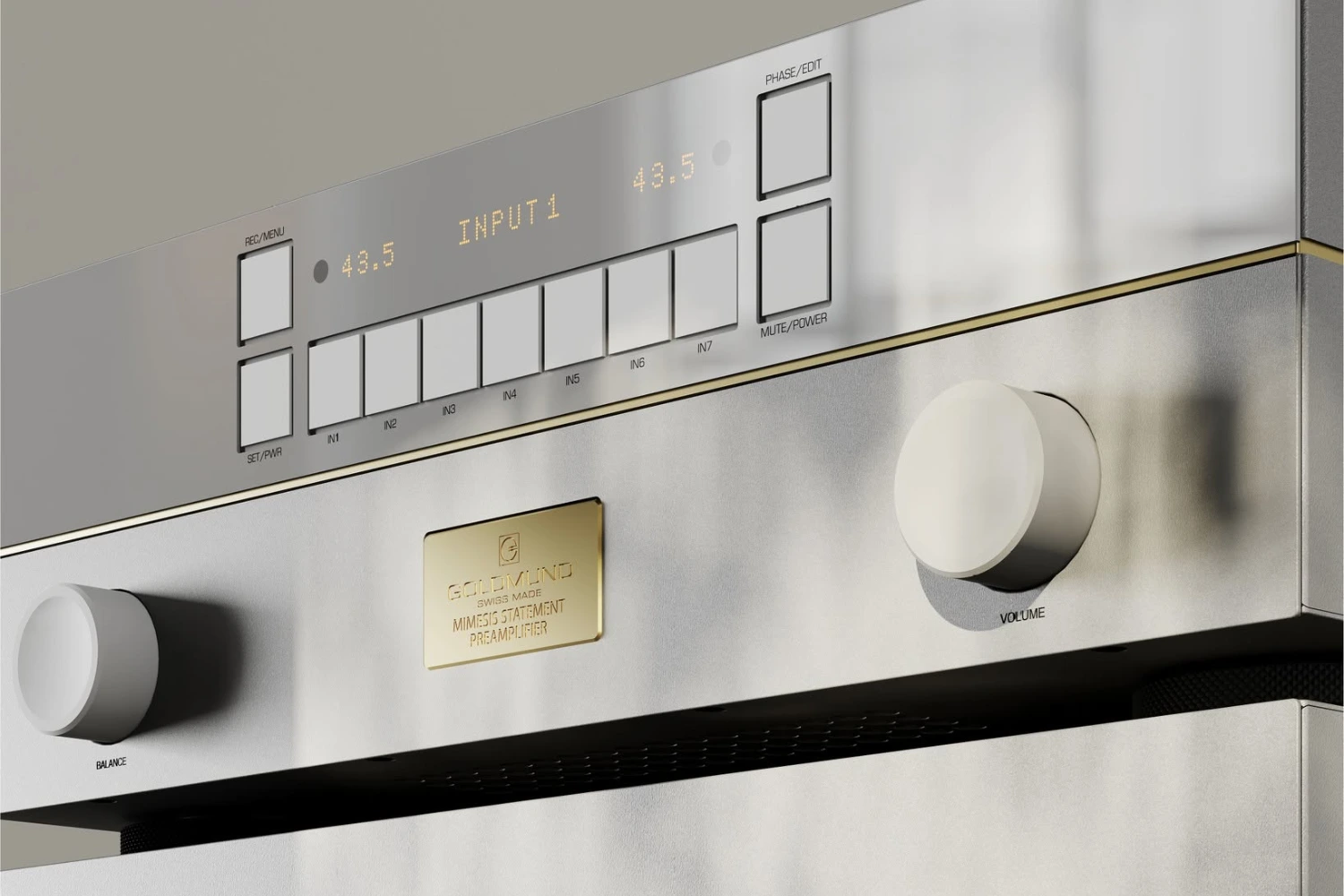
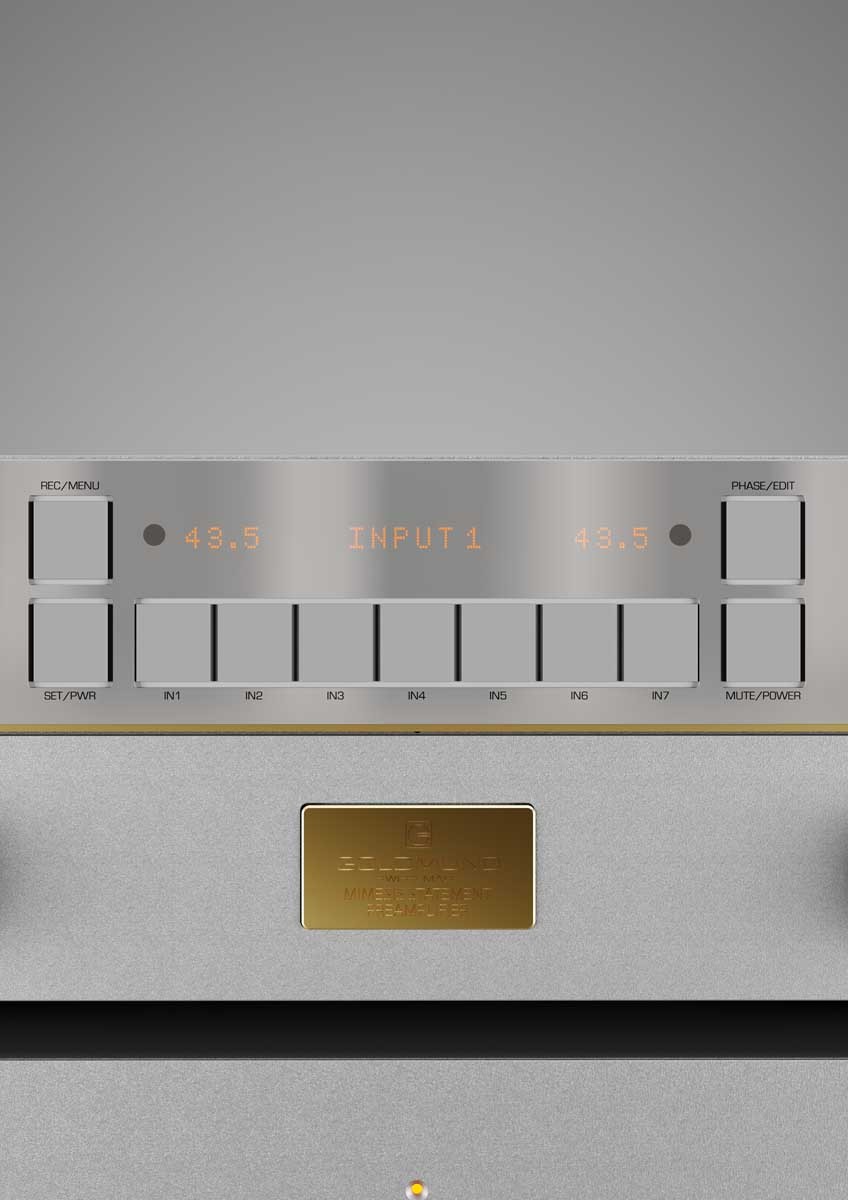
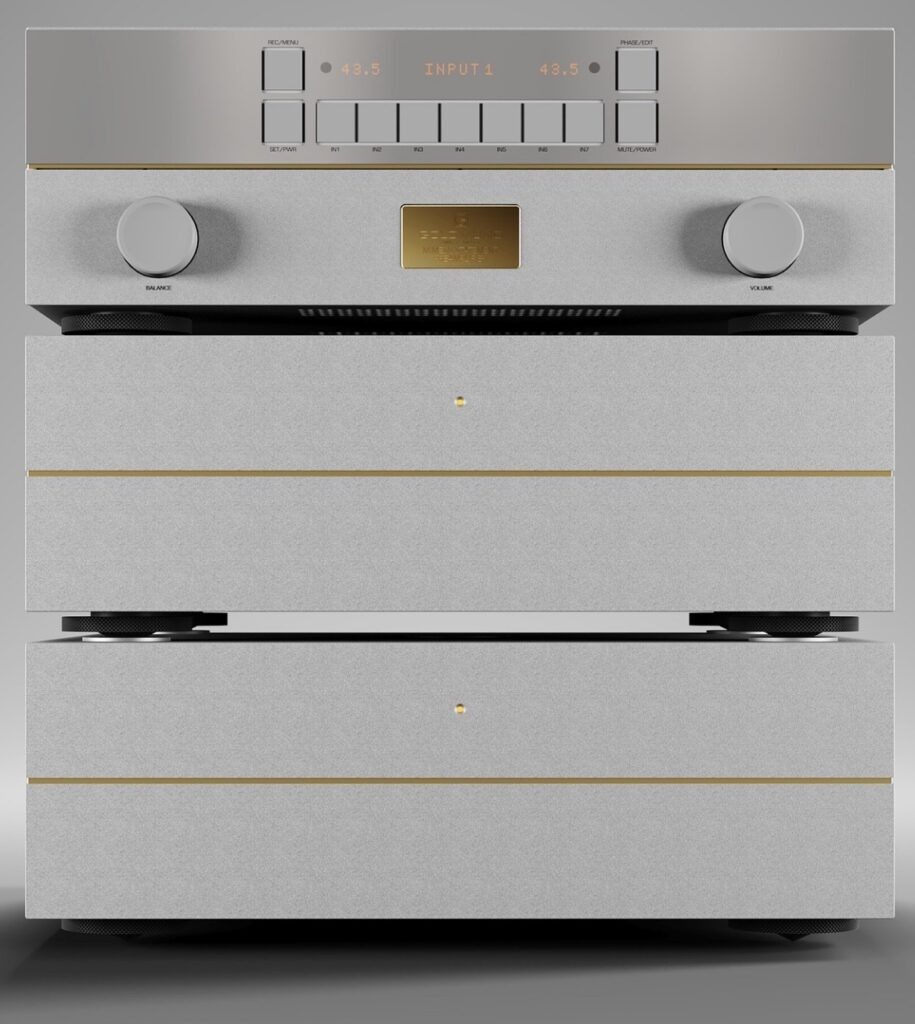
Goldmund has placed physical and electrical separation at the center of its latest flagship analog preamplifier. The Mimesis Statement is a three-chassis design comprising a central audio unit and two outboard power supplies, one dedicated to each channel. Developed largely from the ground up, it now occupies the highest position in the Swiss manufacturer’s preamplifier lineup. Rather than concentrating every circuit in one enclosure, Goldmund has used the additional chassis to distance sensitive analog stages from their power sources, reinforce channel independence and provide a more tightly controlled operating environment for the signal path.
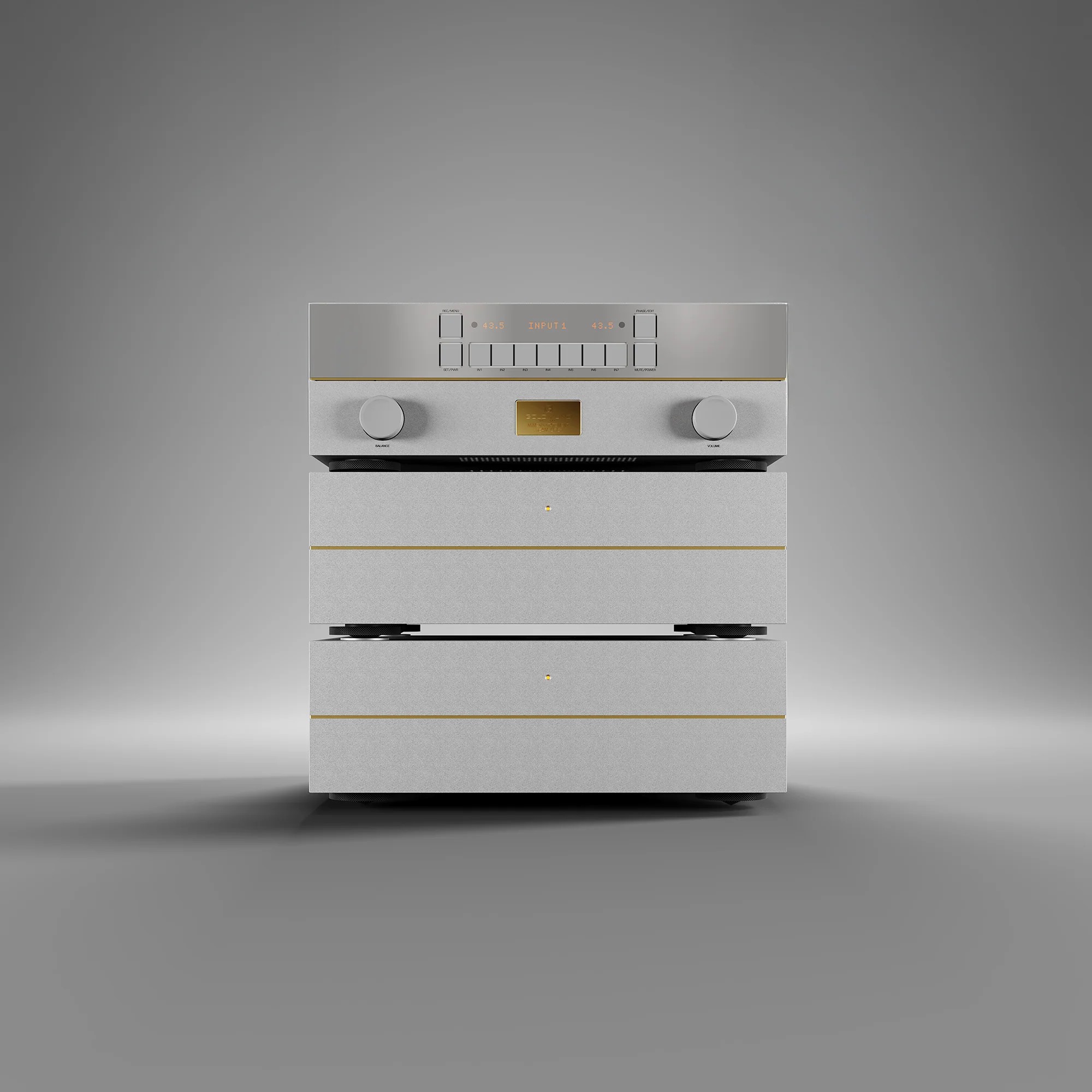
Three enclosures serve one central engineering idea
The defining feature of the Mimesis Statement is not simply its size or flagship status, but the way its principal functions have been distributed. Core preamplifier electronics reside in the central enclosure, while power for the left and right channels comes from two separate housings. That arrangement gives electrical isolation a physical dimension: potential sources of interference are no longer packed alongside the low-level analog circuitry they support.
Separating the audio section from the power supplies is intended to reduce electrical noise before more localized regulation strategies come into play. It also avoids asking a single power-supply enclosure to serve both stereo channels. Goldmund identifies lower interference and greater channel independence as key goals of this architecture, with the broader aim of protecting the integrity of the musical signal as it passes through the preamplifier.
The approach carries an obvious system-level implication. Mimesis Statement ownership requires space for three coordinated components rather than one conventional preamplifier chassis. Goldmund has therefore prioritized circuit separation over compact installation, a choice consistent with the model’s position at the top of the range. No dimensions or placement requirements have been disclosed in the supplied announcement, so the exact practical footprint remains unspecified.
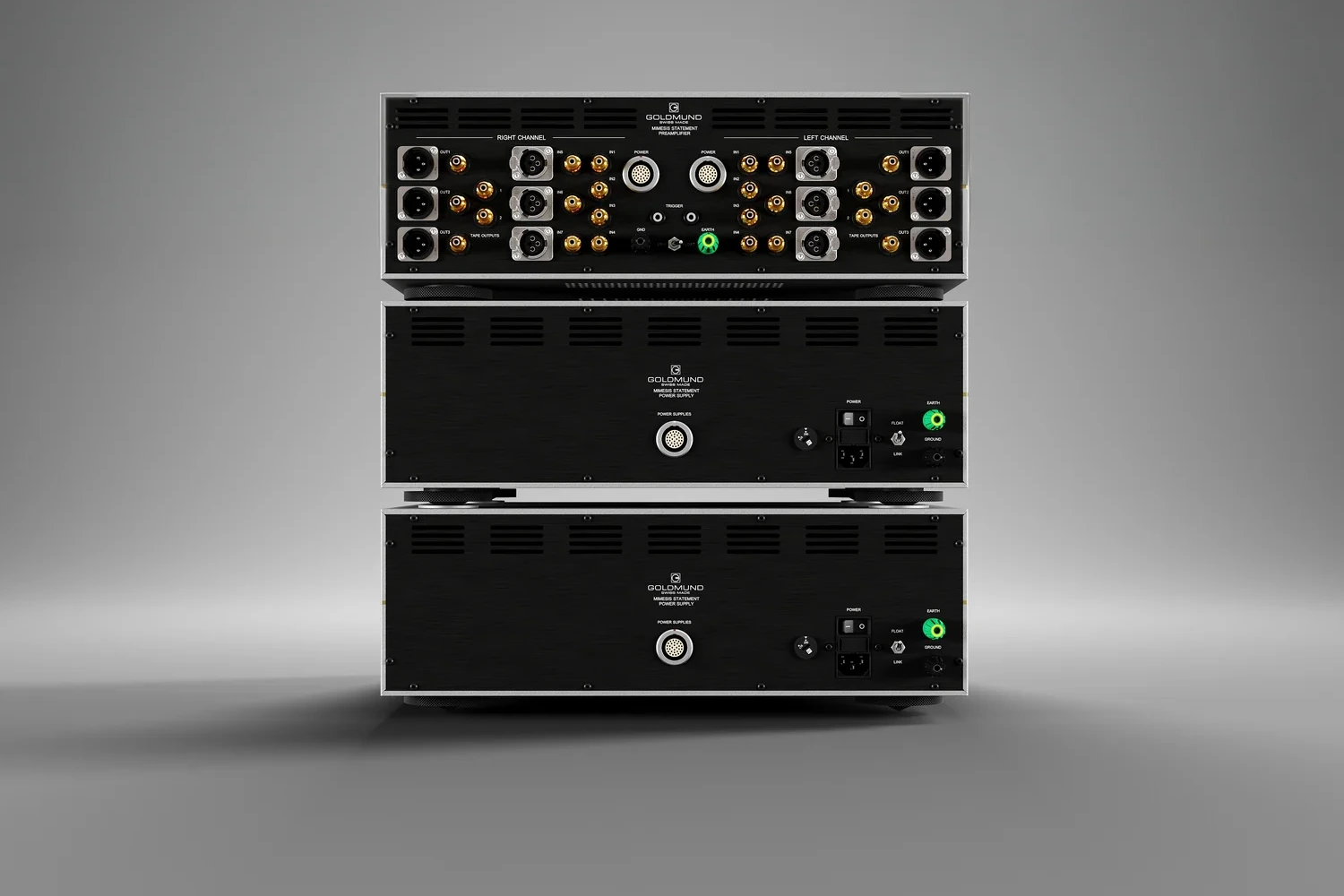
A dedicated power supply for each stereo channel
Using one external power-supply unit per channel extends the separation concept beyond simply moving transformers and regulation away from the audio circuitry. The left and right sides receive their power from physically distinct enclosures, reducing the opportunities for one channel’s supply network to interact with the other. Goldmund’s stated objective is stable operation regardless of the reproduced material, rather than a power system whose behavior is more closely shared across the stereo pair.
This division complements the preamplifier’s fully symmetrical internal architecture. These are related but distinct design decisions: symmetry governs the organization of the signal circuitry, while the twin supplies address how each channel is powered. Together, they form the central hierarchy of the Mimesis Statement design—first isolate the audio path from the power source, then preserve separation between the two channels within that wider arrangement.
Goldmund associates this high degree of channel separation with retaining spatial information contained in recordings. That is a design claim rather than a published listening result, but the engineering direction is clear. The preamplifier is built to limit unwanted interaction between channels at both the signal-path and power-supply levels, instead of relying on a single measure to address stereo independence.
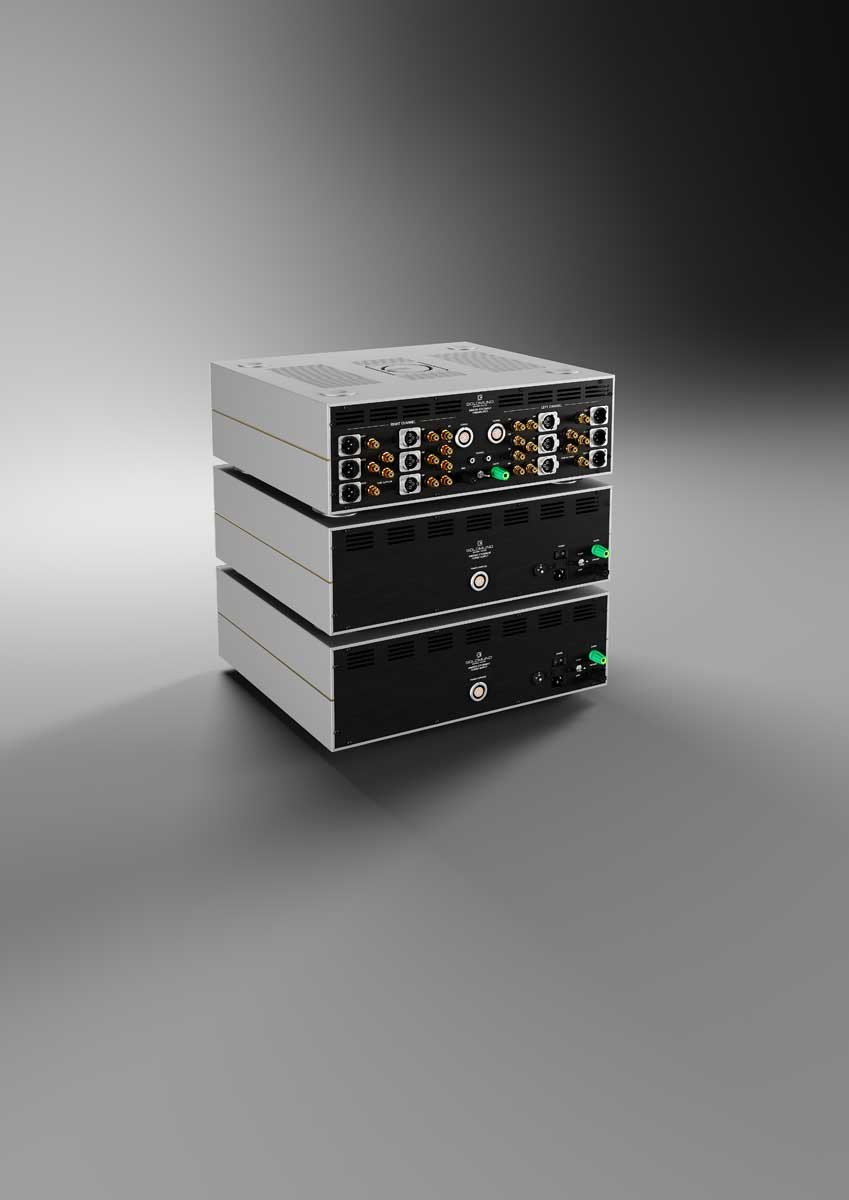
Symmetrical analog circuitry takes the central role
Inside the main enclosure, the Mimesis Statement uses a fully symmetrical topology. The announcement does not provide a detailed circuit diagram or identify individual gain devices, so the exact implementation cannot be assessed from the available information. What is established is that symmetry is maintained as a core architectural principle rather than appearing only in the external power arrangement.
That distinction matters because the central chassis remains where the preamplifier’s primary electronic circuits are located. Moving the supplies elsewhere would not, by itself, guarantee strong channel separation within the audio unit. Goldmund’s symmetrical layout is intended to preserve that separation through the signal stage and support the accurate handling of spatial information in the source material.
The result is a design organized around isolation at several levels. There is distance between audio electronics and power supplies, physical independence between the supplies serving each channel, and symmetry within the main analog circuit. Those layers explain more about the Mimesis Statement’s intended role than a long list of secondary functions would: this is a preamplifier whose identity rests on controlling interactions among circuits.
Discrete regulation adds another barrier to noise
Power conditioning does not end with the use of two external enclosures. Goldmund has equipped the Mimesis Statement with its proprietary discrete voltage-regulation technology, supported by multiple regulation stages. These stages are intended to suppress noise more effectively and maintain stable operating conditions for the sensitive analog circuitry.
The layered regulation scheme follows the same logic as the wider mechanical layout. Physical separation addresses where major sections are located; independent supplies address channel-to-channel interaction; and multistage regulation deals with the quality and stability of the voltage reaching individual circuits. Rather than treating the three chassis as the complete solution, Goldmund has paired the arrangement with local electrical control.
According to the stated design rationale, this configuration is also meant to prevent individual sections from influencing one another. The supplied information does not include noise measurements, distortion figures or comparative data, so the scale of any improvement cannot yet be quantified. Still, the relationship among the documented elements is coherent: each stage of the architecture is directed toward reducing interference and maintaining predictable circuit conditions.
A flagship defined by focus rather than a feature list
Mimesis Statement sits above Goldmund’s other preamplifiers, but the announcement emphasizes the fundamentals of analog signal handling rather than convenience features. No digital conversion, streaming functions or other source-processing capabilities are specified. Based on the disclosed information, its role is that of a dedicated analog control component built for systems in which the preamplifier and power amplification remain separate.
That specialization helps explain the unusual allocation of hardware. Two of the three enclosures exist specifically to power the stereo channels independently, while the remaining chassis is reserved for the audio electronics. Buyers considering the model will therefore need to value segregation of system functions enough to accommodate the extra boxes and associated installation complexity.
Important operational details have not been provided. The announcement does not specify input and output counts, connector formats, volume-control implementation, remote-control facilities, dimensions, weight, finishes or power consumption. There is also no disclosed USD price or availability date. Those omissions limit a full assessment of how the Mimesis Statement will integrate into a particular system, even though its core engineering priorities are already well defined.
The Mimesis Statement appears aimed at listeners assembling a highly separated analog system and willing to devote substantial physical space to the preamplifier stage alone. Its defining choices are tightly connected: a central audio chassis keeps the signal circuitry away from the power hardware, one supply per channel reinforces stereo independence, and discrete multistage regulation is intended to control noise closer to the circuits it serves. What comes next will be as important as the architecture itself. Goldmund has yet to detail the interface, connection options, installation demands, measured performance, USD pricing or release schedule. Until those points are known, the clearest reading of the product is as a focused engineering statement—one that treats power distribution and channel isolation as the primary tasks of a flagship analog preamplifier.



Sound Off
0Join the discussion if you have something to add.