

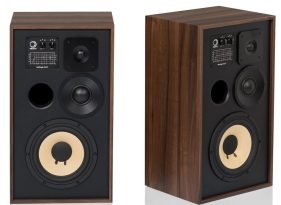
The Elipson Heritage XLS11 is designed for listeners who appreciate the visual character and physical presence of classic loudspeakers but still want the practical considerations of a contemporary design. Sitting alongside the larger XLS15 and XLS17, it applies ideas developed for the XLS15 to a more compact three-way bass-reflex enclosure. That reduced footprint is an important part of the XLS11’s appeal: it retains a substantial 12-inch woofer, dedicated midrange driver and adjustable front-panel controls without demanding as much space as the larger models in the Heritage range. Designed and manufactured in Burgundy, France, the XLS11 also offers a clear alternative to slim floorstanding speakers, favoring broad proportions, visible drive units and optional angled stands.
A classic format with a more manageable footprint
The XLS11’s appearance draws directly from the wide-baffle loudspeakers associated with earlier generations of home hi-fi. Rather than disguising its drivers behind a narrow cabinet, the design makes the three-way layout and front bass port central visual elements. This gives it a purposeful, equipment-like character that should work particularly well in systems built around vintage components or modern electronics with similarly traditional styling.
Its practical distinction within Elipson’s Heritage family is size. The XLS11 takes lessons from the XLS15 while placing them in a more compact form factor. That makes the model relevant to owners who want the proportions and driver configuration of a large-format standmount but cannot accommodate one of the bigger Heritage designs. Compact is relative here—the inclusion of a 12-inch woofer means this remains a physically substantial loudspeaker—but the format creates more placement options than a larger cabinet would offer.
An optional dedicated stand is available to position the cabinet at the intended height and angle. This is more than a cosmetic accessory: raising and tilting a wide, relatively low cabinet helps align its drivers appropriately with the listening position. Elipson describes the stand as supporting optimal acoustic phase, while its visual integration also allows the speaker to retain its low-slung retro identity rather than resembling a conventional standmount placed on a generic pedestal.

A genuine three-way driver arrangement
The XLS11 uses a three-way architecture, assigning bass, midrange and treble duties to separate drivers. Low frequencies are handled by a 12-inch woofer, while a 2.2-inch dome covers the midrange. At the top is a 0.87-inch silk-dome tweeter borrowed from Elipson’s Prestige line. The reported crossover regions are 850 Hz and 5,000 Hz.
This configuration is distinctive because many speakers of comparable domestic intent use either a two-way layout or a smaller cone midrange. Elipson’s large dome midrange allows the XLS11 to use a dedicated driver across a considerable portion of the vocal and instrumental range, leaving the 12-inch woofer to concentrate on lower frequencies and the smaller silk dome to handle the treble.
The design should not be interpreted as vintage technology simply because it has vintage proportions. Its appeal lies in combining that familiar external format with specialized drivers and a modern crossover arrangement. For a prospective owner, the important point is functional separation: each part of the audible range has a driver selected for that task, rather than requiring the large woofer to extend directly into the tweeter’s operating region.

Front-ported bass for practical placement
The 12-inch woofer operates with a flared bass-reflex port on the front of the cabinet. The port is tuned to 37 Hz, while the stated overall frequency response is 45 Hz to 25,000 Hz within a 3 dB range. Those figures describe a design intended to cover a broad frequency span without relying on an unusually tall enclosure.
A front-facing port can be useful when integrating a speaker into real living spaces. It does not eliminate the effect of nearby walls or room boundaries, and the XLS11 will still require thoughtful positioning, but it avoids directing the port’s airflow immediately toward the wall behind the cabinet. That may make experimentation less awkward in rooms where the speakers cannot be brought far into the listening area.
The flared port profile is another considered detail. Flared openings are commonly used to manage airflow more smoothly than a simple sharp-edged tube. Elipson does not provide performance claims beyond the documented tuning and frequency response, so the significance here is primarily one of deliberate engineering and usability rather than an invitation to infer undocumented bass output.

Useful adjustment without external processing
One of the XLS11’s most practical features is its pair of front-panel fine-tuning controls. These allow the amplitude of the midrange and high-frequency sections to be adjusted independently by plus or minus 2 dB. The adjustment range is deliberately moderate, making the controls suitable for fine correction rather than dramatic tonal reshaping.
That flexibility can help accommodate differences in room furnishing, speaker position and listening distance. A reflective room with large areas of glass or hard flooring presents different conditions from a heavily furnished space with carpets and curtains. Similarly, the tonal balance at a listening seat can change as the speakers move closer to walls or as the listener changes the degree of toe-in. The XLS11’s controls provide a direct way to refine the upper ranges without adding a separate equalizer or digital signal processor.
Placing the controls on the front panel also supports experimentation. Owners can make small, repeatable changes without moving the cabinet or reaching behind it. The visual treatment reinforces the XLS11’s classic studio-monitor influence, but the feature has clear contemporary value for anyone assembling a system in a multipurpose room rather than a dedicated, acoustically treated space.

Amplifier matching and intended owner
Elipson specifies a sensitivity of 90 dB for 1 watt at 1 meter, a nominal impedance of 6 ohms and a minimum impedance of 3.4 ohms at 2,600 Hz. The sensitivity figure suggests the XLS11 does not require very low efficiency to be overcome, but amplifier matching should also account for the impedance minimum. A prospective owner should use an amplifier that is comfortable driving loads that fall below the nominal 6-ohm rating. The available figures do not support prescribing a particular amplifier type or power output, but they do offer useful information when checking compatibility.
The XLS11 is most suitable for someone who wants a substantial three-way loudspeaker without moving to the larger XLS15 or XLS17. It is also a logical candidate for rooms in which a front port and modest midrange and treble adjustment could make setup more flexible. The design will naturally appeal to listeners who prefer broad, low cabinets and visible controls over visually discreet towers.
It may be less appropriate where floor space is extremely limited, where only a small bookshelf speaker can be accommodated, or where the wide vintage aesthetic conflicts with the room. The optional stands also need to be considered as part of the installation if the intended height and angle cannot be achieved with existing furniture. This is therefore a compact Heritage model rather than a compact speaker in the absolute sense.
Conclusion
The Elipson Heritage XLS11’s strongest documented qualities are its combination of a 12-inch woofer, dedicated dome midrange, Prestige-derived silk-dome tweeter and a cabinet more manageable than the larger Heritage models. Its front-facing port, optional angled stand and accessible ±2 dB midrange and treble controls give owners several practical tools for integrating it into a real room. Add the distinctive wide-baffle styling and French design and manufacture, and the XLS11 emerges as a thoughtfully configured option for listeners seeking the presence of an old-school three-way speaker with useful modern flexibility.



Sound Off
0Join the discussion if you have something to add.