
The amplifiers gathered here take markedly different approaches to building a hi-fi system.
The selection ranges from compact tube preamplifiers and fully analog control units to integrated designs with digital conversion, network playback or phono inputs.
There are also dedicated power amplifiers for listeners who prefer to choose their source and volume-control components separately. Connectivity is one of the clearest dividing lines. The Lyngdorf TDAI-2210 combines amplification with streaming, while the WiiM Vibelink Amp deliberately leaves streaming to an external source. The Denon PMA-800NE and Micromega M-Amp Solo accommodate both digital and analog equipment, whereas the Avid Hifi Celsus Pre is an intentionally analog-only preamplifier. One source entry, the Monitor Audio Hyphn, is a loudspeaker rather than an amplifier. It remains included to preserve the supplied ranking, but should be considered a potential system partner rather than an alternative to the amplifiers and preamplifiers around it. The distinctions below focus on documented design, connectivity and system roles rather than unsupported listening claims.

1. Douk Audio P2: Tube preamp with Bluetooth
The compact Douk Audio P2 combines visible vacuum tubes with front-panel tone controls and headphone connectivity.
The Douk Audio P2 is a compact tube preamplifier that can sit between a source and either a power amplifier or powered speakers.
Its supplied 6K4 tubes can be replaced with several compatible alternatives, while socketed operational amplifiers provide another route for users interested in changing components.
Separate high-, mid- and bass-frequency controls broaden its appeal for listeners who prefer hands-on tonal adjustment. The P2 also functions as a headphone amplifier and can send signals through its RCA and 3.5 mm headphone outputs simultaneously. Bluetooth, USB storage and TF card playback make it more flexible than a conventional analog tube preamplifier, with listed file support including APE, FLAC, WAV and WMA.
Best for: Compact systems needing tube preamplification and headphones
- Replaceable tubes and socketed operational amplifiers
- Separate high, mid and bass controls
- Headphone and RCA outputs can operate simultaneously
- Bluetooth, USB storage and TF card playback
Verdict: A small and unusually flexible tube preamplifier for listeners who value tone controls, component swapping and multiple playback options.

2. Spec RSA-EX1000: Integrated amplifier made in Japan
The SPEC RSA-EX1000 uses maple side frames and a spruce-laminate chassis around its redesigned amplifier circuitry.
The SPEC RSA-EX1000 is an integrated amplifier built around a redesigned main board and shorter internal wiring.
Its level-controller and low-pass-filter circuit has been optimized to reduce internal resistance and interference, while EMC paint, internal shielding and electromagnetic absorption sheets are used to improve isolation inside the chassis.
A 600VA R-core transformer anchors the power supply. The amplifier is specified to deliver a maximum of 200 watts per channel into 4 ohms and supports speakers with nominal impedances from 4 to 16 ohms. Two pairs of XLR inputs, three pairs of RCA inputs and an included remote control make it suitable for systems with several balanced and unbalanced sources. Maple side frames and a spruce-laminate chassis give the design a distinctive material identity.
Best for: Multi-source systems requiring balanced and unbalanced inputs
- Two XLR and three RCA input pairs
- Maximum output of 200 watts per channel into 4 ohms
- Specified for speakers from 4 to 16 ohms
- Extensive internal electromagnetic shielding
Verdict: A carefully constructed integrated amplifier distinguished by substantial power-supply engineering, extensive shielding and useful analog connectivity.

3. Lyngdorf TDAI-2210: Fully Digital Network Amplifier from Denmark
The Lyngdorf TDAI-2210 brings digital amplification, source selection and network playback into a single chassis.
The Lyngdorf TDAI-2210 combines integrated amplification, network playback and both analog and digital inputs.
Its True Digital Amplifier Integrated architecture keeps the signal in the digital domain through to the speaker terminals, with volume adjusted by changing gain in the output chain rather than by using a conventional analog volume circuit.
Rated output is 105 watts per channel into 8 ohms and 210 watts per channel into 4 ohms. Optional modules allow the system to be expanded, making the TDAI-2210 relevant to listeners who want a centralized digital and streaming hub without ruling out future additions.
Best for: Digital-first systems needing amplification and streaming in one component
- Integrated network playback
- Analog and digital source connectivity
- 105 watts per channel into 8 ohms
- Expandable through optional modules
Verdict: A network integrated amplifier with a distinctive all-digital signal architecture and useful scope for system expansion.

4. Monitor Audio Hyphn: New Flagship Speakers
The Monitor Audio Hyphn links two bass towers with a compact tweeter and six-driver midrange array.
The Monitor Audio Hyphn is the outlier in this amplifier-focused selection because it is a passive loudspeaker, not an amplifier.
Each enclosure stands almost 140 cm tall, weighs 106.9 kg and contains eleven drivers.
Its central midrange and high-frequency array forms the architectural link between two bass towers. A third-generation Micro Pleated Diaphragm tweeter is surrounded by six two-inch midrange drivers positioned closely together to approximate a point source and support broad dispersion. Four eight-inch woofers are installed inside the linked cabinets, while the stated overall frequency range extends from 18 Hz to 60 kHz. Amplifier buyers should treat the Hyphn as a possible system partner and investigate its full electrical requirements before choosing amplification.
Best for: Large reference-oriented systems seeking a statement loudspeaker
- Eleven-driver configuration in each loudspeaker
- Six-driver midrange array surrounding the tweeter
- Four eight-inch woofers per enclosure
- Stated frequency range of 18 Hz to 60 kHz
Verdict: An ambitious flagship loudspeaker rather than an amplifier, included here only as a potential partner for a suitably researched amplification system.

5. M-Amp Solo: Retro-Inspired French Integrated Amplifier Reborn for Modern Audiophiles
The Micromega M-Amp Solo uses a transparent top panel to reveal portions of its dual-mono internal layout.
Micromega’s M-Amp Solo combines retro-influenced styling with a dual-mono Class AB amplifier.
It delivers 85 watts per channel into 8 ohms and 105 watts per channel into 4 ohms, giving buyers concrete figures to compare against the requirements of their loudspeakers.
An ESS ES9280AQ PRO-based DAC handles digital sources, while the integrated moving-magnet phono stage allows a compatible turntable to be connected without a separate phono preamplifier. Streaming can be added through the optional Escape M1 Air module. A transparent plexiglass top panel exposes part of the internal construction and reinforces the amplifier’s visual character.
Best for: Mixed digital and vinyl systems with optional streaming
- Dual-mono Class AB topology
- Built-in ESS-based DAC
- Integrated moving-magnet phono stage
- Optional network-playback module
Verdict: A versatile integrated amplifier that combines Class AB power, digital conversion and moving-magnet vinyl support in a distinctive enclosure.

6. NAD C 298: A robust and versatile stereo power amplifier
The NAD C 298 houses Purifi Eigentakt amplification in a ventilated metal chassis designed for passive cooling.
The NAD C 298 is a dedicated stereo power amplifier, so it requires a separate preamplifier, source with volume control or another suitable control component.
Purifi Eigentakt modules manufactured under licence by NAD provide a specified 185 watts per channel into 8 ohms and 340 watts per channel into 4 ohms, with peak output stated at more than 570 watts.
Balanced XLR and unbalanced RCA inputs are provided, with automatic signal detection and an adjustable activation threshold. An RCA line output can feed an additional amplifier or active subwoofer. The metal chassis is designed for passive airflow rather than active fan cooling, and each channel uses its own rectifier and filter capacitors.
Best for: Separate-component systems requiring a powerful stereo power amplifier
- 185 watts per channel into 8 ohms
- Balanced XLR and unbalanced RCA inputs
- RCA line output for expansion or an active subwoofer
- Passive cooling without an active fan
Verdict: A well-equipped power amplifier offering substantial specified output, balanced connectivity and practical system-expansion features.

7. Avid Hifi Celsus Pre: Fully Balanced Analog Preamplifier with Built-In Phono Stage
The Avid Hifi Celsus Pre separates its power supply from the fully balanced analog and phono circuitry.
The Avid Hifi Celsus Pre is a fully balanced analog preamplifier with no onboard DAC.
Inputs and outputs can use XLR or RCA connections, while the power supply occupies a separate enclosure to keep it away from the main signal circuitry.
Its built-in phono section is derived from Avid’s Pulsare II design. Front-panel adjustments operate relays so that the signal remains on the main circuit board, and connections are provided for two cartridges at once. A selectable mono function can help reduce distracting background noise when playing mono records. Buyers building an analog-focused system should remember that a separate power amplifier is still required.
Best for: Vinyl-focused systems built around separate preamplifier and power-amplifier components
- Fully balanced analog topology
- XLR and RCA connection options
- Built-in phono stage with two cartridge connections
- Separate power-supply enclosure
Verdict: A purpose-built analog preamplifier for listeners who need balanced connectivity and unusually flexible control of two phono sources.

8. Denon PMA-800NE: Integrated Amplifier with built-in DAC and phono preamplifier
The Denon PMA-800NE provides direct access to source selection, tone adjustment, speaker switching and headphones.
The Denon PMA-800NE is a conventional integrated amplifier equipped for analog, digital and vinyl sources.
Its DAC accepts PCM signals up to 24-bit/192 kHz through three optical inputs and one coaxial input.
When analog mode is selected, the dedicated digital power supply and digital input circuit are switched off to limit high-frequency interference with the analog section. Front-panel facilities include a 6.3 mm headphone socket, speaker A and B selection, loudness, Source Direct, tone and balance controls. Denon’s Separated Signal Level Design assigns distinct layouts to the phono, preamplifier and power-amplifier circuits, while an anti-vibration metal chassis and aluminum front panel complete the construction.
Best for: Traditional hi-fi systems mixing digital sources, vinyl and headphones
- Three optical and one coaxial digital input
- PCM support up to 24-bit/192 kHz
- Built-in phono preamplifier
- Speaker A and B selection plus headphone output
Verdict: A practical integrated amplifier with broad source support and unusually comprehensive front-panel controls.

9. WiiM Vibelink is the integrated stereo amplifier i want for my birthday
The compact WiiM Vibelink Amp combines Class D amplification with RCA, coaxial and optical source connections.
The WiiM Vibelink Amp is an integrated Class D amplifier designed to work with external analog and digital sources.
Unlike several other WiiM products, it does not contain a streaming platform.
That distinction makes it a logical companion for a separate network streamer rather than an all-in-one streaming amplifier. Its output is specified at 100 watts per channel into 8 ohms and 200 watts per channel into 4 ohms. One RCA analog input is joined by coaxial and optical S/PDIF inputs, with an ESS 9038Q2M DAC supporting signals up to 24-bit/192 kHz. Thermal management combines a copper heat pipe, an aluminum radiator and active operating-parameter monitoring.
Best for: Compact systems using a separate streamer or digital source
- 100 watts per channel into 8 ohms
- Coaxial, optical and RCA inputs
- ESS DAC supporting up to 24-bit/192 kHz
- Copper heat pipe and aluminum radiator
Verdict: A focused integrated amplifier with strong specified output and digital conversion, but no built-in streaming service platform.
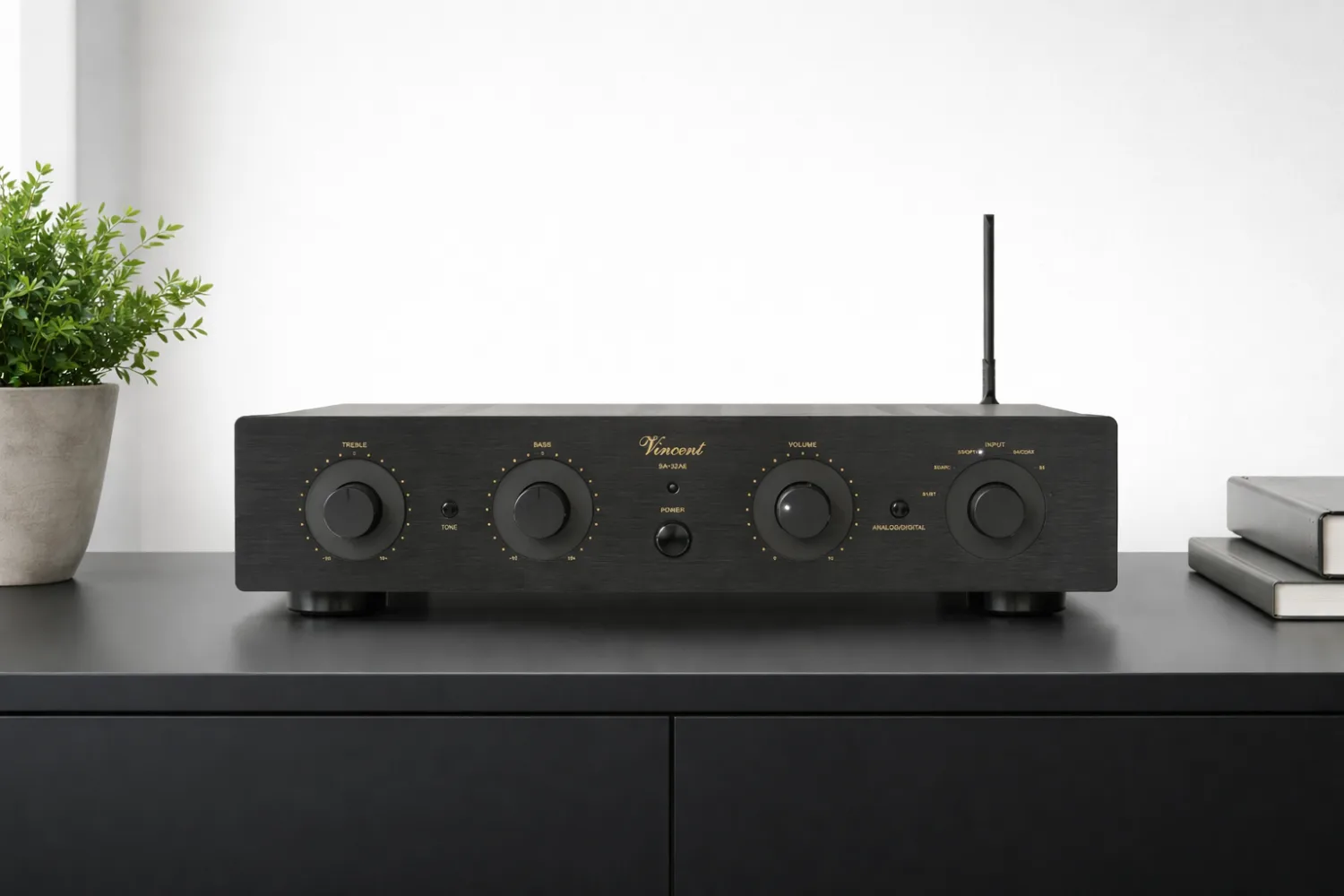
10. Vincent SA-32 AE: 30th Anniversary Hybrid Tube Preamplifier with HDMI ARC
The Vincent SA-32 AE is a limited-production hybrid preamplifier with expanded digital inputs and HDMI ARC.
The Vincent SA-32 AE is a limited-edition hybrid stereo preamplifier, with production restricted to 200 units.
It expands the digital connectivity of the underlying SA-32 design by adding HDMI ARC alongside Bluetooth, coaxial and optical inputs.
HDMI ARC is particularly useful for routing television sound through a dedicated hi-fi system without a separate adapter. Its revised tube complement comprises two 12AU7 and two ECC88 valves. The 12AU7 pair follows the inputs at the front of the signal path, while the ECC88 pair operates in the tone-control stage as phase splitters. As a preamplifier, the SA-32 AE must be partnered with a separate power amplifier or suitable active speakers.
Best for: Hybrid hi-fi systems that need television and digital-source connectivity
- HDMI ARC for television integration
- Bluetooth, coaxial and optical inputs
- Hybrid circuit using 12AU7 and ECC88 tubes
- Limited production of 200 units
Verdict: A feature-expanded hybrid preamplifier whose HDMI ARC input makes it especially relevant to combined television and music systems.
Quick comparison
These products cannot be compared by wattage alone because they perform different jobs.
Integrated amplifiers can drive passive speakers directly, preamplifiers require a separate power amplifier, and the NAD C 298 needs an upstream volume-controlled component.
The Monitor Audio Hyphn is a passive loudspeaker rather than amplification. Use the distinctions below to identify the appropriate component type before comparing connectivity or output figures.
| Product | Best for | Verdict |
|---|---|---|
| Douk Audio P2 | Compact tube-based systems and private headphone listening | A preamplifier and headphone amplifier with tone controls, replaceable tubes and storage playback. |
| SPEC RSA-EX1000 | Analog systems with several XLR and RCA sources | A Japanese integrated amplifier with 4-to-16-ohm speaker compatibility and extensive internal shielding. |
| Lyngdorf TDAI-2210 | Networked, digital-first systems | An integrated network amplifier that retains a digital signal architecture through to its speaker outputs. |
| Monitor Audio Hyphn | Large systems needing flagship passive loudspeakers | A complex eleven-driver loudspeaker, not an amplifier or source-control component. |
| Micromega M-Amp Solo | Digital and moving-magnet vinyl playback | A Class AB integrated amplifier with a DAC, phono stage and optional streaming module. |
| NAD C 298 | Separate systems needing substantial power output | A stereo power amplifier with XLR and RCA inputs, automatic signal sensing and an expansion output. |
| Avid Hifi Celsus Pre | Balanced analog and dual-cartridge vinyl systems | An analog-only preamplifier with a separate power supply and a flexible built-in phono section. |
| Denon PMA-800NE | Mixed digital, vinyl and headphone systems | A traditional integrated amplifier with a DAC, phono input, tone controls and two speaker selections. |
| WiiM Vibelink Amp | Systems with an existing or separate streamer | A compact digital-capable integrated amplifier that deliberately omits built-in streaming. |
| Vincent SA-32 AE | Music systems that also handle television sound | A limited-production hybrid preamplifier with HDMI ARC, Bluetooth and conventional digital inputs. |
Frequently asked questions
Should I choose an integrated amplifier or separate preamplifier and power amplifier?
Choose an integrated amplifier when you want source control and speaker amplification in one chassis.
A preamplifier such as the Avid Celsus Pre, Vincent SA-32 AE or Douk P2 needs a separate power amplifier or compatible active speakers, while the NAD C 298 is a power amplifier that needs an upstream component with volume control.
How should amplifier power be matched to passive speakers?
Start with the speaker manufacturer’s recommended amplifier range and nominal impedance, then compare those requirements with the amplifier’s output rating at the same impedance.
Do not infer compatibility from a headline wattage figure alone; room size, listening level and the speaker’s electrical demands also matter.
Does a digital input mean that an amplifier includes streaming?
No.
Optical, coaxial or USB playback only describes how a digital signal can enter the component.
The Lyngdorf TDAI-2210 includes network playback, the Micromega offers it through an optional module, and the WiiM Vibelink Amp specifically requires an external streamer for network services.
Can every built-in phono stage be used with any turntable cartridge?
Not necessarily.
Confirm the cartridge type and the phono stage’s stated compatibility before connecting it.
The Micromega M-Amp Solo explicitly includes a moving-magnet stage, while the Avid Celsus Pre emphasizes two-cartridge connectivity and selectable mono operation; the supplied material does not establish universal cartridge support for either product.
How to Choose the Right Amplifier for Your System
Begin by identifying the component role you actually need.
An integrated amplifier is the simplest route for passive speakers because it combines input selection, volume control and power amplification.
A standalone preamplifier offers more freedom to choose the power stage, but it adds another chassis and requires careful connection planning. A power amplifier such as the NAD C 298 cannot replace a complete integrated amplifier by itself. Next, list every source you intend to connect. Vinyl users should verify cartridge compatibility rather than merely checking for a phono label. Digital listeners should count the required optical, coaxial and other inputs, while television users may find the Vincent SA-32 AE’s HDMI ARC particularly practical. Streaming also deserves separate attention: it is integrated into the Lyngdorf, optional on the Micromega and absent from the WiiM Vibelink Amp despite that brand’s association with network audio. Speaker matching should come before cosmetic preference. Compare the loudspeaker’s nominal impedance and manufacturer guidance with the amplifier’s rating at the corresponding load. The figures supplied for the SPEC, Lyngdorf, Micromega, NAD and WiiM models offer useful starting points, but they do not replace full compatibility checks. The Monitor Audio Hyphn entry reinforces this point: it is a loudspeaker, and the supplied material does not provide enough electrical information to nominate a particular amplifier for it. Finally, consider the controls and expansion options that will remain useful over time. Headphone outputs, tone adjustment, balanced connections, line outputs and optional modules can determine whether an amplifier fits a real system more effectively than raw power alone. Choosing by component type, source requirements and verified speaker compatibility will produce a more coherent result than ranking these products on a single specification.



Sound Off
0Join the discussion if you have something to add.