
Choosing an AV receiver starts with the system you intend to build.
Channel count determines how many conventional, surround, height and subwoofer channels can be accommodated, while HDMI support affects compatibility with current displays, game consoles and video sources.
Room correction, streaming and multiroom facilities may matter just as much as headline power. The source material behind this guide covers several genuine AV receivers, but it also includes stereo receivers, integrated amplifiers, a preamplifier, turntable advice and a brand history. Those entries are retained in their supplied positions and clearly identified rather than being presented as interchangeable home-cinema products. Among the dedicated AV models, the main distinctions are straightforward: the Denon AVC-A110 offers the largest stated channel count, the NAD T 778 combines nine amplified channels with modular construction, the Denon AVR-S980H and Onkyo TX-NR696 address more conventional 7.2-channel systems, and the low-profile Marantz Cinema 70s prioritizes a slimmer chassis. The right choice depends on speaker layout, video requirements and room-calibration needs rather than specifications considered in isolation.

1. Onkyo TX-8390: State-of-the-art Stereo receiver
The Onkyo TX-8390 combines two-channel amplification, network playback and AccuEQ room calibration.
The Onkyo TX-8390 is a two-channel stereo receiver rather than a multichannel AV receiver.
Its amplifier is rated at 200 W per channel into 6 ohms, while a discrete transistor output stage, high-current transformer and audio-specific capacitors support the analog section.
AccuEQ calibration measures speaker size, distance and sound pressure level, then selects a subwoofer crossover and applies equalization. An AK4458 DAC, dual-band Wi-Fi, AirPlay, Bluetooth and network playback make it a well-equipped option for listeners whose entertainment system remains firmly stereo.
Best for: Networked two-channel systems
- AccuEQ stereo room calibration
- AirPlay, Bluetooth and dual-band Wi-Fi
- Network playback for PCM and DSD files
- Discrete transistor output stage
Verdict: A feature-rich stereo receiver with room correction, but not a substitute for a surround-capable AV receiver.

2. 5 useful tips for choosing your first turntable
The turntable guide explains the practical difference between automatic playback and manual record handling.
This is a turntable buying article, not an AV receiver or associated amplifier.
Its most relevant contribution is helping vinyl newcomers decide between fully automatic operation and the more hands-on approach of a manual hi-fi design.
It also introduces the importance of construction materials when assessing sound quality. Readers adding vinyl to an AV system can use this advice when selecting a source component, but it does not address receiver channels, HDMI connectivity or surround processing.
Best for: Beginners adding vinyl playback
- Explains manual and automatic operation
- Introduces construction as a sound-quality factor
- Written for first-time turntable buyers
Verdict: Useful source-component guidance for vinyl newcomers, though it does not help compare AV receivers directly.

3. Marantz 40n: Integrated analog amplifier with built-in digital audio streaming
The Marantz Model 40n integrates analog amplification with digital audio streaming in a stereo design.
The Marantz Model 40n is a streaming integrated stereo amplifier, not a multichannel AV receiver.
Its current-feedback circuit, HDAM SA3 discrete amplifier modules and shielded toroidal transformer are paired with separate internal preamplifier and output-stage sections.
Output is stated as 70 W into 8 ohms. It suits listeners who need digital streaming and conventional two-channel amplification, but the supplied material does not establish surround decoding or the channel capacity expected from an AV receiver.
Best for: Streaming-focused stereo listening
- Built-in digital audio streaming
- 70 W output into 8 ohms
- Shielded toroidal transformer
- Separate preamplifier and output-stage sections
Verdict: A purpose-built stereo integrated amplifier for music systems rather than a route to multichannel home cinema.

4. Denon AVC-A110: Special edition 13.2-channel AV receiver
The Denon AVC-A110 provides 13.2-channel processing with immersive-audio formats and advanced HDMI video features.
The Denon AVC-A110 is a 13.2-channel home-cinema amplifier built for extensive surround systems.
It supports Dolby Atmos, DTS:X, DTS:X Pro, IMAX Enhanced and Auro-3D, alongside 8K at 60 Hz and 4K at 120 Hz video.
Its HDMI inputs support HDR10, Dolby Vision and HLG, while gaming provisions include Auto Low Latency Mode, Variable Refresh Rate and Quick Frame Transport. The integrated power amplifier is rated at 210 W per channel, although buyers should avoid comparing that figure directly with ratings quoted under potentially different conditions.
Best for: Large, advanced home cinemas
- 13.2-channel architecture
- Dolby Atmos, DTS:X Pro and Auro-3D support
- 8K at 60 Hz and 4K at 120 Hz video
- VRR, ALLM and QFT gaming features
Verdict: The most expansive surround option in this selection, with broad immersive-audio and high-resolution video support.
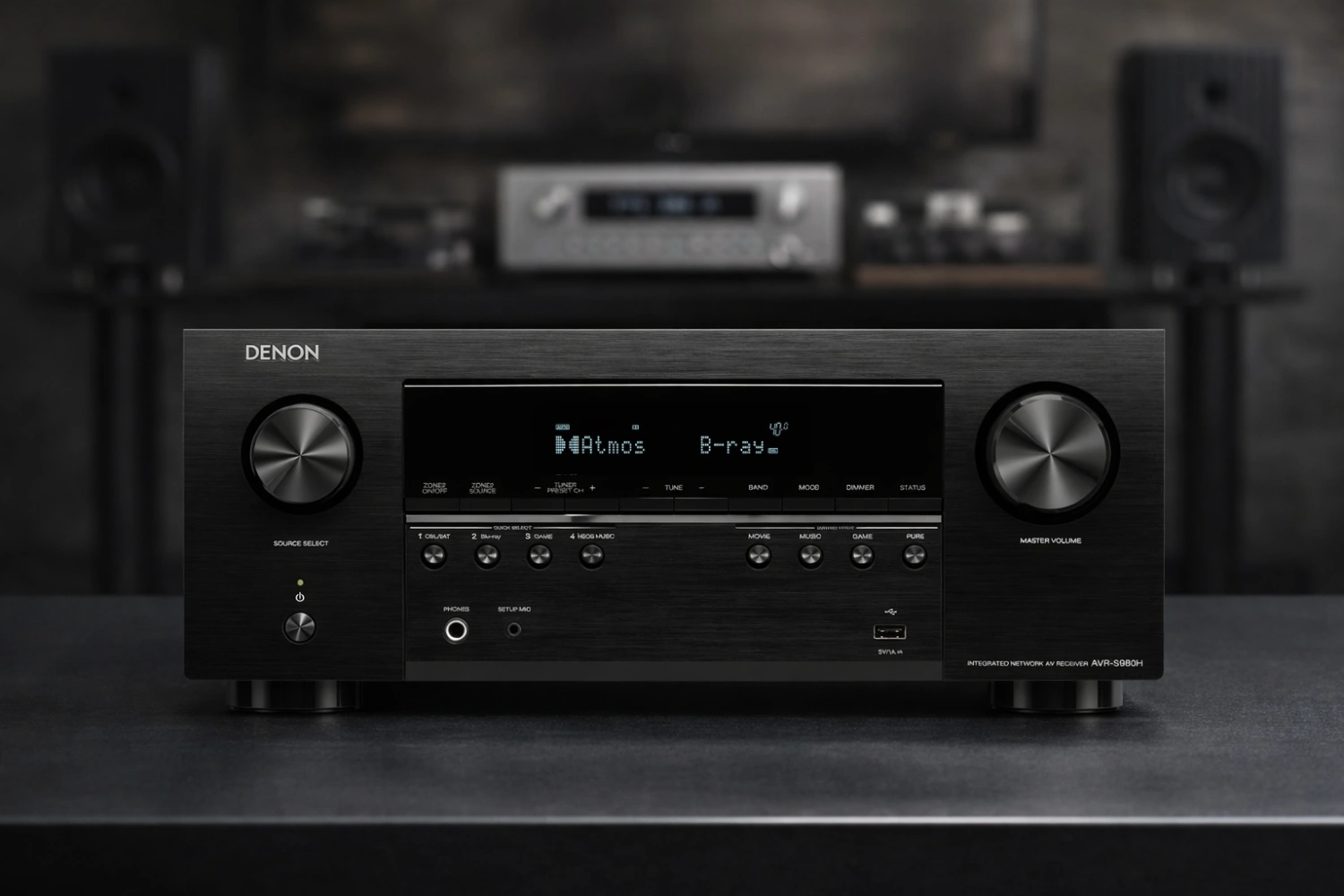
5. Denon AVR-S980H: Powerful 7.2 AV Receiver with HEOS Multiroom & Wireless Surround Upgrade
The Denon AVR-S980H combines a 7.2-channel layout with HEOS multiroom and wireless surround options.
The Denon AVR-S980H is a 7.2-channel receiver aimed at households moving beyond a soundbar or basic speaker system.
Its stated 90 W-per-channel amplifier supports both two-channel music and multichannel entertainment, while HEOS provides a path to multiroom use and a wireless surround upgrade.
The source emphasizes accessibility and flexibility, making this the most clearly positioned option here for buyers who want conventional AV-receiver versatility without targeting the channel scale of a flagship installation.
Best for: Accessible 7.2-channel home entertainment
- 7.2-channel configuration
- HEOS multiroom support
- Wireless surround upgrade
- Suitable for stereo and multichannel use
Verdict: A practical step up from a soundbar for buyers seeking a flexible receiver with HEOS integration.

6. Onkyo TX-NR696: AV receiver with plenty of bass
The Onkyo TX-NR696 supports 5.2.2 playback, virtual height processing and second-room stereo output.
The Onkyo TX-NR696 is a seven-channel AV receiver with Dolby Atmos and DTS:X support.
It can run a 5.2.2 speaker arrangement, while Dolby Atmos Height Virtualizer and DTS Virtual:X are available when dedicated height speakers cannot be installed.
Its amplification uses a custom low-noise transformer, high-capacity capacitors and discrete output stages for the left, right and center channels; the source cites 175 W per channel and emphasizes high-current delivery and bass reproduction. Stereo output to a second room and THX Select certification broaden its home-cinema credentials.
Best for: Seven-channel systems with strong bass priorities
- Dolby Atmos and DTS:X support
- Virtual height processing without dedicated height speakers
- Stereo output for a second room
- THX Select certified
Verdict: A versatile seven-channel receiver for 5.2.2 installations or rooms that need virtualized height effects.

7. Marantz Cinema 70s: Modern 7.2-channel AV receiver
The low-profile Marantz Cinema 70s supports 5.1.2 immersive audio and modern HDMI video formats.
The Marantz Cinema 70s is a low-profile 7.2-channel receiver for installations where a full-height chassis is undesirable.
Three of its six HDMI inputs support 8K at 60 Hz, and the receiver also handles 4K at 120 Hz, 8K upscaling, HDR10+, Dynamic HDR, VRR, QMS, ALLM and QFT.
Dolby Atmos and DTS:X are supported in a 5.1.2 arrangement, with virtual alternatives available when height speakers are absent. Its discrete amplifiers are rated at 50 W per channel into 8 ohms, and Audyssey MultEQ provides automatic room calibration.
Best for: Space-conscious 5.1.2 systems
- Low-profile 7.2-channel design
- Three 8K-capable HDMI inputs
- Dolby Atmos and DTS:X support
- Audyssey MultEQ room calibration
Verdict: A slim receiver that preserves modern video, immersive-audio and room-calibration features while accepting a lower stated power rating.

8. Naim NAC 282: A preamplifier that takes sound to the next level
The Naim NAC 282 includes a configurable unity-gain input for integration with an AV receiver.
The Naim NAC 282 is an analog preamplifier rather than an AV receiver, so it requires appropriate partnering amplification and does not replace surround processing.
Its relevance to home cinema lies in a configurable unity-gain input intended for integration with AV receivers.
Six inputs provide separate listening and recording functions, while two can be used through either DIN or RCA connections. Anti-resonance construction, optical protection circuits and precision rotary potentiometers reflect its focus on analog system control.
Best for: Integrating a dedicated stereo preamplifier with an AV system
- Configurable unity-gain input for AV integration
- DIN and RCA connection options
- Separate listening and recording functions
- Anti-resonance construction
Verdict: A specialist analog preamplifier that can complement an AV receiver through unity-gain integration, but cannot replace one.

9. NAD T778: Flagship AV receiver with a modular design
The NAD T 778 pairs nine-channel amplification and Dirac Live with two user-replaceable MDC module slots.
The NAD T 778 combines nine channels of hybrid digital amplification, each stated at 100 W, with processing for systems up to 7.1.4 channels.
Dolby Atmos, DTS:X and DTS Master Audio are supported, while Dirac Live handles room correction.
Its defining feature is the presence of two Modular Design Construction slots that allow installed components to be replaced. Additional facilities include 4K Ultra HD transmission, MQA decoding on digital inputs, AirPlay 2, aptX HD Bluetooth, a front-panel touchscreen and control connections for home-theater integration.
Best for: Expandable home cinemas with advanced room correction
- Nine channels of hybrid digital amplification
- Dirac Live room correction
- Two replaceable MDC module slots
- Supports configurations up to 7.1.4 channels
Verdict: A strong choice for buyers prioritizing Dirac Live, 7.1.4 capability and a modular hardware architecture.

10. Marantz
The Marantz history article traces the company’s origins to Saul Bernard Marantz and his early amplifier work.
This article is a history of Marantz rather than a review or buying guide for a particular receiver.
It traces the company back to founder Saul Bernard Marantz and describes how his interest in high-quality reproduction led to amplifier development during the transition from 78 rpm records to long-playing records.
The background may interest readers researching the identity of a hi-fi manufacturer, but it supplies no current receiver specifications or model-specific guidance for a purchasing decision.
Best for: Readers researching Marantz brand history
- Provides background on the Marantz founder
- Explains the brand’s early amplifier origins
- Places the company in recording-industry context
Verdict: Informative company background, but not evidence for choosing a specific Marantz AV receiver.
Frequently asked questions
How many receiver channels do I need?
Match the receiver to the speaker layout you intend to install.
A 7.2-channel model can support a conventional seven-channel arrangement or a 5.1.2 immersive system, while larger layouts such as 7.1.4 require more processing and amplification, as offered by models such as the NAD T 778.
Should I choose an AV receiver based on watts per channel?
No.
Power figures can be measured under different loads and operating conditions, so the numbers in separate articles may not be directly comparable.
Consider speaker requirements, room size, channel use, calibration facilities and connectivity alongside the stated rating.
Which video features matter for gaming and modern displays?
Check the formats supported by the specific HDMI inputs you plan to use.
Features such as 4K at 120 Hz, VRR, ALLM and QFT are relevant to compatible gaming sources, while 8K passthrough, HDR10+, Dolby Vision or Dynamic HDR may matter for particular displays and content.
Can a stereo amplifier or preamplifier replace an AV receiver?
Not when surround decoding, multiple amplified channels and HDMI video switching are required.
A stereo receiver such as the Onkyo TX-8390 is intended for two-channel use, while the Naim NAC 282 is a preamplifier that can join an AV system through its unity-gain input but cannot perform the receiver’s core functions.
How to choose the right receiver for your room
Begin with a realistic speaker plan.
If the goal is a compact 5.1.2 system, a seven-channel receiver such as the Marantz Cinema 70s or Onkyo TX-NR696 may provide the required amplification and immersive-audio processing.
The Denon AVR-S980H is another 7.2-channel route, with HEOS facilities and an emphasis on accessible everyday use. A larger installation may justify the nine amplified channels and 7.1.4 capability of the NAD T 778 or the 13.2-channel architecture of the Denon AVC-A110. Next, audit every source and display connection. Confirm that enough HDMI inputs support the exact resolution, refresh rate, HDR and gaming functions you need; the presence of an advanced feature on some inputs does not establish that it is available on all of them. Room correction is also worth treating as a primary feature rather than an afterthought. Audyssey MultEQ, Dirac Live and AccuEQ are distinct systems, and their inclusion may help separate otherwise similar candidates. Finally, distinguish AV receivers from adjacent hi-fi components. The Onkyo TX-8390 and Marantz Model 40n are stereo products, the Naim NAC 282 is a preamplifier, and the turntable and Marantz history articles are supplementary reading rather than receiver recommendations. Once unsuitable product types are removed, choose according to channel capacity, physical dimensions, video compatibility, calibration and system integration—not a single headline specification.



Sound Off
0Join the discussion if you have something to add.