
A convincing home cinema begins with choosing the right type of component.
A soundbar can simplify installation, an AV receiver can power and coordinate a conventional speaker system, and a dedicated processor can sit at the center of a much larger installation.
Disc players and source compatibility matter too, particularly for viewers maintaining physical-media collections. The articles gathered here cover those different routes rather than forcing unlike products into one ranking. They range from compact Dolby Atmos soundbars and accessible five-channel receivers to expandable electronics with advanced room correction, multi-subwoofer management and extensive HDMI connectivity. Before settling on any option, map out the intended speaker layout, source devices and display requirements. Pay particular attention to amplified-channel counts, processing capacity, room-calibration support and the precise HDMI features needed by televisions, projectors and game systems.

1. Best soundbars
Dolby Atmos soundbars offer a compact route to clearer dialogue and a broader home cinema sound field.
This soundbar guide examines Dolby Atmos models intended to deliver immersive sound without the space and wiring demands of a conventional multichannel system.
Its highlighted options include the compact Bose Smart Soundbar 600, praised for dialogue clarity, upward-firing speakers, AirPlay 2 and Chromecast, and the Sonos Arc, which supports Dolby Atmos, Dolby TrueHD and Dolby Digital Plus.
The latter is positioned particularly strongly for listeners already using the Sonos ecosystem. Format support still requires attention: the Bose model does not support DTS:X.
Best for: Simplified immersive sound
- Compact Dolby Atmos options
- Strong dialogue processing from the Bose model
- Music and film versatility from the Sonos Arc
- AirPlay 2 and Chromecast support
Verdict: A useful starting point for buyers who want a less complicated alternative to a receiver and separate speakers.

2. Denon AVC-X3800H: Affordable AV receiver with flagship specs
The Denon AVC-X3800H provides nine amplified channels, extensive HDMI connectivity and room calibration.
The Denon AVC-X3800H combines nine amplified channels with Dolby Atmos and DTS:X decoding, supporting layouts up to 7.2.2 or 5.2.4.
Its 11.2-channel processor outputs also leave room for expansion through external power amplifiers.
Audyssey MultEQ XT32 provides automatic room calibration, while seven HDMI inputs and three outputs cover a substantial collection of sources and displays. Video support includes 8K input, HDR10+, Dolby Vision, Dynamic HDR and eARC, making this a particularly flexible control center for a system expected to grow.
Best for: Expandable Dolby Atmos systems
- Nine channels of amplification
- 11.2-channel processor outputs
- Audyssey MultEQ XT32 calibration
- Seven HDMI inputs and three outputs
Verdict: The AVC-X3800H is a well-equipped choice for a multichannel installation that may gain more speakers or external amplification later.

3. Arcam AVR11: High-performance 12-channel AV receiver
The Arcam AVR11 combines seven amplified channels with Dirac Live calibration and scope for expanded surround layouts.
The Arcam AVR11 is aimed at buyers who prioritize room correction and system expansion.
It uses Class AB amplification and supplies seven channels rated at 60 W into 8 ohms, while its wider processing architecture accommodates more ambitious configurations.
Dolby Atmos can be used in a 5.1.2 system with the internal amplification; reaching 7.1.4 requires an additional four-channel power amplifier or two stereo amplifiers. Full Dirac Live calibration takes measurements at nine positions, processes the results on a computer and uploads the correction to the receiver. AirPlay 2 and Chromecast provide mobile streaming options.
Best for: Room-corrected, expandable systems
- Full Dirac Live calibration
- Nine-position room measurement
- Class AB amplification
- AirPlay 2 and Chromecast streaming
Verdict: The AVR11 suits enthusiasts prepared to use external amplification and computer-based calibration to build a more advanced installation.

4. Onkyo HT-S3705: Home cinema system with true high-resolution surround sound
The Onkyo system is built around the five-channel TX-SR333 receiver with HDMI, Bluetooth and USB audio support.
Although the article is titled for the Onkyo HT-S3705 system, the supplied discussion concentrates on its TX-SR333 receiver.
That receiver has five discrete amplification channels using Onkyo's WRAT architecture, six HDMI inputs, Bluetooth, HDMI pass-through and a Hybrid Standby mode.
It also supports high-resolution audio transmission over USB and handles ultra-high-definition video signals at up to 60 Hz. The material does not provide enough detail about the accompanying speaker package to assess the complete system separately, so the receiver features are the strongest basis for consideration.
Best for: Straightforward five-channel installations
- Five discrete amplification channels
- Six HDMI inputs
- Built-in Bluetooth
- High-resolution audio over USB
Verdict: The documented TX-SR333 features make this system relevant to buyers seeking a conventional entry-level surround setup, although the supplied speaker information is limited.
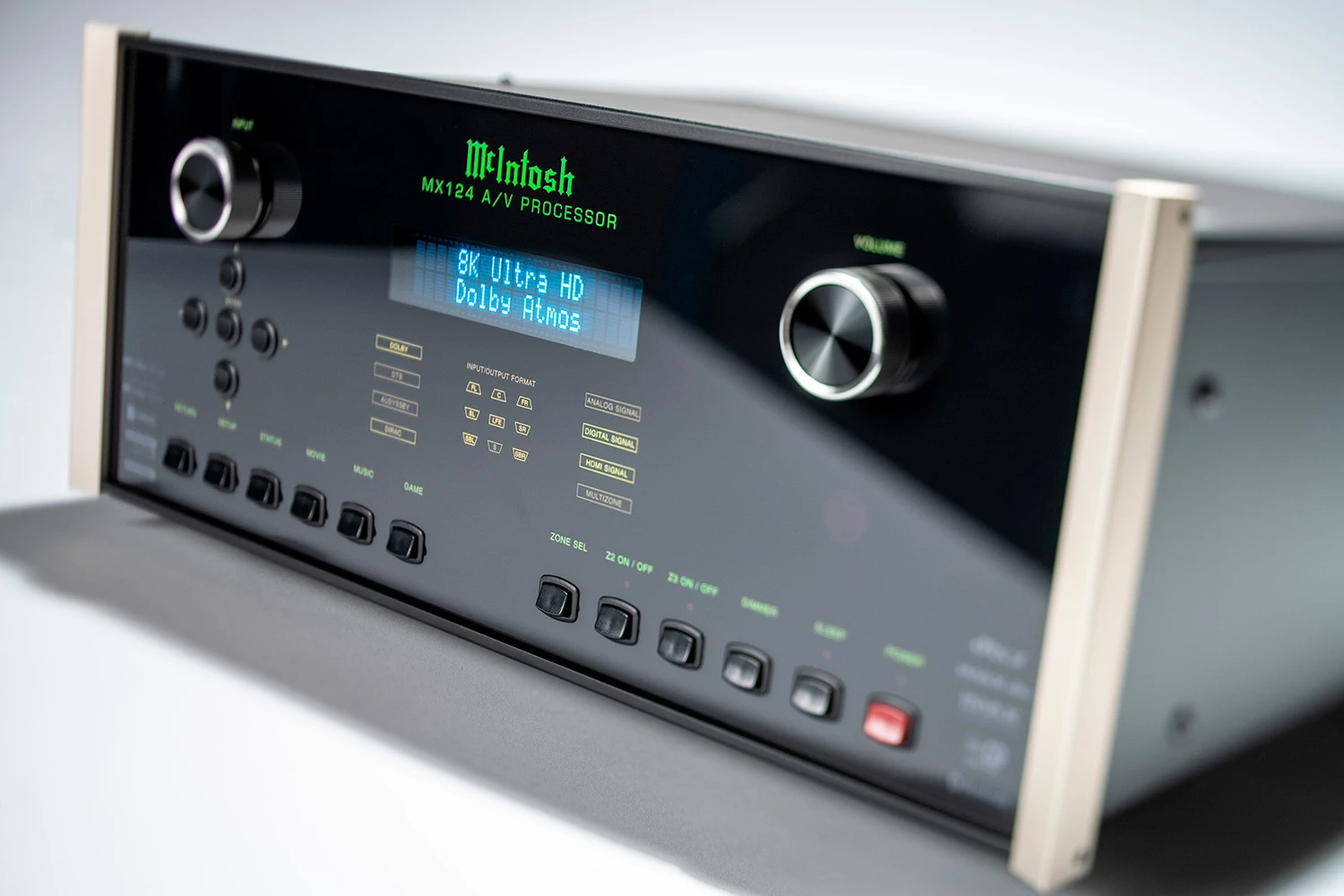
5. McIntosh MX124 Expands Home Cinema Control With 13.4-Channel Processing
The McIntosh MX124 coordinates up to 13.4 channels and four independently managed subwoofers.
The McIntosh MX124 is a dedicated 13.4-channel AV processor for substantial, professionally planned home cinemas.
It supports configurations up to 7.4.6 or 9.4.4 and provides four independently managed subwoofer outputs, allowing low-frequency channels to be integrated individually.
Supported immersive formats include Dolby Atmos, DTS:X Pro, Sony 360 Reality Audio and MPEG-H Audio. Its room-optimization package is unusually broad, with licenses for Dirac Live Room Correction, Dirac Live Bass Control and Audyssey MultEQ XT32. Nine 32-bit DAC chips and 8K-capable HDMI connectivity complete its core processing specification.
Best for: Large, multi-subwoofer cinemas
- Processing for up to 13.4 channels
- Four independent subwoofer outputs
- Dirac Live and Audyssey calibration options
- Support for 7.4.6 and 9.4.4 layouts
Verdict: The MX124 is the specialist option here for complex systems requiring extensive channel processing and flexible bass management.
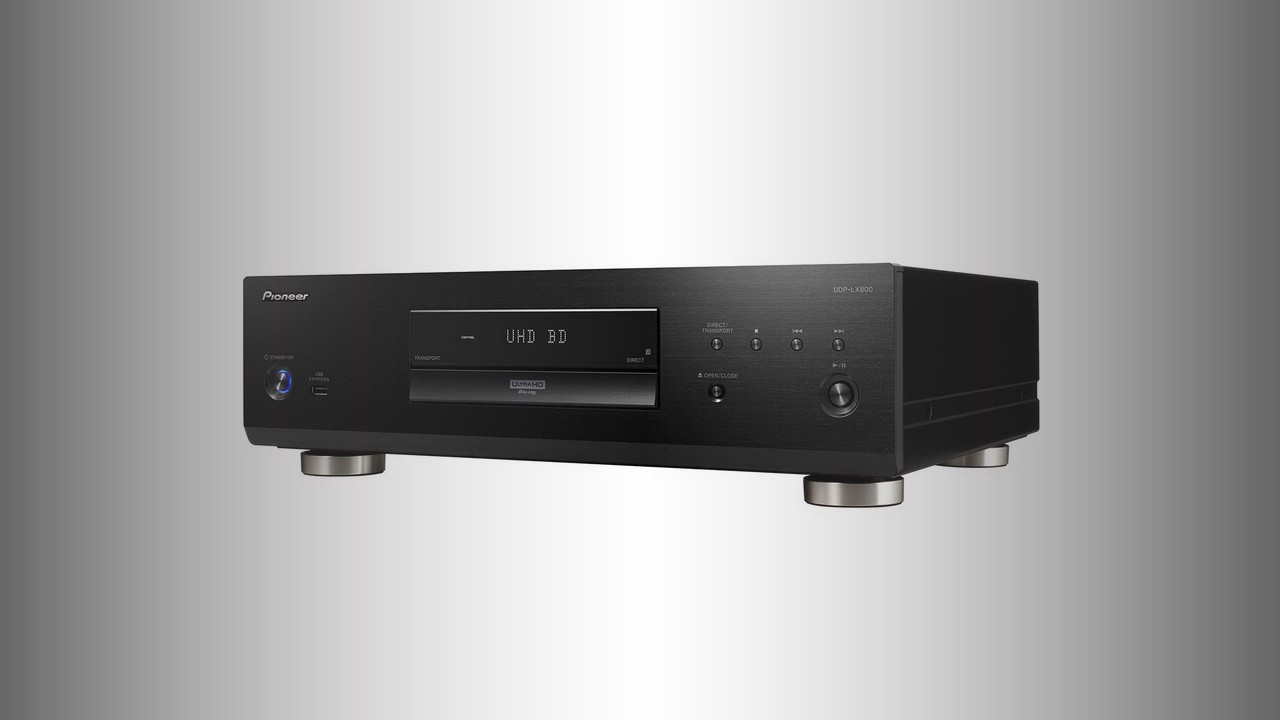
6. Pioneer UDP-LX800: Top-class universal player
The Pioneer UDP-LX800 supports Ultra HD Blu-ray, SACD, DVD-Audio and other optical-disc formats.
The Pioneer UDP-LX800 is designed for collections spanning CD, DVD, DVD-Audio, DVD-Video, SACD and Ultra HD Blu-ray.
Its video features include Dolby Vision and HDR10, with separate processor settings for HDR and SDR signals.
Two HDMI outputs allow audio and video to be routed separately, while PQLS can reduce jitter when the player is partnered with a compatible Pioneer AV receiver. Mechanical construction is a major focus: the optical drive sits on a 4.6 mm steel chassis inside an anti-vibration enclosure, and internal sections isolate the power supply, digital circuitry and analog audio path.
Best for: Mixed music and movie disc collections
- Wide optical-disc compatibility
- Dolby Vision and HDR10 support
- Separate HDMI outputs for audio and video
- Substantial anti-vibration construction
Verdict: The UDP-LX800 is a comprehensively engineered source for viewers and listeners who use several physical-disc formats.

7. Best AV Receiver: Choosing the very best for your home cinema
The receiver guide covers practical distinctions in channel count, video support, networking and system flexibility.
This broader receiver guide provides a useful shortlist across different system sizes and budgets.
One highlighted model is the Yamaha RX-V4A, a 5.2-channel receiver with five 80 W amplification channels, Dolby Atmos and DTS:X support, Bluetooth, Wi-Fi, AirPlay 2 and MusicCast.
Its channels can be reassigned for a second zone or front-speaker bi-amplification. The guide also notes that its surround effect is less forceful than that of more expensive alternatives, which helps frame the compromise involved when choosing an entry-level model.
Best for: Building an initial receiver shortlist
- Receiver options across different system levels
- Dolby Atmos and DTS:X coverage
- Network and multiroom features on the Yamaha RX-V4A
- Flexible channel reassignment
Verdict: This guide is most useful as an overview for comparing receiver classes before investigating an individual model in detail.

8. LG stops production of Blu-ray players
LG's withdrawal from Blu-ray player production narrows the choice of major brands serving physical-media users.
This is market context rather than a product recommendation, but it is relevant to anyone planning a disc-based cinema.
LG has stopped developing and manufacturing Blu-ray players, with its remaining UBK80 and UBK90 inventory available only while supplies last.
The report follows earlier exits by Oppo and Samsung and identifies Panasonic and Sony as the other major brands continuing to offer UHD players. It also notes that neither remaining range has been refreshed recently. Buyers maintaining an optical-disc library should therefore check current availability and support rather than assuming every familiar brand still produces players.
Best for: Planning around physical media
- Clarifies LG's exit from Blu-ray hardware
- Identifies remaining major UHD player brands
- Explains the limited status of existing LG stock
Verdict: The report is a practical warning to verify availability before designing a home cinema around a particular Blu-ray player brand.

9. Denon AVR-X580BT: AV receiver equipped with a well-thought-out set of functions
The Denon AVR-X580BT combines a 5.2-channel layout with four HDMI inputs and gaming-focused video features.
The Denon AVR-X580BT offers a focused 5.2-channel specification with five discrete amplifiers rated at up to 70 W.
Its decoding covers Dolby TrueHD and DTS-HD Master Audio, while four HDMI inputs support 8K at 60 Hz, HDCP 2.3, HDR10, HDR10+ and Dolby Vision.
Gaming-oriented video support includes 4K at 120 Hz, ALLM and QFT. The feature set is more basic than that of Denon's expandable models, but it addresses the essentials for a conventional five-speaker cinema with up to two subwoofers and several modern HDMI sources.
Best for: Compact five-channel cinemas
- 5.2-channel configuration
- Four HDMI inputs
- Dolby Vision and HDR10+ support
- 4K at 120 Hz, ALLM and QFT support
Verdict: The AVR-X580BT is a sensible foundation when five amplified channels and current video features matter more than height-speaker expansion.

10. Denon AVR-X3600H: Fully equipped 7-channel AV receiver
The Denon AVR-X3600H offers seven amplified channels, 11.2-channel processing and extensive HDMI connectivity.
The Denon AVR-X3600H supplies seven amplified channels and supports Dolby Atmos and DTS:X, with 11.2-channel signal processing available for broader system configurations.
Audyssey MultEQ XT32 uses the supplied microphone to measure the room and adjust the surround presentation.
Connectivity is extensive, comprising eight HDMI inputs and three outputs with 4K, HDR and Dolby Vision support; a front HDMI input also simplifies temporary source connections. High-current output stages, a four-core DSP and 32-bit AKM DACs in every channel round out a specification designed for demanding multichannel systems.
Best for: Feature-rich seven-channel systems
- Seven amplified channels
- 11.2-channel signal processing
- Audyssey MultEQ XT32 calibration
- Eight HDMI inputs and three outputs
Verdict: The AVR-X3600H combines generous source connectivity, room correction and processing headroom for a sophisticated receiver-based cinema.
Frequently asked questions
Should I choose a soundbar or an AV receiver?
Choose a soundbar when simple installation, limited cabling and a compact footprint take priority.
An AV receiver is better suited to separate speakers, configurable surround layouts and future expansion, but it requires more space, setup and wiring.
How many receiver channels do I need for Dolby Atmos?
Start by defining the intended speaker layout and then match both the amplified-channel count and processing capacity.
A 5.1.2 system needs seven amplified speaker channels, while larger layouts may require a receiver with additional processing outputs and external power amplifiers.
Which HDMI features should I check before buying?
Confirm that the component supports the resolutions, frame rates and HDR formats used by the display and sources. eARC matters when returning audio from a television, while 4K at 120 Hz, ALLM and QFT may be important for compatible game systems.
Is room calibration worth prioritizing?
Room calibration can help balance speaker levels, timing and frequency response for the listening space.
Audyssey MultEQ XT32 and Dirac Live are both represented here, while Dirac Live Bass Control and independent subwoofer outputs become especially relevant in more complex multi-subwoofer systems.
How to Choose the Right Home Cinema Foundation
Begin with the room and desired speaker layout rather than the longest feature list.
A compact soundbar is the least complicated route, whereas a five-channel receiver such as the Denon AVR-X580BT or the receiver documented within the Onkyo system supports a traditional surround arrangement without committing to height channels.
Buyers planning Dolby Atmos speakers should count the required amplified channels carefully and distinguish them from the larger number of channels a receiver may only process. Expansion changes the calculation. The Denon AVC-X3800H combines nine internal amplifier channels with 11.2-channel outputs, while the Arcam AVR11 can reach a 7.1.4 arrangement with added power amplification. At the other end of the scale, the McIntosh MX124 is intended to coordinate a much larger system, including four independently managed subwoofers. Room correction also deserves weight: Audyssey MultEQ XT32 offers guided automatic calibration, while Dirac Live uses computer-based measurement and processing. Finally, audit every source and display connection. Count HDMI inputs, check eARC requirements, and verify the specific HDR and high-frame-rate video formats in use. Physical-media owners should consider disc compatibility and current player availability as part of the system plan. Buying for the actual room, sources and speaker layout is more reliable than paying for channels or formats that will never be used.



Sound Off
0Join the discussion if you have something to add.