Marten Dexter Series: Swedish High-End Speaker Design With a Flexible Core
Marten’s Dexter series brings several of the Swedish company’s high-end loudspeaker ideas into a four-model family, combining diamond tweeters, ceramic and carbon-fiber drivers, a new cabinet structure, and a room-friendly bass loading system.
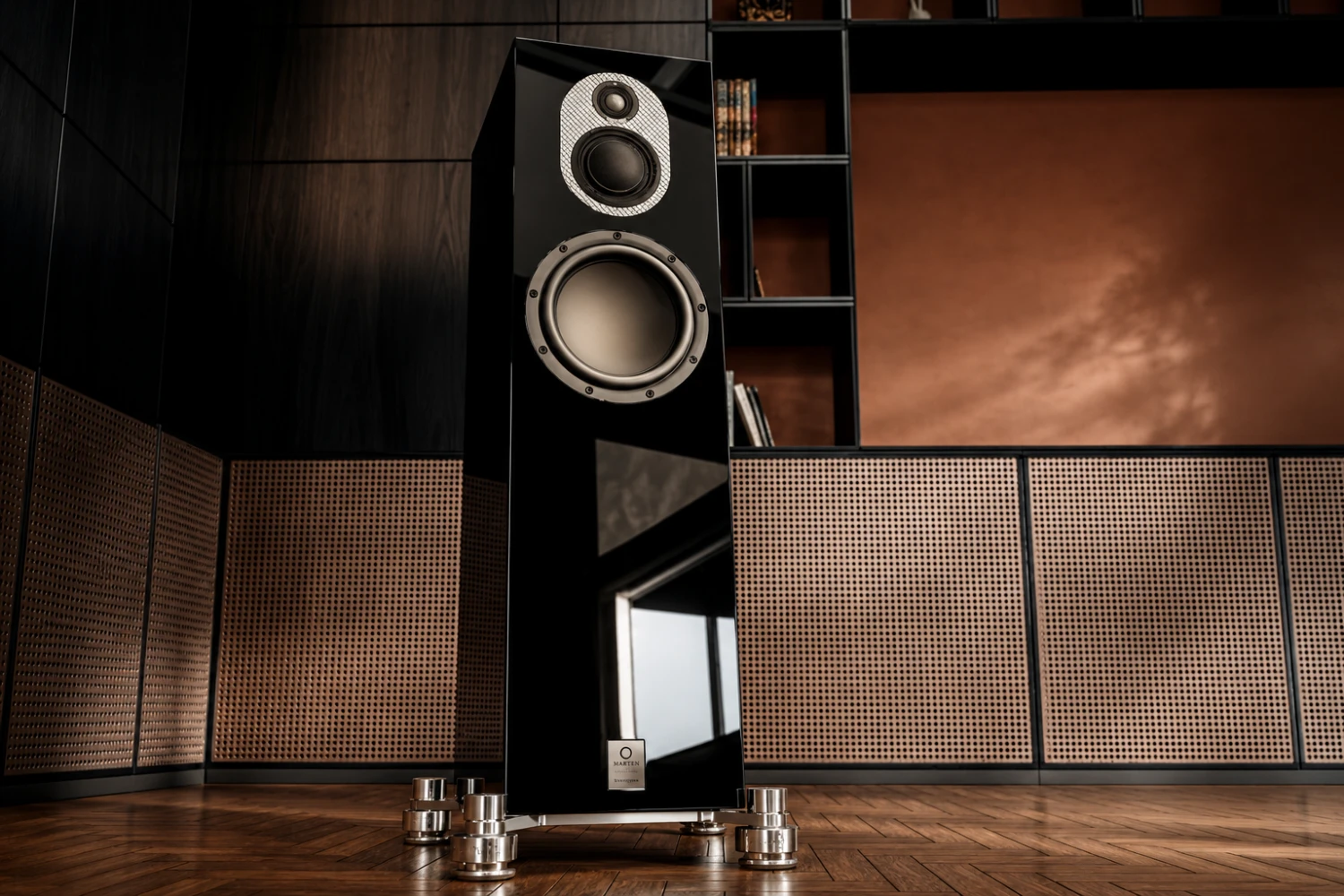
The Marten Dexter series is built around a clear idea: take several of the Swedish manufacturer’s advanced loudspeaker concepts and package them in a range that can suit different rooms and system ambitions. Rather than being a single statement model, Dexter is a family of four loudspeakers: the compact Dexter Duo monitor and three floorstanding designs named Dexter Trio, Dexter Quartet, and Dexter Quintet. Across the range, Marten has kept a common technical foundation, including a pure diamond tweeter, a new M-Core cabinet construction, internal Jorma Duality wiring, and a bass loading system developed specifically for these models. That shared platform is what makes Dexter interesting. It gives prospective owners a way to choose the scale and configuration that fits their space while retaining the same essential design language and many of the same engineering priorities.
A Four-Model Range With a Common Engineering Language
The Dexter line is not simply a collection of unrelated models with similar styling. Marten describes the series as sharing a common architecture, and that matters for anyone trying to build a system around a consistent set of priorities. The monitor model, Dexter Duo, and the floorstanding Dexter Trio both use a ceramic Marten midrange/bass driver together with the series-wide diamond tweeter. The larger Dexter Quartet and Dexter Quintet move to three-way layouts, adding a ceramic Marten midrange driver and carbon-fiber Marten bass drivers.
This structure gives the range a practical sense of progression. The Duo is the obvious candidate where a standmount form is preferred or where a room does not call for a larger enclosure. The Trio offers a floorstanding format while retaining the more compact two-driver concept. Quartet and Quintet are intended for listeners who want a fuller three-way architecture with dedicated bass drivers. The important point is that the buyer is not choosing between entirely different design philosophies; the models scale the Dexter concept across different use cases.
That kind of range planning can be useful in real homes. A loudspeaker is rarely chosen in isolation from room size, furniture placement, listening distance, amplification, and aesthetic requirements. By offering monitor and floorstanding choices, Marten gives the Dexter series a degree of adaptability without abandoning the technical features that define it.

The Diamond Tweeter as a Series-Wide Anchor
One of the most distinctive documented features of the Dexter series is the use of a Marten pure diamond tweeter in every model. This driver is not reserved only for the top floorstanding speaker; it appears in the Duo, Trio, Quartet, and Quintet. Marten developed the tweeter based on work associated with its Coltrane Supreme Extreme project, which places the Dexter range within a broader company engineering lineage.
For a prospective owner, the significance is not that one should assume a particular sonic result without hearing the loudspeaker. Rather, the value lies in consistency and intent. By using the same tweeter across the series, Marten makes the high-frequency driver a defining component of the family, not an upgrade reserved for one model. This can also matter for system planning. If a listener is comparing different Dexter models for room size or placement reasons, the shared tweeter helps preserve a common technical identity across the range.
Diamond tweeters are associated in high-end loudspeaker design with rigidity and low moving mass, though the final performance of any loudspeaker depends on implementation, crossover design, enclosure behavior, and system matching. In Dexter, the diamond tweeter sits within a broader architecture that includes ceramic, carbon-fiber, cabinet, wiring, and bass-loading decisions rather than being treated as a standalone headline component.

Driver Layouts Designed for Different Scales
The Dexter Duo and Dexter Trio use a ceramic Marten midrange/bass driver. This makes them simpler two-way-style propositions within the Dexter family, pairing that driver with the same diamond tweeter used throughout the range. Such a configuration may appeal to listeners who value a more compact driver complement or who are working with smaller or more moderate listening spaces.
The Dexter Quartet and Dexter Quintet expand the concept into three-way loudspeakers. Each uses a ceramic Marten midrange driver and carbon-fiber Marten bass drivers. Separating midrange and bass duties is a traditional high-end loudspeaker approach, allowing each driver type to be assigned a more specialized role within the overall system design. The source material does not provide dimensions, frequency response figures, sensitivity, or impedance, so those details should be confirmed from Marten’s own specifications when evaluating compatibility. Still, the architectural distinction between the models is clear enough to understand how the lineup is organized.
Marten’s use of ceramic and carbon fiber also reflects a materials-led approach. Ceramic is used for the midrange or midrange/bass role, while carbon fiber is assigned to bass duties in the larger three-way models. The result is a range that scales not only in cabinet size but also in driver specialization.

M-Core Cabinet Construction and Why It Matters
Cabinet design is one of the less glamorous but most important areas of loudspeaker engineering. In the Dexter series, Marten introduces a new three-layer M-Core cabinet construction. The source material does not give a detailed technical breakdown of the materials or exact layering, but the fact that the enclosure construction is common to the series indicates that cabinet behavior is central to the Dexter platform.
A loudspeaker cabinet has to provide a stable mechanical environment for the drivers while fitting into a domestic room. A three-layer construction suggests an emphasis on structural control and enclosure integrity, both of which are relevant to how a speaker behaves when driven by an amplifier. Without making unsupported claims about measurable performance, it is fair to say that Marten has positioned the cabinet as more than a visual shell. It is part of the product’s engineering identity.
For owners, this matters because the cabinet is one of the elements they live with physically and visually every day. It influences the speaker’s footprint, finish quality, perceived solidity, and long-term relationship with the room. In Dexter, the cabinet also works together with the series’ dedicated bass loading system, making the enclosure a functional part of the acoustic design rather than a passive container.

Loaded Reflex Line: A Placement-Friendly Bass Concept
Marten has developed a new bass loading system for Dexter called Loaded Reflex Line. It combines principles associated with bass reflex and transmission line designs, using a shaped internal channel and a wide, downward-facing slot port. According to Marten’s description, the system is intended to reduce air velocity, increase bass depth, and provide significantly more flexibility in room placement than conventional bass ports.
The placement aspect is especially relevant. Many loudspeakers with rear-facing or otherwise conventional ports can be sensitive to wall distance and nearby boundaries. While no loudspeaker is immune to room interaction, a downward-facing slot port and controlled internal channel are design choices that may make installation less restrictive. For listeners who cannot place speakers far into the room, or who share a listening space with everyday furniture, this kind of design thinking can be highly practical.
It is also notable that the Loaded Reflex Line is not described as a generic inherited feature; it was developed specifically for the Dexter series. That reinforces the sense that Dexter has been engineered as a coherent family rather than assembled from existing parts alone. The bass system, cabinet, drivers, and model hierarchy are all part of the same project.

Internal Wiring and the Statement Edition Option
All four Dexter models are internally wired with Jorma Duality cable. Internal cabling is easy to overlook because it is not visible once the loudspeaker is installed, but in a high-end product it reflects the manufacturer’s attention to the complete signal path inside the cabinet. The presence of named internal wiring across the line is another example of Marten applying a consistent build standard to the family.
Marten also offers a Statement Edition for all four Dexter models. This version includes an improved crossover and better internal cabling. The source material does not specify the precise crossover changes, cable differences, or any performance measurements associated with the Statement Edition, so it should be understood as a documented configuration upgrade rather than a quantified performance claim.
The important editorial point is flexibility. Some owners may prefer the standard Dexter specification, while others may want the highest available factory configuration within the series. By making the Statement Edition available for the Duo, Trio, Quartet, and Quintet, Marten avoids limiting the upgrade path to only the largest models. That can be useful for buyers who have a smaller room but still want the elevated internal specification.
Finishes That Support the Design Rather Than Distract From It
The Dexter series is available in four finishes: True Grain Oak, Piano Walnut, Matte Walnut, and Piano Black. True Grain Oak is new to Marten and exclusive to Dexter. It is described as an oak with an open grain and a natural, tactile surface. The walnut finishes were developed specifically for this series and selected for their deep grain and natural, understated tone, while Piano Black provides a more traditional polished option.
This finish selection gives Dexter a broad domestic range without overwhelming the buyer with excessive customization. True Grain Oak appears to be the most distinctive of the group because of its exclusivity to the series and its more tactile, natural presentation. Piano Walnut and Matte Walnut offer two interpretations of walnut, allowing the same underlying wood character to suit different interiors. Piano Black remains a familiar choice for listeners who want the speaker to integrate with other black-finished audio components or create a more formal visual presence.
For many buyers, finish is not a superficial detail. Loudspeakers are large objects in a living space, particularly floorstanding models. A finish palette that includes natural, understated, and high-gloss options can make the difference between a technically suitable speaker and one that feels realistic to own.
Conclusion
The Marten Dexter series is most suitable for listeners who want a high-end loudspeaker platform with multiple room-appropriate formats rather than a one-size-fits-all design. Its strongest documented qualities are the shared pure diamond tweeter, the new three-layer M-Core cabinet, the Loaded Reflex Line bass system, Swedish design and construction, Jorma Duality internal wiring, and the option of a Statement Edition across all four models. The Duo and Trio appear aimed at systems where a more compact configuration is desirable, while the Quartet and Quintet extend the concept into dedicated three-way floorstanding designs. With its carefully structured model range and considered finish options, Dexter is best understood as a flexible Swedish loudspeaker family for owners who value advanced materials, coherent engineering, and room-conscious design choices.