
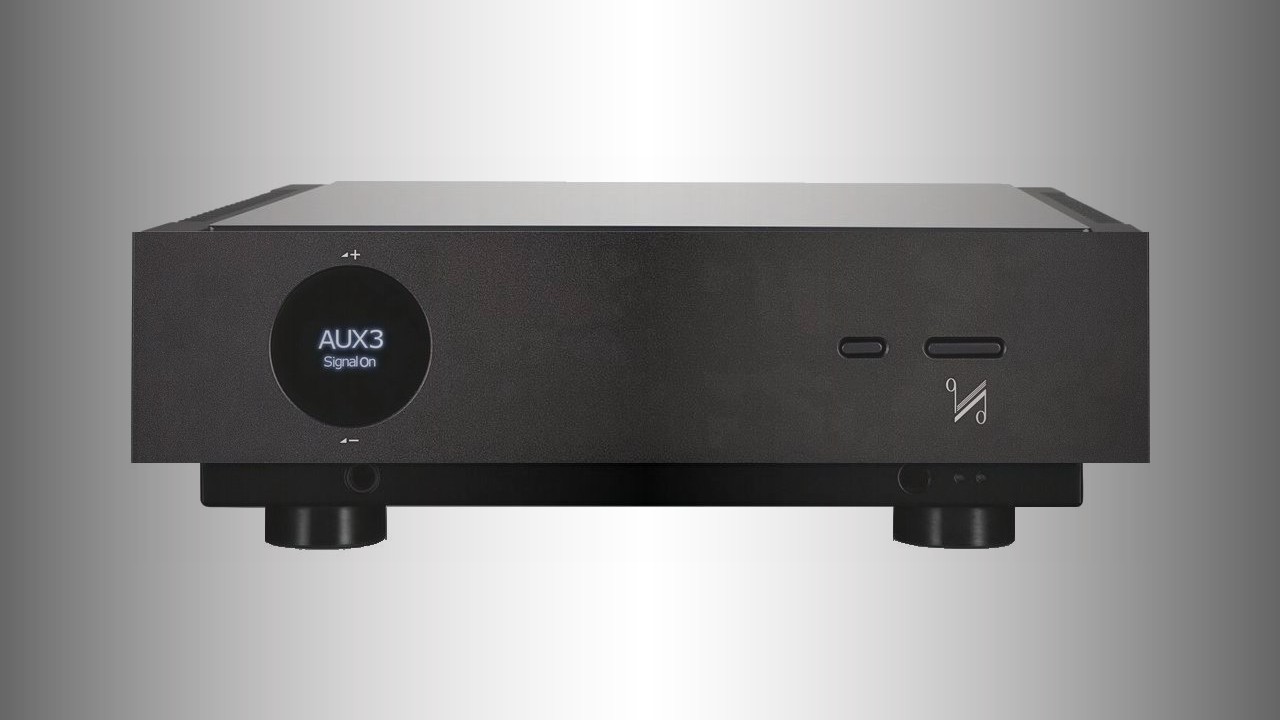
The Quad Artera Pre is positioned as a serious analogue control hub for systems that need more than simple source selection and volume adjustment. Its appeal lies in how many aspects of system matching it brings under the listener’s control without abandoning the traditional role of a preamplifier. With RCA and XLR inputs, an MM/MC phono stage, adjustable output options, input sensitivity trimming, per-input tone settings, 12V triggers, and a headphone amplifier, it is designed for users who want one central component to manage several analogue sources and downstream devices. Just as importantly, its tone-control approach is not a conventional bass-and-treble arrangement: Quad’s Tilt function changes the balance of the frequency response around a central point, allowing broader tonal compensation in measured steps.
A preamplifier designed around system control
At its core, the Quad Artera Pre is an analogue preamplifier, but its feature set shows a wider ambition than basic line-level switching. It offers four stereo RCA inputs, three of which are line-level, plus a built-in Class A phono input. That phono input can be switched for moving-magnet and moving-coil cartridges, which is useful for vinyl listeners who may want to use the Artera Pre without adding a separate phono stage. A balanced XLR input is also included, giving owners a way to connect a compatible source with balanced output.
This mixture of inputs makes the Artera Pre suitable for systems where analogue sources vary in type and output level. A turntable, disc player, DAC with analogue output, tuner, tape-related device, or other line source could all sit within the same control framework, depending on the owner’s setup. The presence of both single-ended RCA and balanced XLR connectivity is also important for system integration, as it allows the preamplifier to serve more than one style of source component.
Tilt tone control as a distinctive Quad feature
One of the most distinctive elements of the Artera Pre is its Tilt tone control. Rather than acting as two independent bass and treble knobs, the Tilt system changes the relationship between upper and lower frequencies simultaneously. In practical terms, it attenuates one side of the spectrum while strengthening the other, or does the reverse, in 1 dB steps relative to a stationary point at about 700 Hz. The result is a frequency response that effectively “leans” in one direction or the other.
This kind of control can be useful because many tonal mismatches in a home audio system are broad rather than narrow. A source may sound subjectively lighter or warmer than another; a room may encourage a balance that feels slightly too full or too lean; a recording may need gentle overall compensation. The Tilt function is intended to address those kinds of tonal shifts without requiring a user to make multiple separate adjustments.
The Artera Pre also provides stepped low-frequency adjustment at three levels: -4.5 dB, 0, and +4.5 dB. This adds a more direct way to tailor bass level where needed. Importantly, the tone settings can be combined individually for each input. That means a vinyl source, a line-level source, and a balanced source do not all have to share the same compensation. For owners with multiple sources of differing character, per-input tonal memory can be more useful than a single global tone setting.

Per-input sensitivity matching for smoother operation
Another practical feature is the ability to adjust the sensitivity of each input separately. The available range is -8 dB to +8 dB in 0.5 dB steps. This matters because different source components can produce noticeably different output levels. Without input trimming, switching from one component to another may cause large volume jumps or require constant manual correction.
By allowing each input to be matched more closely, the Artera Pre can make daily use more predictable. A high-output source can be trimmed down, while a quieter source can be raised. This is not a cosmetic feature; it addresses one of the common frustrations in multi-source systems. It also complements the product’s tone-adjustment flexibility, because each input can be treated as a distinct source with its own level and tonal requirements.
The four-channel volume control is also described as corresponding to the switching arrangement. Along with the specified channel unbalance of ±0.02 dB at 1 kHz and channel separation of more than 100 dB at 1 kHz, the design emphasis appears to be on precise control and clean routing between source and output.
Direct mode for a simpler signal path
All inputs on the Quad Artera Pre can operate in direct mode, passing the signal through with minimal interference. This is a meaningful inclusion because not every listener wants tone adjustment active all the time. Some may prefer to use the Tilt and bass settings only with certain sources or recordings, while leaving other inputs as unprocessed as possible within the preamplifier’s architecture.
The combination of direct mode and tone memory makes the Artera Pre flexible without forcing a single operating philosophy. A user can configure one input for direct pass-through, another with Tilt correction, and another with bass adjustment. That approach suits real-world systems, where the most useful setting is rarely identical for every source.

Outputs for power amplifiers, recording paths, and headphones
On the output side, the Artera Pre provides adjustable balanced XLR and unbalanced RCA outputs, along with a fixed-level RCA output. The adjustable outputs allow connection to a power amplifier or active component requiring variable level control, while the fixed-level output can support uses where a constant signal level is needed. This output arrangement increases the number of system configurations the preamplifier can support.
The specified output voltage is 0–2.5 V via RCA and 0–5 V via XLR. These figures indicate the different output ranges available from the single-ended and balanced connections. The inclusion of both connection types is especially useful for owners who may change power amplifiers later, or who want to keep balanced operation available where supported by the rest of the system.
The Artera Pre also includes two 12V trigger outputs, allowing it to control the activation of external devices such as power amplifiers. In a system with separate preamplifier and power amplifier chassis, trigger control can make operation more convenient by allowing associated equipment to power up in sequence from a central point.
Built-in headphone amplifier and day-to-day usability
The Quad Artera Pre includes a built-in headphone amplifier with a discrete Class A output stage and low output impedance. Its front-panel headphone connection is specified as a 6.35 mm output. This gives the unit a secondary role as a headphone listening component, which can be valuable in systems where loudspeaker listening is not always practical.
Usability details also matter. The Artera Pre includes a remote control, so core functions can be managed from the listening position. The display brightness can be adjusted, and the display can also be turned off. In a dark room or a visually minimal system, the ability to reduce or eliminate display light can be a small but worthwhile advantage.
The unit is available with black or silver front panel finishes. Its dimensions are 320 x 105 x 320 mm, and it weighs 7.8 kg. Those proportions place it outside the full-width component stereotype while still giving it the physical substance expected of a dedicated preamplifier. Power consumption is listed at 45 W.

Power supply and measured specifications
The Artera Pre’s development was led by Jan Ertner, with collaboration involving Audiolab. One notable design detail is its power supply arrangement, which includes 11 adjustable power rails, some described as ultra-low noise. In a preamplifier, power supply design is especially relevant because the component is handling low-level signals and volume control before amplification. Stable, low-noise supply rails can support the broader goal of maintaining signal integrity across multiple inputs and operating modes.
The published specifications include a frequency response of 20 Hz to 20 kHz at -0.2 dB, harmonic distortion of less than 0.001% from 20 Hz to 20 kHz, and a signal-to-noise ratio of 110 dB at 1 kHz, or 118 dB A-weighted at 1 kHz. These figures help define the engineering targets of the product, though they should not be treated as a substitute for system matching or listening preferences. They do, however, align with the Artera Pre’s role as a control component intended to pass, adjust, and route analogue signals with precision.
Conclusion
The Quad Artera Pre is most suitable for listeners building an analogue-focused system with several sources, especially those who value adjustability and clean system integration. Its strongest documented qualities are its distinctive Tilt tone control, per-input bass and sensitivity settings, MM/MC phono input, RCA and XLR connectivity, direct mode, balanced and unbalanced outputs, 12V trigger control, and built-in Class A headphone stage. Rather than being aimed at users who want a minimalist preamplifier with no adjustment options, it is better suited to owners who want a central control component capable of adapting to different sources, cartridges, amplifiers, rooms, and listening habits.


Sound Off
0Join the discussion if you have something to add.