

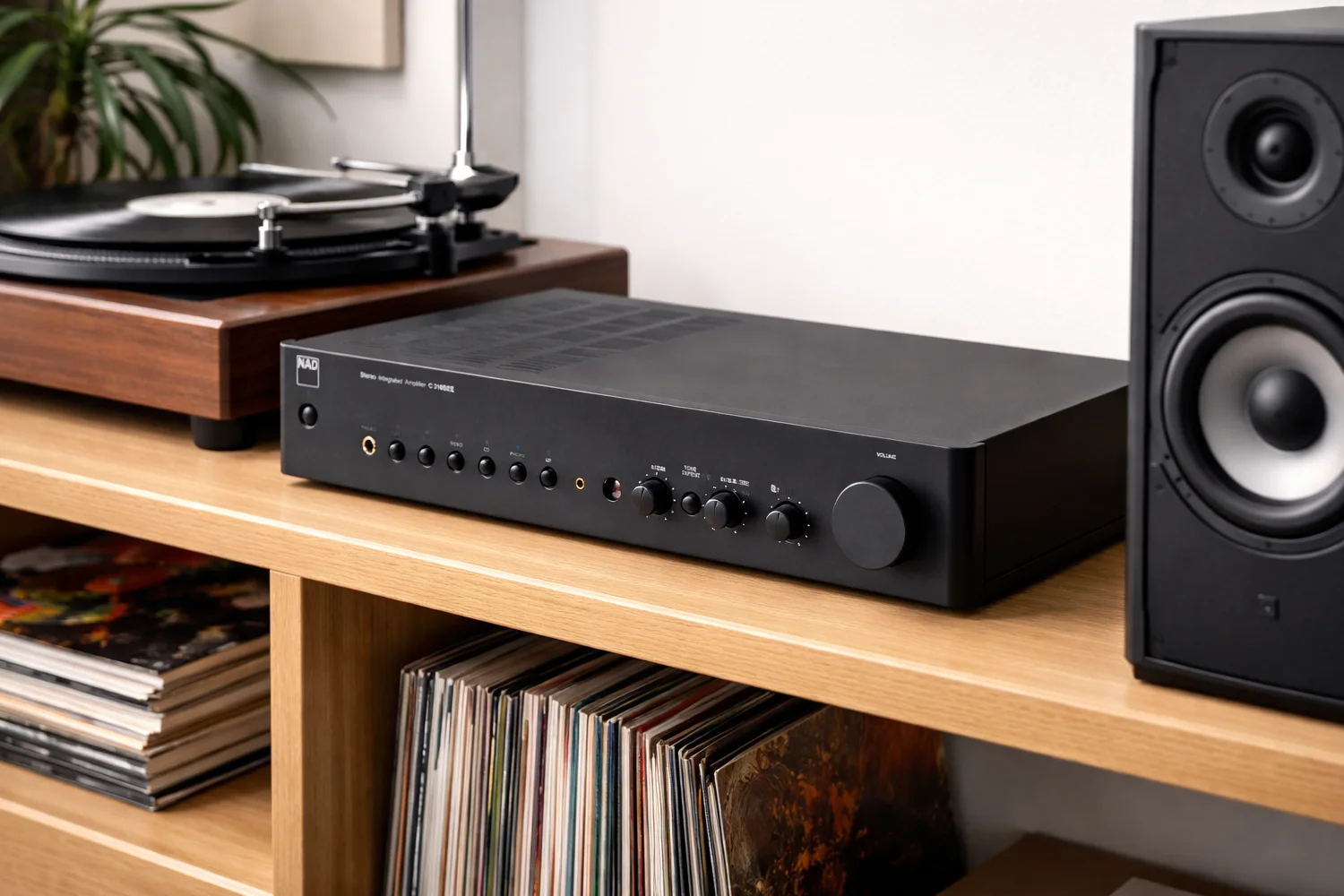
The NAD C316 v2 is an integrated stereo amplifier built around a deliberately traditional idea: a compact analog amplifier should drive a pair of hi-fi speakers, accept everyday music sources, support vinyl playback, and stay easy to live with. Instead of presenting itself as a feature-packed control center, it concentrates on core two-channel duties. That makes it notable in a market where amplifiers often compete through long specification lists, digital processing, app control, and multiroom functions. The C316 v2 takes a quieter route. Its appeal lies in straightforward engineering, a modest footprint, and a feature set that covers the fundamentals of a conventional stereo system without turning the amplifier into something more complicated than it needs to be.
A compact integrated amplifier with analog priorities
The C316 v2 is described as a fully analog stereo amplifier, which immediately defines its role. It is intended for listeners who want a direct, conventional signal path from source to amplifier to speakers, rather than a component dominated by digital features. This does not make it minimalist in a limiting sense; instead, it narrows the product’s focus. For many music systems, especially those based around a turntable, line-level sources, speakers, and headphones, that focus can be genuinely useful.
Its compact nature is also part of the attraction. Not every hi-fi setup sits in a dedicated listening room or a large equipment rack. A smaller amplifier can be easier to place on a shelf, sideboard, desk, or modest rack while still anchoring a serious stereo system. The C316 v2’s understated graphite finish reinforces that approach. It is not designed to draw attention through decorative styling. It visually communicates the same priorities as its specification: practical, serious, and restrained.
PowerDrive and the importance of dynamic headroom
On paper, the NAD C316 v2 is rated at 2 x 40 watts into 8 ohms. That figure is modest by modern amplifier marketing standards, but the product’s design is not defined only by continuous power output. NAD’s PowerDrive technology is included to allow the amplifier to deliver short bursts of significantly higher dynamic power when music demands it. This matters because music is not a steady test tone. It contains transients, crescendos, bass accents, and sudden changes in level that can require extra current for brief moments.
For a prospective owner, the practical value of this approach is confidence. A compact amplifier with useful dynamic headroom can feel less constrained with real music than its basic wattage number might suggest. It is not necessary to exaggerate what 40 watts per channel can do; speaker sensitivity, room size, and listening level will still matter. But the documented presence of PowerDrive shows that NAD has paid attention to musical peaks and short-term demands, rather than treating amplifier power as a single static number.

A proper phono input for vinyl-based systems
One of the C316 v2’s most important functional strengths is its moving-magnet phono input. This is not a decorative inclusion for a specification sheet; it meaningfully changes how the amplifier can be used. A turntable with a moving-magnet cartridge can be connected without requiring an external phono preamplifier, reducing box count, cabling, and setup complexity. For someone building a first vinyl system, or returning to records after years away, that can make the system feel more approachable.
The presence of a phono stage also supports the amplifier’s classic hi-fi character. Many traditional stereo systems begin with a turntable, an integrated amplifier, and passive loudspeakers. The C316 v2 fits naturally into that structure. It does not ask the owner to assemble multiple specialist components before playing records, yet it keeps the system organized around separate loudspeakers and dedicated amplification rather than an all-in-one lifestyle format.
Headphone listening without adding another component
The C316 v2 also includes a headphone output, which adds everyday flexibility. This is particularly useful in shared homes, apartments, or late-night listening situations where speaker playback is not always practical. A dedicated headphone output means the amplifier can remain the central hub of the system even when the loudspeakers are not in use.
That convenience should not be underestimated. Many simple stereo systems become less useful if they only work well in one listening scenario. By supporting headphones, the C316 v2 gives owners another way to use the same connected sources. A record, a line-level source, or another analog component can remain part of the system without requiring a separate headphone amplifier solely for private listening.

Low-noise, low-distortion design as a usability advantage
The source material emphasizes low noise and low distortion as part of the C316 v2’s design. In an amplifier of this type, those qualities matter because they support the fundamental task of preserving musical information without adding obvious interference. A low noise floor is especially relevant for quieter passages, headphone use, and vinyl playback, where unwanted hiss or hum can become distracting if system setup and component design are not handled carefully.
Low distortion is similarly important not because it creates a dramatic feature in itself, but because it supports long-term listening. An amplifier intended for daily music use should not depend on exaggerated tonal effects to create interest. The C316 v2 is positioned around an honest, balanced presentation rather than artificial sparkle or inflated bass. For listeners who prefer their system to reflect the character of recordings and speakers rather than impose a heavy signature of its own, that design direction is a meaningful part of the product’s identity.
Designed for simple system matching
The C316 v2 is best understood as the center of a straightforward two-channel system. Pair it with a suitable set of hi-fi loudspeakers, connect a turntable through the moving-magnet input, add any needed analog source, and the system remains easy to understand. This simplicity can be a strength for owners who do not want to manage complex menus, network settings, or multiple software ecosystems just to listen to music.
System matching still matters. The amplifier’s 2 x 40-watt rating means buyers should think sensibly about speaker choice, room size, and desired playback levels. It is not presented as a high-powered amplifier for every possible loudspeaker or large-room scenario. Its more natural territory is a carefully chosen traditional stereo setup where efficient or moderately easy-to-drive speakers are partnered with an amplifier that prioritizes clean analog operation and useful dynamic behavior.

Who the NAD C316 v2 is most suitable for
The NAD C316 v2 is most suitable for listeners who value a classic stereo experience over feature accumulation. It makes particular sense for someone building a compact analog system around passive speakers and a turntable, especially if the goal is to avoid purchasing a separate phono preamp at the outset. It also suits owners who want headphone access from the same amplifier used for speaker listening, and who prefer understated industrial design to a more visually assertive component.
It is less suitable for buyers who want extensive digital connectivity, built-in streaming, app-based control, or a single-box modern media hub. Its strengths are concentrated elsewhere: analog inputs, vinyl readiness, compact placement, and conventional two-channel operation. For the right user, that restraint is not a drawback. It is the point of the product. The C316 v2 is aimed at people who want to spend less time managing features and more time using a stable, understandable hi-fi system.
Conclusion
The NAD C316 v2 stands out because it keeps its ambitions focused and useful. It combines compact analog integrated amplification, a documented 2 x 40-watt output into 8 ohms, NAD’s PowerDrive technology for short-term dynamic demands, a moving-magnet phono input, a headphone output, and an understated graphite design. Its strongest qualities are not novelty or complexity, but coherence: it is built for listeners who want a traditional stereo amplifier that supports speakers, vinyl, and private listening without unnecessary complication. For music fans assembling a simple, compact, analog hi-fi system, the C316 v2’s appeal is its disciplined balance of practicality, flexibility, and classic NAD restraint.


Join the discussion
Share your thoughts, listening impressions or product experience.