
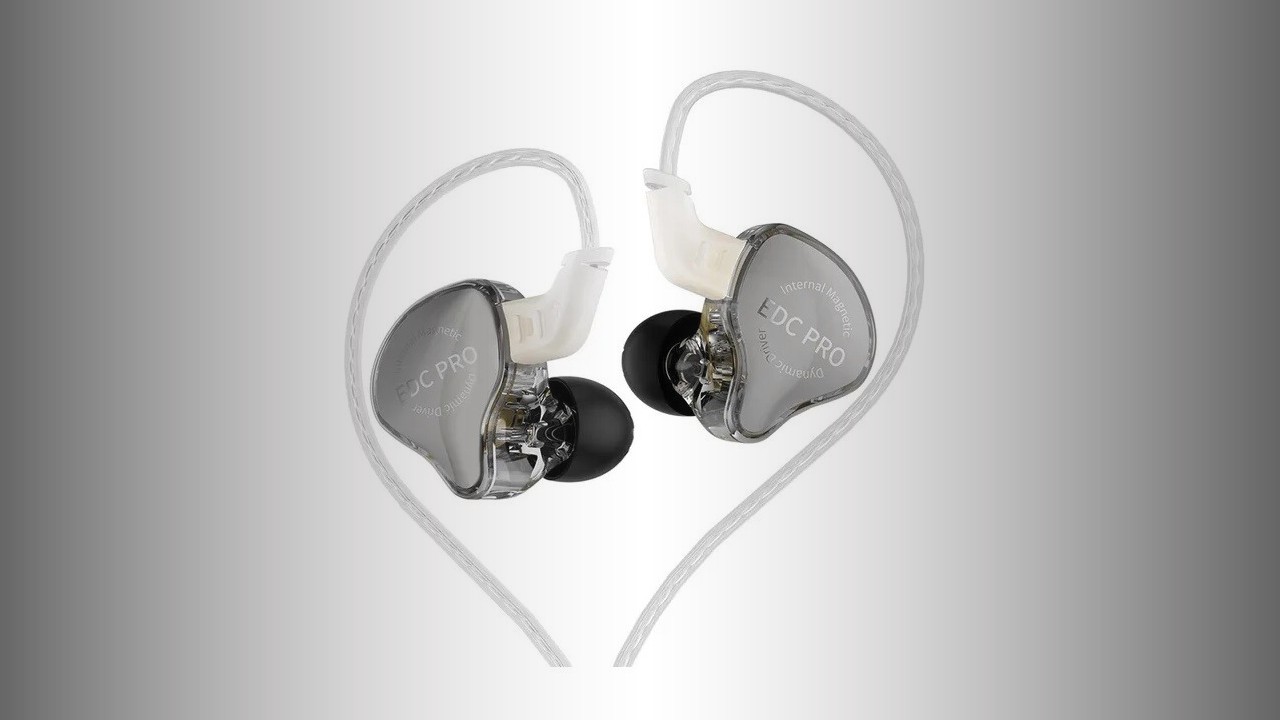
The KZ EDC Pro is an in-ear monitor built around a straightforward idea: use a single high-sensitivity dynamic driver, keep the connection format accessible, and add practical details that help the earphones stay useful over time. Rather than leaning on a complex multi-driver layout, the EDC Pro places its emphasis on dynamic-driver performance, cable flexibility, and a refreshed housing design. For listeners who want a wired earphone that is simple to understand, easy to connect, and not locked into one fixed cable, those choices are central to its appeal.
A single dynamic driver as the core of the design
At the center of the KZ EDC Pro is a single dynamic driver. The source material describes this driver as engineered for wide dynamic range, low distortion, strong bass handling, and high sensitivity. In practical product terms, the single-driver approach can be attractive because it keeps the acoustic architecture direct. There is one driver responsible for the full frequency range, rather than a combination of multiple driver types that must be blended together inside a small enclosure.
The stated frequency range is 20Hz to 40000Hz, with a sensitivity rating of 108dB and an impedance of 23.5 ohms. Those figures position the EDC Pro as a wired in-ear monitor intended for broad compatibility with common headphone outputs, particularly devices or adapters with a standard 3.5mm connection. The 108dB sensitivity specification is especially relevant for users who want an earphone that should not require a dedicated desktop amplifier simply to reach usable volume, though actual performance will still depend on the connected source.
KZ’s emphasis on bass handling is also consistent with the choice of a dynamic driver. Dynamic drivers are commonly used in in-ear monitors where designers want a compact transducer capable of moving air effectively across the audible band. The EDC Pro is presented as having an energetic low-frequency foundation while also aiming to retain detail across different music styles such as classical, rock, and jazz. Without making listening claims, the design brief is clear: this is not an earphone built around a specialist driver array, but around a single full-range dynamic unit intended to cover everyday music use in a coherent package.
Why the 3.5mm wired format still matters
The KZ EDC Pro uses a 3.5mm plug, a detail that may seem ordinary but remains important for many listeners. The 3.5mm connection is still widely supported by laptops, desktop headphone outputs, portable audio players, USB-C or Lightning dongles with headphone jacks, small DAC/amp devices, and many audio interfaces. For an in-ear monitor like the EDC Pro, that makes system matching relatively uncomplicated: the user does not need a proprietary wireless app, a battery-charging routine, or a codec decision before listening.
A wired 3.5mm design can also be useful for people who need predictable latency. Musicians practicing along with a source, listeners watching video through compatible hardware, or users who simply prefer a direct connection may find this type of earphone more convenient than a Bluetooth model. The source material does not present the EDC Pro as a professional monitoring tool with studio-specific features, but its conventional wired architecture makes it suitable for straightforward listening setups where reliability and immediacy are valued.
The impedance rating of 23.5 ohms further supports the idea of an easy-to-pair earphone. It is not presented as a high-impedance design requiring specialized amplification. That does not guarantee equal results from every phone dongle, music player, or computer output, but it does suggest that the EDC Pro is intended to live in ordinary wired systems rather than being restricted to more elaborate hi-fi chains.
Replaceable 0.75mm cable for longer-term usefulness
One of the most practically important features of the EDC Pro is its replaceable cable. The earphones use a 0.75mm connector type, allowing the cable to be detached and replaced. This matters because cables are often the part of an in-ear monitor most exposed to daily wear: they are bent, coiled, pulled from pockets, routed around clothing, and connected repeatedly to devices.
A fixed-cable earphone can become unusable if the cable fails. A replaceable-cable design gives the owner a better path to continued use, provided compatible cables are available. It also allows some adaptation to different listening scenarios. Users may prefer one cable for portable use, another for a desktop setup, or a replacement if the original becomes damaged. The source material specifically frames the replaceable cable as a way to adapt to different headphone usage scenarios and extend the lifespan of the earphones.
This is a meaningful design choice even in an affordable or everyday product category. Longevity is not only about premium materials; it is also about whether the product can be maintained when a vulnerable component wears out. By making the cable replaceable rather than permanently attached, the EDC Pro gains a degree of modularity that many practical wired-earphone users will appreciate.
Two cable versions for different preferences
The KZ EDC Pro is offered with two cable versions: a silver cable and an oxygen-free copper flat cable. The silver cable version is described as using silver plating on the surface of oxygen-free copper, with the goal of improving conductivity and supporting cleaner transmission of musical detail. The oxygen-free copper flat cable version is presented as retaining the original style and sound elements, with a balanced and neutral character.
It is important not to overstate what a cable choice can guarantee in a listening system. Source device, ear tips, fit, recording quality, and personal hearing will all play a role in the final experience. Still, offering two cable options gives buyers a clearer way to choose the version that best matches their priorities. Some may prefer the silver-plated cable version because it is positioned as the more detail-oriented option. Others may be drawn to the OFC flat cable version for its stated balance, smoother presentation, or simply the practical handling associated with a flat cable design.
The presence of both options also reinforces the EDC Pro’s broader theme: it is a simple wired in-ear monitor, but not a completely fixed one. Between the replaceable connector system and the two cable configurations, the product leaves some room for personal preference without requiring the user to understand a complex platform or ecosystem.
Housing design and visual refinement
The EDC Pro also receives attention on the industrial-design side. The source material describes an upgraded housing with better transparency than the previous generation, intended to provide a more pleasing visual effect. In the in-ear category, appearance is not only decorative; it can influence how a product feels to own and use daily. A transparent or semi-transparent housing can give the earphones a more technical, component-focused look, which suits a product centered on driver and cable design.
The reference to a classic design that has been updated suggests continuity rather than a radical redesign. That can be appealing for users who prefer familiar IEM ergonomics but still want a product that looks current. The available information does not provide dimensions, weight, or shell material details, so it would be inappropriate to make claims about fit or comfort. What can be said is that KZ has chosen to make the housing part of the EDC Pro’s identity, pairing a transparent visual style with a replaceable-cable wired format.
For many buyers, this combination is attractive because it avoids making the product feel disposable. A visible design language, detachable cable, and conventional connector format together help frame the EDC Pro as a practical object rather than a sealed accessory with limited serviceability.

Who the KZ EDC Pro is most suitable for
The KZ EDC Pro is likely to make the most sense for listeners who want a wired in-ear monitor with a straightforward technical foundation. It is especially relevant for people who prefer the predictability of a 3.5mm connection, use portable DACs or devices with headphone outputs, or want an earphone that does not depend on charging, pairing, firmware, or wireless codecs.
It may also appeal to users who value replaceable cables. If an owner plans to carry earphones daily, route the cable under clothing, or use them across multiple devices, the ability to change the cable can be a practical advantage. The choice between silver-plated oxygen-free copper and oxygen-free copper flat cable versions gives the product a little more flexibility at the point of purchase.
The EDC Pro is less suited to someone specifically looking for wireless convenience, active noise cancellation, app-based EQ, or advanced smart features. It is also not aimed at buyers who want a documented multi-driver configuration, balanced connectors, or detailed published measurements beyond the listed specifications. Its strengths are instead concentrated in a compact wired format: one dynamic driver, accessible electrical specifications, replaceable cabling, and a refreshed visual design.
Conclusion
The KZ EDC Pro stands out through practical, clearly documented choices rather than unnecessary complexity. Its single high-sensitivity dynamic driver, 23.5-ohm impedance, 3.5mm plug, claimed 20Hz to 40000Hz frequency range, replaceable 0.75mm cable system, and two cable-version options make it a flexible wired in-ear monitor for everyday audio use. The upgraded transparent housing adds a visual identity, while the detachable cable design gives the product a stronger sense of longevity. It is best suited to listeners who want a simple, serviceable wired IEM with conventional connectivity and a choice of cable styles, rather than wireless features or a more elaborate driver configuration.


Sound Off
0Join the discussion if you have something to add.