
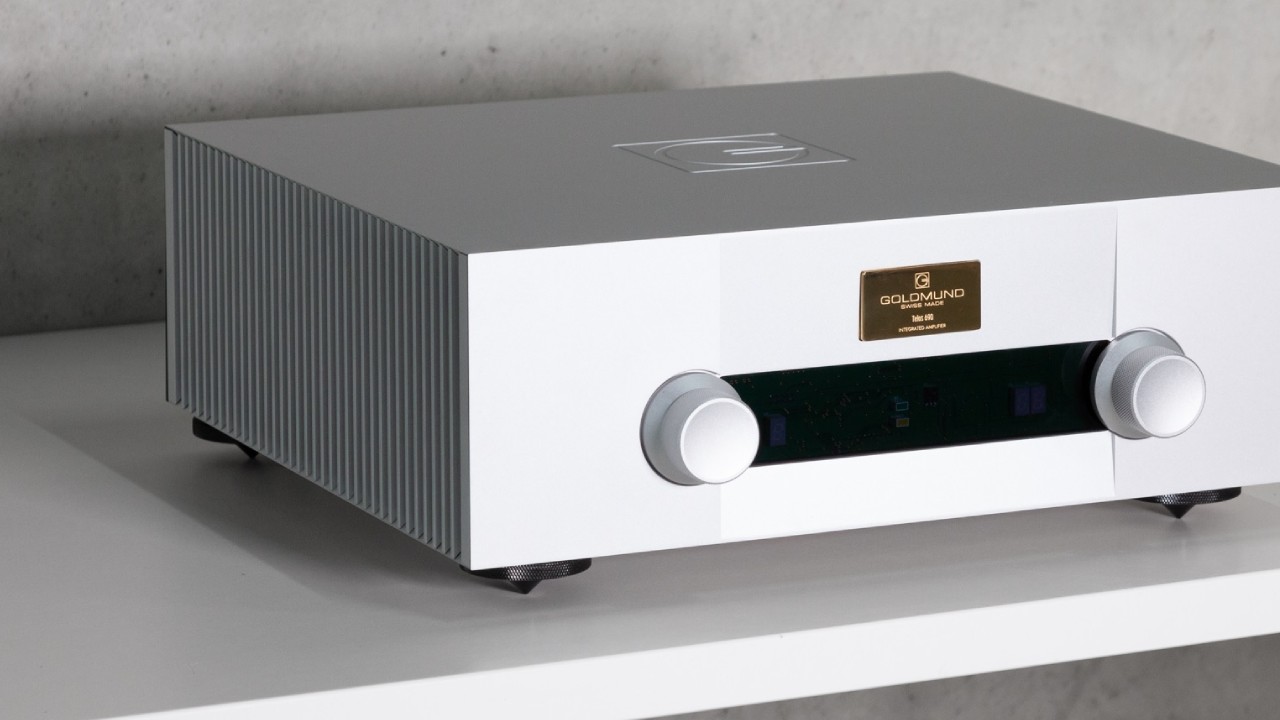
Goldmund’s Telos 690 is positioned as a serious integrated amplifier for listeners who want fewer boxes without giving up substantial drive capability or source flexibility. Its appeal lies in the way it brings together three core priorities: high output power, broad analog and digital connectivity, and a chassis design that reflects the Swiss brand’s emphasis on mechanical precision. At $36,250, this is not a casual purchase, but the specification tells a clear story: the Telos 690 is intended for ambitious systems where an integrated amplifier must serve as the central control and power component rather than a convenience compromise.
A powerful integrated amplifier rather than a minimalist control hub
The most important thing to understand about the Telos 690 is that it is not simply an integrated amplifier with a long input list. Its power supply and output figures indicate that Goldmund has designed it to function as the foundation of a high-end loudspeaker system. The amplifier is specified at 250 watts RMS into 8 ohms and 320 watts RMS into 4 ohms, measured at 1% THD. Those numbers give it a level of stated output that should be relevant to owners of larger floorstanding loudspeakers, lower-sensitivity designs, or systems used in more spacious listening rooms.
That matters because an integrated amplifier often has to do two jobs at once. It must manage sources and volume like a preamplifier, while also delivering current and control like a power amplifier. The Telos 690’s published output suggests that Goldmund has prioritized the latter role as much as the former. For prospective owners who want a single amplifier chassis but do not want to build a system around modest power reserves, that combination is central to the product’s appeal.
The specified damping factor of 600 at 8 ohms and 1 kHz is also notable in practical system terms. Damping factor is not a complete description of amplifier behavior, and it should not be treated as a substitute for system matching. Still, a high stated figure points to an amplifier design intended to exert strong electrical control over the loudspeaker load. For users considering demanding speakers, or those who value an amplifier that is engineered with driver control in mind, this is a meaningful part of the Telos 690’s documented design.

Power supply design with substantial energy storage
Goldmund specifies a 350 VA dual toroidal transformer and 46,000 µF of smoothing capacity for the Telos 690. These figures help explain why the amplifier is being presented not merely as a connected integrated solution, but as a power-oriented component. A transformer of this type and size is part of the amplifier’s ability to supply energy to the output stage, while smoothing capacitance helps stabilize the DC supply rails after rectification.
For a prospective owner, those details matter because power delivery is not defined only by a wattage number printed on a specification sheet. The behavior of an amplifier under changing musical loads depends heavily on its power supply architecture. Loudspeakers do not present a perfectly simple load, and music is dynamic. A robust supply can be valuable when an amplifier is asked to reproduce transient changes or maintain composure as loudspeaker impedance varies.
The source information describes the power supply as contributing to improved dynamics, response, and clarity. Without claiming any listening result, it is fair to say that Goldmund has clearly placed importance on the supporting architecture behind the output stage. The Telos 690’s appeal is therefore partly in the confidence that its integrated format has not led to a lightweight internal approach.

Digital connectivity for high-resolution sources
The Telos 690 includes a USB Audio Class 2.0 interface supporting digital music signals up to 32-bit/384 kHz. That gives the amplifier direct relevance in systems where a computer, music server, or suitable streamer is used as a primary source. Rather than requiring a separate digital-to-analog converter for USB playback, the amplifier can accept a high-resolution digital feed directly, reducing the number of components and cables in the system.
Goldmund also includes optical and coaxial digital inputs. These remain useful because many real-world systems include more than one type of digital source. A television, disc transport, network bridge, or other digital component may use optical or coaxial output rather than USB. By including all three input types, the Telos 690 can act as the digital entry point for a mixed system instead of being tied only to one playback method.
This flexibility is especially attractive for listeners who want a high-end integrated amplifier to remain useful as sources evolve. A system might begin with a computer over USB, later add a dedicated streamer over coaxial, and still use optical for a secondary digital device. The Telos 690’s digital input selection supports that kind of gradual system development without forcing an immediate expansion into additional external boxes.

Five analog line inputs for traditional source systems
Alongside its digital section, the Telos 690 offers five cinch line inputs for analog sources. This is an important part of the amplifier’s identity because high-end systems often remain hybrid. A prospective owner may have a separate DAC, tuner, phono stage, tape machine, or other analog-output component. Five line-level inputs provide room to accommodate several of those devices simultaneously.
The use of cinch line inputs keeps the analog side straightforward. The Telos 690 is not documented here as having a built-in phono stage, so vinyl users would need an external phono preamplifier. However, the presence of multiple analog inputs means such a phono stage can be easily accommodated alongside other line-level components. For listeners with established source collections, this avoids the common frustration of an integrated amplifier that supports streaming or USB well but leaves too little room for legacy or specialist analog equipment.
In practical terms, the analog input count reinforces the Telos 690’s role as a system center. It is not only aimed at someone with one digital source and one pair of speakers. It is built to accept a wider source ecosystem, which is valuable in high-end installations where the amplifier may need to support both current digital playback and long-owned analog components.

Mechanical construction as part of the design philosophy
Goldmund’s description of the Telos 690 places unusual emphasis on the casework. The amplifier’s casing is described as being crafted with meticulous attention to detail, with an improved panel structure that strengthens the chassis, improves mechanical grounding, and damps the propagation of physical vibrations. This is not merely an aesthetic claim; it reflects a long-standing high-end audio concern with the way mechanical energy can interact with electronic components.
A stronger chassis can contribute to the physical stability of a heavy amplifier, while mechanical grounding and vibration damping are intended to reduce unwanted movement and resonance. The relevance for a prospective owner is twofold. First, a carefully built chassis helps justify the Telos 690’s role as a long-term system anchor. Second, it shows that Goldmund has not treated the enclosure as a passive shell around the electronics, but as an engineered part of the product.
The physical specification supports that impression. The Telos 690 measures 44 x 16.5 x 44.5 centimeters and weighs 28 kilograms. This is a substantial component, and buyers should plan for an equipment rack or support that can accommodate both its footprint and mass. The weight also signals that installation and positioning deserve care. This is the kind of integrated amplifier that may reduce box count, but it does not reduce the need for proper furniture and ventilation planning.
Why the integrated format is useful at this level
At $36,250, the Telos 690 sits in a segment where many listeners might otherwise consider separate preamplifier, DAC, and power amplifier components. Its strength is that it packages several major system functions into one chassis while still documenting serious power output and broad source support. For the right owner, that can simplify system layout, reduce cable complexity, and create a more coherent control point without abandoning a high-power amplifier specification.
The integrated approach can also be useful in rooms where equipment visibility, rack space, or cable management matter. A single amplifier that accepts USB, optical, coaxial, and five analog sources can reduce the practical burden of building a sophisticated system. It does not eliminate the importance of choosing appropriate sources or loudspeakers, but it can make the system architecture cleaner.
This is not the same as saying the Telos 690 is for everyone. Its size, weight, power, and price all point to a specific type of system. It is most attractive where the owner wants a premium integrated solution with substantial reserves and is prepared to build the rest of the system around that central component.
Who the Goldmund Telos 690 is most suitable for
The Telos 690 is best suited to listeners assembling a high-end two-channel system around demanding loudspeakers, multiple sources, and a preference for fewer main electronics boxes. Its documented power output makes it relevant for larger listening spaces or speaker choices that benefit from a capable amplifier. Its input selection makes it practical for users who combine computer audio, conventional digital sources, and several analog line-level components.
It will also appeal to owners who value mechanical engineering as part of amplifier design. The reinforced chassis structure, attention to grounding, and vibration-damping approach are likely to matter to buyers who see build quality as more than appearance. In this sense, the Telos 690 is not only a feature-rich integrated amplifier, but also a physically substantial component intended to serve as a long-term system centerpiece.
It may be less suitable for buyers seeking a compact amplifier, a low-cost path into hi-fi, or an all-in-one unit with every possible convenience feature documented. Vinyl users should also note that only line-level analog inputs are specified, so a separate phono stage would be required. The Telos 690’s strongest case is for a listener who already understands the value of source flexibility and amplifier drive, and who wants those priorities combined in a single premium chassis.
Conclusion
The Goldmund Telos 690 stands out through a clear combination of documented strengths: 250 watts RMS into 8 ohms, 320 watts RMS into 4 ohms, a 350 VA dual toroidal transformer, 46,000 µF of smoothing capacity, a high specified damping factor, and a useful mix of USB, optical, coaxial, and five analog line inputs. Its mechanically refined, vibration-conscious chassis further reinforces its role as a serious high-end integrated amplifier rather than a lightweight convenience product. For listeners who want one central amplifier to handle modern digital playback, several analog sources, and demanding loudspeaker duties in a substantial two-channel system, the Telos 690 is a distinctive and carefully specified option.


Sound Off
0Join the discussion if you have something to add.