
A remarkable AV receiver does more than amplify a roomful of speakers.
It must provide enough channels for the intended layout, accommodate the required sources and displays, and offer calibration tools capable of integrating every speaker and subwoofer into a coherent system.
The strongest receiver options in this selection take notably different approaches. Denon emphasizes high channel counts and extensive subwoofer integration, Arcam combines room correction with expandable architectures, JBL offers a family spanning 5.2 to 9.2 channels, and Sony balances surround formats with broad streaming support. Several supplied entries are not AV receivers at all. Rather than presenting turntables, a soundbar, compact speakers and a media player as direct alternatives, this guide identifies their proper roles as potential source components, speakers or receiver substitutes. One Samsung entry also contains a product-name discrepancy that prevents a confident recommendation for the model in its headline.

1. Denon AVC-A10H: A solid choice for your next AV receiver upgrade
The Denon AVC-A10H is a 13-channel A-Series AV receiver with four independent active-subwoofer outputs.
The Denon AVC-A10H is the most channel-rich individual receiver described here.
Its monolithic amplification is rated at 150 watts per channel across 13 channels into a nominal 8-ohm load, allowing connection of as many as 13 speakers and four active subwoofers.
Audyssey MultEQ XT32 is included, while Dirac Live Room Correction and Bass Control are supported with the appropriate paid license. ESS digital-to-analog converters, an oxygen-free-copper-wound transformer and production at Denon's Shirakawa Audio Works further distinguish this A-Series model.
Best for: Large, subwoofer-rich theater systems
- Thirteen amplified channels
- Four independent subwoofer outputs
- Audyssey MultEQ XT32 included
- Optional Dirac Live and Bass Control
Verdict: The AVC-A10H is the clearest fit here for an ambitious single-chassis installation requiring 13 amplified channels and extensive bass-system integration.
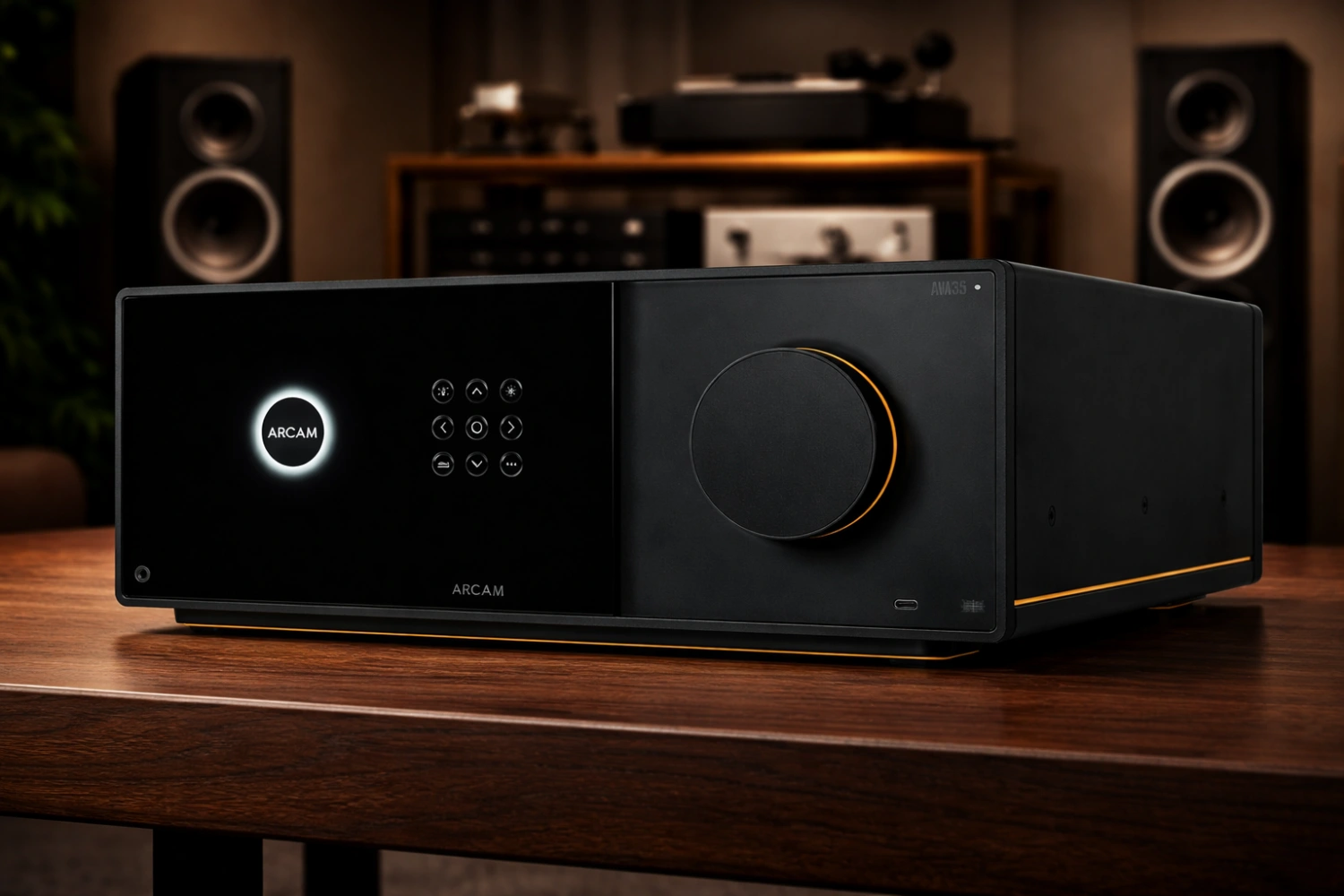
2. Arcam AVA35: Flagship Class G AV Receiver with Dirac Live, 16-Channel Processing & 8K HDMI
The Arcam AVA35 leads the Radia AV receiver range with Class G amplification and 16-channel processing.
Positioned at the top of Arcam's Radia AV receiver range, the AVA35 combines nine channels of Class G amplification with 16-channel processing.
Its amplifier section is rated at 100 watts per channel into 8 ohms across all nine channels, while the ESS Hyperstream IV DAC Pro platform handles digital conversion.
Matrix channel assignment adds system flexibility, and the source identifies Dirac Live and 8K HDMI among the receiver's defining features. It is aimed at buyers who want substantial processing and amplification in one chassis rather than a basic surround hub.
Best for: Flexible flagship-level systems
- Nine-channel Class G amplification
- Sixteen-channel processing
- Matrix channel assignment
- Dirac Live room correction
Verdict: Arcam's AVA35 stands out for pairing nine amplified channels with 16-channel processing and unusually flexible channel assignment.

3. Arcam AVR20: AV receiver equipped with a powerful toroidal transformer
The Arcam AVR20 provides seven amplified channels and can support a larger 7.1.4 layout with external amplification.
The Arcam AVR20 is a seven-channel receiver rated at 7 x 90 watts into 8 ohms and built around a toroidal transformer.
It can run a 5.1.2 Dolby Atmos layout from its internal amplification or form the basis of a 7.1.4 system when supplemented by four channels of external power amplification.
Its format support includes Dolby TrueHD, Dolby Atmos, DTS-HD Master Audio, DTS:X and IMAX Enhanced. Full 16-channel Dirac calibration, AirPlay 2 and Chromecast make it relevant to buyers who value room correction and streaming as much as raw channel count.
Best for: Expandable 5.1.2 or 7.1.4 systems
- Full 16-channel Dirac calibration
- Expandable to 7.1.4 with external amplification
- AirPlay 2 and Chromecast streaming
- Dolby Atmos, DTS:X and IMAX Enhanced support
Verdict: The AVR20 is a considered choice for a seven-channel installation that may later grow through external power amplifiers.

4. Denon DP-300F: Vinyl player made in an elegant, laconic style
The Denon DP-300F is a fully automatic turntable that can serve as a vinyl source in a home audio system.
The Denon DP-300F is a fully automatic turntable, not an AV receiver.
Once configured, it can place the stylus at the beginning of a record and return the tonearm after playback, with controls for 12-inch and 7-inch records.
Its rigid plastic enclosure has 4 mm walls, anti-vibration feet and a dust cover. It belongs in this guide only as a possible vinyl source for a compatible receiver or amplifier.
Best for: Convenient vinyl playback within a wider system
- Fully automatic operation
- Automatic tonearm return
- Anti-vibration feet
- Protective dust cover
Verdict: Choose the DP-300F as an automatic record player, not as a substitute for an AV receiver.

5. Samsung HW-Q900A: Soundbar with an impressive 11.1.4 multi-channel system
The headline identifies a Samsung HW-Q900A soundbar, although the supplied article body discusses the different HW-Q950A model.
This entry cannot support a firm recommendation for the Samsung HW-Q900A because the supplied headline names the HW-Q900A while the article text describes the HW-Q950A.
The latter is presented as an 11.1.4-channel package comprising a soundbar, subwoofer and two rear speakers, but those details should not automatically be attributed to the differently named headline model.
In either case, a soundbar system is a compact alternative to a receiver and separate passive speakers rather than an AV receiver itself.
Best for: Buyers investigating a compact receiver alternative
Verdict: The model-name conflict must be resolved before using the supplied 11.1.4-channel claims to evaluate the HW-Q900A.

6. Audio-Technica AT-LP120XBT: Upgraded turntable with wireless technology
The Audio-Technica AT-LP120XBT is a direct-drive turntable with Bluetooth, USB and a switchable phono stage.
The Audio-Technica AT-LP120XBT is another source component rather than a receiver.
This direct-drive turntable supports 33, 45 and 78 rpm playback and includes quartz speed stabilization, adjustable anti-skating and an S-shaped tonearm with adjustable tracking force.
Its switchable phono stage permits connection to either a line-level input or a dedicated phono input on a stereo amplifier or AV receiver. Bluetooth with aptX and a USB connection for digitizing records broaden its role beyond a conventional wired turntable.
Best for: Adding versatile vinyl playback to an AV system
- Switchable built-in phono stage
- Bluetooth with aptX
- USB output for record digitization
- Three playback speeds
Verdict: The AT-LP120XBT is a flexible turntable source for receivers with either line-level or phono connectivity.

7. Cambridge Audio MINX MIN22: Powerful compact designer speakers
The Cambridge Audio MINX MIN22 is a miniature speaker constructed with damped thermopolymer and extruded aluminum.
The Cambridge Audio MINX MIN22 is a compact speaker, so it requires amplification and cannot perform the switching, decoding or calibration duties of an AV receiver.
The supplied material emphasizes its miniature dimensions and construction from acoustically damped thermopolymer and extruded aluminum.
It may suit installations where discreet speaker placement is important, but the source does not provide the impedance, sensitivity or power-handling information needed to judge receiver matching in detail.
Best for: Space-conscious speaker installations
- Compact enclosure
- Acoustically damped thermopolymer construction
- Extruded-aluminum elements
Verdict: The MINX MIN22 is a compact speaker option, but receiver compatibility should be checked using specifications not included in the source.

8. JBL Launches MA Line of Five AV Receivers
JBL's five-model MA receiver family ranges from the 5.2-channel MA310 to the 9.2-channel MA9100HP.
JBL's MA range covers five AV receivers rather than one specific model, beginning with the 5.2-channel MA310 and extending to the 9.2-channel MA9100HP.
Shared features include Class D amplification, Dolby and DTS decoding, 24-bit/192 kHz digital-to-analog conversion and a broad selection of inputs for stereo and multichannel sources.
JBL's free EZ Set EQ app provides guided room equalization using an iOS or Android device. The MA7100HP and MA9100HP additionally support Dirac Live, although a license must be purchased.
Best for: Choosing a receiver tier to match system size
- Range spans 5.2 to 9.2 channels
- Class D amplification throughout the line
- Free EZ Set EQ app
- Optional Dirac Live on the two upper models
Verdict: The JBL MA family offers a clear progression from modest 5.2-channel systems to 9.2-channel theaters, with more advanced calibration reserved for its upper models.

9. Sony STR-DN1080: AV Receiver perfect for any home theater
The Sony STR-DN1080 supports 5.1.2 Dolby Atmos or 7.1-channel playback and provides six HDMI inputs.
The Sony STR-DN1080 can be configured as either a 5.1.2 Dolby Atmos system or a conventional 7.1-channel system, with DTS:X also supported.
Six HDMI inputs provide more source capacity than the four-input competitors cited in the supplied article, while two HDMI outputs can route 4K video and surround sound to two areas.
Network features include Chromecast, UPnP and Spotify Connect, alongside Bluetooth, Wi-Fi and Ethernet. Optical and coaxial inputs are available, although the source characterizes the remaining connection selection as relatively modest.
Best for: Streaming-focused 5.1.2 systems with several HDMI sources
- 5.1.2 or 7.1-channel configuration
- Six HDMI inputs
- Two HDMI outputs
- Chromecast, UPnP and Spotify Connect
Verdict: The STR-DN1080 combines useful HDMI capacity with broad streaming support for a relatively compact Atmos installation.

10. Zidoo unveils Z3000 PRO media player with 8k support
The Zidoo Z3000 PRO is a media player with dual HDMI outputs and a concealed hard-drive bay.
The Zidoo Z3000 PRO is a media player rather than an AV receiver.
Its dual HDMI outputs can separate audio and video, allowing 4K video and HD audio to be routed independently without necessarily replacing an existing receiver.
The player uses an Amlogic S928X-K processor with 8 GB of DDR4 memory and 64 GB of integrated eMMC storage, while a concealed drive bay accepts storage up to 16 TB. HDMI 2.1 output supports 8K at 60 Hz, and listed HDR compatibility includes HDR10, HLG, HDR10+ and Dolby Vision.
Best for: Local media playback alongside an existing receiver
- Separate HDMI outputs for audio and video
- Concealed drive bay supporting up to 16 TB
- 8K at 60 Hz output
- HDR10, HDR10+, HLG and Dolby Vision support
Verdict: The Z3000 PRO is a capable source for a home theater, particularly when separate audio and video HDMI paths are required, but it does not replace a receiver's amplification.
Frequently asked questions
How many receiver channels do I need for Dolby Atmos?
A 5.1.2 system needs seven amplified channels, as illustrated by the Arcam AVR20 and Sony STR-DN1080.
Larger layouts may require more internal channels or external power amplifiers; the AVR20, for example, needs added amplification to expand to 7.1.4.
Is room correction included with every AV receiver?
No.
The Denon AVC-A10H includes Audyssey MultEQ XT32, while its Dirac functions require a license.
JBL provides EZ Set EQ across the MA range, but Dirac Live is a licensed option limited to the MA7100HP and MA9100HP in the supplied material.
Should receiver power ratings be compared directly?
Only when the ratings use comparable loads, channel counts and test conditions.
Also consider speaker requirements, room size, listening distance and whether external amplification will be needed; a larger wattage figure alone does not determine system suitability.
Can a soundbar, turntable or media player replace an AV receiver?
A soundbar can replace a receiver-based system when it contains its own amplification and processing.
Turntables and media players are sources that connect to a receiver or amplifier, while passive compact speakers such as the Cambridge Audio MINX MIN22 still require amplification.
How to Choose the Right AV Receiver and Avoid the Wrong Category
Begin with the speaker layout you intend to build rather than the largest channel count available.
Seven amplified channels are sufficient for 5.1.2 Atmos, while layouts such as 7.1.4 require eleven amplified channels in total.
A receiver with extra processing can still support that expansion if suitable external power amplifiers are added, as demonstrated by the Arcam AVR20. Next, count every HDMI source and display, then examine room correction and subwoofer support. The Denon AVC-A10H is particularly relevant to installations using several subwoofers, while the Arcam models emphasize Dirac-based calibration and system expansion. JBL's MA range offers multiple channel tiers, and the Sony STR-DN1080 is notable for six HDMI inputs, two HDMI outputs and integrated streaming options. Check whether advanced calibration software is included or requires a separate license before deciding. Finally, distinguish the receiver from the equipment around it. Turntables and media players are sources, passive speakers require amplification, and a soundbar is an alternative system architecture. Confirm speaker compatibility, connection requirements and the exact product designation before purchase, especially where source material contains a model-name conflict. The right receiver is the one that supports the planned layout and sources without forcing unnecessary complexity or leaving no sensible route for expansion.



Sound Off
0Join the discussion if you have something to add.