
A convincing home cinema system is not built from one kind of component.
The center speaker anchors dialogue, the AV receiver coordinates decoding and switching, the projector or display source determines how much of the picture reaches the room, and disc playback still matters for collections built around Blu-ray, SACD, DVD, or high-resolution files.
This selection brings together notable Home Cinema products from the supplied Stereoindex source material: center-channel loudspeakers, AV receivers, Blu-ray players, a laser projector, and an integrated Blu-ray receiver. The emphasis is on practical system roles rather than ranking by price or size, because the strongest choice depends on whether the room needs immersive decoding, flexible HDMI handling, physical-disc versatility, projection brightness, or a stronger dialogue channel. Where the source material states a limitation, it is kept in view. Some products focus on straightforward 5.2-channel surround rather than Dolby Atmos; one universal player does not read 4K-UHD Blu-ray discs; other models are defined by gaming-friendly video support, room calibration, or broad disc and file compatibility. The result is an editorial guide intended to help match the component to the job it is actually described as doing.

1. DALI RUBIKORE CINEMA
DALI RUBIKORE CINEMA center speaker designed for dialogue, effects, and flexible front-channel placement.
The DALI RUBIKORE CINEMA is presented as the central speaker in the RUBIKORE series, with a brief that squarely addresses dialogue, film effects, and front-channel duties in a home cinema.
Its two 6.5-inch SMC Clarity Cone bass/midrange units are described as delivering deep, dynamic bass while integrating with the treble, and DALI’s double hybrid tweeter is singled out for resolution and wide horizontal dispersion.
A particularly useful installation detail is the hybrid tweeter module’s ability to rotate 90 degrees, helping the ribbon tweeter perform properly when the speaker is used horizontally beneath a screen or TV.
Best for: A serious front soundstage with strong center-channel focus
- Designed for dialogue and film effects
- Two 6.5-inch SMC Clarity Cone bass/midrange units
- Rotatable hybrid tweeter module
- Wide horizontal dispersion
Verdict: Choose the RUBIKORE CINEMA when the priority is a purpose-built center speaker that can also serve across the front channels in a RUBIKORE-based cinema system.

2. Denon AVR-580BT
Denon AVR-580BT AV receiver with 5.2-channel surround and HDMI switching for 8K and Dolby Vision sources.
The Denon AVR-580BT is positioned as a more accessible route into multi-channel AV sound, aimed at users who want a straightforward surround system rather than a soundbar.
It provides 5.2-channel surround and supports 8K video switching and Dolby Vision through its HDMI section, with four HDMI inputs and one output.
The source is clear about its boundary: this is not a Dolby Atmos receiver, and it does not offer multi-channel processor outputs, but it does decode Dolby TrueHD and DTS-HD formats and supports ARC and eARC for simpler TV audio integration.
Best for: Straightforward surround systems without Dolby Atmos
- 5.2-channel surround sound
- 8K video switching support
- Dolby Vision support
- ARC and eARC over HDMI
Verdict: The AVR-580BT is a sensible AV receiver for buyers who want proper 5.2-channel surround and current HDMI video support without stepping into Atmos complexity.
3. Optoma UHZ78LV
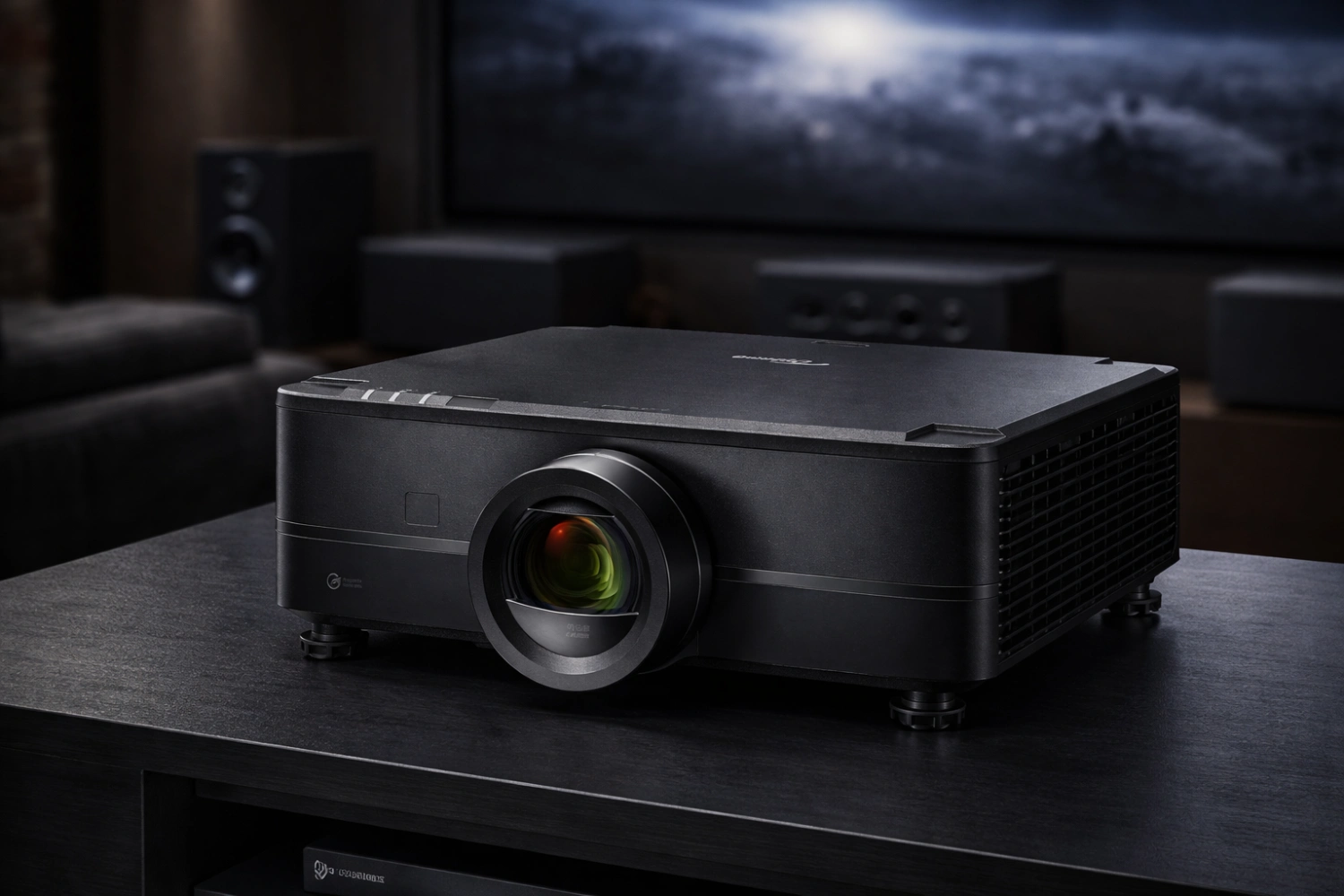
Optoma UHZ78LV 4K laser projector specified with 5,000-lumen peak brightness and Dolby Vision support.
The Optoma UHZ78LV is the visual centerpiece in this selection: a 4K laser projector described with a peak brightness of 5,000 lumens and support for both Dolby Vision and HDR10+.
Optoma positions it for larger projection screens, and the source specifies a 3RGB laser design with claimed 98% DCI-P3 color accuracy.
Installation flexibility is also part of the appeal, with front, rear, and ceiling mounting listed, while the laser system is described as offering up to 30,000 hours of viewing.
Best for: Large-screen projection systems that need high brightness
- 5,000-lumen peak brightness
- Dolby Vision and HDR10+ support
- Claimed 98% DCI-P3 color accuracy
- Front, rear, or ceiling mounting
Verdict: The UHZ78LV stands out for rooms where 4K projection, HDR format support, and very high stated brightness are central requirements.

4. McIntosh MVP901
McIntosh MVP901 universal audio and video player for Blu-ray, DVD, CD, SACD, and file playback.
The McIntosh MVP901 is described as a universal audio and video source for disc-based systems, covering Blu-ray, DVD, CD, SACD, and multiple related disc variations.
Its file support is broad, including MP3, WMA, AAC, FLAC, ALAC, AIFF, LPCM, and DSD, with Hi-Res audio stated up to 24-bit/192 kHz and DSD128.
The source also makes an important distinction: the MVP901 does not read 4K-UHD Blu-ray discs, though it can upscale compatible formats to that standard. For system integration, it offers balanced XLR and unbalanced RCA stereo outputs, with optical, coaxial, and HDMI outputs available for multi-channel use through an AV processor.
Best for: Disc-heavy systems needing a broad universal source
- Plays Blu-ray, DVD, CD, and SACD
- Supports several audio file formats including FLAC, ALAC, AIFF, LPCM, and DSD
- Balanced XLR and RCA stereo outputs
- Upscales compatible formats toward 4K-UHD output
Verdict: The MVP901 is best understood as a high-grade universal disc and media player for Blu-ray and music collections, with the caveat that it is not a 4K-UHD Blu-ray reader.

5. Yamaha HTR-3072
Yamaha HTR-3072 AV receiver front panel with display, USB input, AUX connection, headphone output, and YPAO microphone input.
The Yamaha HTR-3072 is covered in the source primarily through its practical receiver layout and front-panel usability.
It follows the visual approach of Yamaha’s budget RX-V line, with a large display, auxiliary function buttons, headphone output, a microphone input for the YPAO auto-calibration system, and a large volume knob.
Front connectivity includes USB for a flash drive or external hard drive with audio files, plus an analog AUX mini-jack for mobile devices. The description points to a receiver that keeps common everyday controls and setup connections visible rather than hidden behind a door.
Best for: Users who value accessible setup and front-panel connections
- YPAO microphone input on the front panel
- USB input for audio files on storage devices
- Analog AUX mini-jack for mobile gadgets
- Front headphone output
Verdict: The HTR-3072 is the practical pick here when easy physical access to calibration, USB playback, AUX input, and headphone listening matters most.

6. Marantz SR7015
Marantz SR7015 9.2-channel IMAX Enhanced AV receiver with immersive audio decoding and advanced video support.
The Marantz SR7015 is one of the most fully specified AV receivers in the supplied material.
It is a 9.2-channel model with IMAX Enhanced certification, support for DTS:X and Dolby Atmos up to a 7.1.4-channel configuration with an added stereo driver, plus Auro-3D and DTS Virtual:X.
Its video section supports 8K at 60 Hz, 8K upscaling, 4K at 120 Hz, and HDR formats including HDR10+, Dolby Vision, Dynamic HDR, HLG, and HDR10. On the audio side, the source cites HDAM amplification modules, current feedback, 125 W per channel into 8 ohms, a 32-bit AK4458 DAC, network and USB Hi-Res playback including DSD 2.8/5.6 MHz, and Audyssey MultEQ XT32 calibration.
Best for: Ambitious immersive cinema systems with advanced video needs
- 9.2-channel AV receiver
- IMAX Enhanced certification
- Dolby Atmos, DTS:X, Auro-3D, and DTS Virtual:X support
- Audyssey MultEQ XT32 calibration
Verdict: The SR7015 is the most expansive receiver choice in this guide for systems that need broad immersive-audio format support, advanced video pass-through, and serious room calibration.
7. JBL MA510
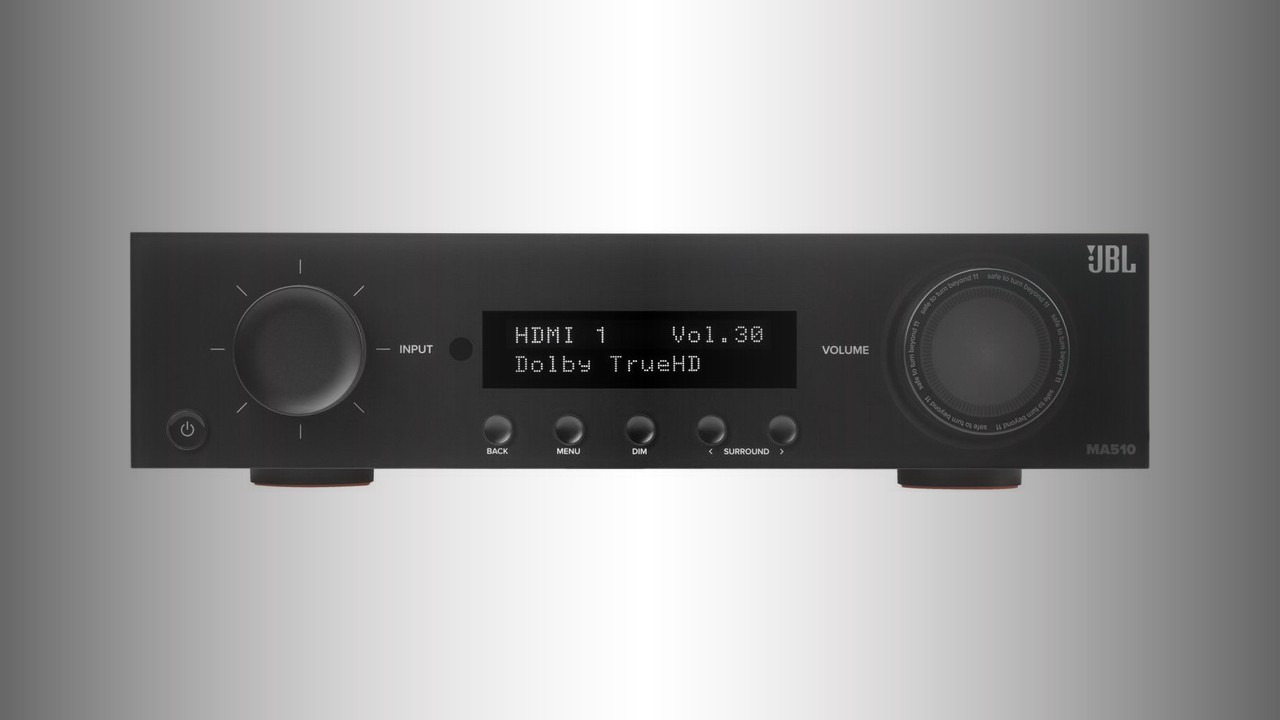
JBL MA510 AV receiver designed around 5.2-channel sound, 8K HDMI inputs, eARC, and gaming-friendly video features.
The JBL MA510 is framed as a hub for video and gaming as much as for surround sound.
It offers 5.2 channels and four dedicated HDMI inputs compatible with 8K resolution, while HDMI 2.1 support brings 4K/120Hz, VRR, and Auto Low Latency Mode into the picture for game consoles.
HDMI eARC is included for returning uncompressed audio from a TV to the receiver, which is useful for Smart TV apps and services. Wireless playback is also part of the package, with Bluetooth and Wi-Fi listed in the source.
Best for: Gaming-focused living-room cinema systems
- 5.2-channel receiver design
- Four HDMI inputs compatible with 8K
- 4K/120Hz, VRR, and ALLM support
- Bluetooth and Wi-Fi built in
Verdict: The MA510 is a strong match for users who want 5.2-channel surround with HDMI features aimed at current TVs, consoles, and Smart TV audio return.

8. Denon AVR-X1800H
Denon AVR-X1800H 7.2-channel AV receiver with Dolby Atmos, DTS:X, Audyssey MultEQ XT, and six HDMI inputs.
The Denon AVR-X1800H is described as a fully equipped 7.2-channel AV receiver with seven built-in power amplifiers and decoding for Dolby Atmos and DTS:X.
It can be used as the basis for a 5.2.2-channel surround system, while DTS Virtual:X and virtual height-channel processing are noted for systems without dedicated height speakers.
Audyssey MultEQ XT is included for room calibration using the supplied measurement microphone. HDMI connectivity is also well specified in the source, with six HDMI inputs, one output, HDCP 2.3 support, video transmission up to 8K, and an upscaling function.
Best for: Mainstream Atmos-ready home cinema builds
- 7.2-channel configuration
- Dolby Atmos and DTS:X decoding
- Audyssey MultEQ XT calibration
- Six HDMI inputs with up to 8K video support
Verdict: The AVR-X1800H is a well-rounded receiver for building a 5.2.2-channel immersive system while retaining useful calibration and modern HDMI support.

9. OPPO UDP-203
OPPO UDP-203 Blu-ray player with dual HDMI outputs, HDMI input, Dolby Vision support, and AK4458VN DAC.
The OPPO UDP-203 is presented as a carefully designed Blu-ray player built around the MediaTek OP8591 chipset, with decoding for 4K video, HDR10, and Dolby Vision.
Its connection strategy is notable: two HDMI outputs are provided, one HDMI 2.0a universal output and one HDMI 1.4 output, with the stated aim of avoiding unwanted changes from third-party video switching.
The source also describes an HDMI input for other sources such as game consoles or Smart TV dongles, with 12-bit 4K video passing through. Audio is given weight too, with an Asahi Kasei AK4458VN DAC and the option to feed analog signals to separate power amplifiers.
Best for: Blu-ray systems that need careful HDMI routing and strong audio output options
- Decodes 4K video with HDR10 and Dolby Vision
- Dual HDMI outputs
- HDMI input for external sources
- Asahi Kasei AK4458VN DAC
Verdict: The UDP-203 remains the source-material choice for users who want a Blu-ray player with Dolby Vision, flexible HDMI handling, and credible analog-audio provision.

10. Harman/Kardon BDS 580
Harman/Kardon BDS 580 Blu-ray receiver with slot-loading disc drive, EzSet/EQ III calibration, and app control.
The Harman/Kardon BDS 580 is an integrated Blu-ray receiver, combining disc playback, receiver functions, calibration, and app-based control in one unit.
The source describes a slot-loading disc mechanism that reads broadly relevant formats including Blu-ray 3D, with BD-Live support.
Its Dolby volume technology is said to maintain a constant level across entertainment and lift quiet dialogue, while Harman’s EzSet/EQ III automatic calibration adjusts volume levels, tuning, and equalization for the speaker system and room. Front convenience features include a calibration microphone input combined with a 3.5 mm headphone jack and a USB port compatible with Apple devices, with control also available through iOS and Android apps.
Best for: Compact systems built around an all-in-one Blu-ray receiver
- Integrated Blu-ray receiver design
- Blu-ray 3D and BD-Live support
- EzSet/EQ III automatic calibration
- iOS and Android app control
Verdict: The BDS 580 is the most integrated option in this group, suited to rooms where disc playback, receiver duties, calibration, and control are best kept in a single component.
How to Choose the Right Home Cinema Component
Start with the role your system is missing.
If dialogue clarity and front-stage consistency are the weak points, a dedicated center-channel solution such as the DALI RUBIKORE CINEMA is the relevant upgrade.
If the room still relies on TV speakers or a soundbar but you want discrete surround, the Denon AVR-580BT and JBL MA510 point toward simpler 5.2-channel systems, with the JBL adding stronger emphasis on gaming-oriented HDMI features. For a more immersive speaker layout, the Denon AVR-X1800H introduces 7.2-channel flexibility and a 5.2.2 Dolby Atmos or DTS:X path, while the Marantz SR7015 is the more ambitious receiver choice where 9.2 channels, IMAX Enhanced certification, multiple immersive formats, and more advanced calibration matter. For picture-first rooms, separate the display question from the receiver question. The Optoma UHZ78LV is the projector-oriented selection here, with its stated 5,000-lumen peak brightness, 4K laser design, Dolby Vision, HDR10+, and flexible mounting options making it the most relevant candidate for a larger projected image. If the display is already in place and the source chain is the priority, the OPPO UDP-203 and McIntosh MVP901 serve different disc-based needs: the OPPO emphasizes 4K, HDR10, Dolby Vision, dual HDMI output strategy, and HDMI input flexibility, while the McIntosh focuses on broad disc and audio-file compatibility, SACD support, analog stereo outputs, and universal-source duties, with the clear limitation that it does not read 4K-UHD Blu-ray discs. Convenience also matters. Yamaha’s HTR-3072 is notable in the source for accessible front-panel setup and playback connections, including YPAO microphone input, USB, AUX, and headphone output. The Harman/Kardon BDS 580 takes another route by combining Blu-ray receiver functions, Dolby volume leveling, automatic calibration, and app control in a single unit. In short, choose the component that solves the system problem you can actually identify: decoding and amplification, HDMI switching, room calibration, projection brightness, disc compatibility, or center-channel authority.



Sound Off
0Join the discussion if you have something to add.