
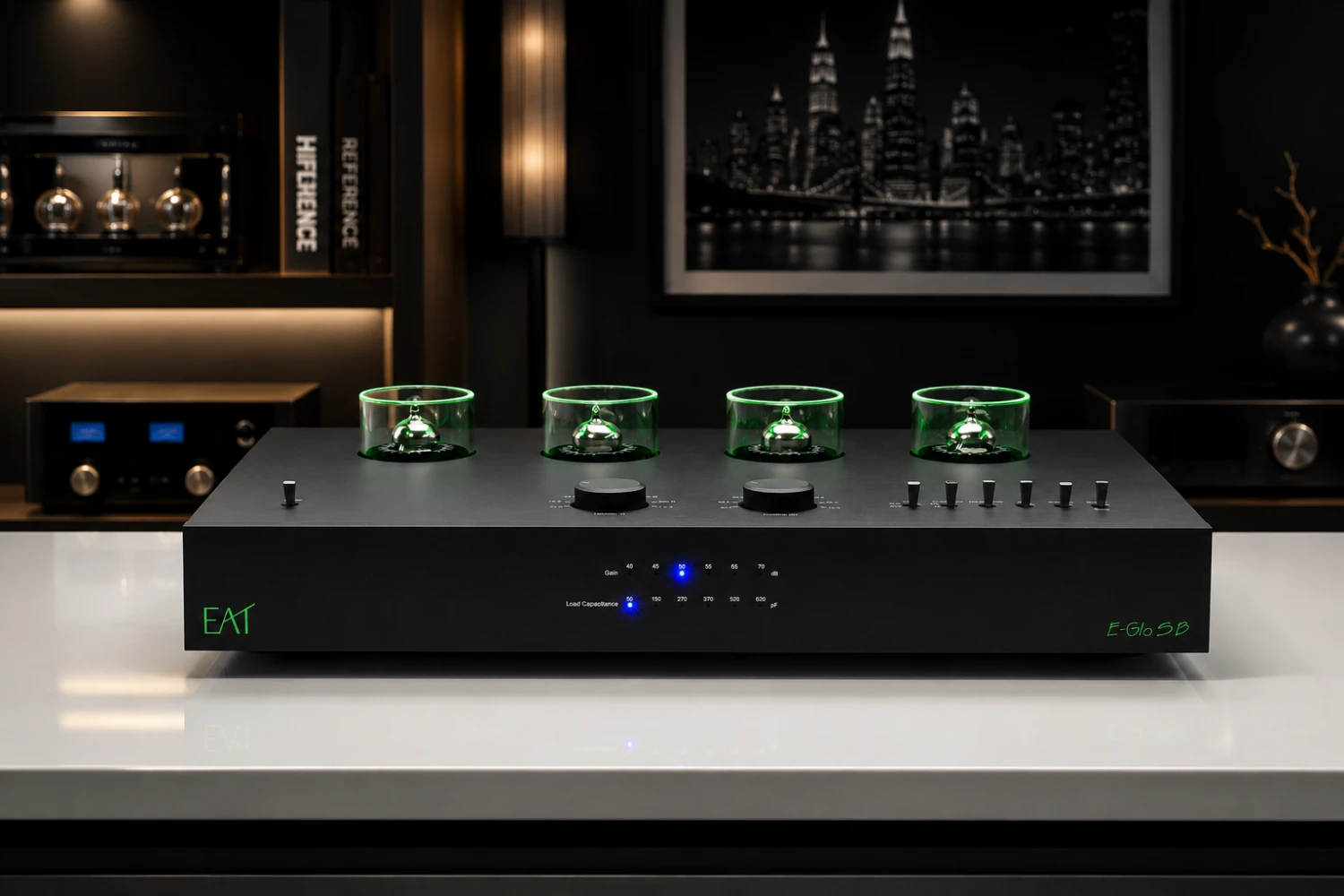
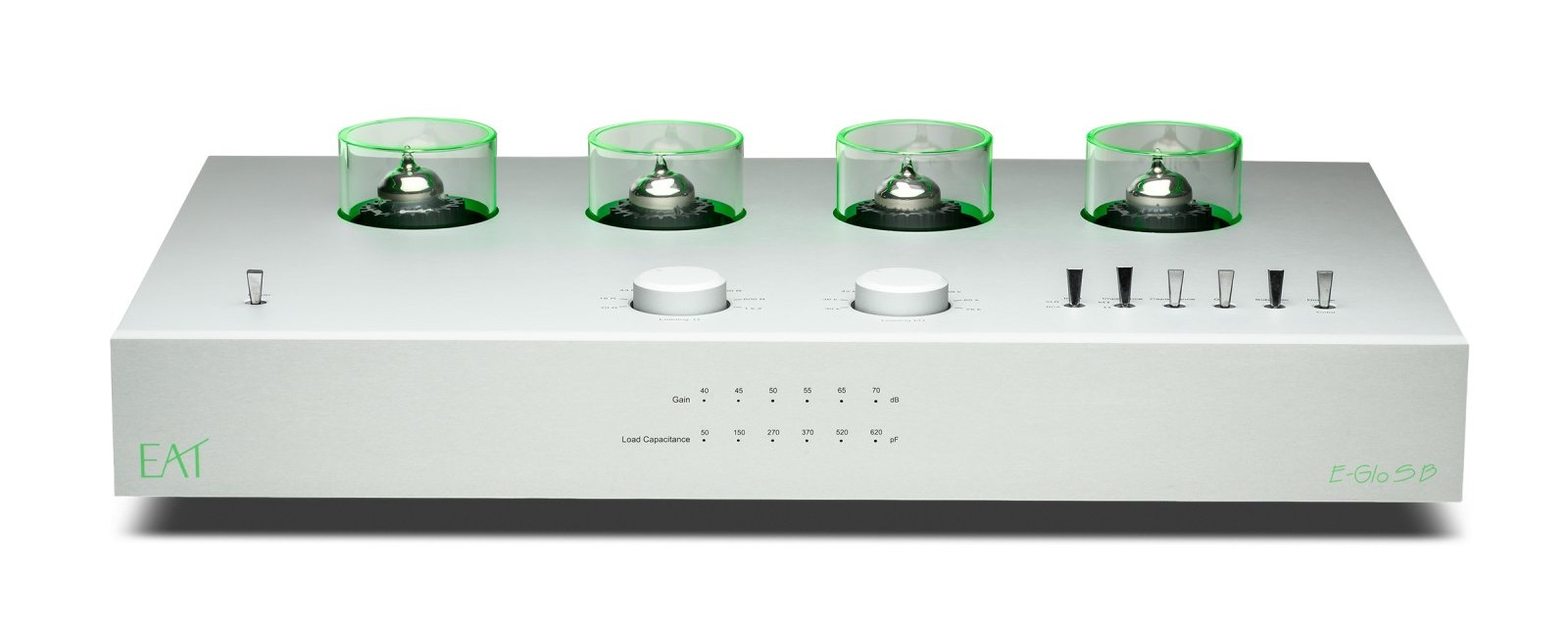
European Audio Team has introduced the E-Glo CB and E-Glo SB phono preamplifiers, positioning the two models between the compact Petit B and flagship E-Glo FB. Both combine discrete circuitry, tube-based amplification and extensive cartridge-matching controls, but differ in how they handle the signal through their second amplification stage.
Three-stage architecture with split RIAA equalization
The E-Glo CB and E-Glo SB employ three amplification stages built from discrete components rather than integrated operational amplifiers. EAT divides RIAA equalization between passive and active sections, while dedicated DC servo circuits are used to minimize offset at the outputs.
In the first stage, three separate semiconductor amplifier circuits perform distinct tasks. Individual circuits process the positive and negative phases, while a third sums the two signals to help suppress common-mode noise. The high-frequency portion of the RIAA equalization curve is also applied at this point in the circuit.
Both phono stages include a switchable 20 Hz subsonic filter with an 18 dB-per-octave slope. This can reduce very-low-frequency energy associated with warped records, turntable suspension movement or other signals below the intended musical content. EAT specifies RIAA accuracy within 0.5 dB from 20 Hz to 20 kHz.
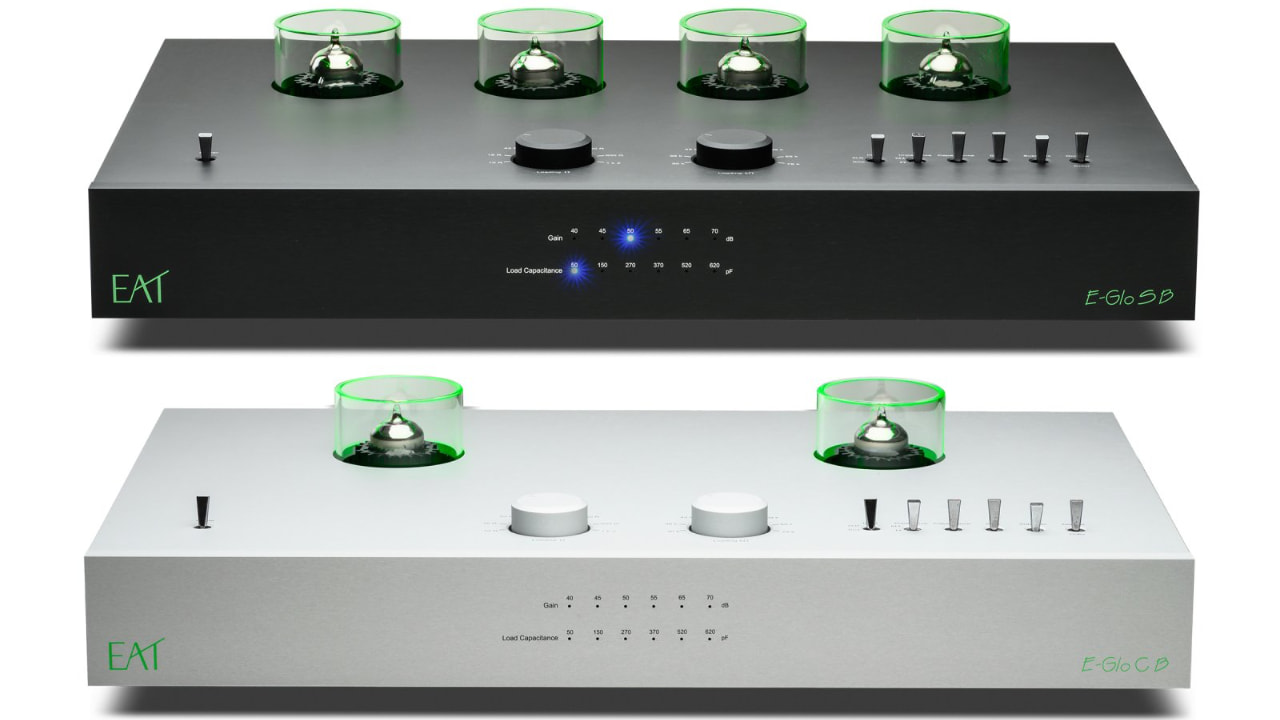
Different tube circuits separate the CB and SB
The principal distinction between the two models lies in the second amplification stage. The E-Glo CB uses a hybrid single-ended tube and transistor circuit comprising two ECC83S triodes and one transistor. This stage handles the low-frequency section of RIAA equalization and incorporates the switchable subsonic filter.
The E-Glo SB moves closer to the architecture of the flagship E-Glo FB. Its second stage is a symmetrical tube design using two ECC83S and two E88CC triodes. EAT also specifies semi-crystalline hydrocarbon polypropylene capacitors for the SB’s amplification and RIAA networks.
This difference affects the signal path as well as the tube complement. The SB preserves balanced operation through its second amplification stage. In the CB, the signal becomes unbalanced before the output stage generates the balanced output signal. The CB therefore provides a balanced moving-coil input, common-mode noise suppression and balanced output, but it is not a fully differential design from cartridge input to output.
Cartridge loading and six gain settings
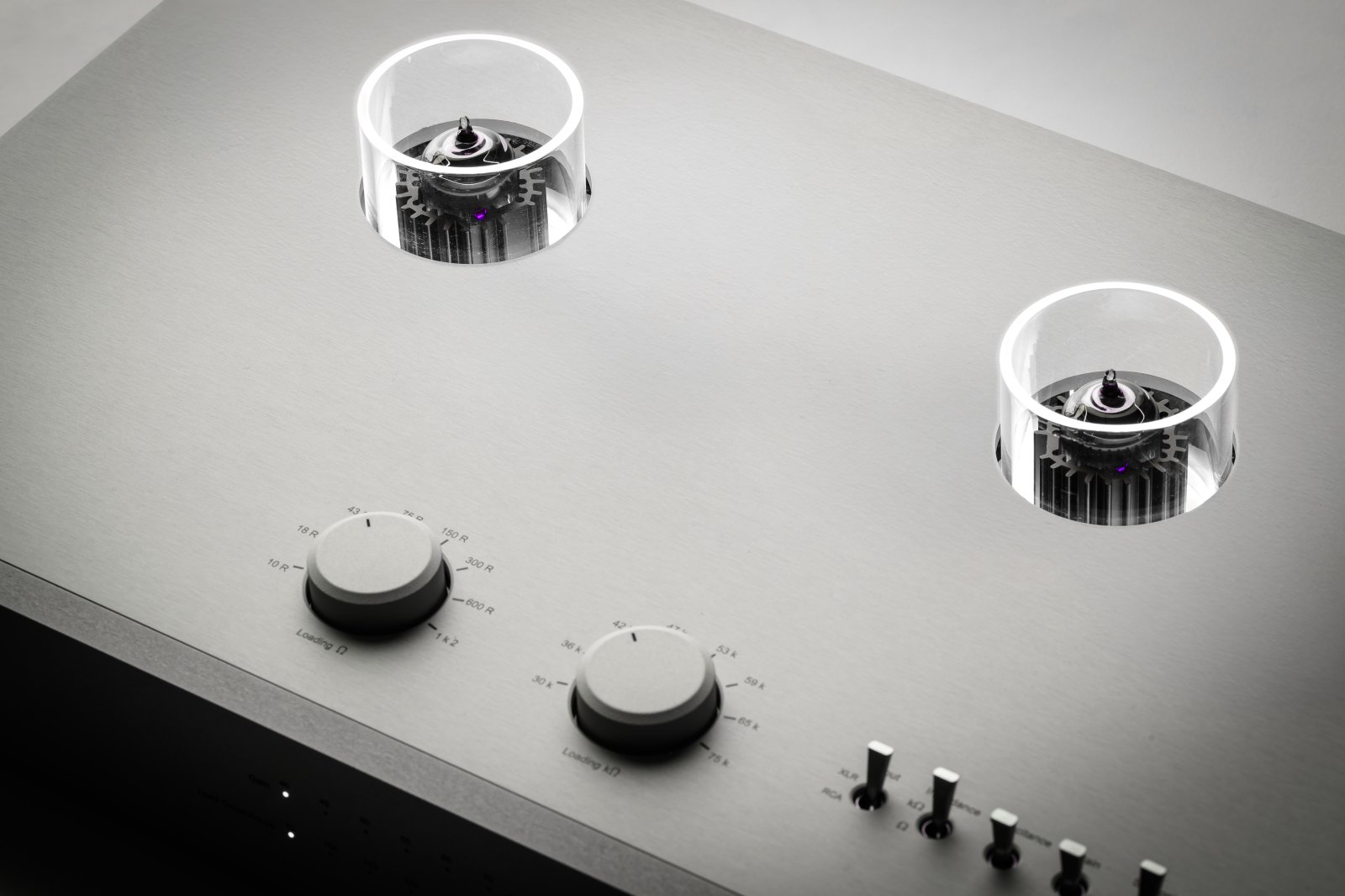
Both models are designed to accommodate a broad selection of moving-magnet and moving-coil cartridges. Moving-magnet resistance can be set between 30 kilohms and 75 kilohms, with capacitance choices spanning 50 pF to 620 pF. Moving-coil loading options extend from 10 ohms to 1.2 kilohms.
Users can select from six gain levels: 40, 45, 50, 55, 65 or 70 dB. According to EAT’s specifications, using the balanced XLR outputs adds a further 6 dB of gain. This combination of loading and gain adjustment allows each phono stage to be configured around cartridges with substantially different electrical requirements.
Balanced MC input and simultaneous outputs
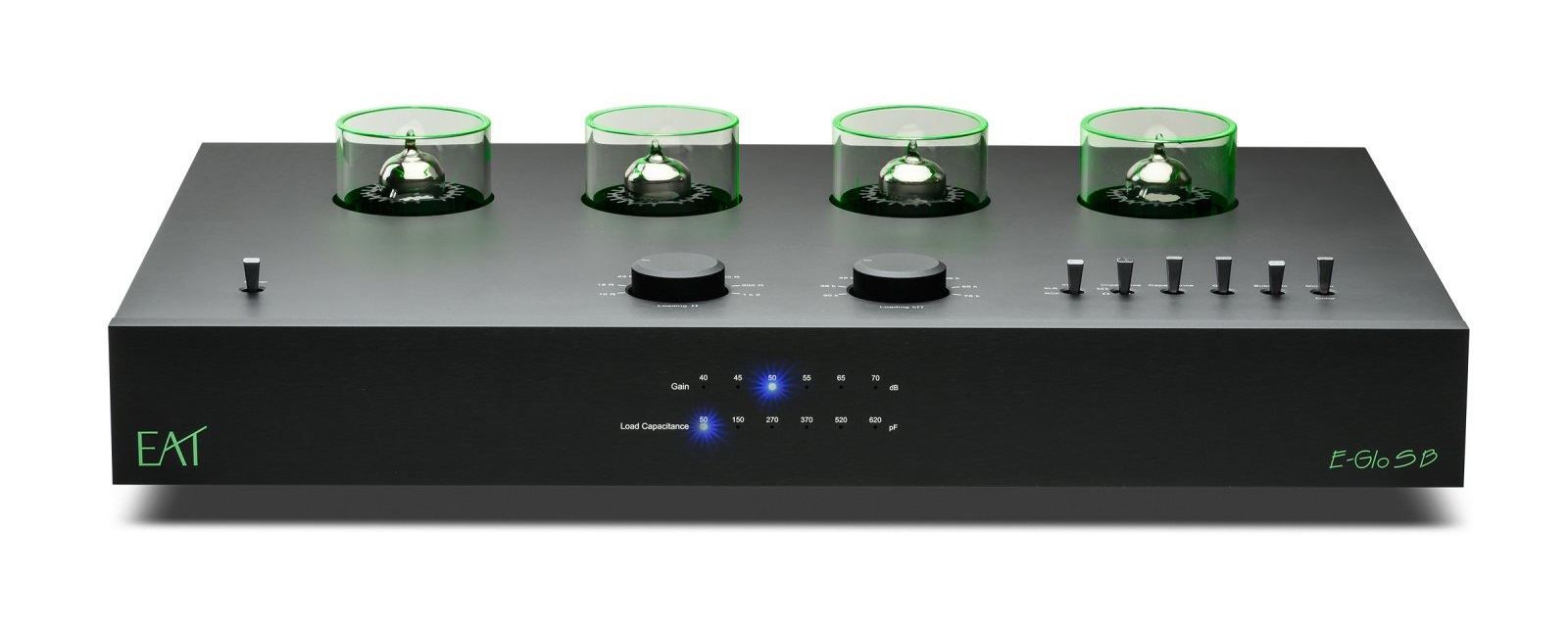
Balanced XLR inputs are reserved for moving-coil cartridges, whose low output makes common-mode noise rejection particularly useful. The RCA inputs accept both moving-magnet and moving-coil designs. Although a phono cartridge is inherently a balanced signal source, the internal wiring of many moving-magnet cartridges does not provide access to a complete differential signal, which is why the XLR input is not intended for balanced moving-magnet models.
Balanced XLR and unbalanced RCA outputs can be used simultaneously. This provides flexibility for systems that need to feed more than one compatible component or connection path without changing cables.
External power supply and availability
Each phono preamplifier measures 395 x 86 x 262 millimeters and uses an external 18-volt power supply. Moving the transformer outside the main chassis keeps it away from the sensitive electronics responsible for amplifying cartridge signals measured in fractions of a millivolt.
Pricing and regional availability have not yet been announced. The E-Glo CB and E-Glo SB join EAT’s range as intermediate options for listeners seeking more adjustment and circuit sophistication than the Petit B without moving directly to the E-Glo FB.
With common adjustment options but clearly differentiated internal architectures, the E-Glo CB and E-Glo SB give EAT two distinct routes into its upper-tier phono preamplifier range. The CB uses a hybrid single-ended stage, while the SB adds a symmetrical tube circuit that more closely follows the flagship design.


Sound Off
0Join the discussion if you have something to add.