
Five DACs Compared: Which One Is Right for Your System?
These five products are not interchangeable: one is a portable headphone DAC, one is a digital bridge, and the others target desktop or high-end systems. Here is how they compare and which one makes the most sense for your setup.

Choosing between these five digital-audio products is less about finding a single winner on a specification sheet and more about identifying the right kind of component. The Gustard R26 II and SPEC RMP-DAC3X are serious standalone DACs, the Shanling EH2 combines a DAC with a headphone amplifier, the Snowsky Retro Nano is a pocket Bluetooth and USB DAC, and the Schiit Eitr 2 is a USB-to-digital bridge rather than a DAC at all.
That distinction matters because each product solves a different problem. The Shanling EH2 is the strongest all-round purchase for a desktop listener who wants one flexible box with R2R conversion, headphone drive and multiple inputs. The others become more compelling when your priority is network streaming, tonal focus, portability, or improving an existing DAC-based system.
Quick verdict
- Best Overall: Shanling EH2 — the most complete desktop solution, combining a 24-bit R2R DAC, powerful headphone outputs, Bluetooth, USB-C, coaxial, optical and RCA line-out.
- Best for network audio: Gustard R26 II — the choice for listeners who want a dedicated network-ready DAC built around a discrete R2R ladder and extensive streaming support.
- Best for high-end tonal focus: SPEC RMP-DAC3X — a dual-case Japanese DAC with a strong emphasis on instrument timbre, component selection and headphone listening.
- Best portable DAC: Snowsky Retro Nano — a 28-gram Bluetooth and USB DAC/headphone amplifier with 3.5mm and 4.4mm outputs, priced at $60 in the source article.
- Best digital-source upgrade: Schiit Eitr 2 — a compact DDC for cleaning up USB audio before it reaches an existing DAC, with an optional smartphone-controlled preamp module.
| Product | What it is | Core strengths | Best suited to |
|---|---|---|---|
| Gustard R26 II | Network-ready standalone DAC | Discrete 26-bit R2R, native DSD, extensive network support, RCA and XLR | A serious streamer-DAC system |
| SPEC RMP-DAC3X | High-end DAC with external power supply | Focus on timbre, dual headphone sockets, volume control, RCA and XLR | A purist system centred on musical tonality |
| Snowsky Retro Nano | Portable Bluetooth/USB DAC and headphone amplifier | 28g, LDAC and aptX HD, 3.5mm and 4.4mm outputs, replaceable battery | Phones, tablets and laptops on the move |
| Shanling EH2 | Desktop R2R DAC, headphone amplifier and preamp | Powerful balanced output, tone controls, Bluetooth, USB-C, coaxial and optical | Listeners wanting one flexible desktop hub |
| Schiit Eitr 2 | USB digital-to-digital converter | USB regeneration, transformer-isolated coaxial, AES/EBU and optical outputs | An existing DAC fed by a computer or mobile device |
Shanling EH2: Best Overall
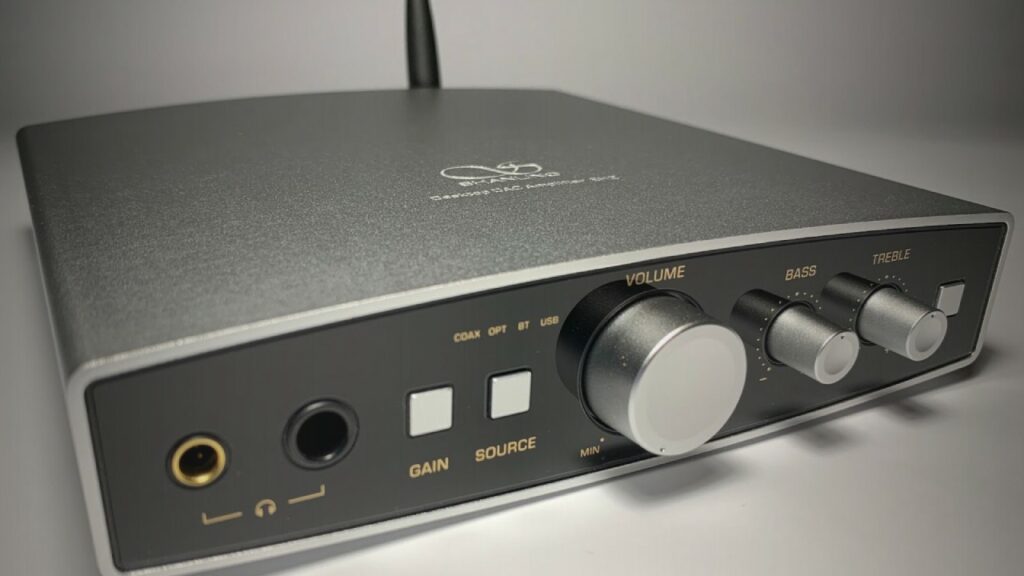
The Shanling EH2 wins this comparison because it covers the widest range of realistic desktop requirements without being merely a collection of features. It is a 24-bit R2R DAC, a headphone amplifier, a preamp and a wireless receiver in one chassis. Its inputs include USB-C, coaxial, optical and Bluetooth 5.2, while outputs include balanced 4.4mm, unbalanced 6.3mm and RCA line-out.
That flexibility gives it an advantage over the other four products. The Gustard R26 II offers a more ambitious network platform, but its outputs are fixed-level RCA and XLR, so it is intended to feed a preamp, integrated amplifier or active speakers rather than directly serve headphones. The SPEC has headphone outputs and a volume control, but its input options are more limited and the source article positions it as a high-end, purist component. The Snowsky is far more portable, but it is not a desktop replacement. The Eitr 2 needs another DAC to complete the conversion chain.
The EH2 also offers practical control over the sound. Its rear-panel switch selects NOS mode at 44.1kHz or oversampling at 352.8kHz, and bass and treble controls provide ±6dB and ±10dB adjustment respectively. For headphone users, the source article lists 4351mW at 32 ohms from the balanced output and 1280mW at 32 ohms single-ended. Those figures, combined with the review's reported success driving Sennheiser HD800S headphones, make the EH2 the most obviously adaptable option here for a range of headphones.
It is not the right choice for every system. It does not provide the Gustard's network bridge, and listeners who want the SPEC's elaborate dual-case construction and stated emphasis on instrument timbre may prefer that more specialised approach. But as a purchase decision, the EH2 asks the fewest compromises from a desktop listener. It is therefore the Best Overall.
Gustard R26 II: Best for network audio
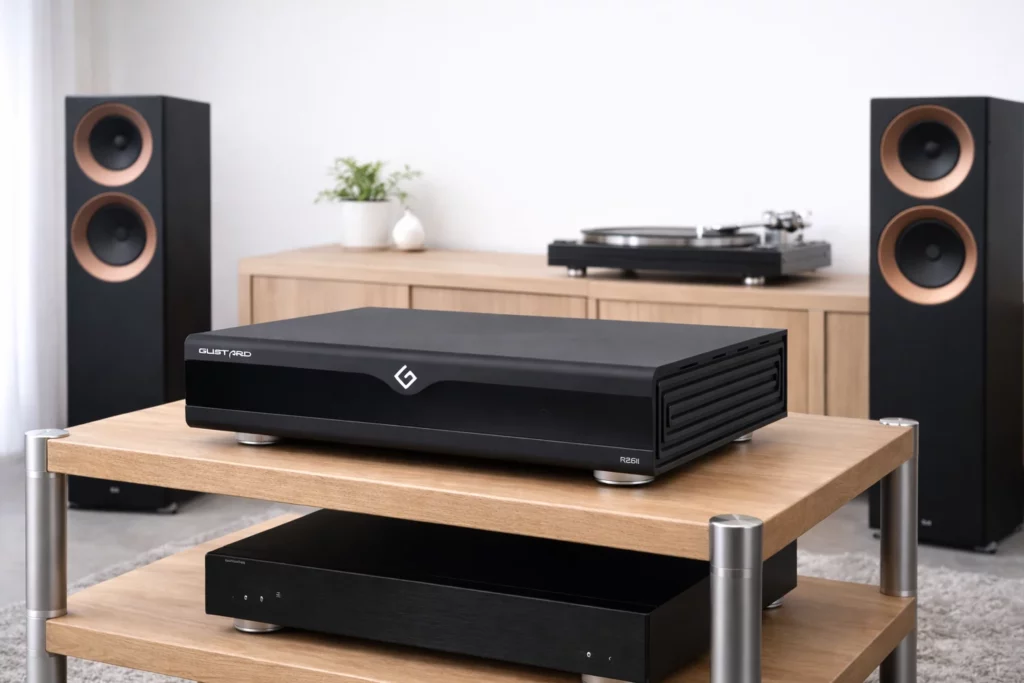
The Gustard R26 II is the most appropriate choice when the DAC is also expected to be the centre of a network-based digital system. Its dedicated network bridge runs an optimised Linux platform and supports Roon Bridge, AirPlay, UPnP, Spotify NAA and HoloPlayer NAA. Management is handled through a web interface, which can disable unnecessary background services.
Its conversion architecture is also distinctive. Gustard uses a fully discrete 26-bit R2R ladder rather than an off-the-shelf delta-sigma DAC chip. The source article specifies PCM support up to 32-bit/768kHz and native one-bit DSD processing up to DSD2048 via I2S. The R26 II also includes a GCLK-02 clock module, a 10MHz BNC input for an external master clock, dual toroidal transformers and separate digital and analogue power supplies.
Unlike the Shanling, the R26 II is not a headphone amplifier. Its fixed-level RCA and XLR outputs make it a natural partner for a preamp, integrated amplifier or active speakers. That is a limitation if you want a single-box headphone system, but an advantage if you already have the amplification and want a dedicated network DAC with a serious analogue stage. The fully discrete Class A output stage uses a dedicated low-pass filter and no op-amps, according to the source article.
Choose the R26 II over the EH2 when network playback is central to the system and you value the Gustard's extensive digital architecture more than the Shanling's headphone drive and tone controls. It is the strongest alternative for a full-size, network-connected stereo system.
SPEC RMP-DAC3X: Best for a high-end, tone-focused system

The SPEC RMP-DAC3X takes a different route from the feature-rich Shanling and network-focused Gustard. Its source article presents it as a carefully built, high-end Japanese DAC designed around realistic instrument tonality and the reproduction of subtle signals. Component selection is a major part of the design, including capacitors and a specialised R-core transformer for the output stage.
The physical construction is unusual. The DAC and power supply occupy separate cases, with the DAC measuring 215 x 82 x 299mm and weighing 3kg, while the external power supply measures 215 x 122 x 273mm and weighs 4kg. The housing incorporates multiple types of wood, including spruce described as the same material used for the top plate of a violin. Whatever the listener makes of that design philosophy, it clearly separates the SPEC from the metal-cased Shanling and the portable Snowsky.
Connectivity is more selective. USB-A and USB-B handle PCM up to 32-bit/384kHz, native DSD256 and DoP128. Other inputs handle PCM up to 24-bit/192kHz. Analogue output is available through RCA and XLR, while the front panel adds 6.35mm and 3.5mm headphone sockets and a volume control that can be disabled.
The SPEC is the better choice for a listener who values its stated focus on timbre and has a system built around a high-quality amplifier. It is less attractive than the Shanling for someone who wants Bluetooth, several digital input types and tone controls in one compact desktop unit. It is also less suitable than the Gustard for someone specifically seeking integrated network streaming. Its appeal lies in its focused design rather than breadth.
Snowsky Retro Nano: Best portable option
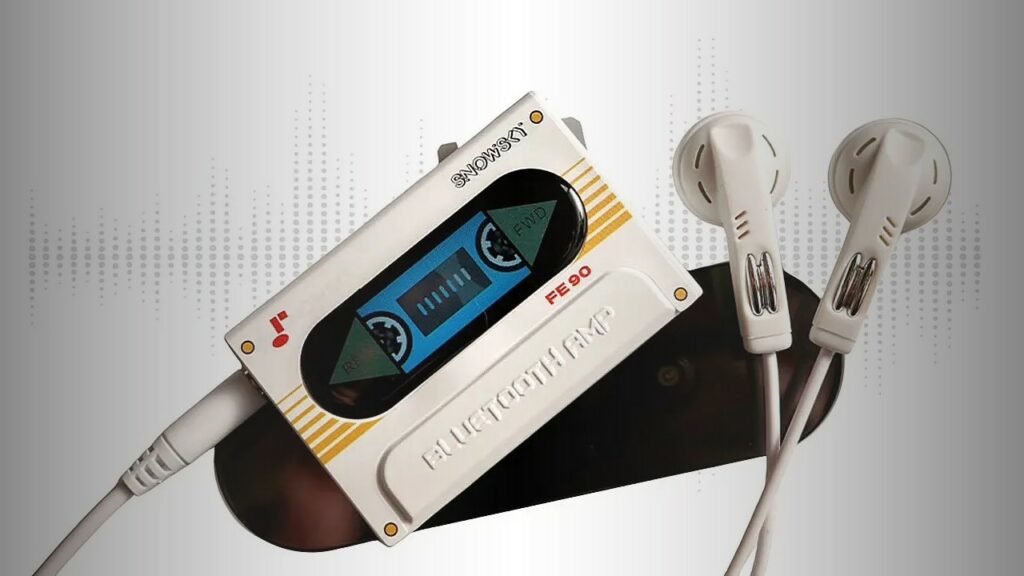
The Snowsky Retro Nano belongs to an entirely different category. It is a 28-gram portable DAC and headphone amplifier styled like a 1980s Walkman, complete with physical buttons and an animated cassette graphic on its 0.96-inch TFT display. It is not a portable music player: it receives music from a phone, tablet or laptop through Bluetooth or USB.
For mobile use, its feature set is unusually complete. iPhone users can connect with AAC, while Android users can use aptX HD and LDAC. The Qualcomm QCC5125 handles Bluetooth reception, and dual Cirrus Logic CS43131 chips handle digital-to-analogue conversion. There are both 3.5mm single-ended and 4.4mm balanced headphone outputs, along with high- and low-gain settings.
The replaceable USB-rechargeable battery is rated in the source article for around 7.5 hours of playback. Physical controls can adjust volume and navigate tracks, and the device supports phone calls through its built-in microphone. The FiiO Control app is available on Android and iOS. At $60 in the source article, it is also the only product here explicitly presented at a low portable price.
Nothing else in this comparison competes with the Retro Nano for weight, convenience or price. Conversely, it cannot replace the Gustard or SPEC in a full-size stereo system, and the EH2 is the obvious choice for a desktop listener who needs more power and inputs. Buy the Snowsky because you want a compact headphone DAC with a playful design, not because you want a high-end home component.
Schiit Eitr 2: Best digital-source upgrade
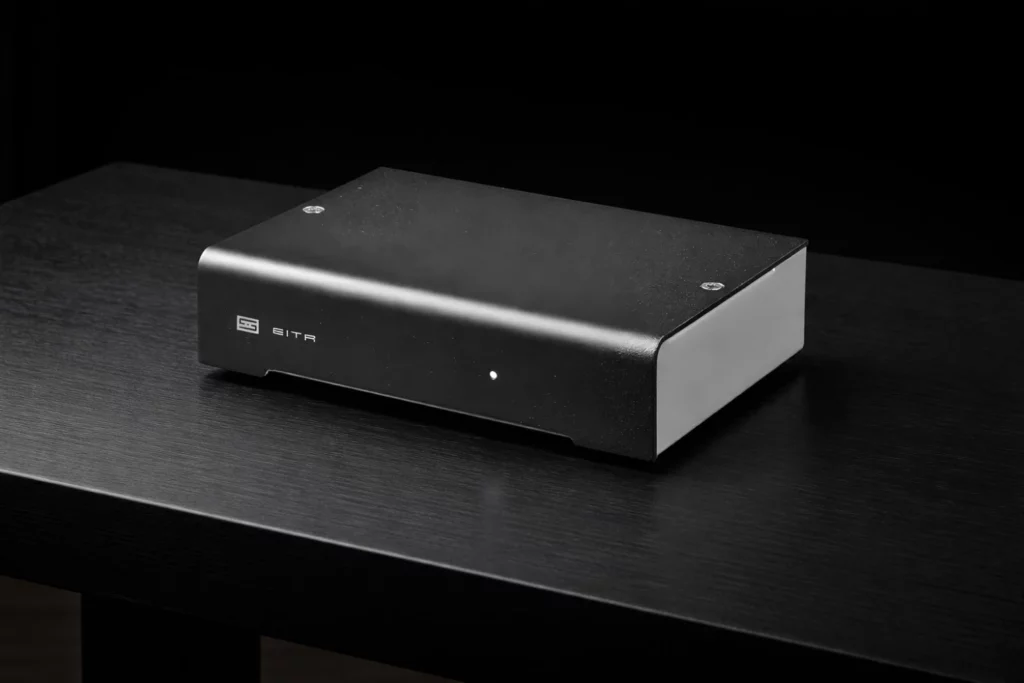
The Schiit Eitr 2 needs to be judged on its own terms because it is not a DAC. It is a DDC, or digital-to-digital converter, designed to take USB audio from a computer, tablet or smartphone and output a regenerated digital signal to an external DAC. Its purpose is to act as an intermediary between a noisy or timing-imperfect USB source and the DAC already in your system.
Its outputs are transformer-isolated coaxial, AES/EBU and optical, with optical supporting PCM up to 24-bit/192kHz. Schiit's Unison USB interface is designed specifically for audio, and the Eitr 2 complies with USB Audio Class 2. It can draw power over USB, while the optional Linear Override supply is offered as an upgrade for systems where noise performance is a priority.
The optional Forkbeard module changes the proposition further. With it installed, the connected DAC can function as a digital preamplifier controlled from an iOS or Android smartphone, with volume, balance, parametric EQ and loudness controls. The source article lists the Converter Only version at $99 and the Digital Preamp Version with Forkbeard at $149.
The Eitr 2 is the most affordable route into this comparison, but only if you already own a DAC that accepts its outputs. It cannot replace the Shanling, Gustard, SPEC or Snowsky as a complete conversion product. Its value is system-dependent: for a computer-based setup with a suitable DAC, it offers a targeted way to change the digital front end without replacing the converter.
How they differ
They do not perform the same job. The Shanling, Gustard, SPEC and Snowsky all include digital-to-analogue conversion. The Eitr 2 does not; it prepares a digital signal for another DAC. That makes it an accessory or upgrade component rather than a standalone DAC purchase.
Their system roles are different. The EH2 is the most complete desktop hub because it combines conversion, headphone amplification, preamp functionality, Bluetooth and several wired inputs. The Gustard is more ambitious as a network component, with Roon Bridge, AirPlay, UPnP and other network playback options. The SPEC is more specialised, pairing a separate power supply with a design centred on tonal reproduction and analogue output quality. The Snowsky is designed around mobility, while the Eitr 2 is designed around USB-source optimisation.
R2R is central to two of the larger DACs. Gustard uses a discrete 26-bit R2R ladder, while Shanling uses a proprietary 24-bit R2R DAC based on 192 high-precision resistors. The SPEC article does not identify an R2R architecture, and the Snowsky uses dual Cirrus Logic CS43131 DAC chips. The Eitr 2 performs no analogue conversion.
Headphone users should narrow the field quickly. The EH2 offers the most power and the broadest desktop headphone feature set. The SPEC includes both 6.35mm and 3.5mm headphone sockets and a volume control. The Snowsky offers 3.5mm and 4.4mm outputs in a pocket-sized form. The Gustard is aimed at line-level stereo systems, while the Eitr 2 requires a separate DAC and headphone amplifier.
Streaming and portability point in opposite directions. The Gustard is the clear choice for integrated network audio. The Snowsky is the clear choice for a phone-based portable setup, supporting Bluetooth codecs including AAC, aptX HD and LDAC. The Shanling also supports Bluetooth 5.2, including LDAC and aptX variants, but its desktop design and power output make it a different kind of product.
Which one should you buy?
- Buy the Shanling EH2 if you want one desktop component for headphones and speakers, need several digital inputs, use Bluetooth and value the option of NOS, oversampling and tone controls. It is the safest all-round purchase in this group.
- Buy the Gustard R26 II if your main source is network audio and you already have, or plan to use, a preamp, integrated amplifier or active speakers. Its network bridge and fixed RCA/XLR outputs make its role clear.
- Buy the SPEC RMP-DAC3X if you are building a high-end system around careful component selection, instrument timbre and a dedicated external power supply. Its limited input approach is less suitable for feature-first buyers.
- Buy the Snowsky Retro Nano if you need the smallest and lightest option for a smartphone, tablet or laptop. Its 28-gram design, balanced output, Bluetooth support and $60 source price make it the practical portable choice.
- Buy the Schiit Eitr 2 if you already own a DAC and want to improve or reorganise a USB-based digital source. Select it for its specific DDC role, not as a replacement for a complete DAC.
Final verdict
The Shanling EH2 is the Best Overall because it offers the most useful combination of conversion, amplification, connectivity and control for a typical desktop hi-fi system. The Gustard R26 II is the more compelling network specialist, the SPEC RMP-DAC3X the more focused high-end tonal proposition, the Snowsky Retro Nano the obvious portable pick, and the Schiit Eitr 2 the most targeted upgrade for an existing DAC system. Decide first whether you need a complete DAC, a headphone amplifier, a network bridge or a USB digital bridge; once that is clear, the right choice becomes straightforward.

Comments 0
Share your experience, questions and perspective with other hi-fi enthusiasts.