
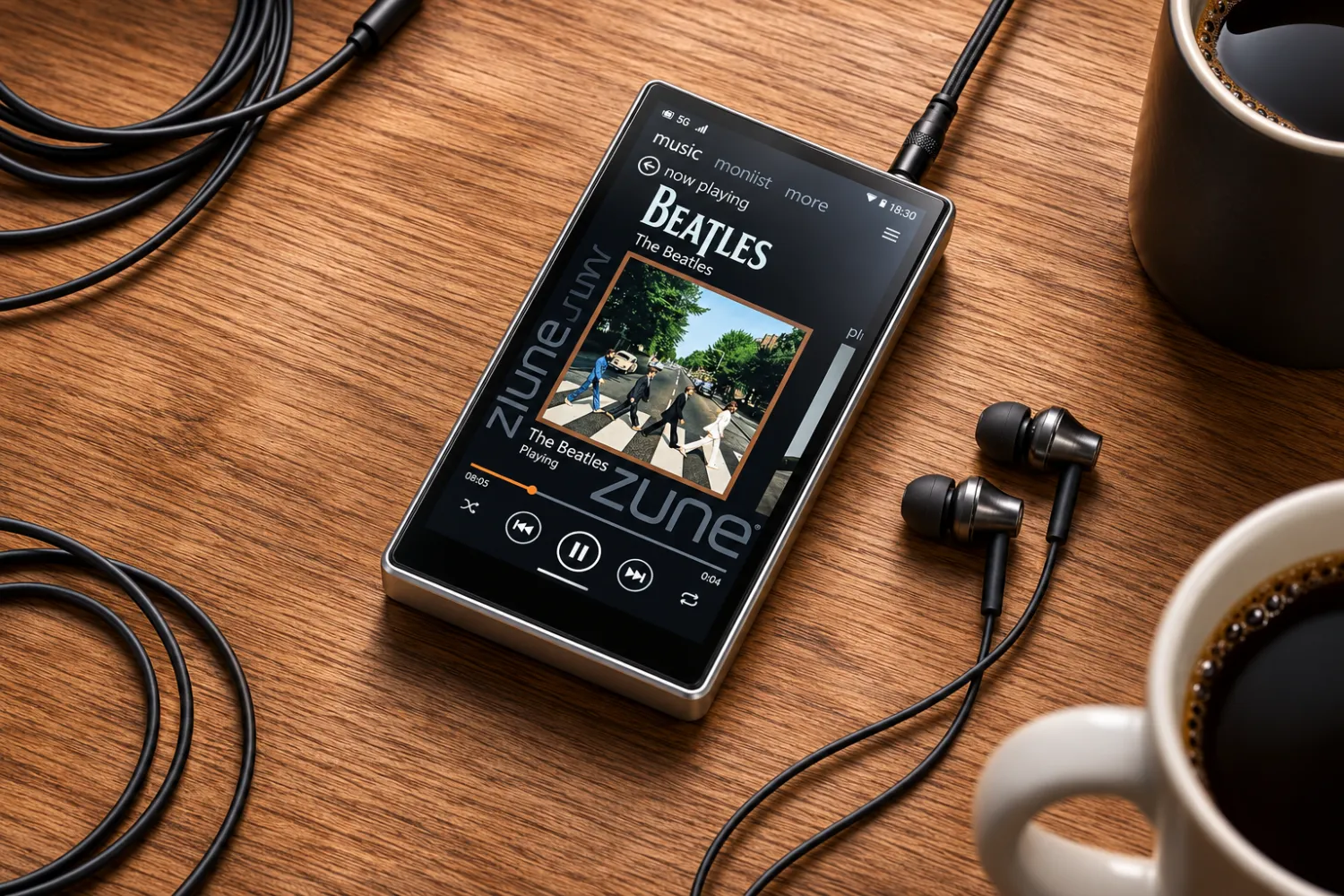
Choosing a hi-fi player is no longer simply a matter of buying the most powerful device. A small player such as the HiBy R1 prioritises portability and battery life, while Shanling’s M7 and M3 Plus are closer to serious headphone sources with large amplifiers, Android and balanced outputs. There is also a crucial alternative: the Shanling UA6, which adds dedicated DAC and headphone-amplifier hardware to a phone or computer rather than replacing either device.
The practical question is therefore: do you want a self-contained music library and streaming player, the most convincing drive for demanding headphones, or the smallest and least expensive route away from a phone’s built-in audio? The five options below occupy very different positions, so the best choice depends on the compromises you are willing to make.
Quick verdict
Best Overall: Shanling M3 Plus. It offers the most balanced combination of power, modern software, streaming support, battery life and portability. Its 800mW balanced output gives it considerably more headroom than the smaller players, while Android 13 and 64GB of internal storage make it practical as an everyday device.
Strongest alternatives: choose the Shanling M7 if sound quality, amplifier capability and storage matter more than weight and heat. Choose the HiBy R1 for an exceptionally small, affordable player with streaming and up to 15 hours of playback. The Shanling UA6 is the better answer when your phone remains central to your listening. The Hidizs AP80 is worth considering when compactness is the overriding priority, although the available information is more limited.
| Model | What it is | Output and power | Software and connectivity | Battery or portability | Best suited to |
|---|---|---|---|---|---|
| Shanling M3 Plus | Android DAP | 3.5mm: up to 200mW; 4.4mm balanced: up to 800mW | Android 13, AGLO, Wi-Fi streaming, Bluetooth 5.0, USB DAC and digital transport | 205g; up to 14 hours single-ended or 11 hours balanced | One-player-does-most buyers and demanding headphones |
| Shanling M7 | Flagship Android DAP | 3.5mm: 400mW; 4.4mm balanced: 900mW, both at 32 ohms | Android 10, Wi-Fi, Bluetooth 5.0, USB DAC, three gain settings | 312g; 7000mAh battery; up to 10 hours | Listeners prioritising refined sound and driving power |
| HiBy R1 | Ultra-compact DAP | 3.5mm output; maximum output power 101mW | HiByOS, Wi-Fi, TIDAL and Qobuz support, Bluetooth 5.1 with LDAC, USB DAC | 70g; up to 15 hours; supports microSD up to 2TB | Travel, walking and small sensitive headphones |
| Shanling UA6 | Portable USB DAC/headphone amplifier | Output power is not specified in the article | iOS, Android and PC compatibility; Android Eddict Player app; Nintendo Switch UAC1.0 mode | 220mAh battery; replaceable cable | Phone users who want better wired audio without buying a DAP |
| Hidizs AP80 | Compact hi-fi player | Output details are not specified in the article | Physical playback controls and volume control are described | Described as a very small glass-and-aluminium cube | Buyers who put size and value ahead of documented features |
The table only includes information stated in the linked product coverage. Output figures are not directly comparable across designs, and maximum power depends on headphone impedance and connection type.
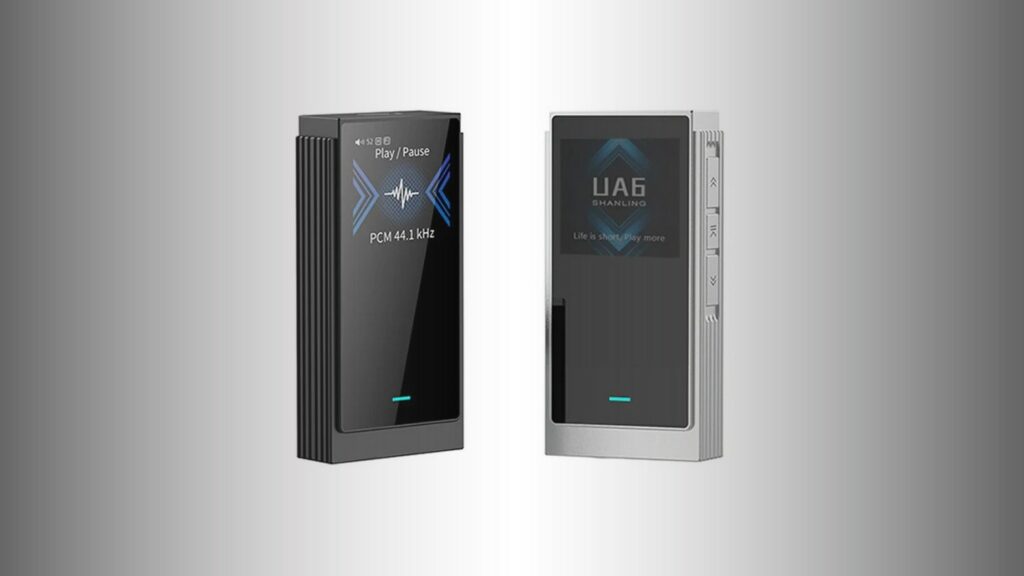
Shanling UA6: the phone-friendly alternative
The UA6 is not a digital audio player in the usual sense. It is a portable DAC and headphone amplifier that takes its music from a connected phone, tablet, computer or compatible console. That distinction is important: it does not give you a separate library, screen or operating system, but it can improve the wired audio chain while allowing you to keep using the phone you already own.
Its strongest practical feature is the 2.0 hybrid power system. The built-in 220mAh battery is designed to supplement power from the connected device, with particular attention to power-sensitive phones such as iPhones. For listeners who dislike carrying a separate DAP but find a phone’s headphone output inadequate, this is a more direct upgrade path.
The UA6 also offers an unusually broad set of adjustments for a dongle-style product. Users can switch between dual and quad DAC modes, select from five filters, adjust gain and channel balance, and control the device through the Eddict Player app on Android. Its replaceable cable supports iOS, Android and PC connections, while a UAC1.0 mode is available for Nintendo Switch use. Windows requires Shanling’s USB driver; macOS does not.
Choose the UA6 if your music already lives on a phone or computer and you mainly use wired headphones. It is less attractive if your goal is to escape notifications, preserve phone battery or carry a self-contained music collection. The Android-only app limitation is also worth noting if you use an iPhone, although the hardware itself is described as compatible with iOS.

Shanling M3 Plus: the most complete everyday DAP
The M3 Plus is the easiest recommendation for most buyers because it avoids the biggest compromises. It is small enough to remain portable at 205g, yet its dual SGM8262 amplifier section delivers up to 800mW through the balanced 4.4mm output. The 3.5mm connection is rated at up to 200mW, which is still a useful step beyond the modest output commonly associated with phones and basic players.
It is also the most convincing choice for people who want a DAP to behave like a modern source rather than a sealed music box. Android 13, a Snapdragon 665 processor, 4GB of RAM and a 4.7-inch 1280×720 screen support local playback and streaming. AGLO is intended to provide bit-perfect playback, and the article specifically cites TIDAL and Spotify alongside FLAC libraries.
Wireless use is covered by Bluetooth 5.0 with LDAC, aptX HD, aptX and SBC. The player can also act as a USB DAC or digital transport. That combination gives it a place in a home system as well as in a pocket, although its 11-hour balanced and 14-hour single-ended playback figures are shorter than the HiBy R1’s claimed 15 hours.
The M3 Plus suits the buyer who wants one product to handle local files, streaming, wired headphones and wireless equipment. It is not the smallest option here, and the headline 800mW figure applies to the balanced output, so you need headphones or a cable with a 4.4mm connection to make full use of it. For most portable headphone collections, however, it has the best balance of capability and manageability.
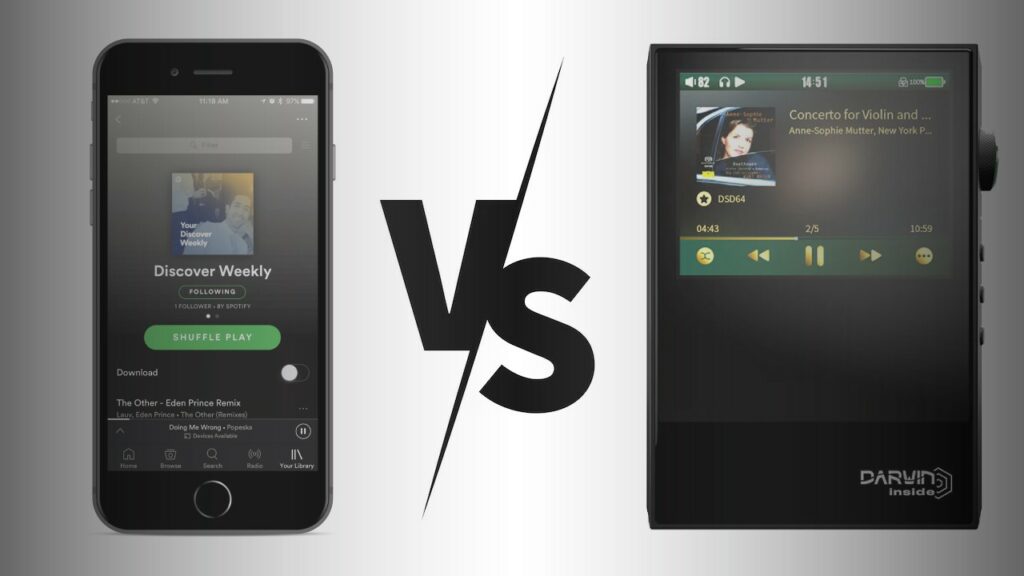
Hidizs AP80: compactness first
The AP80 appears in Stereoindex’s entry-level player guide as a first-place choice for the ratio of price, compactness and sound quality. The available coverage describes it as a very small cube made from glass and aluminium, with physical playback buttons and a volume control on the side.
That is enough to establish its appeal, even though the available details do not provide a full specification or a price for the model itself. Physical controls can be valuable on a player intended for walks, commuting or exercise because they reduce the need to wake a screen or handle a phone. A genuinely small chassis also makes the separate-player concept more persuasive: it can be carried as an audio-only device rather than another substantial piece of electronics.
The AP80 is best viewed as a minimal, portability-led choice rather than a direct rival to the Android-based Shanling models. If you need streaming apps, substantial amplifier power or extensive connectivity, the M3 Plus is more clearly documented and better equipped. If you mainly want a small player with tactile controls and are comfortable with fewer confirmed features, the AP80 remains an interesting entry point.
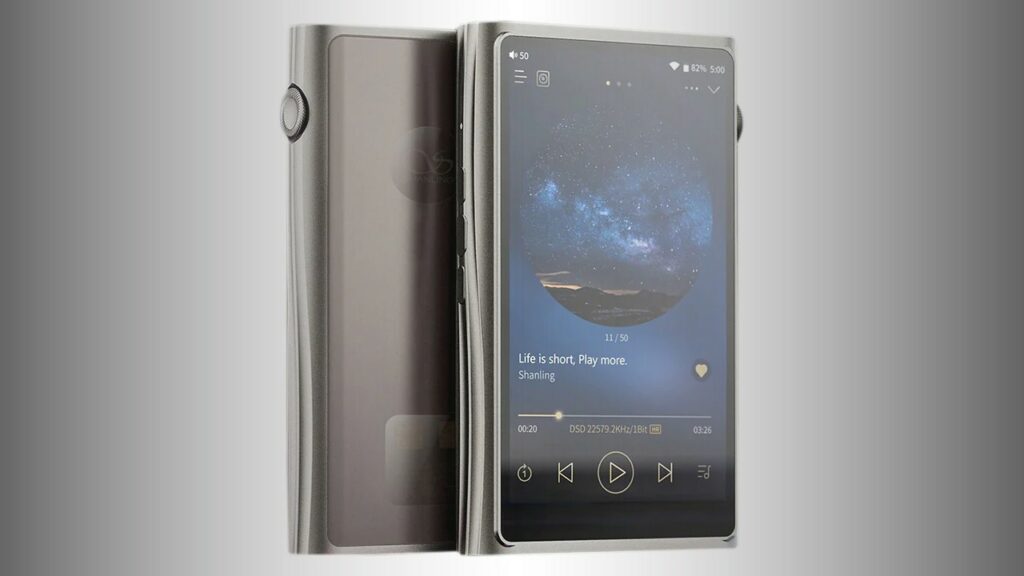
Shanling M7: the high-power, premium option
The M7 is the specialist choice. Its ES9038PRO DAC, fully balanced architecture and amplifier rated at 900mW into 32 ohms through the balanced output give it the largest stated output figure in this comparison. The unbalanced output is also rated at 400mW at 32 ohms, making the M7 more flexible than many portable players when paired with harder-to-drive headphones.
The sound description is notably different from the UA6’s warm presentation. The M7 is described as neutral, refined and detailed, with clear bass, natural vocals and instruments, and a wide soundstage. Those are listening impressions from the product review rather than universal measurements, but they help explain the intended position of the player: a serious source for listeners who care about a polished, controlled presentation.
It runs Android 10 on a Snapdragon 665 platform, with 6GB of RAM, 128GB of internal memory and microSD expansion. Wi-Fi, Bluetooth 5.0 with LDAC, LHDC, aptX HD, aptX and SBC, plus USB DAC operation, give it broad functionality. Three gain settings and seven low-frequency filter presets provide further control.
The trade-offs are physical. At 312g, it is substantially heavier than the M3 Plus and more than four times the weight of the R1. The review also notes significant heat during operation and a battery life of up to 10 hours. It has 3.5mm and 4.4mm outputs but no 6.3mm jack. Buy it when your headphones justify the extra drive and you value its refined presentation; do not buy it merely because the specifications look larger.

HiBy R1: the genuinely pocketable choice
The R1 makes the strongest case for carrying a separate player every day. It weighs 70g and measures 83.5 x 51.1 x 12.35mm, with a 3-inch touchscreen, a translucent polycarbonate case and a strap mount for carrying or clipping it to a belt. Those details matter more than a long list of decoding formats if the player is intended for walks, travel or casual listening.
It is also more capable than its size suggests. HiByOS supports lossless formats, Wi-Fi enables access to TIDAL and Qobuz, and Bluetooth 5.1 includes LDAC. The R1 can work as a USB DAC, and its microSD slot accepts cards up to 2TB. The claimed 15-hour playback time is the longest stated figure among the three full DAPs in this comparison.
The compromise is output. The R1’s maximum output power is listed as 101mW, and it has a 3.5mm headphone output rather than the high-power balanced connection found on the M3 Plus and M7. That makes it a sensible match for efficient in-ear monitors and portable headphones, but less compelling for demanding full-size headphones that benefit from greater voltage or current.
The R1 is also the only product here with a stated price: $85. That makes it the clearest Best Value candidate on the available evidence, provided your headphones do not need a powerful amplifier. It delivers streaming, long battery life, huge expandable storage and USB DAC functionality in a very small package.
How they differ
Start with the source format. The UA6 is an accessory for a phone or computer, while the M3 Plus, M7, R1 and AP80 are self-contained players. If you want to leave your phone at home or avoid calls and notifications during listening, only a DAP fully solves that problem. If you stream from a phone and want the simplest upgrade, the UA6 avoids buying a second smart device.
Then match the amplifier to the headphones. The M7 and M3 Plus are the obvious choices for demanding wired headphones, especially through their balanced outputs. The R1’s lower stated output makes more sense with efficient portable headphones and in-ear monitors. Do not assume balanced automatically sounds better: its main practical advantage here is the higher output available from the relevant player designs.
Consider software carefully. Android 13 makes the M3 Plus the most current-feeling option in this group, while the M7 uses Android 10. Both support broad connectivity and USB DAC use. The R1’s HiByOS is less phone-like but still supports Wi-Fi streaming, TIDAL and Qobuz. The UA6’s Eddict Player controls are available on Android, with some app limitations noted in its coverage. The AP80’s documented appeal is simpler: small size and physical controls.
Finally, be honest about carrying weight. The difference between 70g and 312g is obvious in a pocket. The M7’s larger battery does not make it the longest-lasting option on the stated figures, and its review notes heat. The M3 Plus is a more manageable middle ground, while the R1 is the easiest to carry constantly.
Which one should you buy?
- Buy the Shanling M3 Plus if you want the best all-round DAP: streaming, Android, local files, strong balanced output, USB DAC functionality and sensible portability.
- Buy the Shanling M7 if you use demanding headphones and place the greatest value on amplifier power, storage and the review’s neutral, refined sound description. Accept its weight and heat.
- Buy the HiBy R1 if you want the smallest full-featured player, long battery life and a low entry price. Pair it with efficient headphones rather than power-hungry models.
- Buy the Shanling UA6 if your phone remains the centre of your listening and you want a more capable wired DAC/headphone amplifier without moving to a separate operating system.
- Consider the Hidizs AP80 if compactness, physical controls and the entry-level value proposition matter more than extensive documented features.
For a first serious DAP, the M3 Plus is the safest recommendation because it combines the fewest lifestyle compromises. The R1 is the smarter choice when size and price dominate, while the M7 is for listeners prepared to carry more hardware to get a more ambitious headphone source. And if what you really want is simply better wired sound from the phone already in your pocket, the UA6 may be the more rational purchase than any DAP.


Sound Off
0Join the discussion if you have something to add.