An AV receiver is the switching hub, surround processor and power source at the center of many home cinema systems.
The right choice depends less on a single headline feature and more on how many speakers you plan to run, which video sources you need to connect, and whether room correction or multiroom streaming matters in your setup.
The strongest options in the supplied material range from accessible 7.2-channel receivers to expandable 9.4-channel models and broader receiver families. Some are built for compact Dolby Atmos layouts, while others leave room for external amplification, multiple subwoofers or more advanced room correction. This guide focuses only on the supplied sources that are genuinely relevant to AV receivers. Turntables, compact hi-fi systems, soundbars and standalone AV processors have been left out because they belong to different buying decisions, even when they can be part of a home entertainment system.

1. Audio-Technica AT-LP120XBT
Audio-Technica AT-LP120XBT direct-drive turntable with Bluetooth, USB output and a switchable phono stage.
The Audio-Technica AT-LP120XBT is not an AV receiver, but it can matter to receiver shoppers who want to play records through an amplifier or home cinema hub with suitable inputs.
The source describes a direct-drive turntable with Bluetooth including aptX support, 33, 45 and 78 rpm playback, a switchable built-in phono stage and USB output for digitizing records through a computer.
Its receiver relevance is straightforward: the built-in phono stage allows connection to line inputs, while its phono output can be used with a dedicated phono input where available.
Best for: Vinyl listeners checking how a turntable can connect to an AV receiver
- Bluetooth with aptX support
- Switchable built-in phono stage
- USB output for digitizing records
- 33, 45 and 78 rpm playback
Verdict: This is a source component rather than a receiver, but its switchable phono stage makes it easier to integrate with different amplifier or AV receiver inputs.
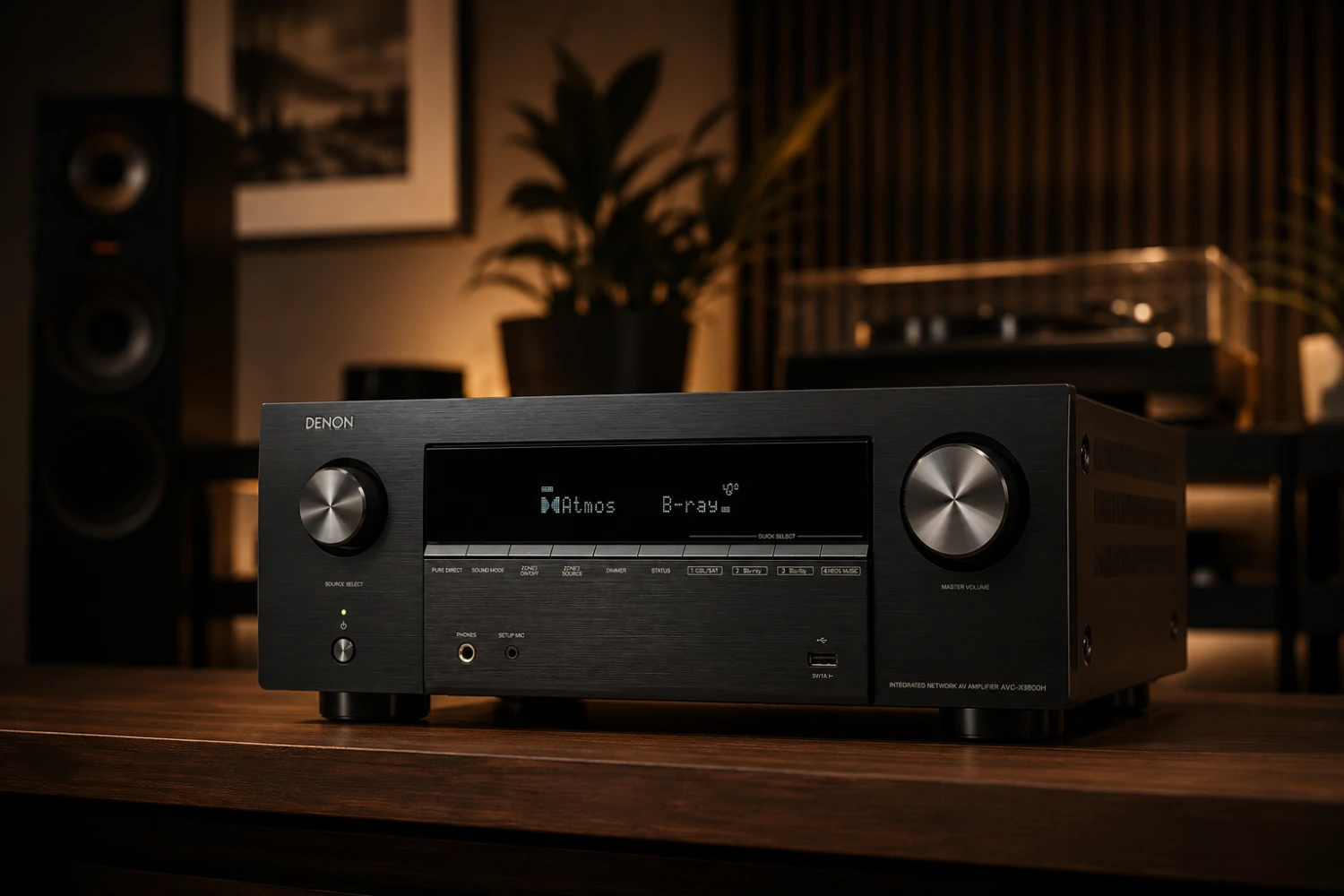
2. Denon AVC-X3900H
Denon AVC-X3900H home cinema receiver with 9.4-channel amplification, 8K HDMI connectivity and HEOS streaming support.
The Denon AVC-X3900H is the most expandable receiver in this selection.
It is built as a 9.4-channel model with 105 watts specified under hi-fi measurement conditions, four subwoofer outputs, 8K-capable HDMI 2.1 connectivity and built-in HEOS streaming.
Its 11.4-channel pre-out capability is the key detail for growing systems, as it allows larger layouts with external amplification beyond what the receiver can power on its own.
Best for: Expandable immersive home cinema systems
- 9.4-channel onboard amplification
- 11.4-channel pre-out capability
- Four subwoofer outputs
- Built-in HEOS multiroom streaming
Verdict: Choose the Denon AVC-X3900H if you want a receiver that can start as a serious nine-channel hub and later support a more ambitious speaker layout.

3. JBL MA Line of Five AV Receivers
JBL MA AV receiver series, spanning compact 5.2-channel models through a 9.2-channel flagship.
JBL’s MA receiver range is useful if you want to choose within one family rather than compare unrelated models.
The line runs from the 5.2-channel MA310 to the 9.2-channel MA9100HP, with shared features including Class D amplification, Dolby and DTS decoding, and 24-bit/192 kHz DACs.
The EZ Set EQ app is designed to simplify room equalization, while the MA7100HP and MA9100HP also support Dirac Live with a separately purchased license.
Best for: Buyers who want a scalable receiver family with a modern setup approach
- Five models from 5.2 to 9.2 channels
- Class D amplification across the line
- EZ Set EQ room equalization app
- Dirac Live support on the top two models with a license
Verdict: The JBL MA line makes sense if you like the idea of choosing a receiver by channel count and setup needs within a single, consistent range.

4. Pioneer SC-LX704
Pioneer SC-LX704 AV receiver with nine-channel amplification and support for immersive surround formats.
The Pioneer SC-LX704 is presented as a substantial nine-channel AV receiver with a focus on dense, large-scale sound and precise spatial effects.
Its feature set includes support for Dolby Atmos, DTS:X and IMAX Enhanced Surround, with four ceiling channels mentioned for building a three-dimensional sound field.
The source also notes sixth-generation Direct Energy HD amplifiers rated at 9 x 135 watts into 8-ohm speakers and Google Cast support.
Best for: Immersive systems using height or ceiling speakers
- 9 x 135 W amplification into 8-ohm speakers
- Dolby Atmos, DTS:X and IMAX Enhanced Surround support
- Designed to support four ceiling channels
- Google Cast support
Verdict: The Pioneer SC-LX704 is a strong match for listeners prioritizing a full 3D surround layout with substantial onboard amplification.

5. Yamaha MCR-N470
Yamaha MCR-N470 compact hi-fi system with CRX-N470 CD receiver and NS-BP150 speakers.
The Yamaha MCR-N470 is a compact hi-fi system rather than an AV receiver.
It combines the CRX-N470 CD receiver with Yamaha NS-BP150 speakers and offers CD, USB, radio, Wi-Fi, MusicCast, AirPlay and Bluetooth functionality.
It is relevant only as an alternative path for someone who mainly wants a compact music system rather than surround decoding, HDMI switching and multi-channel speaker support.
Best for: Music-first listeners who do not need a surround AV receiver
- CD, USB and radio playback
- Wi-Fi, MusicCast, AirPlay and Bluetooth
- Includes Yamaha NS-BP150 speakers
- Compact all-in-one music-system approach
Verdict: The Yamaha MCR-N470 is better viewed as a compact stereo system alternative, not as a home cinema receiver replacement.

6. Denon DHT-S516H
Denon DHT-S516H low-profile 2.1 soundbar with wireless subwoofer and HDMI ARC connectivity.
The Denon DHT-S516H is a 2.1 soundbar with a wireless subwoofer, so it serves a different buyer than a component AV receiver.
Its appeal is convenience: the source describes a low-profile soundbar, automatic wireless subwoofer connection, HDMI input and output with Audio Return Channel, optical and analog inputs, USB playback and HEOS support.
It is relevant here only as the simpler option for users who do not want separate speakers and receiver setup.
Best for: TV sound upgrades without separate speakers and an AV receiver
- 2.1 soundbar with wireless subwoofer
- HDMI input and output with Audio Return Channel
- Optical, analog and USB connections
- HEOS support
Verdict: The Denon DHT-S516H is the easier soundbar route, but it does not replace the speaker-layout flexibility of a true AV receiver.

7. Denon AVR-S970H
Denon AVR-S970H AV receiver, a 7.2-channel model with HDMI 2.1 inputs, HEOS and Audyssey processing.
The Denon AVR-S970H is the value-minded Denon option in the supplied material.
It supports 7.2-channel or 5.1.2-channel configurations, Dolby Atmos and DTS:X, plus a video path covering Dolby Vision, HDR10+ and HLG.
Three HDMI 2.1 inputs can accept 8K at 60 Hz or 4K at 120 Hz signals, while Wi-Fi with AirPlay 2 and DLNA, Bluetooth, HEOS and Audyssey room-correction features broaden its everyday usability.
Best for: Cost-conscious Dolby Atmos and DTS:X systems
- 7.2 or 5.1.2-channel configuration
- Dolby Atmos and DTS:X support
- Three HDMI 2.1 inputs for 8K/60 Hz or 4K/120 Hz signals
- Audyssey MultEQ XT32 with Dynamic EQ and Dynamic Volume
Verdict: The Denon AVR-S970H is the practical pick when you want modern surround and video support without moving into a larger receiver class.

8. Best AV Receiver: Choosing the very best for your home cinema
Stereoindex AV receiver selection guide comparing models by channel layout, power, surround formats and video features.
This source is not a single receiver review, but it is relevant as a broader receiver-selection article.
The excerpt shows how it compares models by channel scheme, power, format support, video capability and weight, then adds short pros, cons and verdicts.
Its Yamaha RX-V4A entry, for example, is described as a 5.2-channel receiver with 80 watts across five channels, Dolby Atmos and DTS:X support, 8K/60 Hz and 4K/120 Hz video handling, HDR format support, Bluetooth, Wi-Fi, AirPlay 2 and MusicCast.
Best for: Readers who want a broader shortlist before choosing a specific receiver
- Compares receivers by key system specifications
- Includes pros, cons and verdicts
- Highlights Yamaha RX-V4A as an affordable 5.2-channel option
- Covers video and wireless features in the model summaries
Verdict: Use this guide as a specification-led overview rather than as a substitute for checking the exact receiver model that fits your room and speaker layout.

9. JBL MA710
JBL MA710 AV receiver with 7.2-channel amplification, Dolby Atmos and DTS:X support, HDMI connectivity and a turntable input.
The JBL MA710 is a mid-range receiver built around a 7.2-channel amplifier and support for Dolby Atmos and DTS:X.
The source highlights its flexibility for a 5.2.2 3D audio system using height or ceiling speakers, along with six HDMI ports, three 8K-compatible HDMI inputs and a turntable input.
That combination makes it especially relevant for users who want surround sound, modern video connectivity and an analog source in the same system.
Best for: A 7.2-channel or 5.2.2 system with both HDMI sources and vinyl playback
- 7.2-channel amplification
- Dolby Atmos and DTS:X support
- Six HDMI ports
- Turntable input
Verdict: The JBL MA710 stands out as a sensible middle-ground receiver for users building a compact immersive setup with plenty of source connections.

10. Best AV Processors: Choosing the very best for your home theater
AV processor buying guide for systems that separate surround processing from power amplification.
This source covers AV processors rather than AV receivers, so it belongs beside this guide rather than directly inside the same buying category.
Its relevance is for readers considering a separates-based cinema system, where processing and amplification are handled by different components.
The excerpt mentions models such as the Tone Winner AT-200 and IOTAVX AVX17, with emphasis on multi-channel processing, Dolby and DTS decoding, HDMI capability and room-correction features rather than built-in receiver amplification.
Best for: Buyers comparing AV receivers with processor-and-power-amplifier systems
- Relevant for separates-based home theater systems
- Covers multi-channel AV processing
- Includes Dolby and DTS decoding information
- Discusses room-correction features on some models
Verdict: Consider an AV processor only if you are prepared to add separate amplification; otherwise, an AV receiver remains the more integrated solution.
How to choose from these AV receiver options
Start with your speaker layout.
If you are building a straightforward 5.1.2 or 7.2-channel system, the Denon AVR-S970H and JBL MA710 are the most directly relevant choices in the supplied material.
The Denon leans on broad video support, HEOS and Audyssey processing, while the JBL MA710 adds a turntable input and a flexible 7.2-channel platform that can be used for a 5.2.2 immersive setup. If your system may grow, prioritize pre-outs, subwoofer outputs and channel expansion. The Denon AVC-X3900H is the clear choice from this set for that role because it combines 9.4-channel onboard amplification with 11.4-channel pre-out capability and four subwoofer outputs. That makes it better suited to a room or system plan that may eventually move beyond the receiver’s internal amplifier channels. If you prefer to shop within a range, the JBL MA line gives you a structured path from 5.2 channels to a 9.2-channel flagship, with shared technologies across the family and optional Dirac Live support on the top two models. The Pioneer SC-LX704, meanwhile, is the most relevant pick here for a nine-channel system focused on immersive formats and ceiling-channel layouts. Also be careful not to confuse adjacent product categories. A turntable, compact music system, soundbar or AV processor can all belong in a home entertainment conversation, but they do not do the same job as an AV receiver. For most buyers who want surround decoding, source switching and speaker amplification in one chassis, a true AV receiver remains the most practical starting point.