

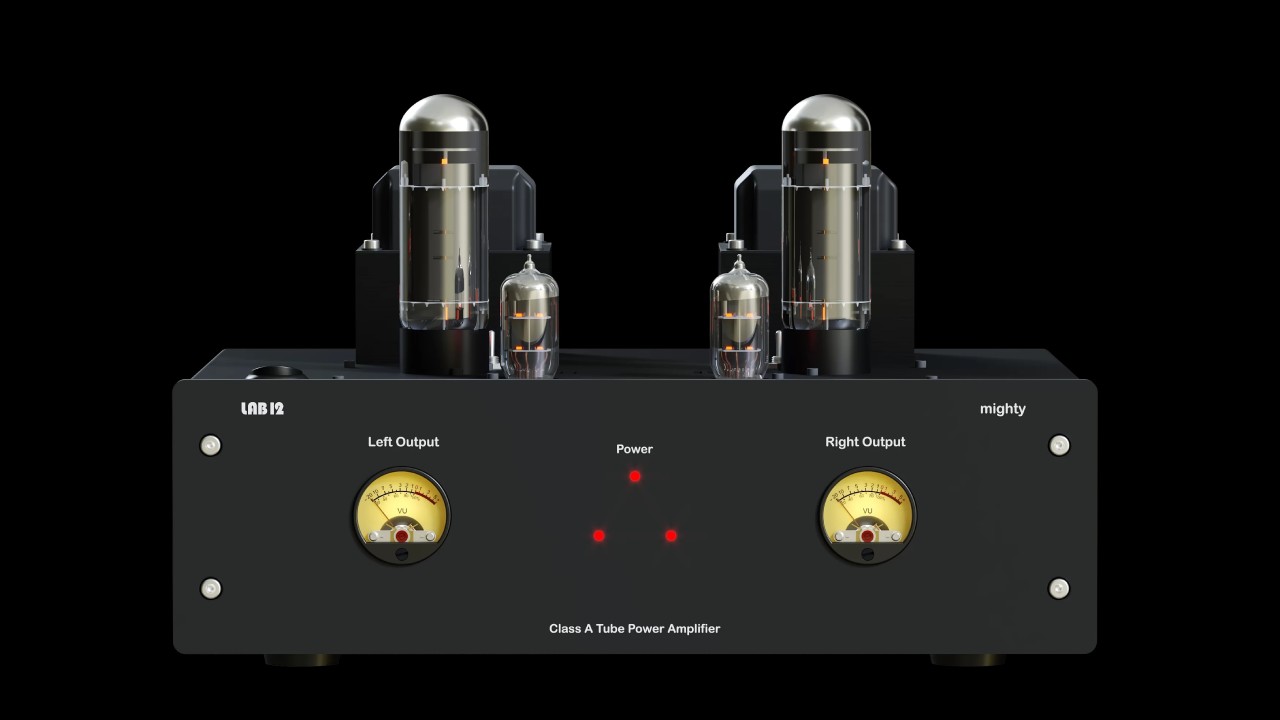
The Lab12 Mighty is a Class A tube power amplifier from the Greece-based manufacturer Lab12, built around a straightforward but demanding proposition: modest output power, carefully selected components, and a circuit concept aimed at listeners who value refinement over brute force. Rated at 10 watts per channel, the Mighty is clearly not designed to compete on raw wattage. Instead, it occupies a more deliberate space in the hi-fi landscape, where system matching, loudspeaker suitability, tube choice, and preamplifier compatibility matter as much as headline specifications. For prospective owners considering a low-powered tube amplifier, the Mighty’s documented strengths are its compact form, focused topology, 4-to-8-ohm speaker recommendation, high input impedance, and compatibility-minded design.
A low-power amplifier with a deliberate identity
The defining fact about the Lab12 Mighty is its 10-watt-per-channel output. In a market where amplifier power figures can easily become a shorthand for capability, the Mighty takes a different route. Its output rating places it firmly among amplifiers intended for carefully considered systems rather than general-purpose installations with difficult speaker loads or very large rooms.
That does not make the specification a weakness in itself. Low-powered Class A tube amplifiers are often chosen by listeners who have suitable loudspeakers and who prioritize circuit simplicity, tube character, and component selection over high-output demands. The Mighty’s recommended speaker range is 4 to 8 ohms, which gives prospective owners a useful starting point when planning a system. As with any 10-watt amplifier, sensitivity, room size, listening distance, and preferred playback levels will be important considerations.
The product is therefore best understood as a specialist power amplifier rather than a universal solution. Its appeal is strongest when it is partnered with loudspeakers and upstream components that allow its design priorities to make sense.
Class A tube design and the importance of component choice
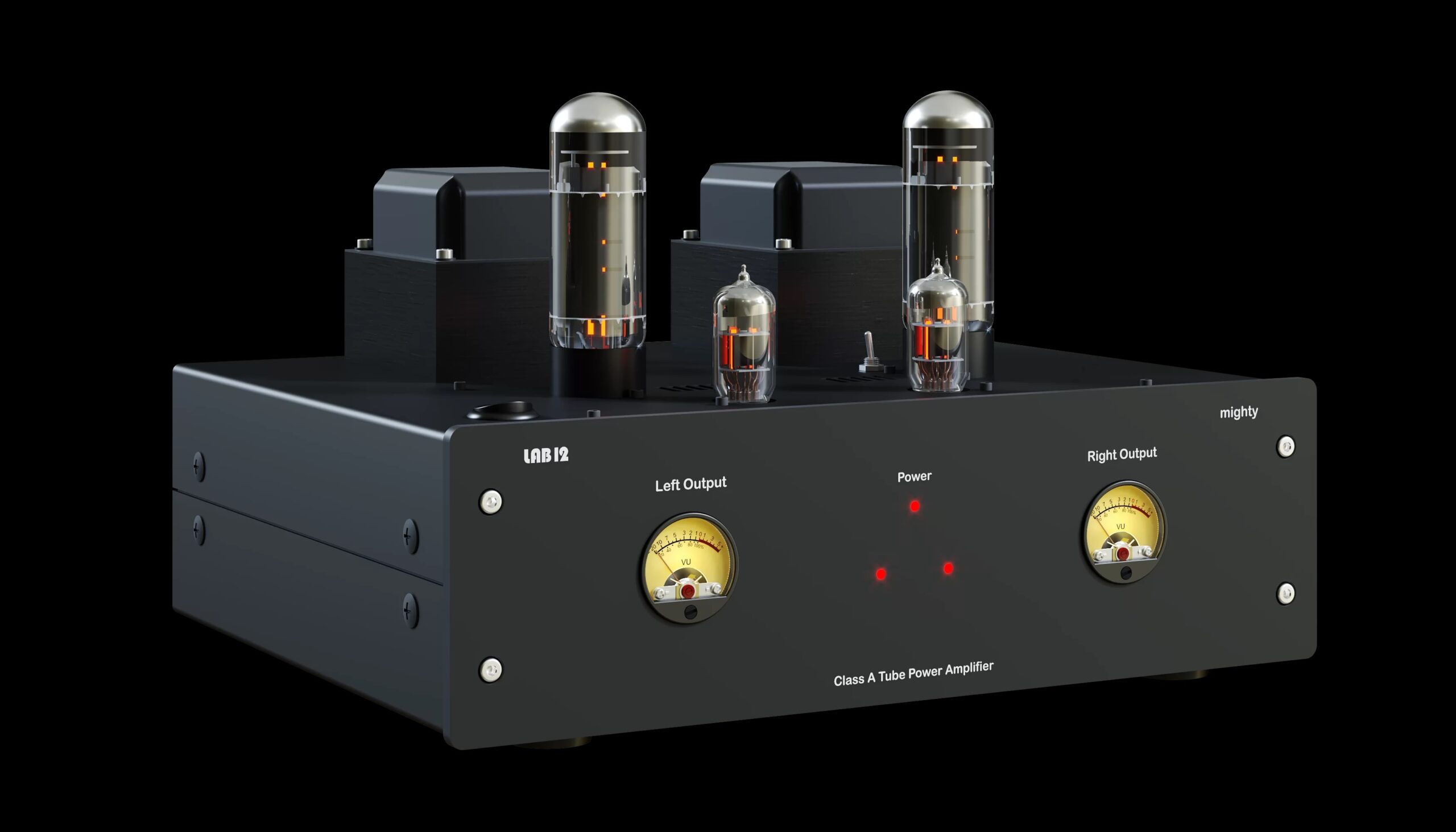
Lab12 positions the Mighty around the virtues of Class A tube amplification. Class A operation is valued in many amplifier designs because the output devices remain conducting throughout the signal cycle, although the practical implementation, heat behavior, power consumption, and speaker matching vary significantly from product to product. In the Mighty, this design direction is combined with a tube complement consisting of two 6N1P dual triodes and two EL34 power pentodes.
The EL34 is one of the most recognizable power tubes in audio amplification, associated with many classic and modern tube designs. The 6N1P dual triodes serve in the amplifier’s small-signal stages. For owners who are interested in tube-based systems, the use of established tube types may be part of the appeal, though any tube rolling or substitution should follow the manufacturer’s guidance rather than assumption.
Lab12 also emphasizes the selection of audiophile-grade electronic components and the time spent listening during development. While those are manufacturer-side design claims rather than independent test findings, they help explain the product’s intent. The Mighty is not specified as a feature-heavy amplifier; it is presented as a carefully voiced, purpose-built power amplifier for systems where the quality and suitability of each stage matter.
Triode and ultra-linear operation: what the sensitivity figures suggest
The specifications list input sensitivity as 600 mV in triode mode and 400 mV in ultra-linear mode. That distinction is useful because it points to different operating configurations with different gain requirements. Even without making assumptions about sonic behavior, these figures matter for system planning: the preamplifier must supply adequate signal voltage, and owners should be aware that the amplifier’s behavior in a system may depend on which mode is used.
The lower 400 mV sensitivity figure in ultra-linear mode means the amplifier requires less input voltage to reach its rated output than it does in triode mode. The 600 mV figure in triode mode is still within the range that many line-level preamplifiers can accommodate, but matching gain structure remains important, especially in systems using high-sensitivity loudspeakers where noise and volume control range can become more noticeable.
This is one of the more practical details in the Mighty’s specification sheet. It reminds buyers that low-powered tube amplification is not only about speaker choice; it is also about the relationship between source, preamplifier, amplifier gain, and loudspeaker sensitivity.
Designed to work with a broad range of preamplifiers
Lab12 states that the Mighty was crafted for compatibility not only with its own Hpa and True preamplifiers, but also with a wide range of solid-state and tube preamplifiers available on the market. That is an important point because the Mighty is a power amplifier, not an integrated amplifier. It requires a preamplifier or suitable volume-controlled source to form a working system.
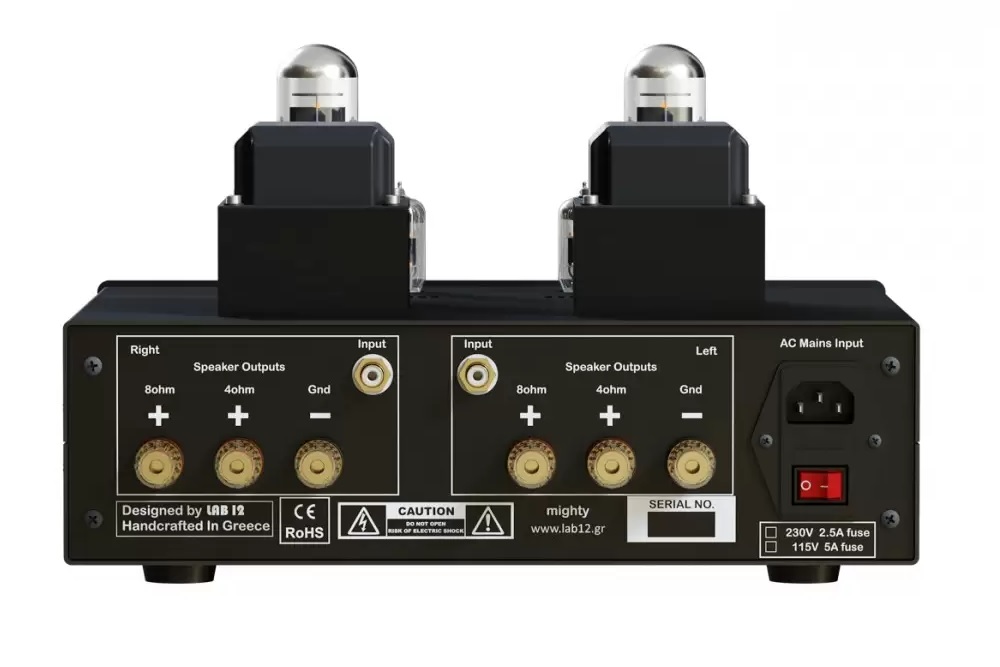
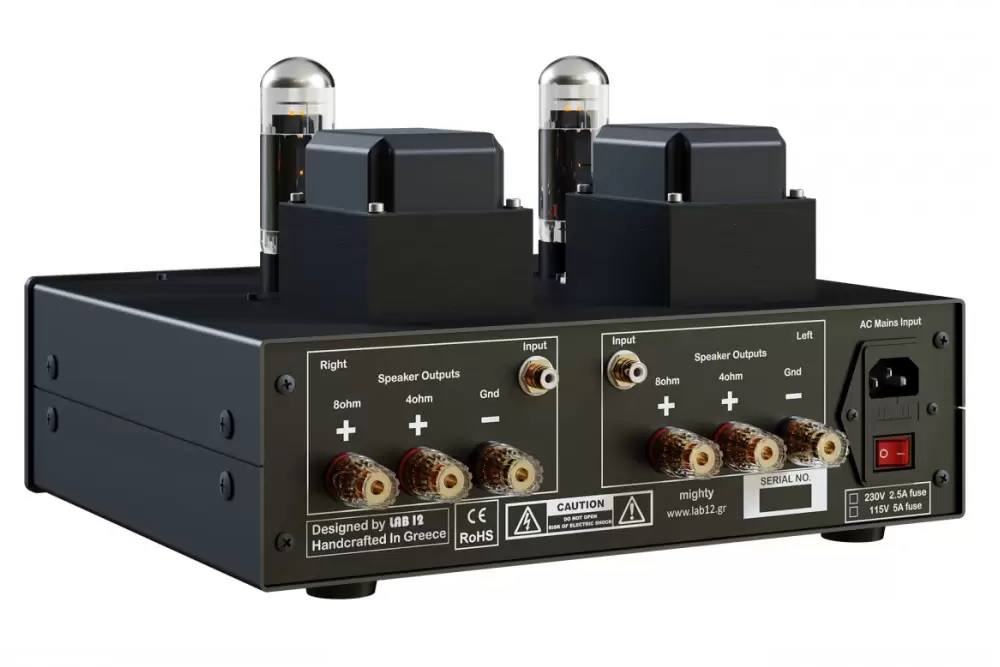
The 100 kOhm input impedance is a helpful specification in this context. A high input impedance generally makes life easier for many preamplifiers, including tube designs that may prefer to see a lighter electrical load. It also supports the manufacturer’s stated emphasis on broad preamp compatibility. The single stereo line input on cinch/RCA connectors keeps the layout simple and reinforces the Mighty’s role as a dedicated stereo power amplifier rather than a switching hub.
For owners with an existing preamplifier they enjoy, this can be part of the attraction. The Mighty is not asking the user to abandon a preferred control center, phono stage arrangement, DAC setup, or source switching system. It is designed to enter the chain at the power-amplification stage.
Compact proportions and understated industrial design
The Mighty’s physical dimensions are 32 x 17 x 29 centimeters, and its weight is 9 kilograms. That makes it compact for a tube power amplifier, while still substantial enough to suggest a serious power supply and transformer complement. Its maximum power consumption is specified at 150 watts, a figure prospective owners should consider when thinking about ventilation, rack placement, and heat management in a Class A tube design.
The amplifier is available in matte black and, like all Lab12 products, features a glass-blasted anodized finish. This gives the Mighty a cohesive appearance within the broader Lab12 range and suits systems where the amplifier is intended to be visible rather than hidden away. The finish specification also indicates attention to enclosure treatment, not just circuit design.
Its simplicity is part of its character. A single stereo line input, a focused tube complement, and a compact chassis create an amplifier that appears designed around doing one job rather than serving as a multi-input control component.
Frequency response and practical system expectations
The published frequency response is 20 Hz to 25 kHz at -0.9 dB. On paper, that covers the conventional audible band and extends beyond 20 kHz, while the stated deviation provides some context rather than simply listing broad endpoints. For a tube power amplifier, the frequency response specification is also indirectly tied to output transformer behavior, circuit design, and load conditions, though the supplied specification does not provide further measurement detail.
Prospective owners should view this specification alongside the output power and speaker recommendation. A 10-watt amplifier with a 4-to-8-ohm recommended speaker range will typically reward careful pairing more than casual matching. The Mighty’s appeal is likely to be strongest in systems where the loudspeakers are compatible with modest power and where the owner is not trying to fill a very large space at high levels.
Used within those boundaries, the specification set describes an amplifier with a coherent purpose: a compact Class A tube power amp intended for quality-focused stereo systems.
Who the Lab12 Mighty is most suitable for
The Mighty is most suitable for listeners building or refining a two-channel system around compatible loudspeakers and a separate preamplifier. It will make the most sense for owners who understand the implications of 10 watts per channel and are prepared to match speakers, room size, and listening habits accordingly. It is also a natural candidate for users who already own a tube or solid-state preamplifier and want to add a dedicated tube power amplifier rather than move to an integrated design.
It is less suitable for buyers who need very high output power, extensive input switching, built-in streaming, onboard volume control, or a one-box solution. It should also be approached carefully by anyone using speakers that are unusually insensitive, present difficult impedance behavior, or are expected to play loudly in a large room. The Mighty’s strengths are tied to intentional system building, not maximum versatility.
For the right owner, that focus is part of the appeal. The amplifier offers a clear engineering and usability brief: tube-based Class A power amplification, simple connectivity, compact dimensions, and attention to preamp compatibility.
Conclusion
The Lab12 Mighty stands out through focus rather than excess. Its strongest documented qualities are its Class A tube design, 10-watt-per-channel output, EL34 and 6N1P tube complement, high 100 kOhm input impedance, triode and ultra-linear sensitivity figures, simple RCA line input, compact chassis, matte black anodized finish, and stated compatibility with both Lab12 and third-party preamplifiers. It is best suited to listeners with appropriate 4-to-8-ohm loudspeakers, a compatible preamplifier, and a preference for a dedicated tube power amplifier built around refinement, simplicity, and careful system matching.


Join the discussion
Share your thoughts, listening impressions or product experience.