

Avid Hifi’s Celsus Pre takes a notably focused approach to preamplifier design. It is entirely analog, provides both balanced and single-ended connectivity, and incorporates phono-stage technology derived from the company’s Pulsare II. Its power supply occupies a separate enclosure, while its volume control and selected components come from ideas developed for Avid’s Reference Pre. The result is not an all-purpose digital hub, but a dedicated control center for owners who want to build a substantial analog system around multiple line sources, one or two cartridges, and a choice of power-amplifier connections.
A fully balanced signal path
The central design feature of the Celsus Pre is its fully balanced amplifier topology. Balanced circuits process the positive and negative phases of a signal separately, an arrangement intended to improve rejection of noise picked up along the signal path. This can be particularly relevant in systems with longer interconnects, multiple components, or nearby sources of electrical interference.
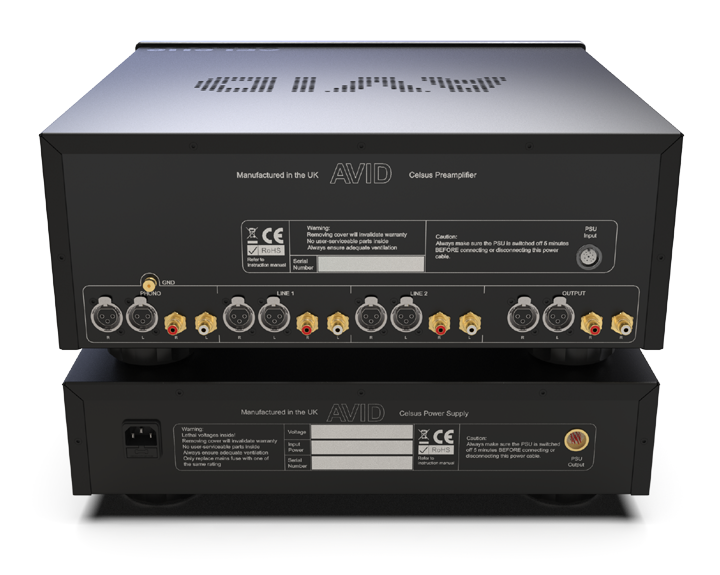
Avid has not limited the preamplifier to XLR connections, however. The Celsus Pre provides two XLR and two RCA line inputs, making four line-level inputs in total. This allows balanced components to use XLR while conventional sources remain accommodated through RCA. Owners therefore do not need an entirely balanced system to make practical use of the preamplifier.
Output flexibility follows the same principle. One XLR and one RCA set of main outputs are provided for connection to power amplification. The choice is useful when matching the Celsus Pre with different amplifier designs or integrating it into an existing system whose cabling is already established. It also avoids making balanced topology a barrier for owners of single-ended power amplifiers.
An integrated phono stage with room for two cartridges
Vinyl replay is not an auxiliary feature here. Avid has incorporated circuitry based on its Pulsare II phono stage, placing record playback at the center of the Celsus Pre’s intended role. The phono section includes both XLR and RCA connection options, allowing it to support conventional turntable cabling as well as suitably configured balanced tonearm and turntable connections.
One of its most useful features is the ability to connect two cartridges at the same time. This can serve owners with two tonearms, two turntables, or a setup that combines stereo and mono cartridges. It removes the need to repeatedly exchange delicate phono cables when moving between record formats or cartridge types.
The stereo-and-mono application is especially relevant for collectors with older pressings. Selecting mono can reduce distracting noise that appears differently in the left and right channels of a mono record. It is also appropriate for records originally made in mono, including 78 rpm discs. A dedicated mono cartridge is not essential to benefit from mono selection, but the two-cartridge facility gives committed collectors the option to maintain specialized playback arrangements.
A subsonic filter provides another practical vinyl-related tool. Warped records can generate very-low-frequency signals that are not part of the recorded music. These signals may be passed to the power amplifier and cause unnecessary woofer movement. The filter is intended to reduce that unwanted low-frequency content before it travels farther through the system.
Relay operation keeps adjustments close to the circuit
The Celsus Pre places its adjustment controls on the front panel, but those controls operate relays rather than routing the audio signal through long runs of wiring. According to the design arrangement, the signal remains on the main circuit board while the relays implement the selected changes.
This architecture combines direct access with disciplined signal routing. Cartridge-related adjustments can be made from the front of the component, avoiding the inconvenience of reaching behind the preamplifier or opening its case. That matters in a phono stage designed to work with two cartridges, because owners may need different settings as they switch between them.
Relay control can also help keep the physical user interface separate from the most sensitive parts of the audio path. The attraction is not automation for its own sake, but a way to make a sophisticated analog circuit easier to operate without unnecessarily extending the signal route.
A separate enclosure for the power supply
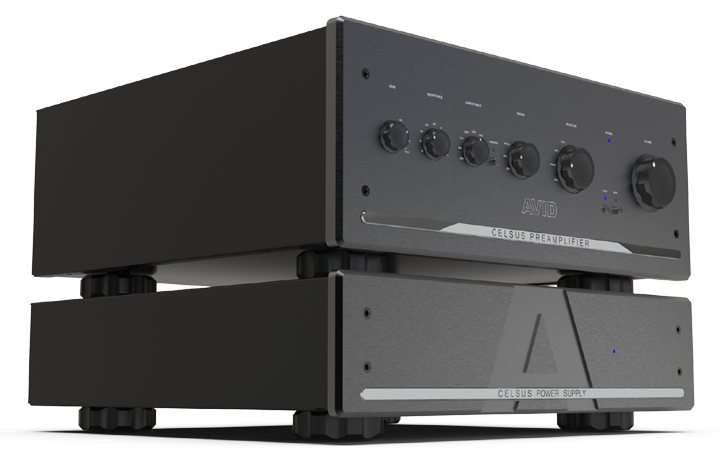
Avid houses the Celsus Pre’s power supply in a separate chassis. Moving the mains transformer away from low-level audio circuitry is a well-established method of reducing the opportunity for electromagnetic and mechanical interference inside the main preamplifier enclosure. It is particularly pertinent when phono signals are involved, since a cartridge produces a much lower output than a typical line-level source.
The external supply contains a large 500VA mains transformer and a dual capacitor reserve. Those specifications indicate that the power architecture has not been treated as a minimal supporting component. Instead, Avid has given the preamplifier a substantial dedicated supply intended to provide stable electrical conditions for its balanced circuits and phono stage.
A separate power box does require additional shelf space and another connection between the two enclosures. For owners prepared to accommodate a two-box component, however, it provides clear physical separation between mains power hardware and the circuits handling delicate analog signals.
Reference-derived parts and a deliberately manual volume control
The Celsus Pre uses factory-wound film capacitors with a polypropylene dielectric, originally developed for Avid’s Reference Pre. It also employs the same ALPS RK50 volume control specified for that flagship model. These choices establish a tangible connection between the two products without implying that they are identical in construction or capability.
The RK50 is a substantial conventional analog volume control rather than a digitally managed attenuation system. Avid has also omitted a remote-control motor and its associated electronics, arguing that these elements could introduce unwanted field effects or digital circuitry near the analog signal path.
That decision defines both the character and the usability of the product. Volume changes must be made at the component, which will be less convenient for listeners who frequently adjust levels from their seat. On the other hand, owners who value a mechanically direct control and a deliberately restricted internal environment may see the omission as consistent with the Celsus Pre’s analog-first purpose.
A preamplifier for focused analog systems
The Celsus Pre is most suitable for listeners whose systems contain several analog sources and for vinyl collectors who can use its unusually developed phono facilities. The combination of four line inputs, two cartridge connections, mono selection, a subsonic filter, and both RCA and XLR interfaces gives it relevance beyond a simple turntable-and-amplifier setup.
It may be particularly attractive to owners moving toward balanced electronics without wanting to replace every single-ended source at once. Its mixed connectivity permits a gradual system transition, while the two output formats broaden power-amplifier matching options.
There are deliberate limits to consider. The Celsus Pre has no onboard DAC, so digital sources require a separate converter with an analog output. It also forgoes remote volume control, and its external supply adds a second enclosure. Listeners seeking streaming, digital input switching, room correction, or extensive remote operation will need other components or a differently conceived preamplifier.
For the intended owner, those omissions may be acceptable because they keep the product concentrated on analog source management. Its appeal lies in the depth of its phono functionality, balanced architecture, direct physical controls, and accommodation of both XLR and RCA equipment—not in trying to combine every modern source format in one chassis.
Conclusion
The Avid Hifi Celsus Pre is distinguished by a coherent analog-first design. Its fully balanced topology is supported by flexible XLR and RCA connectivity, while the integrated Pulsare II-derived phono stage adds two-cartridge operation, mono selection, and subsonic filtering for serious record collections. A separate 500VA power supply, Reference-derived polypropylene film capacitors, relay-operated adjustments, and an ALPS RK50 volume control reinforce the emphasis on careful signal handling. The absence of a DAC and remote volume operation makes it a specialized rather than universal preamplifier, but for listeners building a high-level analog system—especially one involving multiple cartridges or a mixture of balanced and single-ended components—the Celsus Pre offers a thoughtfully organized set of documented features.



Sound Off
0Join the discussion if you have something to add.