

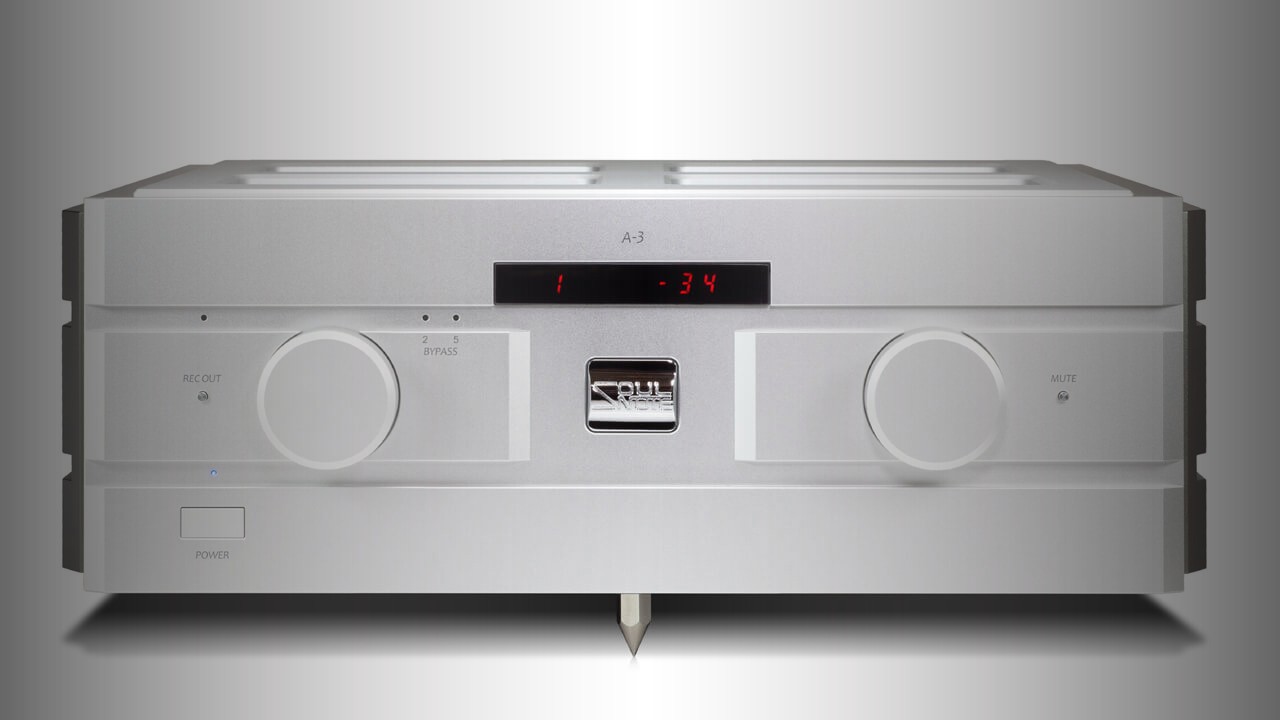
The Soulnote A-3 is an integrated amplifier for listeners who want the convenience of one primary amplification component without abandoning the architecture associated with separate high-end electronics. Drawing on technologies used in Soulnote’s P-3 preamplifier and M-3 monoblock power amplifier, the A-3 places preamplification, source selection, volume control, and stereo power amplification in one chassis. Its $20,990 price and tightly defined feature set position it as a reference-level analog component rather than a general-purpose all-in-one amplifier.
A deliberately pure analog design
The A-3 is a high-level analog integrated amplifier with six line inputs: three balanced XLR connections and three unbalanced RCA inputs. There are no digital inputs, network features, or built-in phono stage. That omission is fundamental to the product’s identity. Rather than attempting to accommodate every source format internally, Soulnote has concentrated the design on analog switching, volume control, and amplification.
For a prospective owner, this approach has clear system-planning implications. A turntable requires an external phono preamplifier, while digital sources need a separate DAC or a source component with analog outputs. In return, the A-3 allows owners to select those front-end components independently and replace them without changing the amplifier. Three XLR and three RCA inputs also provide useful flexibility for systems containing both balanced and conventional single-ended sources. The concept is therefore especially relevant to enthusiasts who already own, or intend to build, a collection of dedicated source components.

Channel separation extends throughout the amplifier
Symmetry is central to the A-3’s internal organization. The left and right channels are designed separately, extending as far as independent ground routing. This dual-mono-style thinking is significant because the amplifier is not merely divided into two channels at the output stage; separation is treated as a guiding principle across the design.
Soulnote also keeps control activity apart from the audio signal path. Commands from elements such as the volume controller and input selector are transferred using optocouplers. These components allow control signals to operate without a direct electrical connection to the signal circuit. It is a thoughtful solution to a recurring integrated-amplifier challenge: placing user controls and audio electronics in one enclosure while limiting interaction between them.
As on Soulnote’s P-3 preamplifier, a slide switch can interrupt the connection to signal ground. This is not a control that every installation will need, but it can be valuable in more complicated systems. Multiple interconnected components may create a ground loop, potentially resulting in unwanted noise or other degradation. Providing a means of changing the grounding arrangement gives installers and experienced owners another tool for addressing configuration-dependent problems rather than forcing one grounding scheme on every system.

Flagship-derived amplification and independent power supplies
According to Soulnote, the A-3’s amplifier circuit operates without negative feedback. Its output stage uses a single-ended push-pull, or SEPP, circuit fitted with two bipolar TO-3 transistors per channel. The substantial TO-3 transistor package and limited device count reflect a focused circuit philosophy, although the documented information does not include an output-power rating or supported loudspeaker-load figures.
The power supply maintains the separation between channels. Each channel receives its own 700 VA toroidal transformer, giving the A-3 two large transformers within its single chassis. Rectification uses current-specification silicon-carbide diodes, while Soulnote also specifies a specially selected film filter capacitor. The manufacturer describes this arrangement as a route to a powerful, fast power supply.
Even without drawing conclusions about audible performance, the engineering priorities are apparent. Independent transformers reduce the degree to which both channels must rely on a shared supply, and the power section has been designed as a major part of the amplifier rather than as a secondary packaging consideration. This is one of the clearest ways in which the A-3 seeks to preserve qualities of separate amplification while retaining integrated-amplifier convenience.

A chassis that combines mass with controlled freedom
The A-3’s mechanical construction is distinctive because Soulnote does not treat maximum rigidity as the only way to manage vibration. Aluminum, copper, and steel are used throughout the structure, but selected parts are allowed to move or release energy rather than being locked together as tightly as possible.
The amplifier block is connected to the enclosure through a three-point structure incorporating titanium sliders. Soulnote’s intention is to minimize the transfer and accumulation of vibration from the transformers and the amplifier itself. The enclosure stands on three steel spikes, continuing the three-point support principle at rack level. Three contact points can provide inherently stable support without the possibility of one foot being left slightly unloaded on an uneven surface.
Because steel spikes can mark furniture or equipment shelves, Soulnote includes a separate birch base plate. This is a practical addition, particularly for an amplifier designed around pointed supports. It enables the specified support system to be used without placing the spikes directly onto a rack surface.
Another characteristic Soulnote detail is the top cover, which is intentionally not fastened tightly. That may appear counterintuitive beside the A-3’s substantial metalwork, but it is consistent with the broader mechanical philosophy: different parts of the chassis are managed according to their function rather than uniformly clamped. Owners should consequently treat the cover’s degree of movement as an intentional construction choice, not automatically as a loose panel requiring adjustment.

Who the Soulnote A-3 is designed for
The A-3 is most suitable for a listener assembling a high-end, component-based analog system who still prefers the practical simplicity of an integrated amplifier. Its combination of balanced and unbalanced inputs supports varied source equipment, while its internal channel separation and two transformers address buyers who might otherwise consider a preamplifier and separate power amplifiers. It may also appeal where reducing the number of chassis and interconnects is desirable but an all-in-one streaming amplifier would be too prescriptive.
Its specialization should be considered just as carefully as its strengths. Anyone expecting an internal DAC, network playback, or direct turntable connection will need additional equipment. Likewise, the supplied information gives no output-power or loudspeaker-impedance guidance, so matching the A-3 to a particular speaker should be based on further manufacturer or dealer specifications rather than assumptions drawn from transformer size alone.
At $20,990, the A-3 is positioned for buyers who place substantial value on circuit separation, power-supply construction, grounding options, and mechanical engineering. Its attraction is not feature quantity. Instead, it offers a concentrated implementation of analog integrated amplification for an owner who already has a clear idea of how digital conversion, vinyl replay, and source selection should be divided across the system.
Conclusion
The Soulnote A-3’s strongest documented qualities are its focused analog architecture, six balanced and unbalanced line inputs, extensive left/right channel separation, isolated control signals, adjustable signal-ground connection, and two independent 700 VA transformer supplies. Its unusual three-point mechanical structure, titanium sliders, steel spikes, birch base, and deliberately loosened top cover further distinguish it from conventionally constructed integrated amplifiers. It is best suited to experienced listeners seeking a reference-level analog hub with flagship-derived engineering in one chassis—and who are comfortable choosing separate components for phono playback, digital conversion, and streaming.



Sound Off
0Join the discussion if you have something to add.