

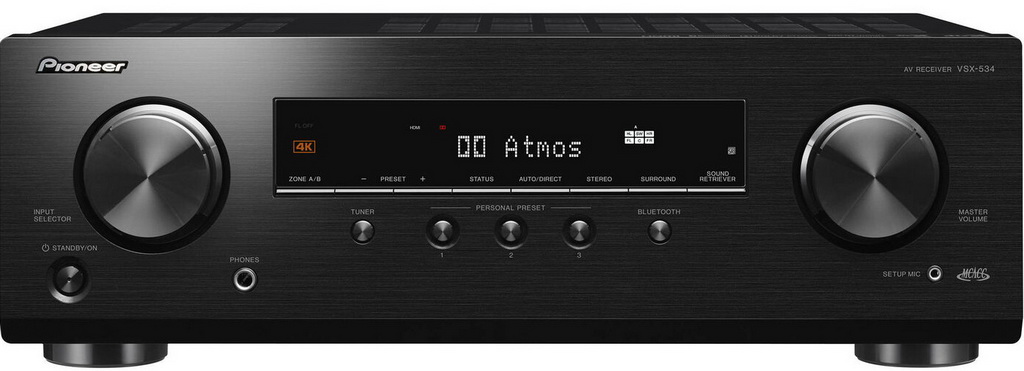
The Pioneer VSX-534 concentrates the essentials of a contemporary home theater into a relatively compact, traditionally styled receiver. Its five-channel architecture is supported by Dolby Atmos and DTS:X decoding, 4K HDR video pass-through, MCACC automatic calibration, Bluetooth, and a varied selection of digital and analog inputs. This combination makes the receiver relevant not only to movie systems, but also to owners who want one central component for a television, disc player, turntable, streaming accessory, headphones, and conventional stereo sources. Its design is deliberately straightforward, with a black finish, two prominent front-panel rotary controls, and a display that clearly acknowledges its 4K capabilities. Behind that familiar appearance is a useful balance of immersive-audio processing, installation flexibility, and source support.
A five-channel foundation with immersive-audio options
The VSX-534 is built around five amplified channels and provides two subwoofer outputs. Pioneer specifies 135 watts per channel into 6 ohms at 1 kHz with one channel driven under the IEC standard. That figure describes a particular test condition rather than simultaneous output across the complete system, but it establishes the receiver’s stated amplification specification without obscuring how it was obtained.
Its decoding roster is unusually broad for a receiver positioned as an entry-level model. Dolby Atmos and DTS:X are joined by Dolby TrueHD, DTS-HD Master Audio, Dolby Digital Plus, DTS-HD High Resolution Audio, DTS-HD Express, and Dolby Pro Logic IIz. Dolby Surround and DTS Neural:X processing can also adapt compatible material to the connected speaker arrangement.
For rooms where physical height speakers are not practical, Dolby Height Virtualizer and DTS Virtual:X provide alternative processing options. These technologies do not add extra amplified channels, but they make the VSX-534 more adaptable to living rooms where ceiling installation, additional wiring, or a larger loudspeaker system would be inconvenient. Buyers should nevertheless remember that this remains a five-channel receiver; its immersive capabilities operate within that channel limit rather than turning it into a larger seven- or nine-channel platform.
Video connectivity for a modern 4K system
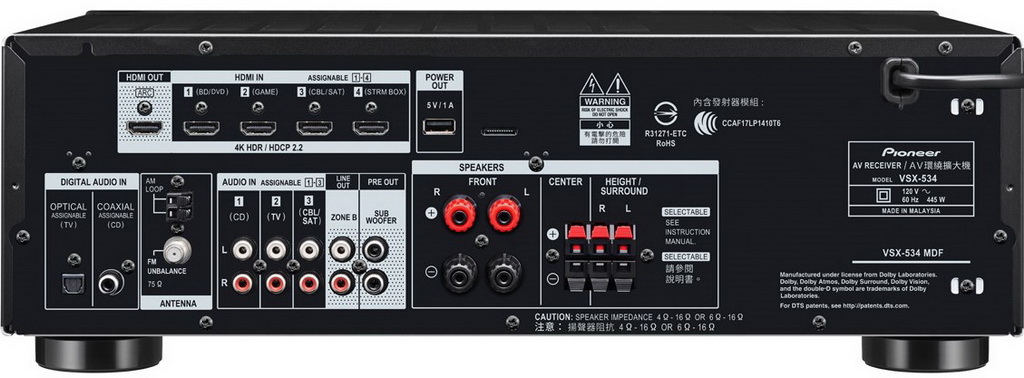
Four HDMI 2.0 inputs allow several video components to be routed through the receiver, while a single HDMI output carries the selected source to a television or projector. The HDMI connections support signals up to 4096 x 2160 at 60 Hz and include HDCP 2.2 compatibility. HDR10 and Dolby Vision input support broaden compatibility with common high-dynamic-range sources and displays, although the listed output specification explicitly identifies HDR10.
This arrangement is suited to systems built around components such as an Ultra HD disc player, media streamer, set-top box, or compatible game system. Switching these sources through the receiver reduces the number of cables running to the display and lets the VSX-534 serve as the system’s central audio and video hub.
A USB power port is positioned near the HDMI connections. It is intended for power rather than USB audio playback, but it can be particularly useful with compact streaming dongles that require a nearby supply. That small installation detail can eliminate an additional wall adapter and keep the area behind the receiver more orderly.
Analog, digital, wireless, and vinyl sources
The source selection extends well beyond HDMI. Three line-level RCA inputs accommodate traditional analog components, while one optical and one coaxial digital input cover televisions, CD transports, and other compatible devices. An integrated phono input is especially useful for a turntable system because it can remove the need for a separate external phono stage when used with a suitable cartridge.
Bluetooth 4.1 provides a simple route for playing audio from a phone, tablet, or computer. The receiver also includes an Enhancer function for compressed music files, alongside a Direct Mode for users who want an alternative signal path. Neither feature requires the owner to commit to a single playback philosophy; instead, they provide different operating choices for casual wireless listening and more conventional source reproduction.
An onboard AM/FM tuner offers 40 memory presets. While radio reception is no longer a universal priority, its inclusion strengthens the VSX-534’s role as an all-purpose receiver rather than a device limited to HDMI sources. A front-mounted 6.3 mm headphone socket adds another practical listening option without requiring a separate headphone component.
MCACC calibration and adjustable bass management
Pioneer’s MCACC automatic calibration system is a central usability feature. A dedicated front-panel microphone input accepts the supplied setup microphone, allowing the receiver to configure the system for the listening space and speaker arrangement. Automatic calibration can make a multichannel installation less intimidating, particularly for owners moving from a soundbar or a basic stereo amplifier.
Bass management is supported by independently selectable crossover frequencies for each channel. Available settings are 40, 50, 60, 70, 80, 90, 100, 120, 150, and 200 Hz. This range is valuable because compact satellite speakers, bookshelf models, and larger floorstanding speakers may require different crossover choices. It also gives installers more control over how low frequencies are divided between the main speakers and a connected subwoofer.
The two subwoofer sockets carry the same signal, so the 5.2 designation should not be interpreted as independent processing for two separate low-frequency-effects channels. Even so, dual outputs simplify the physical connection of two powered subwoofers because an external signal splitter is unnecessary.
Zone B adds a useful stereo connection
The rear panel includes a pair of Zone B line outputs. These carry the same program currently playing through the main front channels rather than providing fully independent source selection for another room. The connection is therefore more limited than a conventional independent multi-zone system, but it can still serve several practical purposes.
One suggested application is a wireless-headphone base station with a line-level input. Zone B can also feed an external power amplifier for the main left and right speakers. In that case, however, the receiver switches the audio path to stereo, so the output cannot be used to add external front-channel amplification while retaining full home-theater playback. That distinction matters for system planning, but the presence of a line-level stereo output remains useful in a category where such flexibility is not always provided.
Compact proportions and pragmatic construction
At 435 mm wide, 148 mm high, and 321 mm deep, the VSX-534 follows standard component width while keeping its height comparatively restrained. It weighs 8 kg and uses a high-current power transformer. The lower chassis profile may make placement easier in furniture where vertical clearance is limited, although adequate ventilation should still be allowed around any AV receiver.
The black front panel uses a traditional layout with large input and volume controls. On the back, Pioneer reserves screw terminals for the front left and right speakers, while the center and surround channels use spring clips. This is a cost-conscious arrangement that favors uncomplicated installation with appropriately sized speaker cable. Prospective owners using thick, heavily terminated cable for every channel should check compatibility before planning the wiring.
Power consumption is specified at 465 watts, with standby consumption of 0.15 watt. Antenna connections for both AM and FM are supplied alongside the speaker, HDMI, analog, and digital terminals, completing a rear panel designed around the expected needs of a compact five-channel system.
Who the Pioneer VSX-534 is most suitable for
The VSX-534 is most appropriate for someone assembling a straightforward five-channel home cinema who wants support for immersive formats without moving to a larger, more complex receiver. It also suits mixed entertainment systems where 4K video sources, a turntable, Bluetooth devices, conventional digital audio components, and radio all need to share one control center.
Its compact height and MCACC calibration should appeal to first-time AV receiver owners, apartment dwellers, and users working with modest equipment racks. Dual subwoofer sockets and flexible crossover settings also make it relevant to systems that may evolve within the receiver’s five-channel boundary.
It is less suitable for buyers who require seven or more amplified channels, independently processed subwoofer feeds, fully independent second-zone playback, multiple HDMI outputs, or multichannel external power-amplifier integration. Those requirements call for a more expandable receiver. The VSX-534’s strength lies instead in keeping the system focused: five amplified channels, broad format support, accessible setup, and enough connectivity for a varied collection of sources.
Conclusion
The Pioneer VSX-534 brings together a well-defined set of home-cinema essentials: five-channel amplification, Dolby Atmos and DTS:X decoding, virtual-height processing, four 4K/60 HDMI inputs, HDR support, Bluetooth, MCACC calibration, and adjustable crossover control. Its phono stage, digital inputs, radio tuner, headphone output, powered USB port, dual subwoofer connections, and Zone B stereo output give it flexibility beyond basic movie playback. It is best matched to owners who want a compact and approachable receiver for a focused 5.1- or 5.2-channel installation, particularly when ease of setup and support for both modern video equipment and traditional audio sources are priorities.



Sound Off
0Join the discussion if you have something to add.