
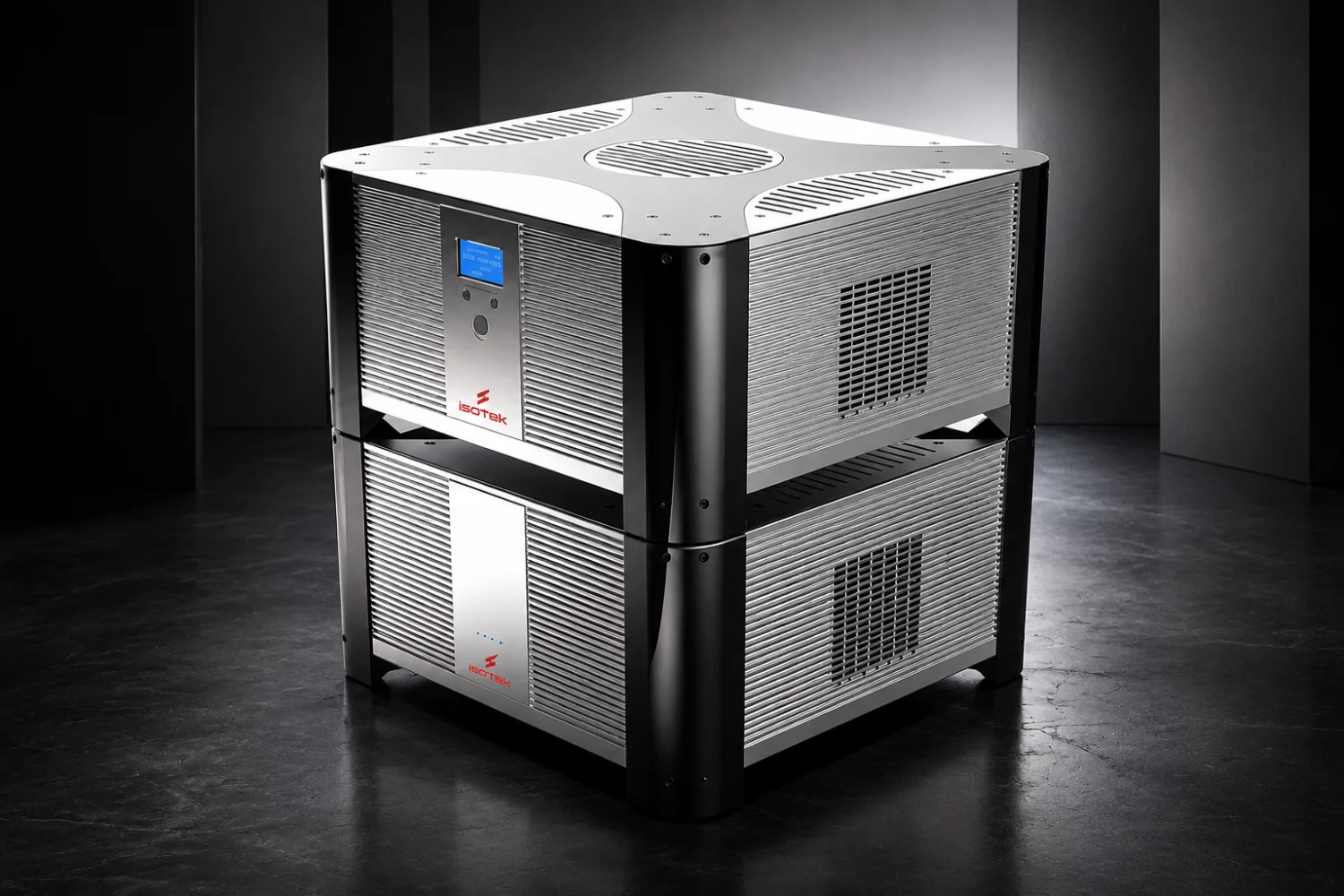
Power products face an unusually complicated assignment in a high-end audio system. Source components and preamplifiers benefit from stable, low-distortion power, but their requirements differ significantly from those of large power amplifiers capable of drawing substantial current. IsoTek addresses that distinction directly with the V5 Genesis mains generator and V5 Super Titan power conditioner. Rather than asking one enclosure to accommodate every type of component, the company has developed two specialized flagships intended to work together. The Genesis creates a new sine wave for lower-power signal components, while the Super Titan provides a high-capacity path for demanding amplification. It is a deliberate division of responsibilities that gives system builders a clearer way to organize power delivery without treating every connected device as an identical load.
Two products with clearly separated responsibilities
The central attraction of the V5 Genesis and V5 Super Titan pairing is its specialized architecture. IsoTek positions the Genesis primarily for signal sources and preamplifiers, while the Super Titan is intended for high-power equipment, including power amplifiers. That separation reflects the practical reality that a source component and a large amplifier place very different demands on a power system.
For a prospective owner, this makes system planning more straightforward. Lower-consumption components can be assigned to the regenerated output of the Genesis, while equipment with much greater current requirements can use the Super Titan. The two products therefore form a coordinated system rather than two competing solutions for the same task. They can also be considered separately when an installation needs only one of those functions.

The V5 Genesis creates a new mains waveform
IsoTek describes the V5 Genesis as a mains power generator rather than a conventional conditioner. Instead of relying directly on the incoming mains waveform, it uses two identical 300-watt generator cells to produce a new sine wave. Each cell incorporates a synchronous sine-wave generator, a Class AB amplification stage and an output transformer.
This approach is significant because the Genesis is designed to control the power waveform supplied to connected components rather than merely filter what arrives from the wall. IsoTek states that the unit provides 600 watts of continuous output independently of the quality of the incoming supply. That capacity also explains its intended role: it is aimed at source equipment and preamplifiers, not at replacing the high-current connection required by powerful amplifiers.
The use of two identical generator cells gives the design a modular internal structure. IsoTek says the Genesis required six years of development, indicating that waveform generation, amplification and transformer implementation were treated as a complete platform rather than as a minor update to an existing conditioner.
Specified control of distortion and voltage
IsoTek publishes several figures to describe the Genesis output. The company claims total harmonic distortion of 0.05 percent, rising to as much as 0.17 percent under normal load and remaining below 0.3 percent with more demanding connected components. These are manufacturer specifications rather than independent measurements, but they communicate the intended benefit of regeneration: a defined output waveform with distortion kept within stated limits as loading changes.
For the 230-volt version, IsoTek also states that output-voltage deviation does not exceed 2 percent. By comparison, the relevant European mains standard permits variations of up to 10 percent. Stable voltage may be especially useful in locations where the supply changes over time or where a complex system shares the electrical environment with other household equipment. The documented figures make the Genesis proposition more concrete than a general promise of cleaner power, although prospective owners should still confirm compatibility with their local mains supply and the total consumption of the components they plan to connect.

Transformer construction receives close attention
Each Genesis generator cell feeds an output transformer containing copper foil between its primary and secondary windings. The source information does not assign a separate performance figure to this construction detail, but it demonstrates that IsoTek has considered the transformer as an integral part of the regeneration system rather than a generic final stage.
Internal wiring is another shared area of emphasis. Both the Genesis and Super Titan use Ohno Continuous Cast silver-plated copper conductors with an FEP dielectric. Ohno Continuous Cast production is intended to create long, continuous crystal structures in the conductor, while FEP is used as an insulating material. In practical ownership terms, these choices indicate that the internal current path has been specified consistently with the products’ flagship positioning.
The V5 Super Titan prioritizes current delivery
The V5 Super Titan takes a different route because power amplifiers cannot always be accommodated sensibly by a 600-watt regenerator. IsoTek rates its flagship conditioner for nearly 8 kW of continuous power, giving it the capacity required for much more demanding components. This high-power focus allows the Super Titan to complement the Genesis without forcing amplifier loads through the latter’s generator cells.
Compared with its predecessor, IsoTek claims that the V5 Super Titan doubles current output, lowers resistance and uses three times as much copper on its printed circuit board. Those changes all support the same design objective: reducing restrictions in the power path while accommodating substantial continuous demand. For owners of large amplifiers, the resistance and current capabilities of a conditioner are important considerations because filtering is only useful if the connected component can still obtain the power it requires.
The Super Titan is therefore not simply a higher-wattage version of the Genesis. It is a conditioner designed around current delivery, whereas the Genesis is a generator designed around production of a new waveform. That distinction is the foundation of the two-product concept.
Mechanical design for serious installations
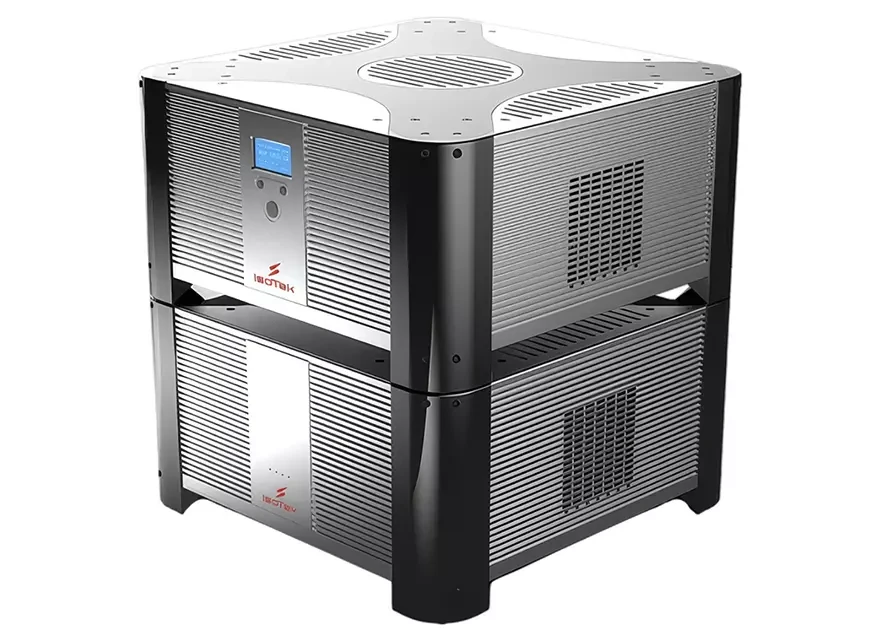
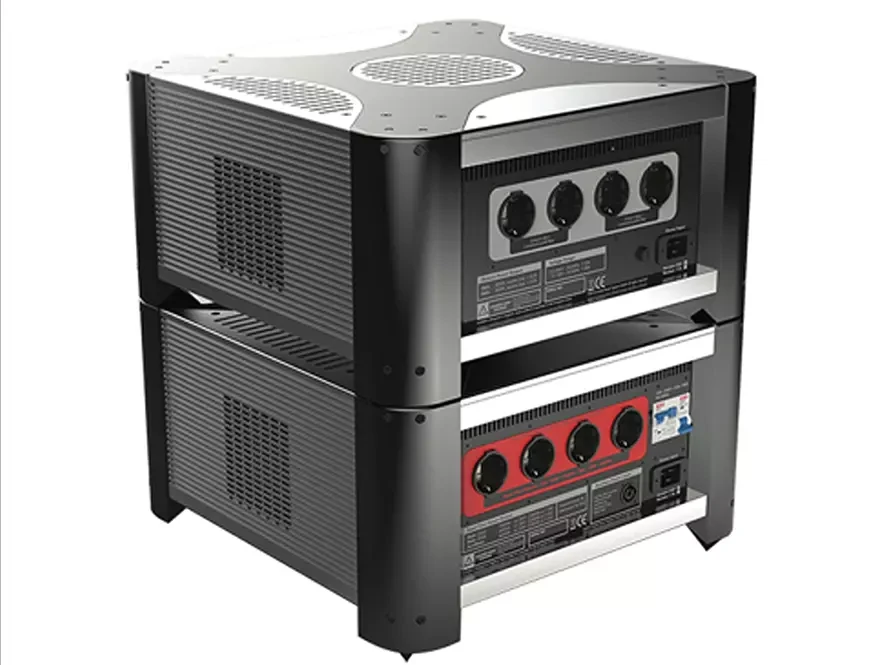
Both models measure 500 x 300 x 500 mm and are designed to be stacked. Identical dimensions give the pair a unified physical footprint and should make it easier to plan a dedicated equipment location. At the same time, each enclosure is substantial, so owners will need suitable support, adequate access for power cables and enough space around the units for a practical installation.
The matching format also matters aesthetically in systems where power equipment remains visible. More importantly, stackability acknowledges that the two models are likely to be installed together. It allows their complementary functions to be housed as one organized power section rather than scattered across separate shelves or floor positions.
Inside, both products use IsoTek’s proprietary ISIS sub-chassis. It is designed to protect the circuitry from microphonic and subsonic vibration. No quantitative vibration data are provided, but the inclusion of a dedicated sub-chassis shows that mechanical energy has been addressed alongside electrical performance. This is particularly relevant for large power products containing transformers and substantial amounts of conductive material.
Flexible system building without a universal solution
The pairing offers useful flexibility because a system does not have to be treated as one undifferentiated electrical load. Owners can allocate regenerated power to the components for which the Genesis was designed and reserve the Super Titan’s high-current capacity for amplification. This can also simplify future expansion: changes to source electronics do not necessarily alter the amplifier-side power arrangement, and vice versa.
Careful load calculation remains essential. The Genesis has a stated continuous capacity of 600 watts, so the combined consumption of all connected source components and preamplifiers must remain appropriate for that limit. The Super Titan’s much higher rating makes it suitable for demanding hardware, but installation still requires attention to the building supply, connectors and local electrical requirements. The products optimize power within a system; they do not remove the need for correctly specified household wiring and professional installation where required.
Conclusion
The IsoTek V5 Genesis and V5 Super Titan are most suitable for owners assembling elaborate, high-value audio systems in which source electronics and powerful amplifiers need different forms of power management. The Genesis is the more relevant product for systems centered on source components and preamplifiers whose combined demand fits within its 600-watt continuous rating. The Super Titan is intended for installations where high-current amplification makes unrestricted power delivery a priority. Smaller systems, modest electrical loads or installations with limited space may not require this two-enclosure approach, and the substantial dimensions deserve consideration before purchase. For the appropriate audience, however, the strongest quality of this pairing is its clarity of purpose: regenerated power with specified voltage and distortion control for signal electronics, nearly 8 kW of conditioned capacity for power-hungry components, shared premium internal wiring and coordinated mechanical design. Rather than proposing one universal treatment for every component, IsoTek has created two complementary tools for owners who want to structure power delivery according to the actual demands of their equipment.



Sound Off
0Join the discussion if you have something to add.