


The Davis Acoustics Krypton 10 sits at the top of its range with a clear brief: deliver a large, full-range loudspeaker for listeners who want scale, bass authority, and a traditional high-fidelity driver architecture. Rather than chasing minimalism or compact convenience, the Krypton 10 is built around a substantial three-way configuration, including two 21 cm woofers, a dedicated Kevlar midrange unit, and a fabric-dome tweeter. That combination gives the speaker an identity that is easy to understand: it is intended for expansive listening environments, serious stereo systems, and home theater installations where a speaker must energize a room without looking like a purely technical object.
A flagship with a clear purpose
The most important thing about the Krypton 10 is that it is not trying to be a small-room compromise. Davis Acoustics positions it as the premier model in its lineup, and the design choices reflect that role. A floorstanding loudspeaker with dual 21 cm bass drivers is aimed at listeners who value physical scale, dynamic headroom, and the ability to reproduce lower frequencies without relying entirely on a subwoofer in every system.
That makes the Krypton 10 particularly relevant for two-channel listeners who want a full-size loudspeaker as the foundation of their system. It also has an obvious role in home theater, where front left and right channels often need to handle demanding musical scores, effects, and dialogue-adjacent information with authority. Davis Acoustics describes the speaker as suitable for both stereo enjoyment and home theater applications, and the hardware layout supports that dual-use ambition.
The cabinet design also appears to favor practical domestic integration rather than purely showroom drama. Magnetically attached grilles covered in premium fabric provide a cleaner appearance when installed, while allowing owners to remove them without visible mounting hardware. This is a small detail, but it matters in a living space: a large floorstander has to coexist with furniture, lighting, and room décor, not just audio equipment.

Three-way engineering with four transducers
At the center of the Krypton 10 is a four-transducer, three-way driver system. This is a traditional but still highly relevant approach for a speaker of this size. By dividing the frequency range among specialized drivers, the design allows each section to work within a more appropriate operating band: the tweeter handles the treble, the midrange driver focuses on vocal and instrumental fundamentals, and the woofers address the bass region.
The 28 mm fabric tweeter is specified with an acoustic chamber intended to reduce distortion, and it is rated to reach up to 24,000 Hz. Fabric tweeters remain popular because they can be engineered for controlled behavior at high frequencies without requiring an exotic visual statement. The presence of an acoustic chamber is also meaningful: the rear environment of a tweeter can influence resonance and distortion behavior, so giving that driver a dedicated working space is a purposeful engineering decision rather than a cosmetic one.
The midrange driver uses a 13 cm thermoformed Kevlar diaphragm. In a three-way loudspeaker, the midrange unit is especially important because it covers much of the information our ears use to identify voices, strings, horns, guitars, and the body of many acoustic instruments. Kevlar is used in loudspeaker diaphragms for its combination of stiffness and low mass, and Davis Acoustics specifies it here for detail and midrange fidelity. The separate midrange also means the woofer pair does not have to stretch upward to cover the critical middle frequencies, which can help maintain a more focused division of labor within the speaker.

Dual 21 cm woofers and bass reach
The most visually and technically assertive part of the Krypton 10 is its bass section. Two 21 cm woofers made from cellulose pulp are partnered with a front-firing bass reflex port, with bass extension specified down to 32 Hz. On paper, that gives the speaker the kind of low-frequency reach expected from a large floorstander intended for bigger rooms.
The use of two woofers can matter in several ways. It increases the radiating area available for bass reproduction, which can help a speaker move more air than a smaller single-woofer design. For prospective owners, the practical benefit is not only deeper bass, but also the potential for more relaxed operation when music or film soundtracks become demanding. The Krypton 10 is described as delivering deep, dynamic bass that can resonate through spacious areas, which aligns with its large-driver configuration.
Cellulose pulp is also a notable material choice. Paper-based and cellulose-based cones have a long history in loudspeaker design because they can offer a useful balance of lightness, damping, and responsiveness when properly engineered. Davis Acoustics does not present the Krypton 10’s woofers as a fashion-driven feature; they are part of a straightforward acoustic package built around size, surface area, and a reflex-loaded enclosure.
Placement flexibility through a front bass reflex port
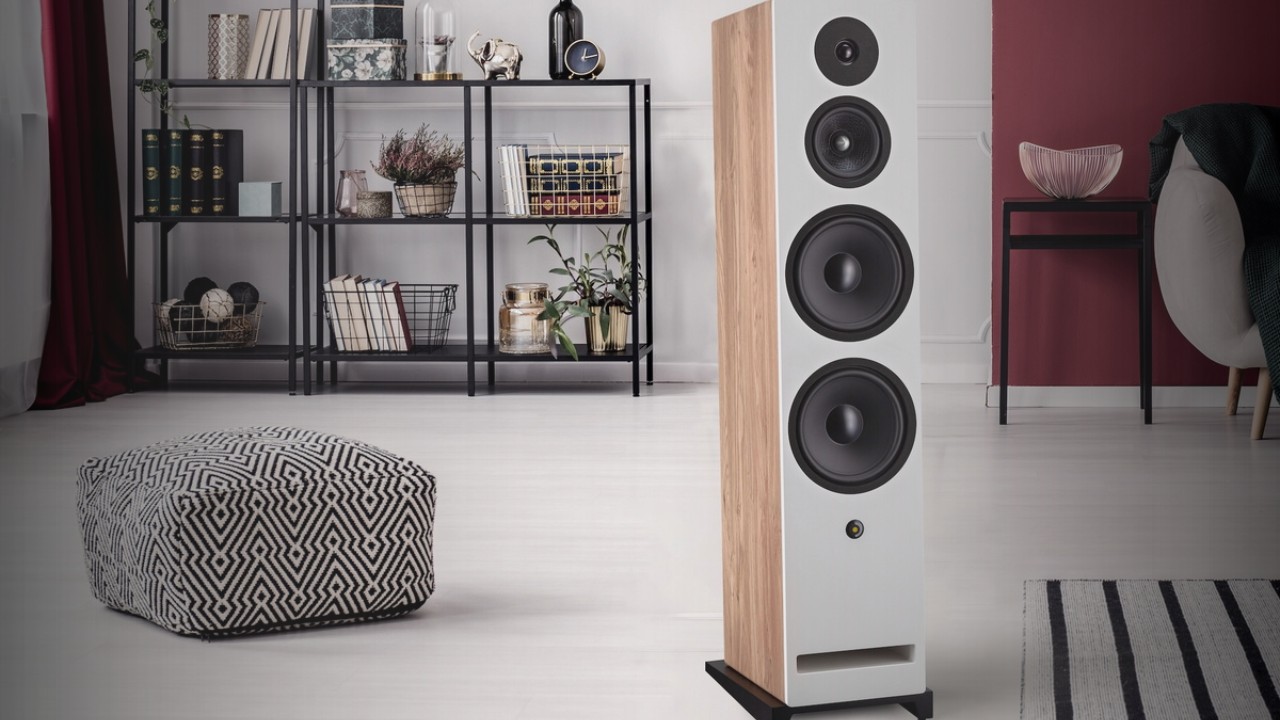
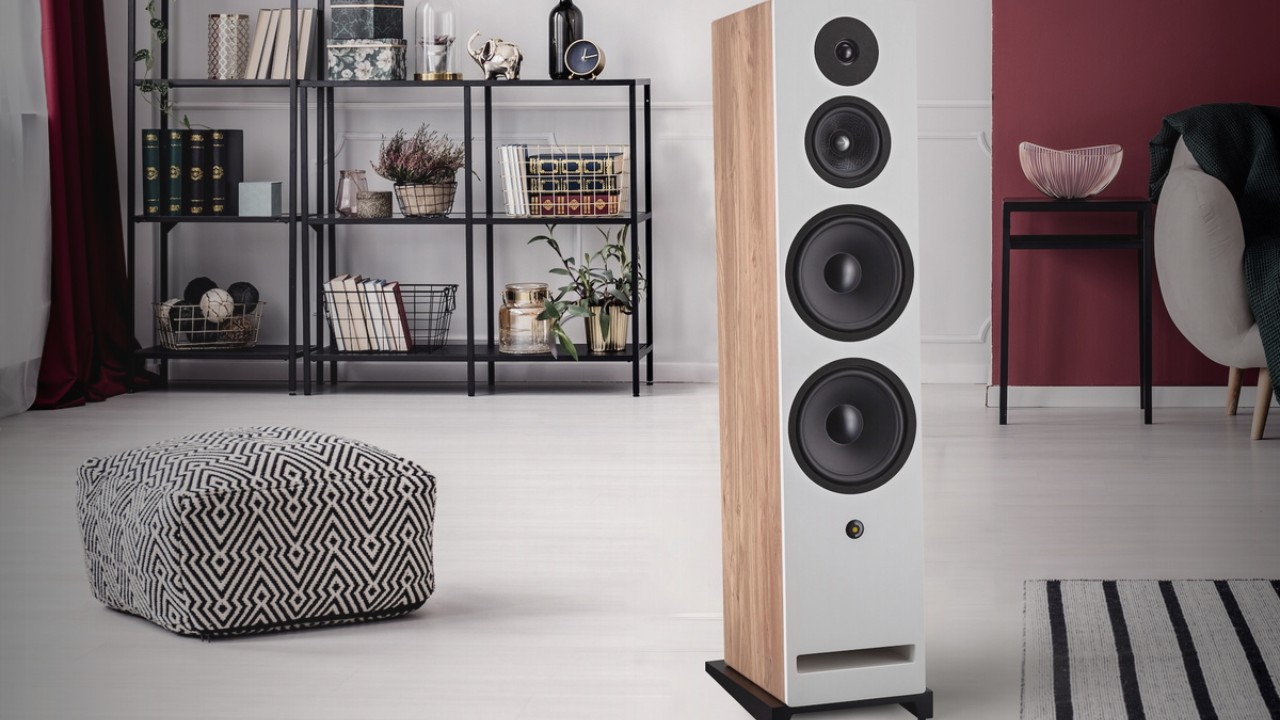
Large loudspeakers can be sensitive to room placement, especially when a rear-facing reflex port requires substantial clearance from the back wall. The Krypton 10 addresses this with a front-facing bass reflex port. Davis Acoustics presents this as a way to allow more flexible placement near walls without compromising sound quality.
For real-world owners, that is a meaningful design choice. Many listening rooms are also living rooms, and not every user can place large floorstanders far into the room. A front port does not remove the need for thoughtful positioning, but it can make the speaker easier to integrate in spaces where rear clearance is limited. In home theater systems, where screen placement, seating distance, and furniture layout are often fixed, this kind of flexibility can be especially useful.
The tilted base is another practical acoustic detail. It is intended to enhance phase alignment between the drivers, which relates to how sound from the tweeter, midrange, and woofers arrives at the listener. Multi-driver speakers must manage the physical spacing and timing relationships among their drivers, and a tilted stance is one established way to address that relationship. It also gives the speaker a purposeful visual posture without relying on unnecessary ornament.
Amplifier matching and system flexibility
The Krypton 10’s specified sensitivity of 93.5 dB is one of its most important system-matching details. A speaker with relatively high efficiency can be easier to drive to satisfying levels than a less sensitive design, depending on room size, listening distance, and amplifier capability. Davis Acoustics notes that this efficiency makes the speaker compatible with various amplifiers, including tube models.
That does not mean amplifier choice becomes irrelevant. A large floorstander with dual woofers still benefits from appropriate amplification and careful setup. However, the Krypton 10’s sensitivity broadens the range of plausible partnering equipment. Owners who prefer tube amplification may find the specification reassuring, while those using solid-state integrated amplifiers or home theater electronics can also see how the speaker is intended to fit into a variety of systems.
This flexibility is part of the product’s appeal. Some flagship loudspeakers demand highly specific electronics to make practical sense; the Krypton 10 is presented as a more accommodating proposition, at least in terms of efficiency. For buyers building a system over time, that can matter. It may allow the speaker to remain the central long-term component while amplifiers and sources evolve around it.
Design details that support daily use
The Krypton 10 includes several design elements that are easy to overlook but important in ownership. Magnetic grilles are cleaner and more convenient than conventional peg-mounted grilles, and premium fabric helps the speaker look more finished when the grilles are attached. For households where exposed drivers are not always desirable, that matters.
The combination of a sophisticated exterior and visible acoustic intent gives the Krypton 10 a balanced identity. It is not described as a lifestyle speaker, but neither is it merely a technical box. Its size and driver layout communicate seriousness, while the grille treatment and front-facing port help it function in a domestic environment. This is the kind of product that has to satisfy both the audio enthusiast and the realities of a shared room.
The result is a speaker whose usefulness extends beyond specifications. Its design decisions address common ownership questions: Can it work in a large space? Is it suitable for stereo and theater use? Can it be placed nearer to a wall? Will it pair with a range of amplifiers? Does it have a finished appearance with grilles installed? Based on the documented features, the Krypton 10 has clear answers to each of those questions.
Who the Krypton 10 is most suitable for
The Krypton 10 is best suited to listeners who want a substantial floorstanding loudspeaker for a medium-to-large or expansive listening environment. Its dual 21 cm woofers, 32 Hz bass extension, and three-way architecture make the most sense for owners who want their main speakers to carry serious low-frequency weight and dynamic responsibility.
It is also a logical candidate for users building a dual-purpose system for music and home theater. In such systems, front speakers often need to be versatile: refined enough for dedicated stereo listening, but capable enough to support cinematic material. Davis Acoustics explicitly frames the Krypton 10 for both roles, which broadens its relevance.
It may be less suitable for listeners seeking compact speakers, nearfield desktop listening, or the least visually prominent solution. A flagship floorstander with large woofers is meant to be seen and given room to operate. Prospective owners should also consider room acoustics and placement, even with the benefit of a front port. The Krypton 10’s strengths are most likely to be appreciated by those who can accommodate its scale and who want a speaker to serve as a long-term anchor for a serious system.
Conclusion
The Davis Acoustics Krypton 10 stands out through a coherent set of documented design choices: a three-way, four-driver architecture; dual 21 cm cellulose woofers; a 13 cm Kevlar midrange; a 28 mm fabric tweeter with an acoustic chamber; a front-facing bass reflex port; a tilted base for phase alignment; magnetic fabric grilles; and a high 93.5 dB sensitivity rating. Together, these features define a flagship speaker aimed at listeners who want scale, flexibility, and full-range ambition in stereo or home theater systems. Its ideal audience is the audiophile or home cinema owner with enough room to accommodate a large floorstander and enough interest in system matching to appreciate a speaker designed for both acoustic capability and practical integration.

Join the discussion
Share your thoughts, listening impressions or product experience.